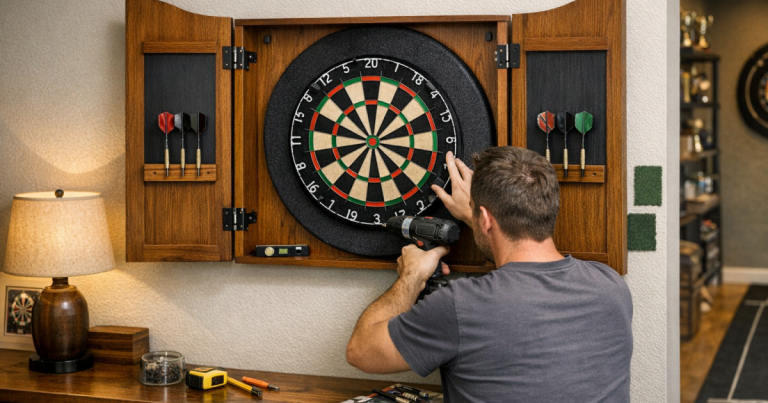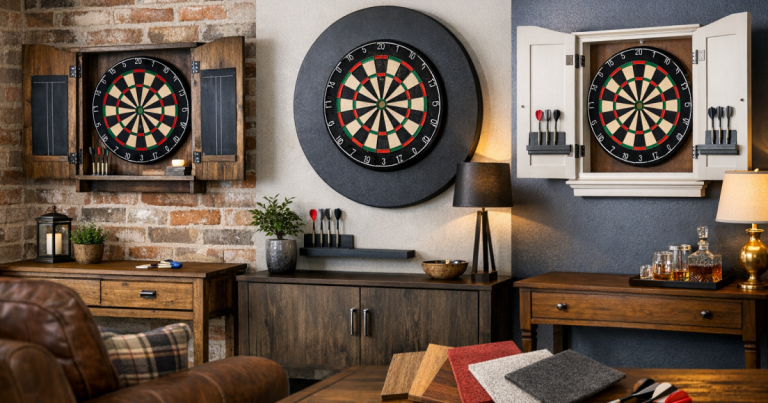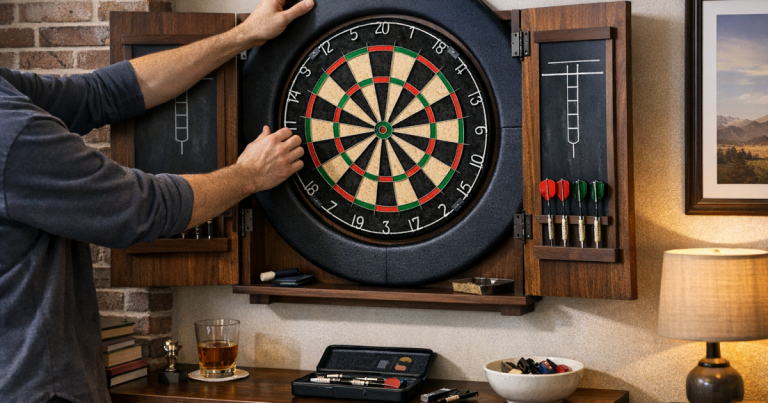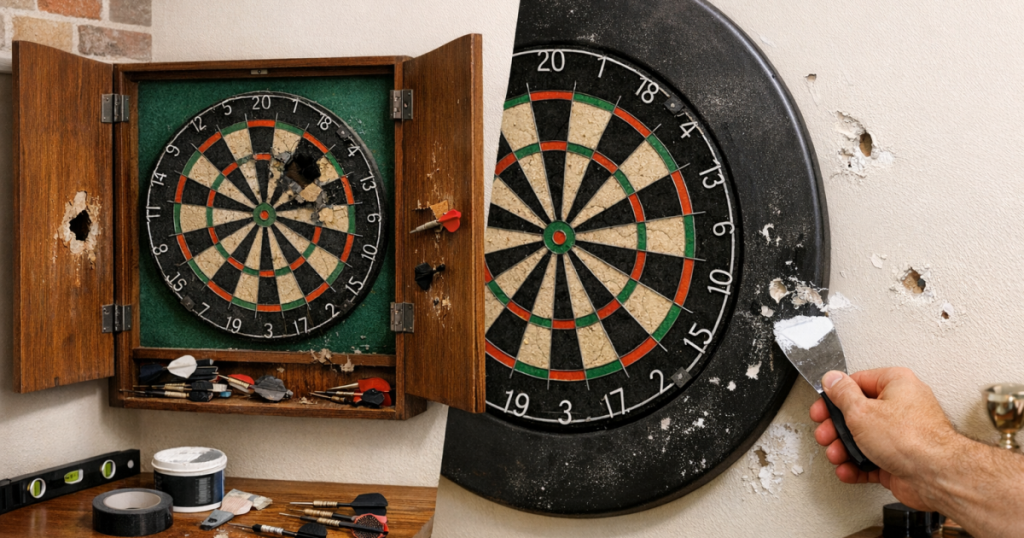
A dartboard cabinet or surround should make a home setup neater, safer for the wall and easier to live with. Most dartboard cabinet problems start with small planning mistakes: the wrong size, poor clearance, untidy accessories or a setup that does not suit the room. A few checks before fitting can prevent most of the irritation.
What to know first
Cabinets and surrounds solve slightly different problems. A cabinet gives you a framed look, closing doors, score panels on many models and a place to keep darts or small accessories. A surround is simpler: it sits around the board and protects more wall area from stray darts, usually without storage or doors.
The main issues are rarely dramatic. They tend to be everyday annoyances: doors hitting a curtain pole, a surround leaving scuffs outside its edge, a cabinet looking off-centre, or flights and stems ending up on a shelf because the storage space is not realistic. Treat the cabinet or surround as part of the whole darts area, not a separate add-on.
- Check the wall area around the board, not just the board diameter.
- Allow space for cabinet doors to open fully without hitting furniture, radiators or sloped ceilings.
- Think about where darts, spare flights, shafts, chalk or a marker will actually live.
- Keep lighting, scoring and cables in mind before the cabinet is fixed in place.
- Make the setup suit the room: a dedicated darts corner needs different choices from a foldaway living-room setup.
Problem 1: the cabinet fits the board but not the room
A cabinet can be the correct size for a standard bristle dartboard and still feel wrong once it is on the wall. The common mistake is measuring only the board rather than the full width of the cabinet with both doors open. In a narrow alcove, under a sloped ceiling or beside shelving, that extra swing space matters.
Before fitting anything, map the full footprint on the wall with low-tack masking tape. Mark the board centre, the cabinet outer edges and the door swing. Then stand at the oche line and check whether the doors feel visually distracting or physically in the way. This quick mock-up is much better than discovering the problem after drilling.
If your room has awkward angles, a surround can sometimes be easier than a cabinet because it adds protection without swinging doors. If you still prefer the cabinet look, use the smallest practical door opening and avoid placing it tight against a side wall. For a deeper measuring routine, use the guide on how to measure properly for a cabinet or surround before committing to the layout.
Problem 2: the surround does not protect enough wall
A standard surround helps, but it cannot perform miracles. New players, guests, children learning with supervision, and anyone practising doubles can all miss wider than expected. The result is a neat-looking ring around the board with little dents or marks just beyond it.
The fix is to match wall protection to the standard of play and the room finish. A painted plaster wall in a spare room may tolerate the odd mark. A feature wall, rented flat, hallway or shared living space usually needs more coverage. Oversized surrounds, larger backboards or a cabinet-and-panel arrangement can give a wider safety margin without making the setup look temporary.
Also consider the wall colour. Dark surrounds on light walls can make stray marks more obvious because the protected zone stands out. If neatness matters, choose a finish that visually blends with the wall or use a larger protective area so the board looks intentional rather than patched in.
For wider protection ideas, the guide to oversized dartboard surrounds for better wall coverage is the natural next step.
Problem 3: the board sits slightly wrong inside the cabinet
A few millimetres can make a setup look untidy. If the board is not centred within the cabinet opening, the number ring may sit too close to one side, or the doors may frame the board unevenly. It does not usually affect scoring, but it can be surprisingly distracting when you are lining up a throw.
This often happens when the cabinet is mounted first and the board bracket is added afterwards by eye. A better method is to mark the playing height and centre line first, then position the cabinet around that centre. The bullseye should still end up at the correct height for your game, and the cabinet should be squared to the wall, not to nearby skirting or shelves that may themselves be slightly out.
Use a spirit level and measure from fixed points where possible. In older UK homes, walls, floors and chimney breasts are not always perfectly straight, so trust the dartboard centre line more than the appearance of a nearby edge.
Problem 4: storage looks useful but does not match real habits
Cabinet storage is handy, but it can be overestimated. Slim door slots may hold assembled darts, yet they may not suit every barrel, flight shape or stem length. Some cabinets include score areas but no practical place for a cloth, spare points, flight protectors or a small sharpening stone. If the cabinet cannot hold what you use weekly, clutter will creep back onto nearby furniture.
Keep storage expectations realistic. Use the cabinet for the items that belong directly with a match: darts, chalk or marker, a small eraser and perhaps spare flights. Keep larger spares in a separate case or drawer nearby. That approach keeps the cabinet tidy and avoids overloading the doors.
If several people use the board, agree one simple rule: only match-ready items go in the cabinet. Everything else goes in a case. This prevents the inside of the cabinet from becoming a mixed box of broken stems, loose flights and unidentified accessories.
Problem 5: doors, chalkboards and score panels become annoying
A cabinet with score panels can feel traditional and tidy, but it is not always the right fit for every home match. Chalk dust, marker smudges and awkward writing angles can become irritating if the cabinet is narrow or the throw area is shared with furniture.
If you prefer manual scoring, check that the writing surface is comfortable for the person standing near the board. The scorer should not need to lean into the throwing lane or stand directly in front of the next player. If you use a phone, tablet or electronic scorer instead, make sure the cabinet doors do not block the viewing angle or create a place where devices are likely to fall.
There is also a style trade-off. Closed doors keep the area looking tidy between sessions, which is useful in a dining room or living room. Open doors during play take up more visual and physical space. If the room needs to switch quickly back to everyday use, a plain surround with separate scoring can sometimes feel less fussy.
Problem 6: lighting and shadows were not planned early enough
Cabinets can change how light falls on the board. Door frames, deep side panels and nearby shelves can create shadows, particularly if the main ceiling light is behind the thrower. A surround is usually flatter, but even then, the surrounding wall colour and room lighting can affect visibility.
Before fixing a cabinet permanently, hold the board or cabinet in position and check it at the time of day you normally play. Evening lighting is the real test for most home setups. Look for shadows across treble 20, the bull and the lower doubles, as these are the areas where poor visibility becomes most obvious.
If you plan to add a dedicated dartboard light, check whether it will fit with the cabinet doors open and closed. Some lighting rings and cabinet shapes work better together than others, so it is worth thinking about the whole arrangement rather than treating lighting as an afterthought.
Problem 7: cables and scorers make a neat cabinet look messy
A smart cabinet can quickly lose its clean look if scorer cables, charger leads or extension cables trail around the board area. Even where the equipment itself works well, visible cables can make the setup feel temporary and can get in the way when the room is used for something else.
Keep cables out of the throwing path and away from the board face. Use simple cable clips, trunking or a tidy route along an edge rather than letting leads hang vertically beside the cabinet. If your scorer sits on a small shelf or nearby unit, leave enough slack for normal use but not so much that the cable loops into the playing area.
For a cleaner finish, the advice on how to tidy scorer cables around a dartboard pairs well with any cabinet or surround setup.
Problem 8: the setup does not suit shared rooms
Many home darts areas live in spare rooms, garages, dining rooms or mixed-use spaces. A cabinet can be excellent in these settings because it hides the board and accessories when play is over. The problem comes when the cabinet is fitted without considering how the room works the rest of the week.
Check the open-door position against chairs, desks, curtain rails, picture frames and radiators. Make sure the oche area does not block the natural route through the room. If you use a darts mat, think about where it will be stored and whether it lines up easily each time. A setup that takes ten minutes to rebuild is less likely to be used regularly.
For shared spaces, the neatest solution is often a simple routine: open doors, place mat, clear the throw line, play, then close everything away. The cabinet or surround should support that routine rather than add extra steps.
Problem 9: the wall surface was not considered
Cabinets and surrounds behave differently on different wall surfaces. A smooth painted wall gives a clean finish, but it also shows small scuffs. Textured wallpaper can make a surround sit unevenly. Plasterboard, brick and old masonry all need different fixings, and a heavy cabinet needs to feel secure once the board is in use.
Use fixings that suit the wall type and the weight being supported. The board will take repeated dart impacts, and the cabinet doors will be opened and closed, so a loose fixing will only get worse over time. Avoid mounting a cabinet so low or so high that you are compensating for an awkward fixing point; the playing dimensions should come first.
If you are in rented accommodation, wall protection matters even more. A freestanding backing panel or a larger removable protection area may be a better choice than putting multiple fixings into the wall. The aim is to protect both the playing area and the room finish.
Problem 10: style wins over practicality
Cabinets can look smart, especially in a room where a plain board would feel unfinished. Surrounds can be cleaner and more modern. Neither is automatically better. Problems arise when the choice is made only on appearance.
A dark wooden cabinet may suit a games room but feel heavy in a small flat. A bright surround may protect the wall well but clash with a carefully decorated room. A cabinet with scoreboards may look traditional but be unnecessary if everyone scores on a device. The best result is the one you can leave in place without it annoying you when darts are not being played.
Think in terms of behaviour. If you play often, prioritise quick access, visibility and durable wall protection. If you play occasionally in a shared room, prioritise neat closing, simple storage and a finish that blends in. If guests play regularly, allow more wall coverage than your own accuracy would suggest.
Simple maintenance that prevents bigger issues
Most cabinet and surround problems can be reduced with occasional checks. You do not need a complicated routine; a few minutes every so often keeps the area tidy and safe to use.
- Check that the cabinet remains level and the doors still close cleanly.
- Look for loose fixings, especially after moving the board or rotating it.
- Wipe score panels and door interiors before marks build up.
- Remove broken flights, bent stems and unused accessories from storage slots.
- Inspect the wall edge around a surround for new marks and increase protection if needed.
- Check that lighting, scorer placement and cable routes still work after any room rearrangement.
Helpful questions
Are dartboard cabinet problems more common than surround problems?
They are different. Cabinets are more likely to cause clearance, door and storage issues. Surrounds are more likely to fall short on wall coverage or look unfinished in a shared room.
Can I use a cabinet and a surround together?
Sometimes, but it depends on the cabinet depth, board fit and available space. Check that the board still sits correctly, the doors open fully and the surround does not interfere with the cabinet frame.
What is the easiest way to stop wall marks around a surround?
Increase the protected area. That may mean a larger surround, a backing panel or moving the setup away from delicate walls. Better players still miss occasionally, especially during practice games.
Why do cabinet doors feel distracting during play?
They may be too close to the board visually, reflecting light, casting shadows or sitting in your peripheral vision. Try playing with different room lighting and check whether a flatter surround would suit the space better.
Should a cabinet be chosen mainly for storage?
No. Storage is useful, but wall fit, door clearance, board position and room layout matter more. Treat storage as a bonus, not the main reason for choosing a cabinet.
Why it matters
A good darts area should feel easy to use, not like a compromise you have to work around. Cabinets and surrounds are there to protect the room, organise the essentials and make the board look at home, whether it sits in a dedicated games room or a shared family space.
The safest approach is to plan the whole playing area before fixing anything: board height, wall coverage, lighting, scoring, cables, storage and the way the room is used day to day. Get those details right, and the cabinet or surround becomes part of a tidy, reliable home setup rather than another source of small frustrations.