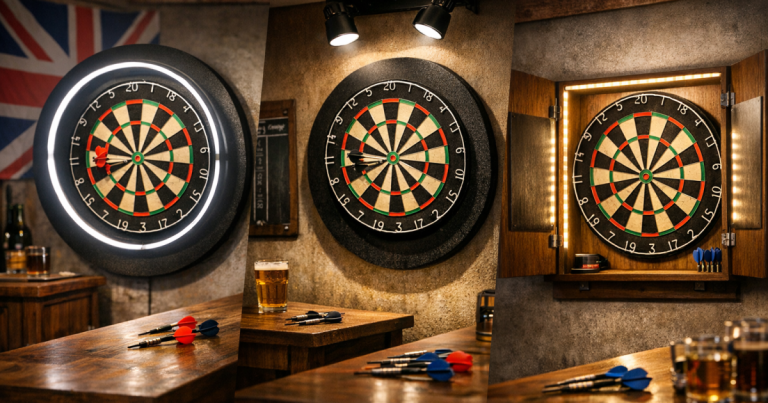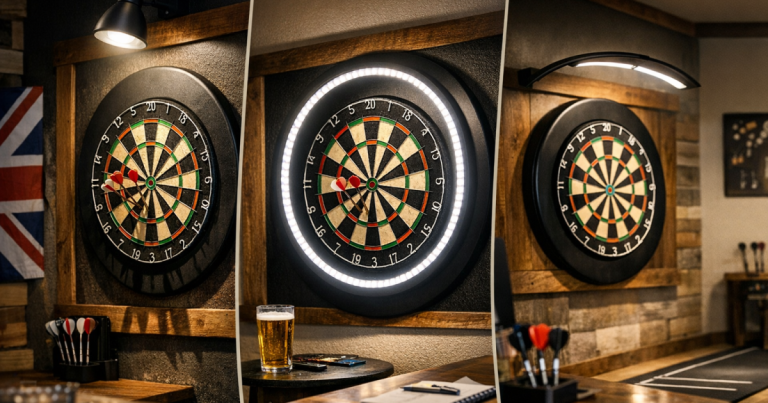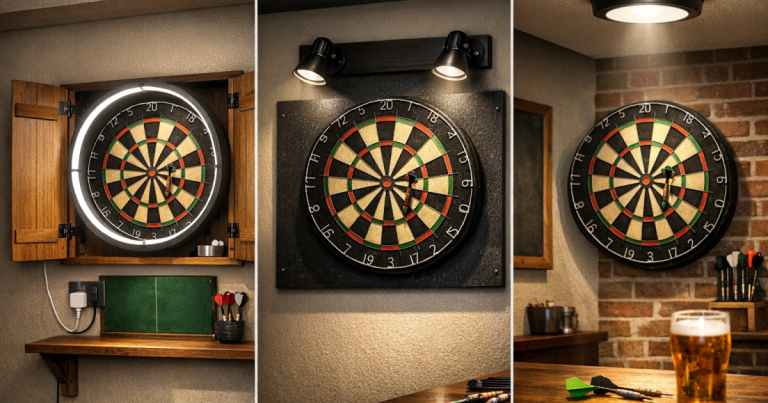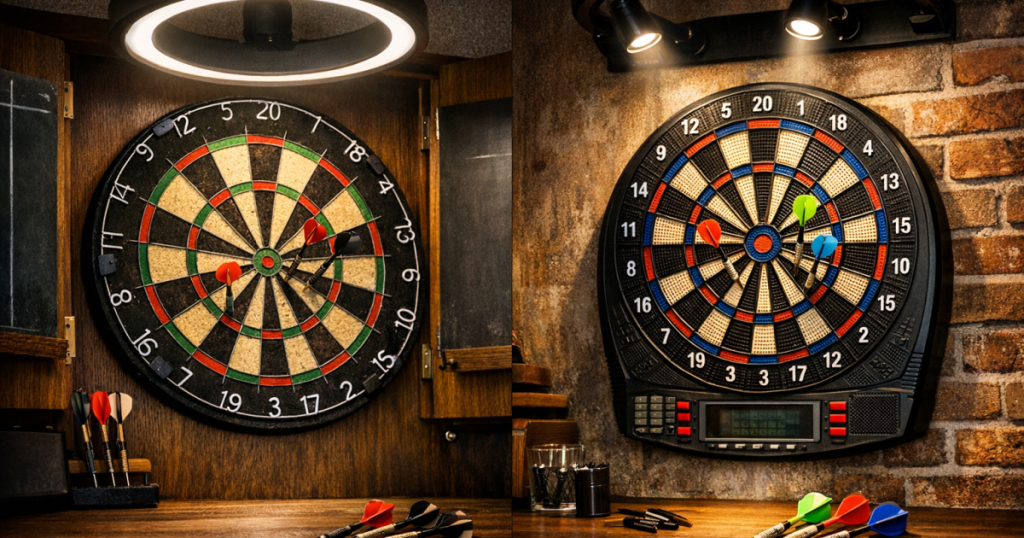
A board can be perfectly mounted and still feel awkward if the light is wrong. Good dartboard lighting lets you see the trebles clearly, keeps the bull free from harsh shadows and stops glossy surfaces from reflecting back at the thrower. The right setup is not identical for every board, because bristle and electronic boards behave differently under light.
Hard-wired wall or ceiling fittings, new sockets and alterations to mains wiring should be carried out by a qualified electrician to meet UK electrical safety requirements and the relevant wiring standards, including BS 7671.
Main points
- Bristle boards usually benefit from even, close-range light around the face of the board, because the wire, staples and dart barrels can cast small but distracting shadows.
- Electronic boards need more care with glare, because plastic segments, score displays and control panels can reflect light towards the thrower.
- A lighting ring is often the neatest answer for a dedicated bristle setup, but it is not automatically suitable for every cabinet, surround or electronic board shape.
- Ambient room lighting still matters. A bright board in a dark room can strain your eyes, while a bright room with poor task light can still leave shadows on the trebles.
- The best test is simple: stand at the oche, look at the bull, trebles and doubles, then check whether the light changes when darts are in the board.
Why bristle and electronic boards need different thinking
A bristle dartboard is a mostly matte surface. The sisal face absorbs light fairly well, so the main enemy is usually shadow rather than reflection. The spider, number ring and darts themselves can all block light if the source is too high, too low or too far to one side. This is why a single ceiling pendant in a typical spare room often feels fine for the room but poor for the board.
An electronic board is a different surface altogether. The segments are usually plastic, the scoring area may include a display, and the outer case may be shaped differently from a round steel-tip board. That means a light which works beautifully on a bristle board can create bright patches or reflections on an electronic board. With electronic boards, you also need to keep buttons, speakers, displays and any power lead clear and easy to access.
If you are still refining the board area itself, it helps to understand exactly which parts need the clearest view. The doubles, trebles, bull and number ring all affect how light should fall across the board face, and our dartboard anatomy guide is a useful reference before you start adjusting angles.
Where dartboard lighting goes wrong most often
The common mistake is assuming that more brightness automatically means better visibility. In practice, direction matters just as much as output. A powerful lamp in the wrong place can make the board look harsh, wash out the number ring, or throw a dart-shaped shadow over the treble twenty. For home players, the goal is not to flood the whole room. It is to create consistent, comfortable visibility from the throw line.
Shadows across the scoring bed
Shadows are most noticeable when the light comes from one direction. A ceiling spotlight set slightly in front of the board may seem logical, but once a dart lands in the upper half, its barrel and flight can create a shadow on the segments below. A side lamp can do the same across the board face. Multi-direction lighting, ring lighting or a carefully positioned pair of lamps usually reduces this effect.
Glare on plastic and number rings
Glare is more likely on electronic boards, glossy cabinets, shiny number rings and protective surrounds with a reflective finish. If your eyes are drawn to a bright patch rather than the target, the light is too direct or too close to your line of sight. The fix may be as simple as changing the angle, using a diffuser, or moving the room light so it is not bouncing straight back from the board.
A board that is bright but a room that feels gloomy
A very bright board in an otherwise dark room can be tiring during longer sessions. Your eyes keep adapting between the lit target and the darker surrounding space. A small amount of soft ambient light in the room makes the setup feel calmer and helps you retrieve darts, mark scores and move around safely without losing the focus on the board.
Lighting styles that make sense at home
Most home setups fall into a few broad approaches. None is perfect for every space, so the sensible choice depends on whether your board is permanent, whether it sits in a cabinet, how close the wall is to furniture, and whether the board is bristle or electronic.
- Board-mounted ring lighting: This is popular for bristle boards because it places light close to the target and spreads it around the face. Ring-style systems such as Target Corona Vision and Mission Torus 270 Lighting System are recognisable examples, but you should still verify compatibility with your board, surround and wall space.
- Overhead task lighting: A wall or ceiling-mounted light can work well if it is aimed carefully and does not sit directly in the thrower’s eyeline. It is often easier to use with cabinets and mixed-use rooms, but it may need adjustment to prevent shadows.
- Track or spotlight systems: These suit rooms where the darts area is part of a wider games room, garage conversion or spare room. The advantage is flexibility; the challenge is avoiding uneven light and harsh angles.
- Cabinet-integrated lighting: Some cabinet setups use lighting above or within the cabinet area. This can look tidy, but check whether the doors, hinges or cabinet top cast shadows when open.
- Room lighting plus a board light: Often the most comfortable arrangement is a modest ambient light for the room and a dedicated task light for the board. Our darts room lighting guide explains how ambient, task and accent lighting work together.
Choosing for a bristle board
For a bristle board, your priorities are evenness, shadow control and not crowding the board. The light should make the scoring bed clear from double one round to double twenty, not just brighten the centre. Pay particular attention to the top section of the board, where poor lighting often shows up first because the treble twenty is heavily used.
Ring lights are popular here because they reduce the strong single-direction shadows that come from a lamp above the board. They can be especially useful in a home setup where the board is mounted on a plain wall with a surround. However, check how the lighting frame sits in relation to your surround, cabinet or wall protection. Some setups leave less clearance than expected once the board, surround and light are all in place.
If you use a cabinet, a ring light may be less straightforward. Cabinet doors need room to open, and the cabinet depth can change where the light sits. In that case, an overhead or angled task light may be tidier, provided it lights the full face evenly. Before fixing anything permanently, tape a temporary light in place or use a movable lamp to test the angle from the oche.
Also think about maintenance. A bristle board should be rotated regularly, so avoid any lighting arrangement that makes rotation fiddly. If a light has to be removed every time you turn the board, you may stop doing it as often as you should.
Choosing for an electronic board
Electronic boards need a slightly more cautious approach. The surface can reflect light, and the board shape may not match lighting products designed around standard round bristle boards. Before using any surrounding light, check whether it obstructs the scoring display, control buttons, outer casing or any area where darts need to land cleanly.
For many electronic setups, soft overhead or angled lighting can be more forgiving than a very close ring. The aim is to light the segments clearly without creating shiny hot spots. Stand at your normal throw line and look for reflections on the display and the segment face. Then move a step left and right, because glare can appear only from certain angles.
If the board has a display, make sure it remains readable when the board light is on. A light that makes the scoring bed clear but washes out the display is only solving half the problem. If the board is used by children or mixed groups, keep the surrounding space visible too, as electronic boards often get used in more casual, social sessions where people move around more between turns.
Power cable routing also matters. Do not stretch leads across walkways or under the throw area. If the board, light and room layout all need power from the same corner, plan cable positions neatly before committing to the setup.
How to test a lighting setup before you commit
You do not need lab equipment to judge a darts light. You need the correct viewing position and a few realistic throws. Set the board up as you normally use it, switch on the proposed lighting, and check it from the oche rather than from directly in front of the board.
- Look at the treble twenty, treble nineteen, bull and both side doubles. These areas quickly reveal uneven light.
- Put three darts in different parts of the board and check whether their barrels or flights cast distracting shadows.
- For an electronic board, check the display and controls from the throw line, not just close up.
- Switch on the room’s normal evening lighting. Many UK home darts areas are used after work, so test the setup in the conditions you actually play in.
- Check whether wall protection, a surround or cabinet changes the light. A dark surround can absorb light, while a glossier one may reflect it.
For a deeper look at positioning, angles and common shadow problems, the separate guide to lighting a dartboard without shadows or glare goes further into the practical setup process.
Small details that improve comfort
Comfort is easy to overlook. A light can be technically bright enough but still annoying over a long practice session. If you squint, feel the board is too stark, or notice the surrounding wall disappearing into darkness, the balance is not quite right.
- Colour appearance: A neutral-looking light is usually easier to play under than one that feels very yellow or very blue. Check the board colours look natural and distinct.
- Flicker and consistency: If a light appears to shimmer, pulse or behave inconsistently, it can become distracting. Test it during a proper throwing session, not just for a few seconds.
- Wall colour: Dark walls can make the board feel isolated, while very light or glossy walls can bounce light back. Matt finishes are often easier on the eyes.
- Scoreboard visibility: If you use a whiteboard or chalkboard nearby, make sure the same lighting plan lets you read scores without stepping away from the oche every visit.
- Floor area: Light should not stop abruptly at the board. You still need to see darts that drop out, the oche line and any mat edge.
Common trade-offs
A permanent, dedicated darts area can justify a more tailored lighting arrangement than a temporary setup in a dining room or garage. That does not mean the most complex setup is automatically better. Sometimes a neat overhead light and sensible room lighting feel more natural than a large board-mounted system, especially if the board is packed away between sessions.
For a bristle board on a plain wall, a dedicated board light is often the cleanest route. For a bristle board in a cabinet, clearance and door movement become more important. For an electronic board, avoid assuming that steel-tip lighting accessories will fit neatly. The casing, display and controls should drive the decision.
It is also worth thinking about how the room will be used when darts is not being played. A spare room, office or garage gym may need lighting that works for more than one activity. In that case, layered lighting is usually better than one very strong source aimed only at the board.
Helpful questions
Can I use the same light for a bristle board and an electronic board?
Sometimes, but do not assume it will work equally well. Bristle boards mainly need shadow control, while electronic boards also need careful glare control around plastic segments and displays.
Is a ring light always better than an overhead light?
No. A ring light can be excellent on a dedicated bristle setup, but an overhead or angled task light may suit cabinets, unusual wall layouts and electronic boards better.
Should the whole room be bright?
The room should be comfortably lit, but the board should still be the clearest target. Soft ambient light plus focused board lighting is usually easier on the eyes than a bright board in a dark room.
How do I know if glare is a problem?
Stand at the oche and look for bright patches on the board face, number ring, display or cabinet. If your eye is pulled to the reflection instead of the segment, adjust the angle or light position.
Does lighting affect bounce-outs?
Lighting does not change the board surface, but poor visibility can affect grouping, aim and confidence. If you are also seeing regular bounce-outs, check board wear, darts and point condition separately.
Main lessons
Good lighting is not just about making the board brighter. It is about giving your eyes a clear, even target from the throw line. Bristle boards usually reward close, even lighting that reduces dart shadows, while electronic boards need extra attention to glare, displays and casing shape.
Before drilling, mounting or rearranging the room, test the light from the oche with darts in the board and the room lit as it normally is. If the trebles, doubles, bull and scoring area all remain clear without reflections or harsh shadows, the setup is doing its job.