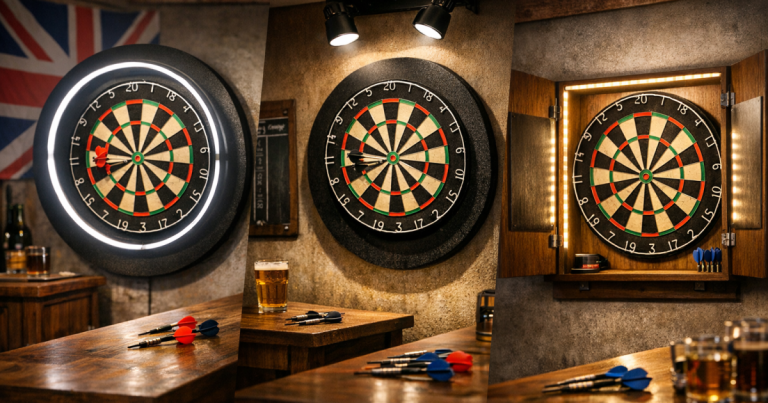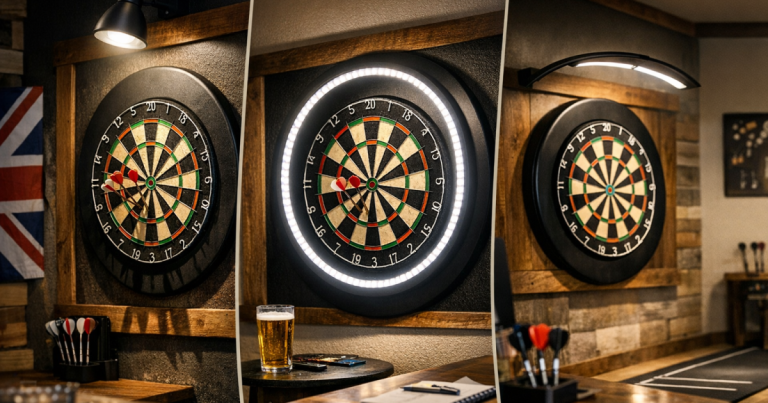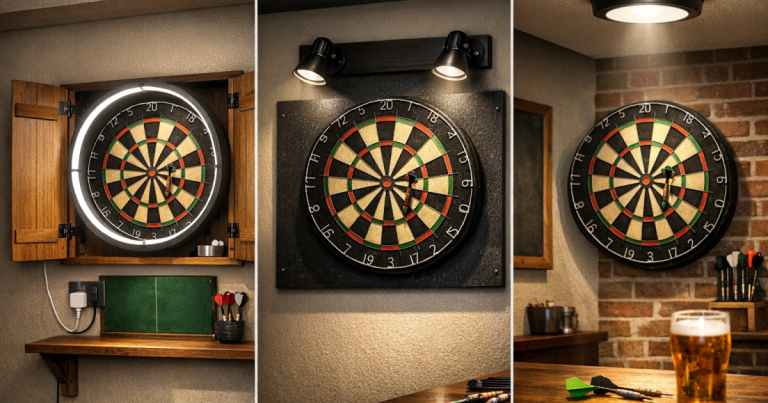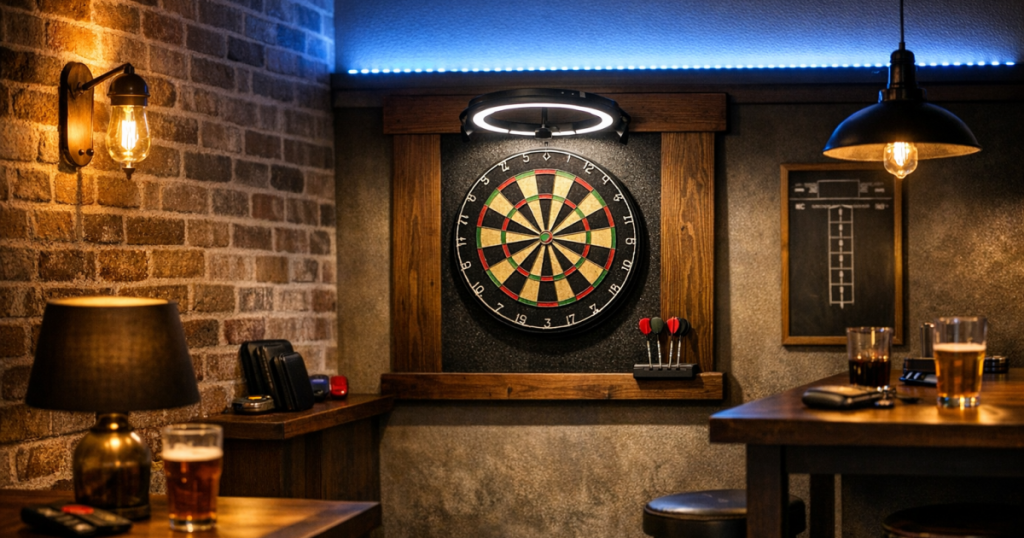
A home board can look fine in daylight and still feel awkward once the evening lamps go on. Good darts room lighting is about layers: enough general light to move around safely, focused light on the board, and a little atmosphere that does not distract from the throw. Get those layers right and you reduce shadows, make scoring easier and help the whole room feel more deliberate.
Mains electrical work for fitted ceiling lights, wall lights or new switched circuits should be carried out by a qualified electrician to ensure compliance with UK electrical safety requirements and relevant wiring standards.
Main points
- Ambient light makes the room usable, but it rarely gives the board enough clarity on its own.
- Task light should cover the whole dartboard face evenly, without casting a strong dart shadow across the trebles and doubles.
- Accent light is for mood and separation, not for replacing proper board illumination.
- The oche area needs enough light for footing, scoring and retrieving darts, but it should not shine into the player’s eyes.
- Glare, reflection and uneven brightness are usually bigger problems than a room simply being too dark.
The three layers that matter
Think of a darts room in three lighting layers: ambient, task and accent. The names sound a bit interior-design heavy, but the idea is simple. Ambient light fills the space, task light helps you play, and accent light shapes the room so it feels comfortable rather than flat.
For a home setup, the most important question is not “how bright can I make it?” but “where does the light land?” A single ceiling pendant behind the thrower can make the board visible while still throwing the player’s shadow forwards. A bright lamp beside the board can make the numbers pop, but it can also create glare on the wire or make one side of the board feel harsher than the other.
If you want to map the board, throw line and surrounding wall properly, it is worth reading our guide to dartboard lighting zones, as it explains how the board, oche and surrounds each need slightly different treatment.
Ambient lighting: the room’s base layer
Ambient lighting is the general light you use to enter the room, find dropped flights, move around furniture and chat between legs. In a spare room, garage conversion or garden room, this may come from ceiling lights, wall lights, track lighting or a few lamps placed away from the throwing line.
The aim is an even, comfortable base level. You should be able to see the floor, the oche and any furniture without feeling as though the room is either gloomy or overlit. If the rest of the room is very dark and the board is extremely bright, your eyes keep adjusting between throws, scoring and retrieval. That contrast can become tiring over a longer session.
In many UK homes, the room shape is the limiting factor. A narrow spare bedroom may only need modest background light, while a garage setup with darker walls and fewer windows may need a stronger general layer. Matt finishes on walls and ceilings help because they soften reflection. Glossy paint, mirrors, glass cabinets and shiny picture frames can bounce light back at awkward angles.
Where ambient light often goes wrong
- One central pendant: this can put the main light source behind or above the thrower, creating shadows on the board.
- Harsh side lamps: a bright lamp beside the board can make one half easier to see than the other.
- Dark corners: poor background light makes retrieving darts and moving around the room less comfortable.
- Too much contrast: a very bright board in a very dim room can strain the eyes over time.
Ambient light should support the playing area, not compete with it. If the room already feels pleasant and safe before the board light is switched on, you are starting from the right place.
Task lighting: the board needs even coverage
Task lighting is the light that actually helps you play darts. It should make the scoring segments, wires and numbers clear from the oche, while keeping shadows and glare under control. For most home setups, this is the layer that makes the biggest difference.
The classic problem is a board that looks bright at first glance but has a shadow line cutting across the lower half. That usually happens when light comes from one direction only. Darts also cast shadows of their own, so if the beam is narrow or angled steeply, each dart can obscure the scoring area around it.
A ring-style dartboard light, a well-positioned overhead fitting or a carefully angled pair of lights can all work, depending on the room. The important checks are practical: stand at the oche, look at the full board face, then throw a few darts and see whether the shadows make any segment harder to read. Do not judge from close up, because the board often looks clearer when you are standing directly in front of it.
Board-light checks from the oche
- Can you clearly separate singles, trebles and doubles across the whole board?
- Are the numbers readable without squinting?
- Do darts create heavy shadows across the bed you are aiming at?
- Is one side of the board brighter than the other?
- Does any light source shine directly into your eyes as you set up to throw?
Board position matters too. A wall near a window, a pale side wall or a reflective cabinet door can change how the light behaves. Before committing to a permanent arrangement, check the advice on choosing the best wall for a dartboard, because the wall itself affects visibility, safety and comfort.
Accent lighting: atmosphere without distraction
Accent lighting is the layer that gives a darts room some character. It might be a soft glow behind shelving, a small lamp away from the throw line, subtle wall lighting, or a warmer light in the seating area. Used well, it makes the room feel less like a utility space and more like a place you want to spend time.
The trick is to keep accent light out of the player’s sightline. Coloured strips, bright signs and exposed bulbs can look good from the doorway but become distracting once you are aiming. Anything that flickers, reflects in the board wire or pulls attention away from the scoring area should be moved, dimmed or switched off during play.
Accent light is particularly useful in multi-use rooms. If your board is in a garage, office or spare bedroom, a softer background glow can help separate the darts zone from storage, desks or gym equipment. It also makes casual games feel more sociable without needing to flood the whole room with light.
Lighting the oche and movement area
The oche is easy to overlook because everyone focuses on the board. You need enough light to stand naturally, see the throw line and move safely when retrieving darts. A mat, raised oche or floor marker should be visible from normal standing height, not only when you look down carefully.
Avoid placing bright lamps directly behind the board facing back towards the player. Even if they do not dazzle you outright, they can create eye fatigue and make it harder to settle into your throw. Low-level side lighting can help define the floor area, but it should not create trip hazards or cables across the route to the board.
If your darts area sits in a shared room, also think about people walking behind or beside the player. Lighting helps, but layout is just as important. Our guide to planning a safe throwing area around your dartboard covers clearance, foot traffic and practical room layout in more detail.
Colour, glare and wall finish
Light colour changes how a darts room feels. Very cool light can make the board look crisp but a bit clinical, while very warm light can make the space cosy but may soften contrast on the board. For most home players, a neutral-looking light around the board and warmer supporting light elsewhere feels comfortable. The key is consistency: if one side of the room is warm and the board light is stark white, the contrast can feel odd.
Glare is often caused by the surface around the light, not just the light itself. Pale glossy walls, glass-fronted cabinets and polished surfaces can bounce brightness back towards the oche. A matt wall finish, a proper surround and careful lamp placement all help keep the board readable.
Also watch the wiring and staple design of the board itself. Thicker wires and shadows can be more noticeable under uneven light, while modern blade-style boards often look cleaner when the light is balanced. For a deeper look at how the scoring area is physically designed, see our explainer on dartboard wiring, staples and blade systems.
A simple setup sequence
You do not need to rebuild the room to improve visibility. Work in a sensible order and judge each change from the player’s position.
- Start with the board switched off or unlit: check whether the room itself feels safe and easy to move around.
- Add the board light: make the full face evenly visible before worrying about decorative lighting.
- Throw test darts: look for shadows from the darts, your arm and your body.
- Check the oche: make sure the line, mat or marker is easy to see without looking into a light source.
- Add atmosphere last: use accent light only once the playing area works properly.
Small adjustments matter. Moving a lamp a short distance, angling a shade down, using a less reflective wall finish or adding a surround can all improve comfort. The best test is a real leg of darts, not a quick glance at an empty board.
Things readers ask
Do I need a dedicated dartboard light?
Not always, but a dedicated board light often makes the result easier to control. If your existing room lights give even coverage with no strong shadows or glare, they may be enough for casual play.
Should the room be bright or slightly dim?
The room should be comfortably lit, with the board clearly brighter than the background but not isolated in darkness. Extreme contrast makes scoring and retrieval less comfortable.
Can coloured accent lighting affect my throw?
Yes, if it is in your sightline, reflects near the board or changes how clearly you see the scoring beds. Keep coloured light away from the board face during serious practice.
What is the biggest mistake in a small room?
Relying on one overhead light behind the player. It can make the room look bright while still casting a shadow across the board at the moment you throw.
Does a cabinet change the lighting plan?
It can. Cabinet doors, finishes and shadows around the board may affect visibility, so check the board with the cabinet open and from the oche rather than from close range.
What to remember
A good lighting setup is layered, not just bright. Use ambient light to make the room comfortable, task light to make the board clean and readable, and accent light to add atmosphere without distraction. The most reliable test is simple: stand at the oche, throw a few darts, score them, retrieve them and notice where your eyes struggle. If the board, floor and surrounding space all remain clear, your lighting is doing its job.