A home darts setup is brilliant for quick practice sessions, family games and a tidy games room, but steel-tip darts are still sharp objects. The safest way to store darts safely around children is to combine a lockable place, a strict put-away routine and a darts area that does not invite climbing, grabbing or unsupervised play.
The aim is not to make your setup awkward to use. It is to make the safe option the easy option every time you finish throwing.
At a glance
- Do not leave darts in the board, on the oche, on a shelf beside the board or loose in a drawer.
- Use a closed case, lockable drawer, lockable cabinet or high storage spot that children cannot reach or open.
- Keep spare points, shafts, flights, sharpeners and repair tools stored with the darts, not scattered around the room.
- Build a simple end-of-game routine: count the darts, check the floor, close the case, lock the storage.
- Teach children that darts are only handled with adult supervision, even if they have played before.
Safety note: Any mains electrical work for cabinet lighting, nearby sockets or permanent dartboard lighting should be carried out by a qualified electrician to meet UK electrical safety requirements. Storage, wall fixings and accessories should also be fitted securely so they cannot fall, tip or be pulled down.
Step 1: Treat every dart as a sharp tool, not a toy
The first rule is a mindset change. A dart is small and familiar, so it is easy to underestimate it, especially once it is tucked into a case or sitting point-down on a table. Children may see darts as miniature arrows, pencils or game pieces rather than sharp sporting equipment.
Steel-tip darts should be treated like craft knives, scissors or other pointed household tools. Soft-tip darts are less sharp, but they can still cause injury if thrown, poked or misused, and small accessories can be a choking concern for younger children.
That means the storage rule should be simple: darts are either being used under supervision or they are fully put away. There should be no middle ground where they are left “just for a minute” in the board, on the floor, on top of the cabinet or beside the scoreboard.
Step 2: Choose one secure storage location
Pick one place where darts always live when the board is not in use. The more places you use, the easier it is for a dart, spare point or loose accessory to be missed.
Good home storage spots include:
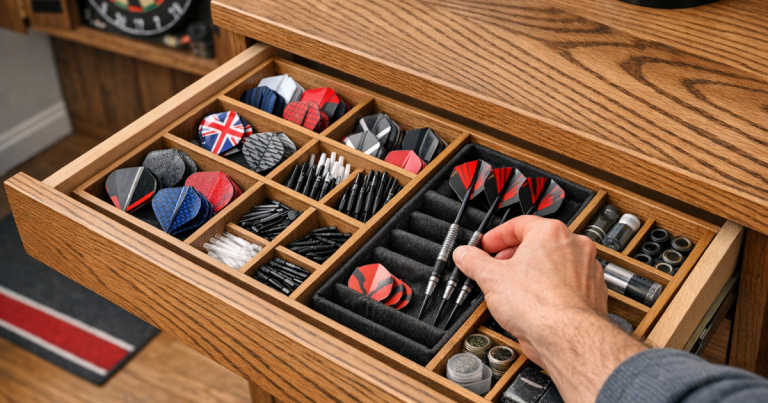
- A lockable drawer: useful if your darts area is part of a living room, dining room or multi-use family space.
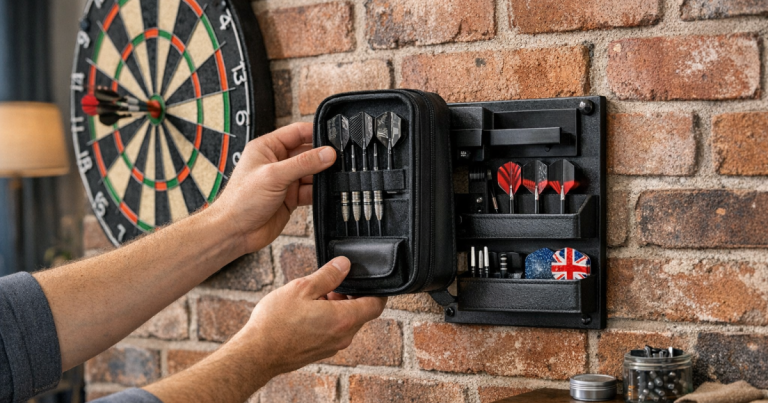
- A lockable darts cabinet: neat for keeping darts, chalk, markers and small accessories together near the board.
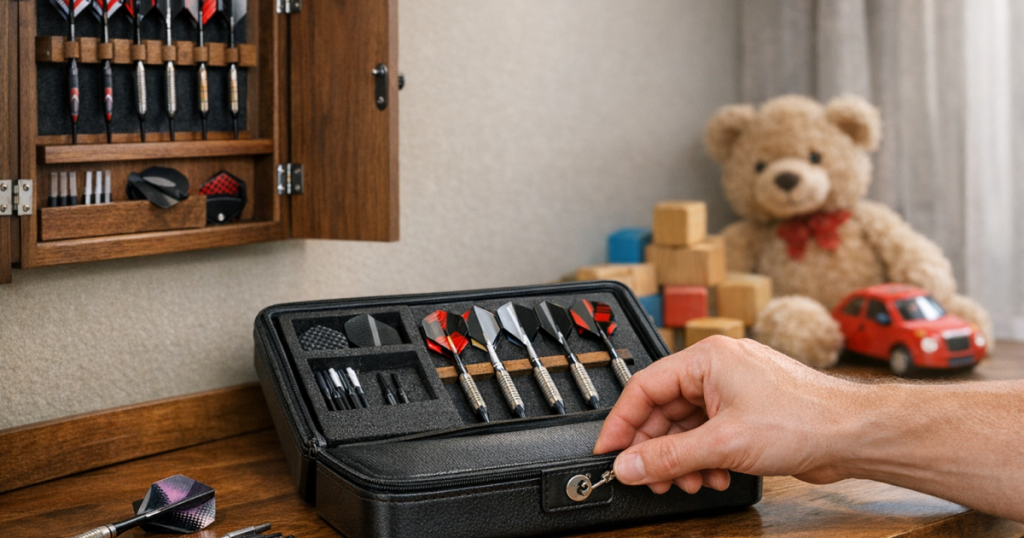
- A hard darts case stored high up: practical if you take your darts to a pub league, club night or friend’s house.
- A closed storage box inside an adult-only cupboard: a sensible choice where wall-mounted cabinets are not suitable.
A high shelf can help, but height alone is not enough if a child can climb to it using a chair, sofa, storage cube or radiator cover. Think about the route to the storage, not just the storage itself.
If your board area is also used by children for homework, toys, gaming or general play, avoid open racks and decorative dart holders. They may look tidy, but they keep the darts visible and tempting.
Step 3: Keep the darts in a proper closed case
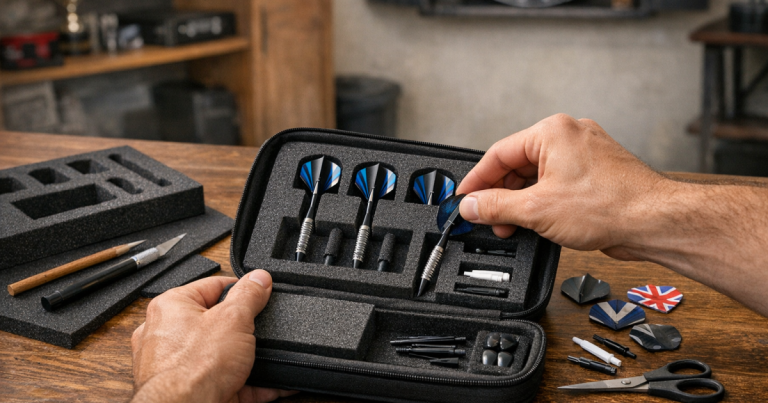
A darts case does more than stop flights getting squashed. It keeps points covered, prevents loose darts rolling into gaps, and makes it obvious whether the full set has been returned.
For child-aware storage, a case should close firmly and hold each dart securely. A soft wallet is better than leaving darts loose, but a rigid or semi-rigid case offers more protection against points pressing through the material. If your darts have removable stems or delicate flights, choose a case layout that keeps everything in place without needing to dismantle the set every time.
Do not rely on rubber point guards alone. They are useful for protecting the point and nearby items in a case, but they are small enough to be removed, lost or put in a child’s mouth. Use them as an extra layer, not the main safety measure.
Step 4: Store accessories with the same care as the darts
Many darts accessories are small, sharp, fiddly or easy to scatter. Spare steel tips, flight protectors, stem rings, sharpening stones, oche markers and repair tools should not be left loose in bowls, trays or open drawers.
Use small lidded compartments inside your darts case or a separate organiser that closes properly. Labelled sections can help if several people in the house use the setup, but the bigger safety win is containment: everything goes back into the same closed place after play.
Repair tools deserve particular care. Point tools, tightening tools and small cutters should be treated as adult-use accessories, not general kit. If you keep a match-night kit, pack it in a way that separates sharp tools from chalk, pens and score sheets. For a more complete organisation routine, the guide to making a match-ready darts accessories grab bag is a useful next step.
Step 5: Never leave darts in the board
Leaving darts in the board is one of the most common bad habits in a home setup. It feels harmless because the darts are off the floor and already where they belong, but it creates several problems.
- A child may pull them out and copy what they have seen adults do.
- Darts can fall if the board is knocked, rotated or disturbed.
- A chair, stool or toy box may give a child enough height to reach them.
- It normalises darts being left out between games.
At the end of each turn or session, retrieve the darts yourself and place them back in the case. If children are watching, make the routine visible and consistent: darts come down, points are covered or enclosed, and the case is put away.
Step 6: Check the floor and surrounding area
A safe storage routine includes the floor. Darts can bounce out, deflect off a wire, drop from a hand or slide under furniture. Before leaving the room, count the darts and scan the area around the oche, skirting boards, cabinet base and any nearby rug or mat.
If you use a mat, make sure it lies flat and does not create a trip hazard while you are collecting darts or checking for dropped accessories. The article on darts mat safety, grip and trip hazards goes deeper into floor protection and safer room layout.
For steel-tip darts, also check the wall protection area. A surround or backboard can reduce wall damage and help catch missed darts more predictably, but it does not replace supervision or storage. If your setup is in a busy family room, review your wall protection options for dartboards so missed throws are less likely to end up in plasterboard, furniture or awkward gaps.
Step 7: Make the rules clear for children
Storage only works if everyone in the home understands the rules. Keep them short and consistent, especially with younger children.
- Darts are only touched when an adult says it is time to play.
- Darts are carried point-down and never waved around.
- No one stands near the board while another person is throwing.
- Only one player collects darts at a time.
- After the game, the darts go straight back into their case and storage spot.
Avoid presenting the rules as a punishment or mystery. Calmly explain that darts are sports equipment with sharp points, so they are stored like other sharp household items. Older children can help with the count-back routine, but an adult should still make the final check and put the darts away.
Step 8: Adapt the setup to the age of the children
A household with toddlers needs a different level of control from a household with teenagers. For very young children, visible darts are usually a bad idea. Use locked storage, keep chairs away from the board area, and avoid low drawers that can be pulled open.
For primary-school-age children, focus on supervision and habits. They may understand the rules but still act impulsively, especially if friends are visiting. Store darts before playdates, parties or family gatherings, even if the dartboard is not being used.
For older children and teenagers, the goal is responsible handling. They can learn correct throwing, retrieval and storage routines, but the darts should still have a fixed home. Shared kit is more likely to go missing, so counting the set at the end matters.
Step 9: Build a reliable end-of-session routine
The best safety routine is short enough that you will actually do it. Use the same sequence every time:
- Stop play and make sure no one is at the oche.
- Remove all darts from the board yourself or supervise the person collecting them.
- Count the darts before they go into the case.
- Check the floor, mat, cabinet shelf and nearby furniture.
- Put spare accessories back into their compartments.
- Close the case fully.
- Place the case in the agreed secure storage spot.
- Lock the drawer, cabinet or cupboard if that is part of your setup.
This takes less than a minute once it becomes automatic. It also protects your darts from bent stems, damaged flights and lost accessories, so the benefit is not just safety; your kit stays game-ready as well.
Common storage mistakes to avoid
- Using an open display stand: tidy for adults, but too accessible in a home with children.
- Leaving a spare set near the board: backup darts need the same secure storage as your main set.
- Keeping tools in an unlocked scoreboard drawer: small accessories are easy to overlook.
- Assuming older children will remember: keep the routine consistent until it is genuinely habit.
- Storing darts with toys or board games: this blurs the line between sports equipment and children’s play items.
Things readers ask
Is a darts cabinet enough to keep children safe?
A standard cabinet helps keep the area tidy, but it is not automatically child-resistant. If children can open it easily, keep the darts inside a closed case as well or use a lockable storage spot.
Should I remove the darts from the board after every session?
Yes. Darts should not be left in the board between sessions, even in a room children do not normally use. Put them back in their case and into secure storage.
Are soft-tip darts safe for children?
Soft-tip darts are less sharp than steel-tip darts, but they are not risk-free. They can still injure if thrown carelessly, and small parts should be kept away from younger children.
Where should I keep spare flights and shafts?
Keep them in a lidded compartment, case pocket or organiser stored with the darts. Avoid open trays, bowls or drawers where small parts can spill or be picked up.
What should I do before children visit?
Remove darts from the board, count the set, check the floor and put all darts, tools and accessories into secure storage before guests arrive.
Final thoughts
Safe dart storage is mostly about consistency. Use one secure location, keep darts in a proper closed case, store small accessories with the same care, and make the end-of-game check part of every session.
A well-organised darts area is safer for children and easier for adults to enjoy. When the darts, tools and spares all have a proper home, you spend less time searching for kit and more time throwing with confidence.