A neat darts area can turn scruffy quickly if stray darts chip paint, mark plaster or chew the edge of a door frame. Good dartboard wall protection is not just about covering the biggest possible area; it is about matching the protection to your room, board height, thrower skill level and whether you need storage as well as padding.
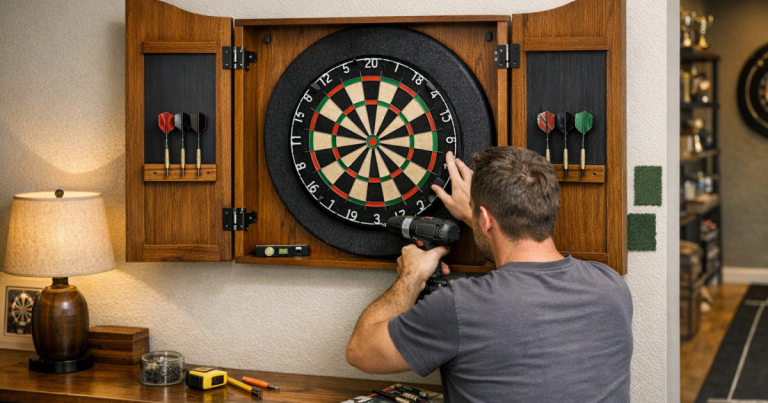
Drilling, wall fixing and checking around hidden cables or pipes should be carried out by a competent qualified tradesperson, with fixings and checks handled in line with UK safety requirements.
The big picture
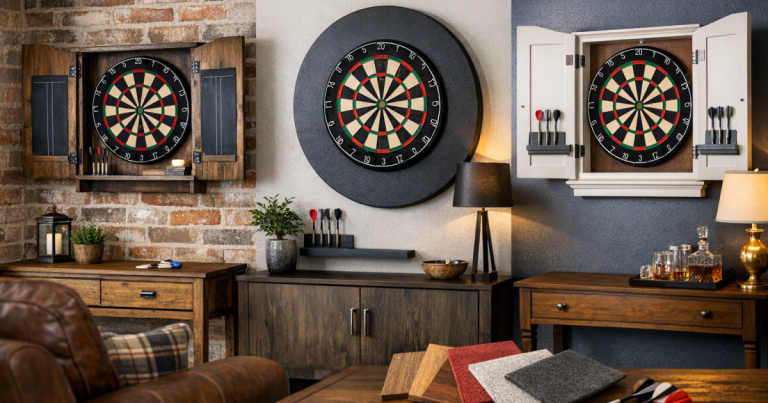
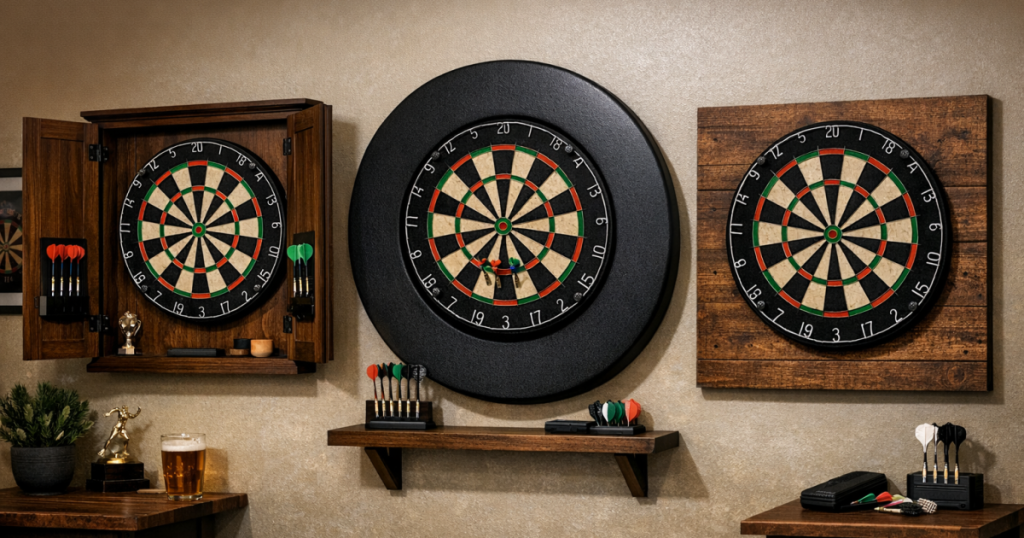
Cabinets, surrounds and backboards all solve slightly different problems. A cabinet makes the setup look tidier and gives you somewhere to keep darts, chalk or a marker. A surround cushions the area immediately around the board and is easy to remove. A backboard gives the broadest coverage and can be shaped around awkward walls, alcoves or multi-use rooms.
The right answer depends on what usually goes wrong in your space. If the odd dart misses by a few centimetres, a snug surround may be enough. If newer players, children or guests are throwing, the risk area becomes wider and less predictable. If your board is in a rented flat, garage conversion or spare bedroom with plasterboard walls, removability and fixing method matter just as much as coverage.
It is also worth separating wall protection from floor protection. A cabinet or surround will not stop bounce-outs hitting laminate, tile or skirting. If darts regularly fall short, pair wall coverage with a mat or another floor-safe solution rather than expecting one accessory to do everything.
Cabinets: tidy, traditional and useful for storage
A dartboard cabinet is the most furniture-like option. It frames the board, hides it when the doors are closed and often gives the setup a more finished look in a living room, dining room or study. For many UK homes where the darts area shares space with everyday furniture, that visual tidiness is a real advantage.
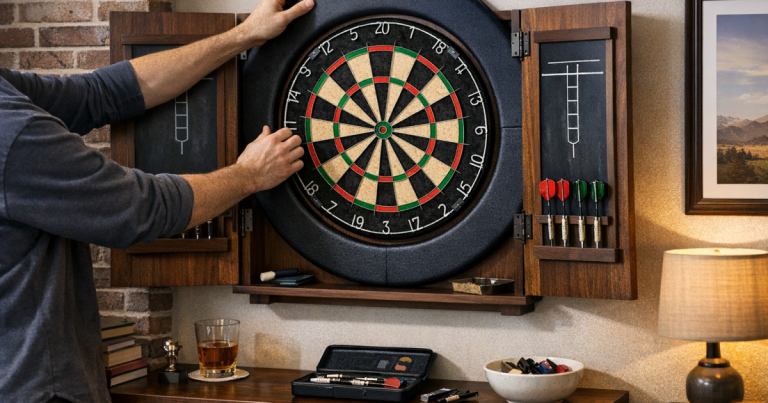
The main benefit is organisation. Cabinet doors can hold a scoreboard, spare flights, stems and chalk, so the essentials stay close to the board rather than scattered on a shelf. If you like a match-night setup but do not want a permanent sports-bar look, a cabinet can strike a good balance.
The limitation is coverage. Cabinets usually protect the rectangular area immediately around the board, but the doors and frame do not always cover the common miss zones above, below or wide of the board. A new player who drags darts low, or a guest who pulls darts wide, can still hit exposed wall. Hinges, door edges and the cabinet frame also need to sit squarely, otherwise the board can feel visually off-centre even when the bull is set at the correct height.
Cabinets are most convincing when the main priorities are appearance and storage, and when the throwers are already reasonably consistent. For a family games room or shared setup, it can make sense to combine a cabinet with a larger backing panel behind it, particularly on softer or freshly decorated walls. For a deeper breakdown of the storage and coverage trade-off, see our cabinet-versus-surround comparison.
Surrounds: simple cushioning for the common miss zone
A dartboard surround is the easiest upgrade for many home boards. It normally sits around the outside of the dartboard and creates a padded landing zone for near misses. There is no need to change the board itself, and many surrounds can be removed quickly if you need to rotate the board or take the setup down.
The appeal is convenience. A surround can make a plain board look cleaner, softens the immediate area around the number ring and is usually less visually dominant than a large backboard. In a spare room or garage setup, it is often the first step once you notice small marks forming around the treble and single beds.
The weakness is reach. Surrounds are designed for close misses, not wild ones. They may leave exposed paintwork above the board, beneath the board and outside the outer edge of the surround. That matters if your throwers vary in height, experience or throwing style. A player who releases late may hit low. A player who snatches across the throw may miss wide. A surround cannot compensate for an unsafe or cramped throwing line.
Plasterboard deserves extra thought. Even if a dart does not punch deeply, repeated impacts can leave visible pinholes and small craters. If you are trying to protect a decorated wall rather than simply hide existing marks, read our look at how much real coverage a surround gives plasterboard before assuming a standard ring is enough.
Backboards: maximum coverage and the most flexible shape
A backboard is the broadest form of protection because it sits behind the dartboard and can extend well beyond the board itself. It might be a purpose-made panel, a timber sheet, cork, felt-covered board or another suitable backing surface. The idea is simple: give missed darts a sacrificial area to hit before they reach the wall.
Backboards work particularly well in multi-user homes. If beginners, visitors or younger players are involved, the miss pattern is rarely neat. A wider panel gives you more forgiveness on both sides and below the board. It can also protect awkward surfaces that a surround does not cover, such as textured plaster, painted brick, wallpaper or the edge of an alcove.
The trade-off is that a backboard becomes part of the room. A large plain sheet can look practical but unfinished, while a framed or fabric-covered panel can look more deliberate. Weight and fixing are important too. A board that is heavy enough to hold a dart impact securely needs suitable wall fixings, and the dartboard bracket still needs to sit firmly so the board does not wobble during play.
For rented homes, a freestanding or non-permanent route may be more sensible than fixing a large panel to the wall. If wall mounting is not an option at all, a stand can move the fixing problem away from the wall, though you still need enough clear space behind and around the playing area.
Where stray darts actually land
Protecting the wall well starts with understanding the likely miss zones. Darts do not simply miss in a perfect circle around the board. In home setups, the pattern is shaped by stance, lighting, board height, fatigue, confidence and how much space the thrower has to move naturally.
- Low misses: common with newer players, tired arms or a throw that drops at release. These often hit beneath the board rather than beside it.
- Wide misses: often caused by pulling across the body, standing off-centre or feeling cramped by furniture or a doorway.
- High misses: less common for experienced throwers, but still possible when someone overcompensates or releases early.
- Clustered near misses: the easiest to handle with a standard surround because the darts are still close to the board edge.
- Bounce-out damage: not strictly a miss, but it can mark walls, floors and skirting if darts kick out sharply from the board.
This is why measuring the playing area matters before choosing a protection method. If a sofa, radiator, cupboard or hallway opening pushes the thrower off line, wall padding will not solve the underlying issue. Start by checking that the throw is comfortable, straight and unobstructed. Our guide to checking your throwing clearance before fixing anything is a useful first step if the room feels tight.
Matching protection to the room
Living rooms and shared spaces
In a room where the board is visible every day, appearance usually matters. A cabinet gives the neatest closed look, while a framed backboard can make a darts area feel intentional rather than improvised. A surround is less bulky, but it leaves the board on show all the time. Think about the surrounding furniture too: a smart cabinet above a sideboard can look tidy, but only if the throwing line and safe clearance still work.
Garages, sheds and utility spaces
Function usually wins here. A wider backboard is often the strongest choice because decoration is less of a concern and walls may already be rougher. Temperature and damp can affect some materials over time, so avoid anything that warps easily or sheds fibres around the board. Good lighting and a clear oche area will do as much for the setup as the backing panel itself.
Rented homes and temporary setups
For renters, the key question is reversibility. A surround can reduce visible marking with minimal visual impact, but it still depends on a properly mounted board. A freestanding stand, removable backing arrangement or carefully chosen fixing method may be more suitable than drilling multiple holes for a large panel. Always consider the tenancy agreement and the condition you need to leave the wall in.
Family games rooms
Family rooms benefit from generous coverage because throwers vary more. A cabinet alone may look smart but can leave too much exposed wall for casual play. A surround plus a larger backboard behind it is often a more forgiving combination, especially when guests are likely to have a few loose practice throws before settling in.
Combining options without making the setup bulky
You do not have to choose only one form of protection. Many of the neatest home setups use layers: a backboard for broad coverage, a surround for close-impact cushioning and a small cabinet or side storage for accessories. The challenge is avoiding a setup that feels overbuilt or pushes the board too far forward from the wall.
Depth matters because the dartboard should feel stable and natural to throw at. If you add a thick panel, then a cabinet, then a board, make sure the mounting remains solid and the oche measurement is taken from the face of the dartboard, not the original wall. Even a smart-looking setup becomes frustrating if the board vibrates or the playing distance is measured from the wrong point.
It is also sensible to leave access for board rotation. Bristle boards last longer when rotated regularly, so do not trap the board in a frame so tightly that maintenance becomes awkward. Any protection setup should let you remove the board, adjust the number ring and clean around the area without dismantling half the room.
Common mistakes that leave walls exposed
- Choosing for looks only: a slim cabinet may suit the room, but it might not cover the actual miss pattern in your household.
- Ignoring the space below the board: low misses and bounce-outs can be more damaging than neat side misses.
- Mounting too close to a corner: side walls, door frames and picture rails can still take hits if the throw is not centred.
- Forgetting lighting: shadows across the board can increase stray darts, particularly in rooms with ceiling lights behind the thrower.
- Using a decorative panel that cannot take impact: thin or brittle materials may mark, split or fail to hold darts safely.
- Skipping maintenance access: if you cannot rotate or remove the board easily, the whole setup becomes less pleasant to own.
Helpful questions
Is a dartboard surround enough for a beginner?
Sometimes, but not always. A surround protects close misses around the board, while beginners often miss low or wide. A larger backboard is usually more forgiving for mixed-ability play.
Can a cabinet protect plasterboard walls?
A cabinet protects only the area it covers. Plasterboard around the outside can still be marked, so consider a larger backing panel if the wall is newly decorated or easily damaged.
Should I put a backboard behind a cabinet?
It can work well if you want storage plus wider coverage. Check the total depth, fixing strength and oche measurement from the dartboard face once everything is installed.
What is the neatest option for a living room?
A cabinet usually looks tidiest when closed. If you need more coverage, a framed backboard in a colour or finish that matches the room can look more polished than a bare panel.
Do I still need a mat if the wall is protected?
Yes, if bounce-outs or dropped darts could damage the floor. Wall coverage and floor coverage solve different problems, especially on laminate, tile or soft timber flooring.
Final thoughts
The best setup is the one that protects the real risk areas without making the room awkward to use. Cabinets are strong on style and storage, surrounds are quick and tidy for close misses, and backboards offer the broadest coverage for busy home boards. For many households, dartboard wall protection works best as a layered approach: enough backing to catch loose darts, enough storage to keep accessories organised and enough clearance to make every throw feel safe and natural.
Before fixing anything permanently, stand at the oche, look at the whole wall around the board and imagine where a tired, distracted or first-time thrower might actually miss. That simple check often tells you more than the accessory label ever will.