A mat can make a home board feel more settled, but darts mat safety depends on more than simply rolling something out beneath the oche. The surface needs to stay flat, grip the floor, mark the throw line clearly and protect the area where darts are most likely to land. Get those details right and the whole setup feels calmer, tidier and easier to use.
For UK homes, the challenge is often space rather than ambition. A darts mat might sit on laminate in a spare room, carpet in a garage conversion, tiles in a kitchen-diner or timber flooring in a rented flat. Each surface changes how the mat behaves, so it is worth thinking about grip, edges and floor protection before regular play starts.
The short version
- A darts mat should lie flat, resist slipping and give a clear, repeatable oche position.
- Raised or curled edges are the main trip concern, particularly in narrow rooms and shared spaces.
- Hard floors usually need stronger anti-slip behaviour than carpeted floors.
- Thicker mats can protect flooring better, but they can also create a more noticeable step at the edges.
- The safest setup is the one that matches your room, walking routes, flooring and throwing distance.
Why the mat matters in a home darts setup
A mat does three jobs at once. It defines where you stand, gives dropped darts somewhere less damaging to land, and helps the board area feel like a proper oche rather than a temporary corner of the room. That is useful for practice because the throw line is consistent from session to session.
The safety side comes from the same details. A mat that creeps forward during play can shift the oche. A thin mat with curling corners can catch a foot. A heavy rubber mat that sits proud of the surrounding floor can become a trip point if it crosses a route to a door, cupboard or sofa. None of these problems are dramatic on their own, but they are exactly the kind of small nuisance that makes a home setup less pleasant to use.
The first check is whether the room itself gives you enough space to throw and move around comfortably. Before worrying about the mat, confirm the playing area with a proper clearance check; the guide to checking throwing clearance before installing a dartboard is a useful next step if your board is going into a tight room, hallway or multi-use space.
Grip: stopping the mat from moving underfoot
A darts mat should not slide when you step into position, pivot, retrieve darts or walk across it between visits. Movement is most common on smooth floors such as laminate, vinyl, sealed concrete, polished timber and tiles. Carpet can be more forgiving, but lightweight mats can still ruck up or shift if the pile is deep.
Hard floors
On hard flooring, grip comes from the underside of the mat. Rubber-backed designs, textured undersides and heavier materials usually behave better than very light roll-out mats. The aim is not to glue the mat to the floor; it is to stop casual movement during normal play.
Before a proper session, place the mat where it will be used and do a few ordinary movements: step onto the oche, step back, walk to the board and return. If the mat turns, creeps or bunches, it needs repositioning or a different grip solution. Do not ignore tiny shifts, because they usually become more obvious once several people are playing.
Carpet and rugs
Carpet reduces sliding, but it can introduce a different issue: the mat may settle unevenly. A mat placed over a thick rug can form ridges or soft spots, particularly where the oche marker sits. That may not bother a casual thrower, but it can make foot placement feel inconsistent.
If the mat is going over carpet, check whether it lies evenly after a few minutes and whether the corners lift when someone turns or drags a foot. A flatter, firmer surface is usually better for repeatable stance and fewer trip points.
Trip hazards: the edges matter most
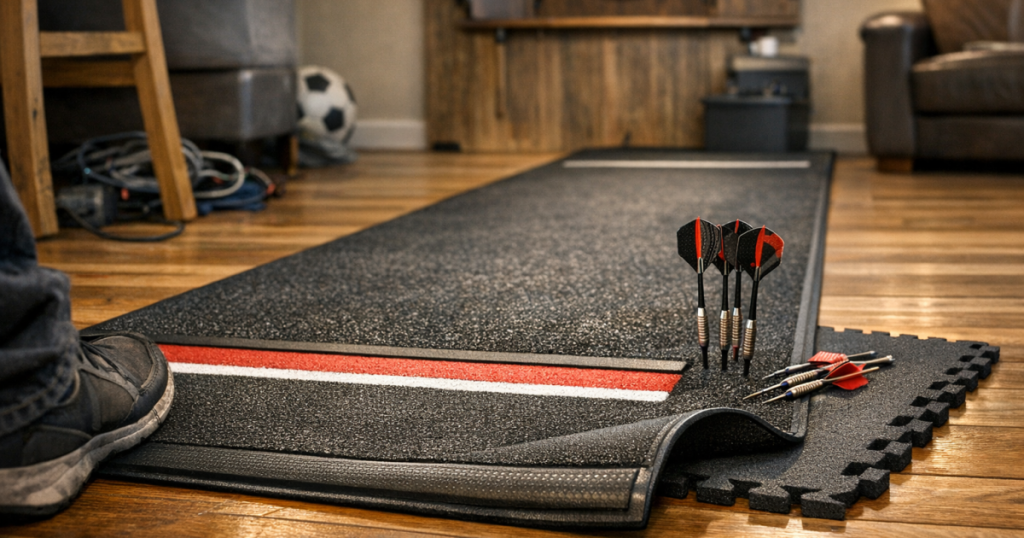
Most mat-related trips happen at the perimeter, not in the middle. The danger points are curled corners, raised lips, thick edges and places where the mat crosses a walking route. This matters more in family spaces where someone may walk through the area without thinking about the darts setup.
Check all four edges from the direction people actually walk. A rear edge near a doorway can be more of a problem than the front edge at the oche. If the mat is in a garage, look for routes to shelves, bikes, tools or appliances. If it is in a lounge, think about the route to seats, curtains and plug sockets.
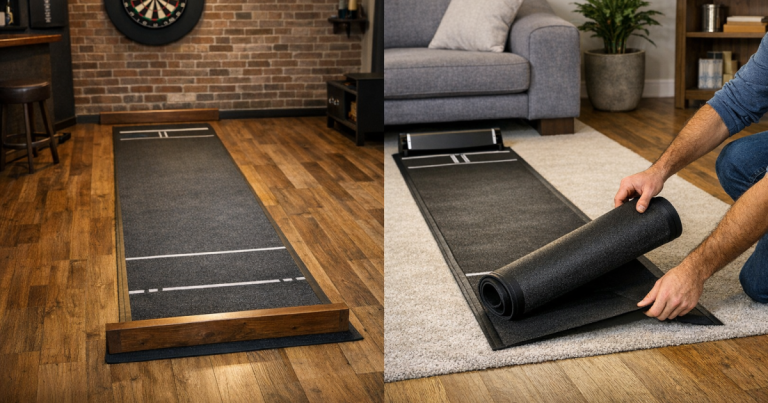
Rolled mats can curl when first unpacked or after storage. Give them time to relax flat before judging them. If a corner keeps lifting, it should not be left in a busy walkway. A mat that only behaves when no one touches it is not behaving well enough for regular home play.
Oche position and mat size
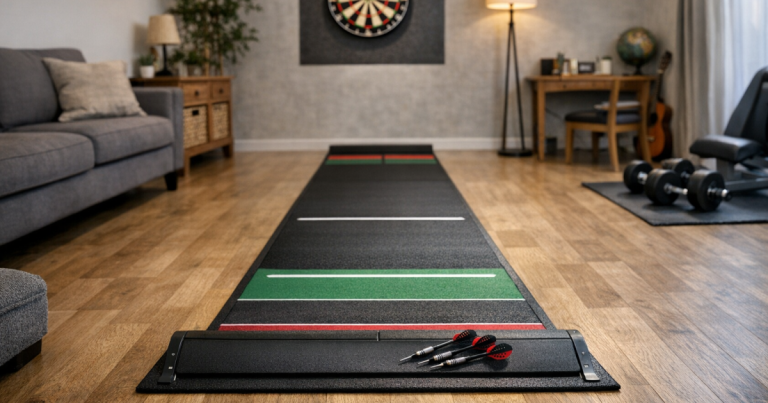
A mat is safest and most useful when it makes the throwing position obvious. Some mats have a printed oche line; others use a raised oche strip or a separate marker. The important point is that the throwing line does not drift, fade into the pattern or sit where players naturally overstep it.
The standard steel-tip throwing distance is measured from the face of the board to the oche, not from the wall. In a home setup, the mat needs to sit in the right place relative to the board face, skirting board and any cabinet or surround depth. If you are setting this up from scratch, use the detailed darts mat size guide for length, width and oche position so the mat supports the correct distance rather than simply filling the floor space.
Width matters too. A very narrow mat can leave one foot partly on the floor and partly on the mat, especially for players with a wider stance. A very wide mat may interfere with furniture or door swings. The safest size is the one that gives players enough standing space without creating unnecessary edges in the room.
Floor protection: what a mat can and cannot do
Darts mats protect floors mainly from dropped darts and occasional bounce-outs that land short. They are not a complete safety barrier, and they will not protect every part of a room. A dart can still deflect sideways, bounce beyond the mat or land near the skirting board.
For hard floors, the benefit is obvious: fewer point marks, chips and dents in the most exposed area. For carpet, the concern is usually less about visible damage and more about lost points, snagged fibres and darts landing where people may step. A mat also makes it easier to spot a fallen dart quickly.
Thickness is a trade-off. A thicker mat may absorb impacts better, but it can create a more prominent edge. A thinner mat is easier to walk over, but it may offer less cushioning for delicate flooring. In rented homes, or rooms with expensive timber or tiled floors, it is worth treating the mat as one part of a wider protection plan rather than the whole answer.
Wall and floor risks often overlap. If your room has plasterboard, painted walls or furniture close to the board, combine floor planning with sensible wall protection; the guide to wall protection options for dartboards covers cabinets, surrounds and backboards in more detail.
Different rooms, different risks
Spare room or office
A spare room usually gives the neatest setup because the mat can stay down permanently. The main checks are chair legs, desk wheels and whether the mat blocks access to cupboards. If the room doubles as a workspace, make sure the mat edge is not where an office chair rolls back.
Garage or outbuilding
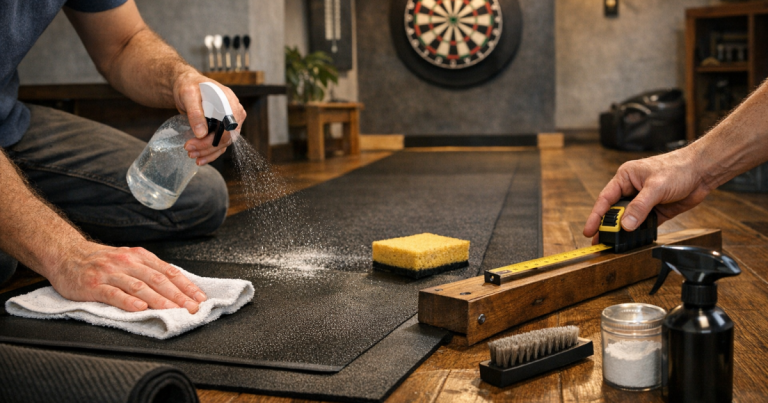
Garage floors are often hard, cold and slightly uneven. A heavier mat can feel stable, but dust and grit underneath may reduce grip or scratch the floor over time. Sweep the area before laying the mat and check that the mat does not sit across a route used for bikes, bins or storage boxes.
Lounge or shared family room
Shared rooms need the most discipline. If the mat is only used for darts, store it flat or roll it carefully when not in use. Do not leave a temporary mat half-unrolled beside furniture, because that is when corners and edges become easy to miss.
Hallways and narrow spaces
A hallway setup can be tempting because it offers a long straight line, but it also concentrates movement through one narrow route. A mat in a hallway can become a trip strip if people pass through while someone is playing. In this situation, room safety matters as much as mat choice, and play should stop whenever the route is being used.
Small habits that keep the setup safer
- Check the mat is flat before every session, especially if it has been rolled or moved.
- Keep the area around the mat clear of shoes, bags, stools and spare darts cases.
- Pick up fallen darts immediately rather than leaving them until the end of a leg.
- Do not place the oche where players have to step backwards onto a raised edge.
- Clean grit from underneath the mat to protect hard floors and maintain grip.
- Store roll-up mats with the playing surface protected and avoid sharp folds.
- Recheck the throwing line after moving the mat, even if it only shifted slightly.
When a mat is not enough
A mat improves the floor area, but it cannot fix a cramped throw, a busy walkway or a poor board position. If players have to twist around furniture, step across the mat at an angle or retrieve darts while others pass behind them, the setup needs rethinking.
The same applies when bounce-outs are frequent. A mat can reduce floor damage, but it does not solve the reason darts are ending up on the floor. Board condition, wire profile, dart points, throwing angle and player technique can all play a part. Treat the mat as protection, not a cure for every problem around the board.
There is also a practical comfort point. If the mat feels spongy, unstable or distracting underfoot, players may alter their stance without realising it. Consistency matters in darts, so a safer setup should also feel natural to stand on.
Questions people ask
Should a darts mat go under the board or only at the oche?
Most home mats run from the board area towards the oche so they mark the throwing line and cover the likely drop zone. The exact position should be measured from the board face, not guessed from the wall.
Is a raised oche safer than a printed line?
A raised oche gives clearer foot feedback, but it also adds another edge. It works best when players expect it, the room is not used as a walkway and the strip sits firmly without movement.
Can I use a normal rug instead of a darts mat?
A rug can protect part of the floor, but it may move, curl or hide the correct throwing distance. If you use one temporarily, check grip, flatness and oche measurement carefully.
What flooring is most awkward for a darts mat?
Smooth laminate, polished timber and tiles tend to show slipping problems first. Thick carpet can also be awkward if the mat ripples or feels uneven underfoot.
How often should I check the mat?
Check it whenever it has been moved, rolled away, cleaned around or used by several players. A quick edge and grip check takes seconds and prevents most common problems.
Why it matters
A good darts area should feel easy to use, not like a temporary obstacle course. The mat is a small part of the setup, but it influences stance, floor protection, room flow and day-to-day confidence. The safest choice is not always the thickest, heaviest or most elaborate mat; it is the one that stays put, lies flat and fits the way your room is actually used.
Start with the room, confirm the throwing distance, then judge the mat by grip, edges and protection. That approach keeps the home oche practical for regular practice without turning the surrounding space into a hazard.