A reliable dartboard lighting guide starts with a simple aim: light the board face evenly enough that every segment, wire and dart angle is easy to see from the oche. The best home setups do not just make the board brighter; they control shadows, stop glare bouncing back at the thrower, and keep the surrounding area safe enough for normal movement.
Any new mains wiring, hard-wired lighting, or changes to wall switches should be carried out by a qualified electrician to meet UK electrical safety requirements and applicable Building Regulations.
At a glance
- Light should fall evenly across the whole dartboard, including the outer doubles and number ring.
- The thrower should not be looking directly into the light source from the oche.
- Shadows from darts, cabinets or surrounds are usually a sign that the light is too directional or too far off-centre.
- Glare is often worse on glossy cabinet doors, pale walls and reflective scoreboards than on the board itself.
- Room layout matters: a brilliant lighting ring will not fix an unsafe or cramped throwing area.
What good dartboard visibility actually looks like
Good visibility is not the same as maximum brightness. A board can be extremely bright and still unpleasant to play on if the centre is blown out, the doubles are dull, or the light catches your eyes during the throw. The aim is a balanced view from the throwing line.
Stand at the oche and look at the board as you would during a real visit. You should be able to pick out the treble 20 bed, the bull, the lower doubles and the number ring without leaning, squinting or waiting for your eyes to adjust. If one side of the board looks flatter or darker, the light is not landing evenly.
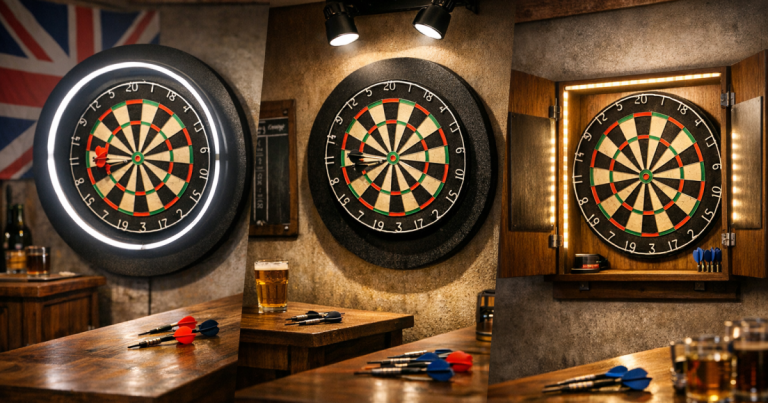
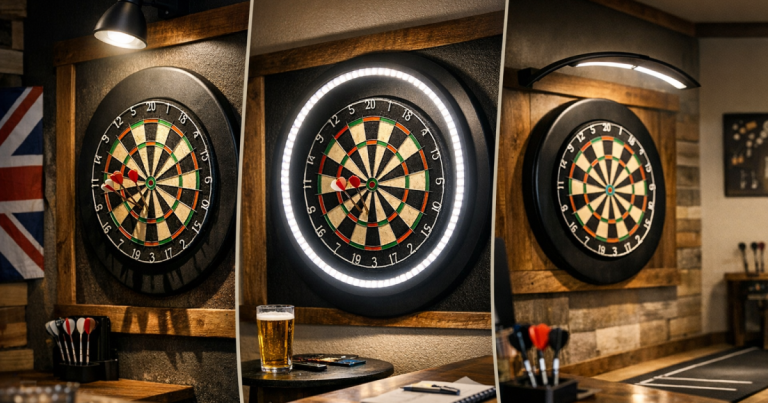
For home players, the most common problem is not total darkness; it is uneven contrast. Ceiling lights often sit behind or above the thrower, so your arm and darts can cast shadows across the board. A side lamp may make one half of the board pop while leaving the opposite edge dull. A purpose-made circular light or a well-positioned pair of directional fittings can reduce those issues because the light arrives from around the board rather than from one obvious angle.
Glare, shadows and why small angles matter
Glare usually shows up in three places: directly from the fitting, reflected from nearby surfaces, or as a bright hotspot on the board area. You may notice it more during longer practice sessions, when your eyes start to feel tired before your throw does.
The easiest test is to stand at the oche and move your head slightly left, right, up and down. If a bulb, LED strip or metal edge keeps catching your eye, the light is too exposed from the throwing position. If the board looks fine but a white wall or glossy cabinet door is shining back at you, the problem is reflection rather than board illumination.
Shadows need the same practical testing. Put three darts in the board at different heights, then view them from the oche. A small shadow under the barrel is normal, but heavy shadows across adjacent beds can make scoring and grouping harder to judge. If you use a cabinet, check with the doors fully open and fully closed, as both positions can change how light falls across the board.
Common home lighting layouts
There is no single layout that suits every spare room, garage, dining room or garden office, but most home darts areas fall into a few patterns.
Board-mounted circular lighting
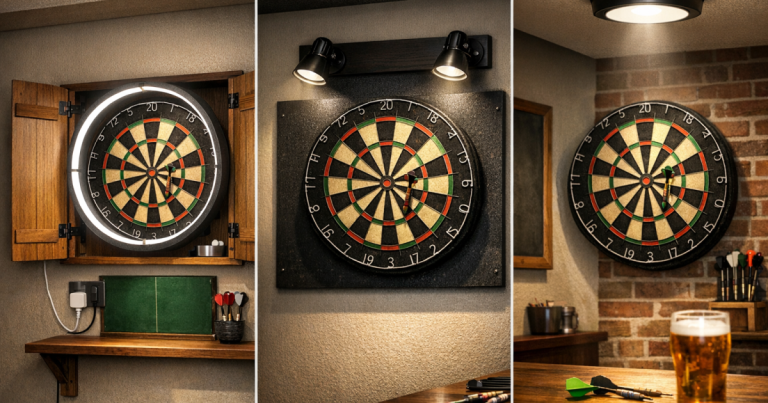
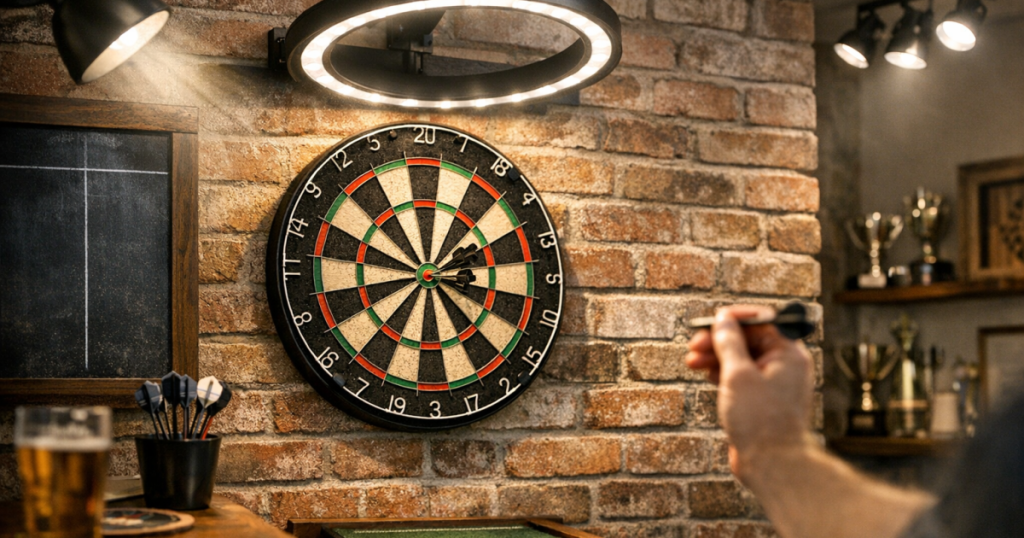
Circular dartboard lights sit around the board and are popular because they put the light source close to the target. Systems such as the Target Corona Vision and Winmau Plasma Dartboard Light are recognisable examples of this style. The advantage is even board coverage; the main check is whether the unit fits comfortably with your surround, cabinet or wall protection.
Ceiling spotlights
Ceiling spotlights can work well when they are aimed accurately and not positioned directly behind the thrower. Two or more angled fittings are usually better than one narrow beam because they reduce harsh shadow lines. They also keep the board area visually cleaner, which suits rooms that double as living spaces.
Cabinet and wall-mounted lighting
Some players add lighting above or around a dartboard cabinet. This can look tidy, but it needs care because cabinet frames and open doors can block light. If you also use a scoreboard inside the cabinet, test whether the writing surface reflects light back towards the oche.
General room lighting plus task lighting
A normal ceiling light can support the room, while a dedicated board light handles the target. This is often the most comfortable arrangement for social darts because people can move around safely without the board light being responsible for illuminating the entire room.
Room checks before changing the lighting
Lighting should be planned around the whole throwing area, not just the board. Before adding fittings or moving furniture, confirm that the oche, player stance and walking routes all still make sense. If the board is going into a tight room, alcove or shared space, it is worth taking a few minutes to check your throwing clearance before you focus on the light position.
Look at what sits behind and around the board. Pale plaster, picture frames, mirrors, gloss paint and glass-fronted cabinets can all increase reflected glare. A darker, matte backing area can make the board easier to read and can also define the darts zone more clearly. If missed darts are a realistic risk, review your wall protection options at the same time, because surrounds, cabinets and backboards all affect how lighting behaves at the board edge.
Also think about where people stand when they are not throwing. A light that is comfortable for the player may still shine into the eyes of someone marking, retrieving darts or sitting nearby. In a shared room, comfort matters as much as neatness.
Simple setup standards to aim for
For a home setup, the standard is practical rather than ceremonial: the board should be consistently readable, the thrower should not be dazzled, and nothing should interfere with a normal throw. Use these checks as a baseline.
- Centre the light around the board face where possible: uneven side lighting is the biggest cause of heavy shadows.
- Check from the oche, not from beside the board: what looks bright up close may glare from the throwing line.
- Keep the number ring readable: if the board face is bright but the numbers disappear into shadow, scoring becomes awkward.
- Avoid exposed bulbs in the thrower’s eyeline: shields, diffusers or repositioning can make a big difference.
- Test with darts in the board: shadows only become obvious once the barrels and flights are in place.
- Match lighting to the room use: a garage practice lane can be more functional, while a dining-room setup may need a softer look when darts are finished.
Controls make a bigger difference than many players expect
The switch setup is easy to overlook. A board light that is either harshly bright or completely off gives you less flexibility than one that can be controlled sensibly. Dimmers, separate switches and suitable smart bulbs can help, provided they are compatible with the fittings and installed appropriately.
For example, you might want full board lighting for practice, lower ambient lighting during a casual evening, or separate control for a cabinet light and the main room light. The important point is to make the darts area easy to use without fiddling around every time you play. For more detail on switching and dimming choices, see the separate guide to dartboard lighting controls.
How to test your lighting in ten minutes
You do not need specialist equipment to judge whether your setup is working. A short practical check from the actual playing position is usually more useful than staring at product photos or room inspiration shots.
- Stand at the oche and look at the bull, treble 20, treble 19 and lower doubles in turn.
- Place three darts in the board and check whether the shadows hide neighbouring beds.
- Open and close any cabinet doors and repeat the same visibility check.
- Turn nearby lamps, TVs and reflective screens on and off to see what changes.
- Ask another player to stand at the oche, because height and stance can alter glare.
- Play one short leg and notice whether you feel eye strain, hesitation or misreads.
If the setup fails only one check, a small adjustment may solve it. If it fails several, the light position or room layout probably needs rethinking rather than a brighter bulb.
Things readers ask
Do I need a dedicated dartboard light?
Not always, but it usually helps if your ceiling light creates shadows or sits behind the thrower. A dedicated board light gives more controlled illumination where it is needed.
Is brighter always better for darts?
No. Excess brightness can cause glare and eye fatigue. Even, comfortable light across the full board is more useful than raw brightness.
Can I use a dartboard light with a cabinet?
Sometimes, but you need to check clearance, door movement and shadows. Some lighting styles suit open wall-mounted boards better than enclosed cabinet setups.
What colour light works best?
A neutral white light is usually the safest starting point for home darts because it keeps segment colours clear without feeling too yellow or too stark.
Why does my board look fine up close but poor from the oche?
The viewing angle changes everything. From the oche, exposed LEDs, cabinet edges, dart shadows and wall reflections can become much more noticeable.
Key takeaways
Treat this dartboard lighting guide as a practical checklist: light the whole board evenly, test from the oche, control glare, and make sure the room still works safely for players and spectators. A good setup should feel almost invisible during a throw. You see the segment, commit to the shot and retrieve your darts without fighting shadows or reflections.
Start with observation before buying or rewiring anything. In many homes, a small change in angle, a better-controlled switch arrangement, or a less reflective backing area can improve the playing experience more than simply adding more light.