The 20 segment takes the heaviest punishment in most home practice sessions, so regular rotation is one of the simplest ways to make a board last longer. The neat way to rotate a bristle dartboard is to move the board body, then refit the number ring so 20 is back at the top.
Do it in the wrong order and the doubles, trebles and numbers stop matching, which makes scoring unreliable. Most modern bristle boards make the job straightforward because the number ring is separate from the sisal playing surface.
The short version
Remove the number ring first, turn the dartboard to spread wear away from the most-used beds, then put the number ring back with 20 at the top and 3 on the right-hand side of 20. The board itself can move; the number layout must return to the standard dartboard order.
- Take off the number ring before turning the board.
- Rotate the board by a few segments rather than a tiny nudge.
- Use the wall bracket or centre screw as the pivot point, not the number ring.
- Refit the ring only after the board is sitting securely.
- Check that 20, 1, 18, 4 and 13 run correctly across the top arc.
If your board sits inside a cabinet, clear the shelf and surrounding accessories before you start. A tidy cabinet makes maintenance quicker, and the same habits covered in organising a dart cabinet for daily practice help stop spare stems, flights and chalk from getting in the way.
Why the number ring must come off first
The number ring is only there to label the scoring beds. It is not the part that needs to wear evenly. If you turn the whole board with the ring still attached, the worn 20 bed may move, but the printed or wire numbers move with it. That leaves the board looking normal from a distance while the scoring layout is wrong.
On a standard clock-style dartboard, the 20 is always at the top. To its immediate right is 1, then 18, 4 and 13 as you move clockwise. To its immediate left is 5, then 12, 9 and 14. When those numbers are not in the correct order, finishing practice, doubles routines and scoring games all become misleading.
The playing surface is what you are rotating. The number ring is effectively reset afterwards, like putting a label back in the correct place. Once you get into that habit, the process takes less than a minute.
Step-by-step: rotating the board cleanly
1. Remove darts, surround and loose accessories
Start with a clear board. Take out any darts, remove a foam surround if it overlaps the number ring, and move nearby accessories away from the cabinet or wall area. If the surround is tight, pull it evenly rather than dragging it across the face of the board.
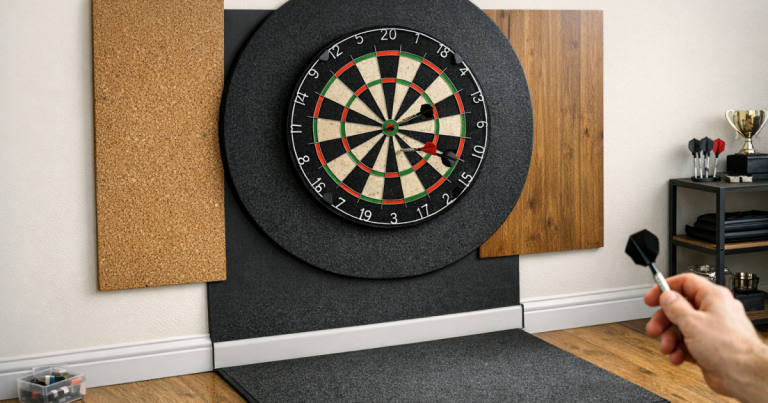
A surround can hide the number ring clips or make it harder to see whether the board is sitting level afterwards. If you use one mainly for wall protection, the guidance on dartboard surround thickness and coverage is also worth keeping in mind when you refit it.
2. Lift off or unclip the number ring
Most bristle boards use a removable metal number ring held by small clips, tabs or pins around the outside edge. Gently ease the ring away without bending it. Do not yank it from one side only, as that can distort the ring and make it sit unevenly when refitted.
Place the ring somewhere flat, with the 20 still easy to identify. If the ring has a slight curve from use, avoid forcing it perfectly flat. You only need it out of the way while the board surface is turned.
3. Rotate the dartboard body
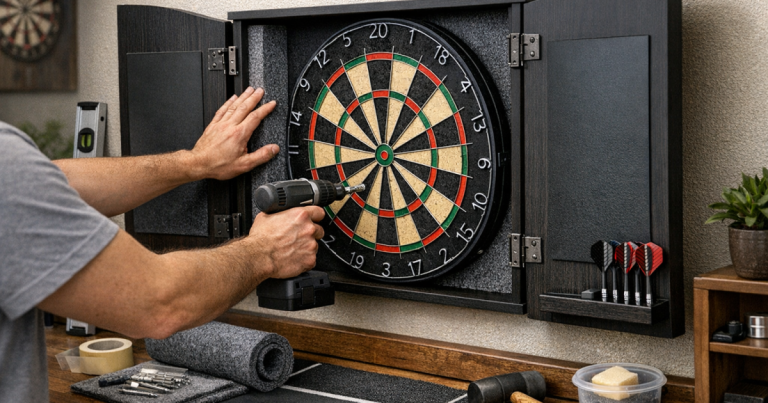
With the number ring removed, turn the bristle board on its centre fixing. Many wall-mounted boards hang from a centre screw and bracket, so the board can be lifted slightly, turned, and settled back into the bracket. Freestanding stands and cabinets may use a similar centre-mount system, but the exact fixing varies.
Move the worn area away from the top. A common approach is to turn the board by two or three number segments, not just a few millimetres. That gives the old 20 bed time to recover and brings a fresher section into the high-traffic area.
If the board feels stiff, do not force the outer edge. Lift it slightly to take pressure off the bracket, then turn it steadily. The goal is a smooth rotation around the middle, not a twist that pulls the board off its fixing.
4. Seat the board firmly before replacing the ring
Once the playing surface has moved, check that the board is properly seated on its bracket. Give it a light touch at the lower edge to see whether it rocks. If it wobbles, lift and reseat it rather than trying to solve the problem by pushing the ring back on tightly.
This is also a good time to check that the board is flush against the cabinet, wall, backing panel or stand. A slight tilt is annoying during practice and can make trebles or doubles feel less predictable, even if the board is technically usable.
5. Put 20 back at the top
Now refit the number ring with 20 at the very top. Align the 20 with the upper centre of the board, not with the most worn bed. Then check the sequence around it: 5 should be to the left of 20, and 1 should be to the right.
If your ring uses clips, press them back evenly around the board. If it uses pins or locating points, make sure each point is seated before you push the next one into place. The ring should sit close to the board without bowing out or touching the scoring wires awkwardly.
Quick alignment checks before you throw
A thirty-second check saves confusion later, particularly if several people use the same home setup. Stand at the oche and look at the top quarter of the board. The treble 20 should be directly above the bull, and the 20 number should sit above that segment.
- Top number: 20 is at 12 o’clock.
- Right of 20: 1 comes next, then 18.
- Left of 20: 5 comes next, then 12.
- Centre line: the 20 bed, bull and 3 bed should sit on a straight vertical line.
- Ring fit: numbers sit outside the scoring area and do not cover doubles.
Throw three gentle darts at the 20 bed from your normal position. You are not testing accuracy here; you are checking that the board feels secure, does not move on impact, and that the scoring segment matches the number you are aiming at.
How often should you turn a home dartboard?
For casual use, rotating every few weeks is usually enough. For daily practice, weekly rotation is a better habit, particularly if most sessions include 20s, 19s and doubles drills. The aim is not to follow a perfect calendar, but to act before one bed becomes visibly crushed, faded or loose.
Heavy 180 practice, around-the-clock doubles, and finishing routines all concentrate wear in predictable areas. If your top trebles are flattening while other parts of the board still look new, rotate a bristle dartboard more regularly and keep the number ring reset each time.
Different bristle boards wear differently depending on sisal density, wire profile, dart point condition and how often you play. Dual-core and triple-core construction can also affect how the board feels and wears, so the explanation of dual-core and triple-core dartboards for home setups is useful if you are trying to understand why one board seems to recover better than another.
Common mistakes that misalign the numbers
Leaving the ring attached
This is the main mistake. The board may look rotated, but the numbers have moved with the worn beds. Always remove the ring first unless your particular board has a fixed printed layout, in which case it cannot be rotated in the same way.
Using the cabinet as the alignment point
Cabinet doors, backing panels and wall marks are not always perfectly level. Use the board’s own centre line and number sequence to check alignment. A spirit level can help with the cabinet or backing board, but the final scoring check should be based on the standard number order.
Turning by too little
A tiny turn puts the most damaged fibres almost back in the same high-impact area. Move the board far enough that a noticeably fresher bed sits under the 20. Small adjustments are fine for levelling, but not for meaningful wear management.
Forcing a bent number ring
If the ring has been stored awkwardly or pulled off from one side, it can sit proud of the board. Gently reshape it by hand only enough for it to rest evenly. A badly distorted ring can make the board look misaligned even when the segments are in the right place.
When rotation will not solve the problem
Rotation spreads normal wear, but it cannot fix a board that has lost its structure. If the sisal is bulging, the spider is lifting, or darts are falling out of several areas, the issue is beyond routine maintenance. The same applies if the board has been kept in a damp garage and the surface feels soft or swollen.
For a garage or outbuilding setup, keep the board away from obvious damp, large temperature swings and direct sunlight where possible. A well-planned darts corner makes regular maintenance easier because the board, mat, lighting and storage all have enough space to work properly.
FAQ
Can I rotate a dartboard with the number ring still on?
No. The scoring numbers will move with the worn segments, leaving the layout wrong. Remove the number ring, turn the board, then refit the ring with 20 at the top.
How far should I turn the board each time?
Turn it by a few segments so a fresher area moves into the 20 position. A very small adjustment does little to spread wear.
What if my dartboard has printed numbers?
A board with fixed printed numbers is not designed for normal rotation. You can still care for it by avoiding damp and using sharp, clean points, but you cannot reset the number layout.
Why does the 20 bed wear faster than the rest?
Most scoring practice is aimed at treble 20, so that section receives far more dart impacts than quieter areas such as low singles.
Should I rotate the board before or after practice?
After practice is usually easiest because you can clear darts away and leave the board ready for the next session. The important part is doing it consistently.
In brief
Take the number ring off, rotate the bristle surface, seat the board securely, then put the ring back with the standard number order restored. Once that habit is built into your home darts routine, you get more even wear, cleaner scoring and fewer annoying alignment mistakes during practice.