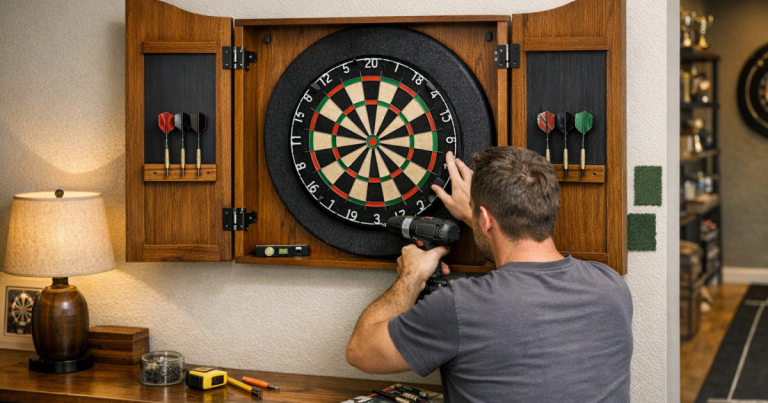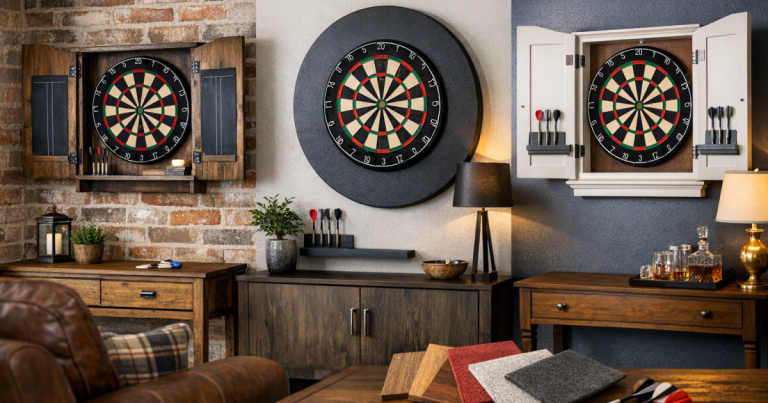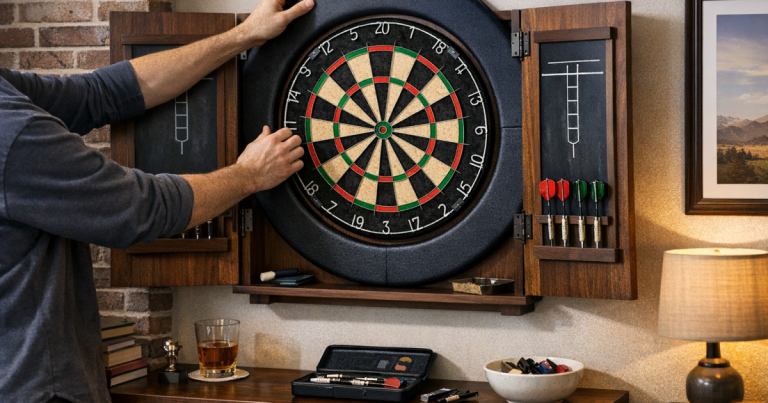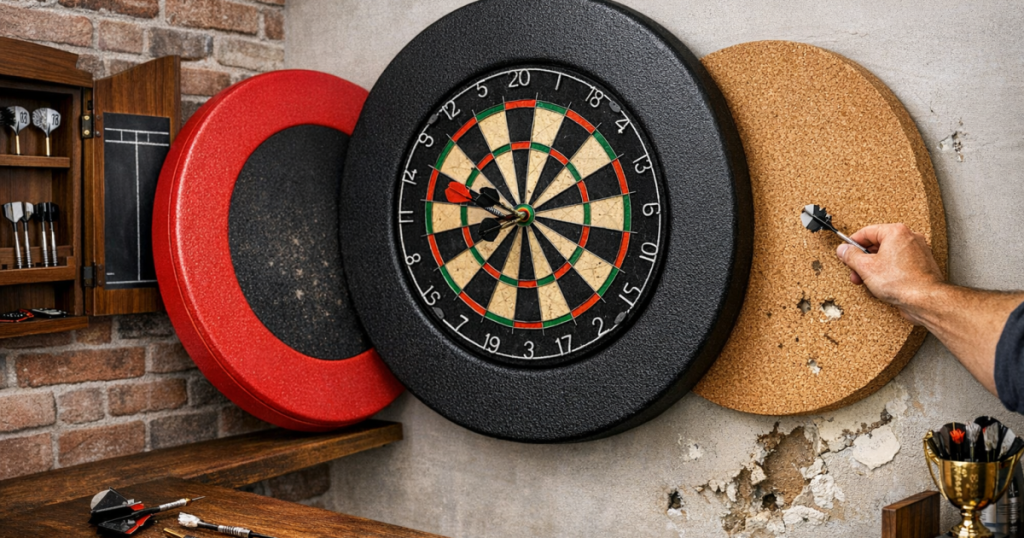
A good surround does two jobs: it catches near misses before they mark the wall, and it makes the board look intentional rather than temporary. For most home setups, dartboard surround thickness is less about looking chunky and more about how much usable material sits around the scoring area, how firmly it grips the board, and how it reacts when a dart lands outside the segments.
That matters in real homes. A board in a spare room, garage, hallway or garden office is usually close to plaster, painted brick, timber cladding or a cabinet back panel. The right surround will not make wild throws harmless, but it can prevent the small chips, peppered marks and repeated scuffs that build up around doubles and trebles during regular practice.
Main points
- A surround protects the area immediately around the dartboard, not the whole wall.
- Coverage width is usually more important than overall bulk when you are trying to stop near misses.
- Thicker-feeling foam can help absorb darts, but fit, density and board grip matter just as much.
- Bounce-out protection is limited: a surround can catch some deflections, but it cannot control every dart that leaves the board.
- Cabinets, surrounds, mats and lighting all work together; wall protection is not only about the ring around the board.
What a surround actually covers
A standard ring-style surround sits around the outside edge of a bristle dartboard. It is normally pushed into place without permanent fixing, using a snug inner cut-out to grip the board. Its job is to cover the wall directly beside the board, especially around the 1, 5, 20, 12, 18, 4 and 13 areas where common misses tend to appear.
The key word is “directly”. A surround is not a full catchment zone. It will not protect a skirting board, radiator, nearby door frame or side wall if the board is placed too close to other surfaces. If the thrower is still learning, or if children and casual guests will be playing, you may need a larger protected area behind the board rather than relying on a neat ring alone.
This is also where room planning matters. Before fitting any surround permanently into your layout, make sure the board is positioned correctly and the throw line is not being compromised by furniture, sloping floors or cramped access. The measurements in our guide to mark dartboard height and oche distance accurately are a useful reference point before you judge whether your wall protection is in the right place.
What dartboard surround thickness actually changes
Thickness affects how much material a dart has to enter before it reaches the wall or backing surface. A very shallow or compressed surround may still stop cosmetic marks, but it has less margin if a dart hits hard, lands at an angle, or follows the edge of the board. A deeper surround gives more foam for the point to travel into, which can make near misses feel more controlled.
However, thickness on its own is not a guarantee. Foam density, recovery, surface finish and how tightly the surround sits around the board all influence performance. A surround that looks chunky but is soft and loose can sag, rotate or leave small gaps. A firmer surround with a clean inner fit can feel more secure even if it does not look dramatically larger.
For a home setup, think of thickness in three practical ways:
- Wall separation: enough material should sit between the dart point and the wall to reduce marks from normal near misses.
- Point retention: the surround should hold a dart briefly rather than letting it skid or fall out immediately.
- Shape stability: the ring should stay flat and snug instead of bowing away from the board.
Coverage width: the more overlooked measurement
Many players focus on how thick the surround feels from the front, but coverage width is often the more useful detail. This is the band of protection extending outwards from the edge of the dartboard. A wider protective band gives you more room for missed doubles and angled throws. A narrow band can look smart but may leave the wall exposed just beyond the surround, which is exactly where beginners often miss.
When checking coverage, do not only look at the front-on product photo. Confirm the internal fit around a full-size board and the overall outside size. If you use a cabinet, check whether the doors, scoreboard panels or cabinet frame reduce the effective protection at the sides. A cabinet can look tidy, but open doors may leave exposed areas beside the board unless the backing panel or surround is generous enough.
There is also a style trade-off. A large surround gives more protection and a stronger “darts zone” visually. A slimmer surround blends into a living room or multi-use space more easily. If your main concern is keeping the board discreet, the ideas in our guide on how to hide a dartboard with a cabinet or surround are worth considering before you choose the smallest possible ring.
Bounce-outs and what protection can realistically do
A bounce-out is not the same as a clean miss. It can happen when a dart strikes wire, another dart, a staple-free divider, a crowded bed, or the board at an awkward angle. The dart may drop straight down, kick sideways, or rebound into the surround or wall. A surround helps most when the dart deflects into the immediate area around the board. It is less useful when the dart drops below the board or rebounds out into the room.
For steel-tip darts, the most common home concern is a point marking the wall or floor after a deflection. A surround can reduce marks around the board, but it will not protect the floor directly under the setup. A darts mat or protected oche area is better for repeated drop-outs and bounce-outs below the board.
There is another important point: a surround should not be used to compensate for a worn or unsuitable board. If darts are falling out of the scoring area frequently, check the board condition, dart points, throwing angle and rotation of the board. Wall protection is useful, but it should not become a workaround for a playing surface that no longer holds darts reliably.
How the material feels in real use
Most modern surrounds use dense foam or a similar impact-absorbing material. The best feel is firm rather than spongy. When a dart lands in the surround, you want it to enter cleanly, stay put long enough to be removed safely, and leave only a small mark that does not quickly become ragged.
Over time, any surround will show use if it is taking regular hits. Rotating a ring-style surround occasionally can spread wear, although logos, colour blocks or shaped designs may limit how natural that looks. If one area is being battered, that can also tell you something useful about your practice. Constant marks around double 1 or double 5, for example, may show a repeatable miss rather than a protection problem.
Colour matters more than many players expect. A black surround can make the board stand out and hide marks well. Lighter colours may suit a room better but can show scuffs, dust and point marks sooner. Bright surrounds are useful in garages or darker spaces, but they can feel visually loud in a shared room.
Cabinet, surround or full backing panel?
There is no single right answer because the best protection depends on the room and the players using it. A neat ring surround is ideal when throws are generally accurate and you want a quick, low-fuss upgrade. A cabinet adds storage and hides the board, but its wall protection depends on the size and shape of the backing around the board. A full backing panel or larger protective board is more suitable where misses are likely to be wider.
Use this simple way to think about it:
- Confident regular players: a standard surround is usually enough to catch routine near misses.
- Mixed household use: a surround plus a wider protected backing area gives more forgiveness.
- Rented homes: avoid relying on a tiny protection zone; test the layout before committing to fixings or visible changes.
- Display-focused setups: a cabinet or framed surround can make the board feel more like part of the room.
- Practice-heavy setups: prioritise durable coverage over the neatest-looking option.
Fit and setup details that make protection better
A surround should sit flush around the board with no obvious gaps. If it is too tight, it may distort or press unevenly. If it is too loose, it can shift when a dart lands. The board should also be mounted flat and stable, because a wobbling board makes the surround work harder and can create inconsistent gaps around the edge.
Lighting also affects wall protection more than it first appears. Poor light can make the board harder to read, increase awkward aiming, and hide the board edge in shadow. A well-lit board gives clearer sight lines and helps the whole setup feel more controlled. If the area looks dim or uneven, start with lighting the dartboard properly at home before assuming you need a larger surround.
Finally, check what sits below and beside the board. A surround protects a compact zone, so nearby shelves, framed pictures, mirrors and narrow alcove returns may still be vulnerable. Stand at the oche and look past the board from a thrower’s eye level. If a missed dart would hit something fragile, move it or protect it rather than hoping the surround will catch everything.
Signs your current surround is not doing enough
You do not always need to replace a surround at the first sign of wear, but repeated wall marks are a clear warning that the protection zone is not matching the way the board is being used. The same is true if darts are hitting the edge, sliding behind the surround, or falling out because the foam has become badly cut up.
Watch for these practical signs:
- New marks appearing just outside the surround after normal play.
- Gaps between the surround and board edge.
- Foam that has become loose, split or heavily gouged in one area.
- The surround rotating or dropping during use.
- Repeated bounce-outs landing on unprotected flooring below the board.
If only one side of the wall is taking hits, the issue might be the board position rather than the surround. A cramped stance, badly aligned oche or awkward room angle can pull throws consistently left or right.
Things readers ask
Is a thicker surround always safer for the wall?
Not always. A thicker surround can give more material between the dart and wall, but coverage width, foam density and a snug fit are just as important for real protection.
Will a surround stop all bounce-outs?
No. It can catch some sideways deflections near the board, but darts that drop below the board or rebound into the room need floor protection and a sensible layout.
Can I use a surround with a dartboard cabinet?
Often, yes, but it depends on the cabinet’s internal space, door clearance and board position. Check that the surround fits without forcing the cabinet doors or hiding the scoring area.
Do soft-tip boards need the same type of surround?
Not necessarily. Many electronic or soft-tip boards have different shapes and outer dimensions, so standard bristle-board rings may not fit. Check the board shape and manufacturer guidance first.
How long should a surround last?
It depends on how often it is hit, the material quality and whether you rotate or reposition it. Regular players should expect visible marks over time, even on a good surround.
Final thoughts
A dartboard surround is a focused protection tool, not a magic shield for the whole room. The most effective setup combines enough thickness to absorb normal near misses, enough coverage width to catch realistic errors, and a stable board position that keeps everything aligned. If your wall is already showing marks, do not only blame the surround: check the oche, lighting, board condition and nearby surfaces too.
For most UK home setups, the best result is a tidy, well-lit board with a surround that looks intentional and gives you a sensible margin around the doubles. That keeps the space enjoyable to play in, easier to maintain, and far less likely to collect the little dents and scars that make a darts corner look neglected.