Daily darts practice gets easier when your cabinet is arranged like a small workstation, not a junk drawer. The simplest way to organise a dart cabinet is to give every item a job-based position: match darts ready to throw, spares easy to reach, scoring tools visible, and clutter kept away from the board.
A good cabinet layout should save time before you throw, reduce interruptions while you practise, and make the five-minute reset at the end feel almost automatic. That matters in a home setup where the board might share space with a garage, spare room, hallway or living area.
What to know first
Your cabinet does not need to hold every darts item you own. It should hold the items you actually use during a normal session. Anything bulky, rarely used or messy is better stored nearby in a box, drawer or shelf rather than crammed into the cabinet doors.
- Keep your main set of darts in the same position every time.
- Separate daily-use accessories from backup stock.
- Put scoring items where they are visible before the first throw.
- Keep sharp points, loose stems and broken flights away from the floor.
- Reset the cabinet after each session, not before the next one.
Think of the cabinet as the control point for practice. If you open the doors and immediately see your darts, scorekeeping method and most-used spares, you are far more likely to start throwing rather than spend ten minutes tidying.
Step 1: Empty the cabinet and sort by actual use
Start by taking everything out. Wipe the shelves, door pockets and scoreboard area, then make three piles: daily use, occasional use and not cabinet-worthy. Be honest here. If an item has not helped a normal practice session recently, it probably does not deserve prime space.
Daily-use items usually include your match darts, a spare set of flights, one or two sets of shafts, a marker or chalk, a small cloth, and whatever you use for scoring. Occasional items might include alternate flights, spare points, flight protectors, a point sharpener or extra chalk. Not cabinet-worthy items include packaging, old receipts, empty flight sleeves, damaged shafts and random loose accessories you never choose.
This first sort is what stops the cabinet becoming a dumping ground. Most messy dart cabinets are not messy because they are too small; they are messy because practice items and storage items have been mixed together.
Step 2: Create zones inside the cabinet
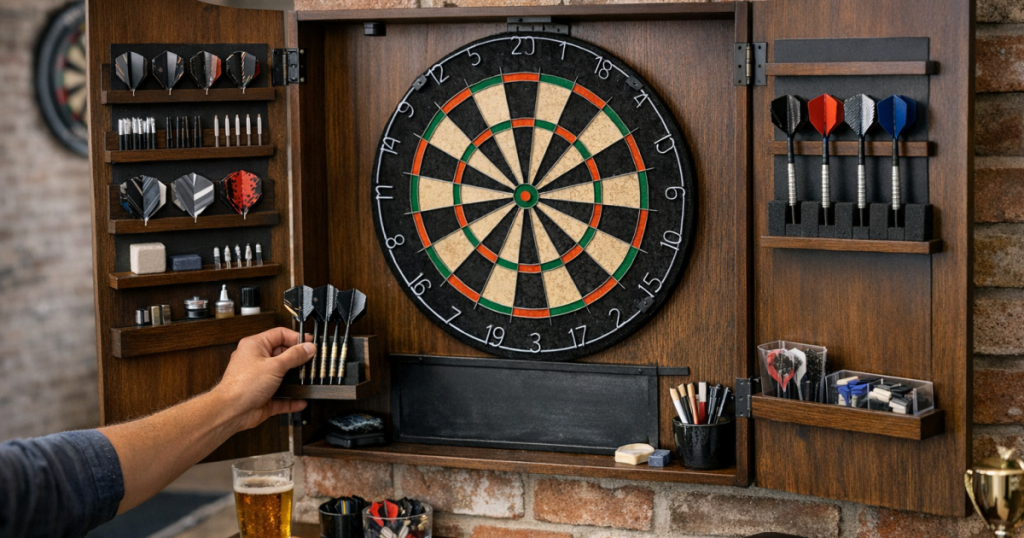
Once the cabinet is empty, divide it into zones. You do not need labels if the layout is obvious, but small labels can help if several people use the same setup.
The ready-to-throw zone
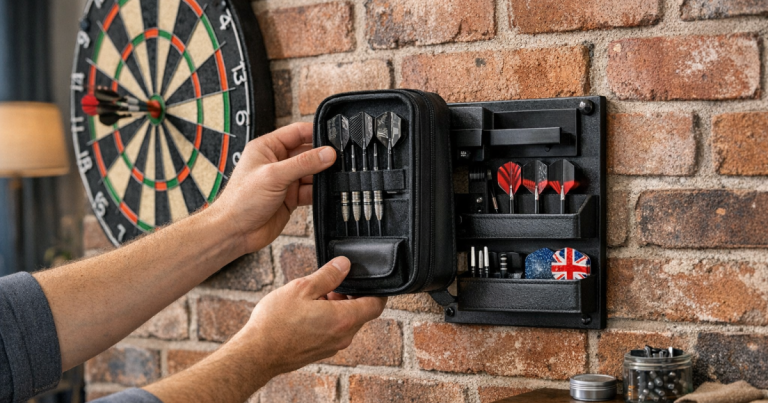
This is where your main darts live. Use the most secure and easiest-to-reach space, ideally away from loose accessories that can catch flights or bend shafts. If your cabinet has dart holders, reserve one holder for your main set and avoid turning the rest into overflow storage.
The quick-spares zone
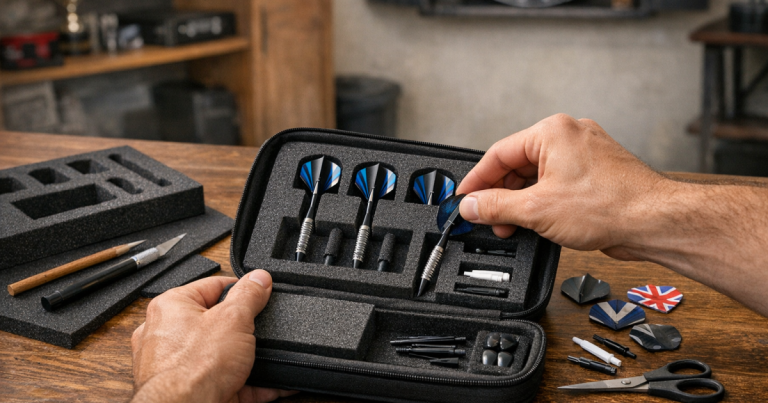
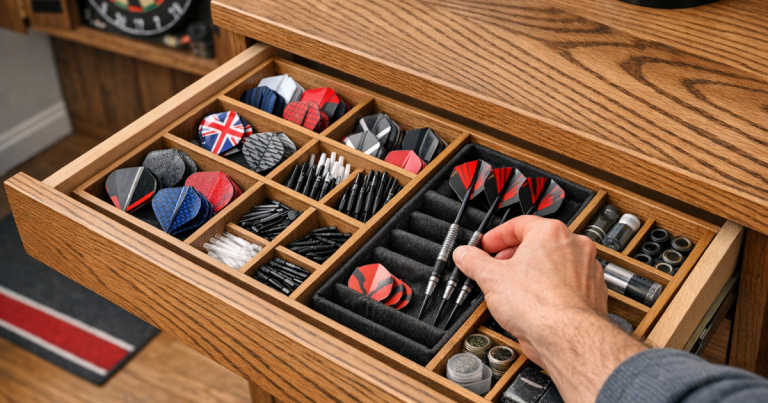
Keep only the spares you might realistically need mid-session here. That normally means a few flights, a couple of shafts, and possibly spare flight protectors if you use them. Larger backup stock is better handled separately; the cabinet should not become a warehouse. If your spares are already spreading across shelves, it is worth setting up a dedicated spares box for flights and shafts and keeping only a small working supply in the cabinet.
The scoring zone
Your scoreboard, chalk, marker, duster or wipe cloth should be visible as soon as the cabinet opens. If you have to move darts or accessories to reach the scoreboard, the layout will annoy you every session. Put scorekeeping items on the side that suits your throwing routine, not simply where they happened to fit first.
The reset zone
Have one small area for items that need attention after practice: blunt pencil, cracked flight, loose shaft, worn cloth or broken accessory. This prevents damaged bits from mixing back into your usable spares. Keep it small, though. If the reset zone fills up, empty it.
Step 3: Arrange the cabinet around your practice routine
A tidy cabinet looks good, but the better test is whether it supports the way you practise. Open the doors and run through your normal start sequence. Can you pick up your darts, check the scorekeeping method and begin without moving anything unnecessary?
For a simple daily routine, arrange the cabinet in this order:
- Open doors.
- Pick up main darts.
- Check scoreboard or scoring sheet.
- Confirm spare flights and shafts are present.
- Throw the first warm-up visit.
If that sequence feels clumsy, adjust the layout. For example, a right-handed player may prefer chalk or marker on the right-hand door, while a left-handed player may find the opposite more natural. If two players share the cabinet, put shared items in the centre or at the lower shelf level, and keep personal darts clearly separated.
For focused practice, keep a few small routine cards or printed prompts in the cabinet. These might list finishing drills, doubles practice or a short 20-minute routine. Keep them flat, clipped or tucked into one door rather than scattered behind the board.
Step 4: Keep spares useful, not excessive
Flights and shafts are the main reason cabinets get untidy. They are small, cheap enough to accumulate, and easy to leave loose after a session. The answer is not to keep every spare in the cabinet; it is to keep a controlled working set.
A sensible cabinet spares setup for daily practice might include:
- One complete spare set of your usual flights.
- One different flight shape if you are testing your setup.
- One complete spare set of shafts in your usual length.
- A small point sharpener if you use steel-tip darts.
- A tiny bag or tray for broken pieces to remove later.
Avoid mixing test accessories with essentials. If you are experimenting with different flight shapes or shaft lengths, keep them in a separate compartment or pouch. That way, your dependable match setup is still easy to find when you just want a quick practice throw.
Also check the cabinet depth before using chunky containers or tubs. Some dartboard cabinets have shallow door clearance, and overfilled boxes can stop the doors closing cleanly or press against the board surround.
Step 5: Make scoring easy to start
Scoring needs to be friction-free for daily practice. If you use a chalkboard or whiteboard inside the cabinet, keep the writing tool attached or stored beside it. A missing marker is one of those tiny problems that can ruin the rhythm of a short session.
If you use paper sheets, keep a few sheets clipped flat and store the pen horizontally so it does not fall out when the doors open. If you use a separate scoreboard near the oche, the cabinet can still hold pens, spare chalk and a simple practice log.
Some home players eventually move beyond a basic cabinet scoreboard, especially when they practise legs, averages or doubles routines regularly. If you are wondering whether a dedicated device would simplify your setup, read our guide on deciding if an electronic dart scorer is worth buying before changing the way your cabinet is arranged.
Step 6: Control clutter around the board area
The cabinet is only one part of the practice corner. If the surrounding area is messy, the cabinet will slowly absorb that mess. Keep non-cabinet items near the oche or on a separate shelf: spare mats, boxes of accessories, cleaning cloths, extension accessories for lighting, and anything used for guests or tournaments.
Lighting also affects how useful the cabinet feels. If the board area is gloomy, players tend to leave cabinet doors open awkwardly or move accessories around to avoid shadows. A clean light path makes the cabinet easier to use and the board easier to read. For a broader setup check, see the explanation of dartboard lighting types for rings, spotlights and cabinet lights.
Keep the top of the cabinet clear as well. It is tempting to stack spare flights, cases or old score sheets above it, but that usually leads to dust and forgotten clutter. If it does not help the next practice session, it should not live there.
Step 7: Add a simple reset habit
The best cabinet system is the one you can reset in under two minutes. At the end of practice, put the darts back in their holder, return flights and shafts to their zone, wipe or clear the scoreboard, and remove any broken bits. Do it while the session is still fresh rather than leaving it for tomorrow.
A reliable reset checklist looks like this:
- Darts back in the same holder or case.
- Scoreboard cleared or practice score recorded.
- Marker, chalk or pencil returned to its place.
- Loose flights and shafts sorted into usable or damaged.
- Cabinet doors closed without forcing them against accessories.
If more than one person uses the board, agree the reset standard. It does not need to be strict, but everyone should know where the main darts, spares and scoring tools belong. Shared home setups fall apart quickly when each player invents a different storage system.
Example layouts for different home setups
Small cabinet in a living space
Keep the layout minimal. Main darts, one spare flight set, one spare shaft set, marker and cloth are enough. Store bulk accessories elsewhere so the cabinet stays neat when the doors are open.
Garage practice corner
Use the cabinet for active practice items and keep a separate storage box on a nearby shelf for extra spares. Garages can collect dust, so closed pouches or small lidded containers are useful for backup accessories outside the cabinet.
Shared family setup
Give each regular player a defined slot for darts and keep shared accessories in the middle. Colour-coded flight sleeves or small labelled pouches can prevent mix-ups without making the cabinet feel over-organised.
Practice-focused setup
Reserve one cabinet door for routines and scoring. Keep a short doubles drill, checkout sheet or weekly practice target visible. This turns the cabinet into a prompt for better habits, not just a place to store darts.
Key checks before you call it finished
Once everything is back in place, test the setup rather than just admiring it. Open the cabinet, start a mock practice session, change a flight, mark a score, then reset everything. Any item that feels awkward should move.
- Can you start throwing within 30 seconds?
- Can you find spare flights without opening packets or boxes?
- Can the doors close without pressing on darts or containers?
- Can guests understand where basic items go?
- Is damaged or unwanted kit kept away from usable spares?
- Does the cabinet still look tidy when the board is in use?
The aim is not a perfect display cabinet. The aim is a practice cabinet that works every day and stays tidy with very little effort.
Common questions
Should darts be stored assembled in the cabinet?
For daily practice, yes, if the cabinet has secure dart holders and enough clearance. If the darts are cramped or likely to catch on the doors, store them in a case instead.
How many spare flights should I keep in the cabinet?
One complete spare set is enough for most daily sessions. Keep extra packets in a separate spares box so the cabinet does not become crowded.
Is it worth labelling cabinet sections?
Labels help in shared setups, but they are not essential. A clear layout usually works better than lots of tiny labels, especially in a small cabinet.
What should not be stored in a dart cabinet?
Avoid bulky packaging, old broken accessories, loose sharp items, unrelated tools and anything that stops the doors closing cleanly.
How often should I organise a dart cabinet?
Do a quick reset after every session and a deeper tidy whenever spares start mixing together or the cabinet takes longer to use than it should.
Final thoughts
A well-arranged dart cabinet makes daily practice smoother because it removes tiny delays: missing markers, scattered flights, mixed-up shafts and cluttered shelves. Keep the cabinet focused on what you use during a normal session, move overflow spares elsewhere, and build a reset habit that takes less than two minutes.
Once the layout feels natural, your cabinet becomes part of the rhythm of practice: open, throw, score, reset and close. That is the sort of organisation that actually lasts in a busy home darts setup.