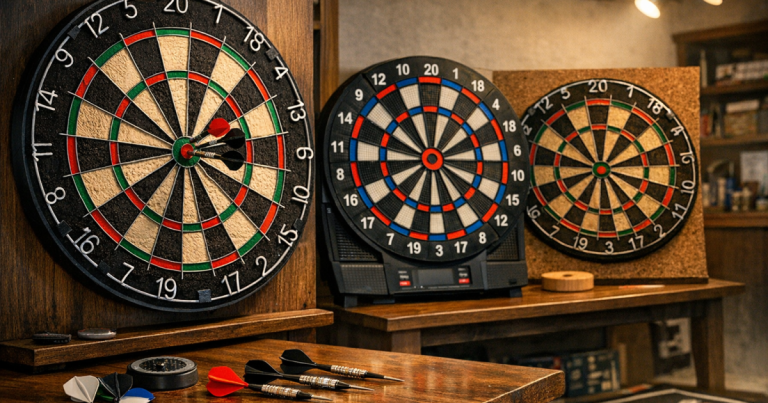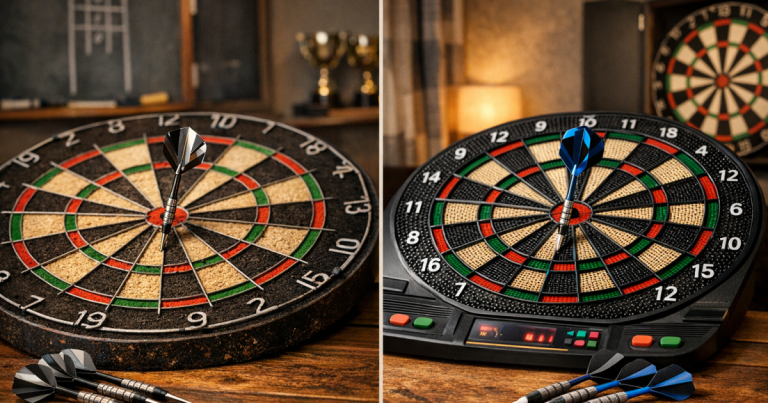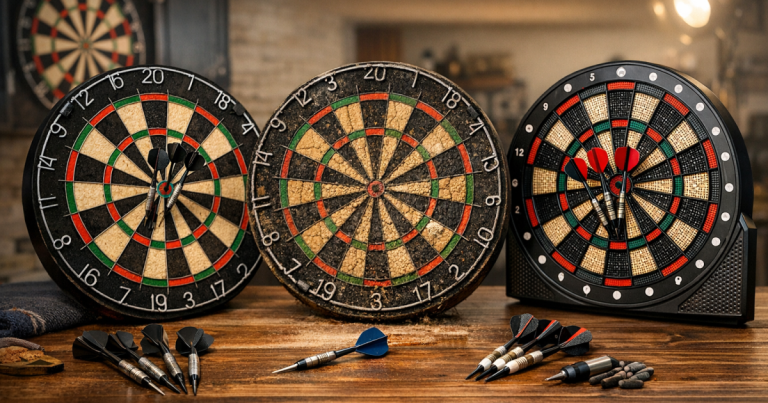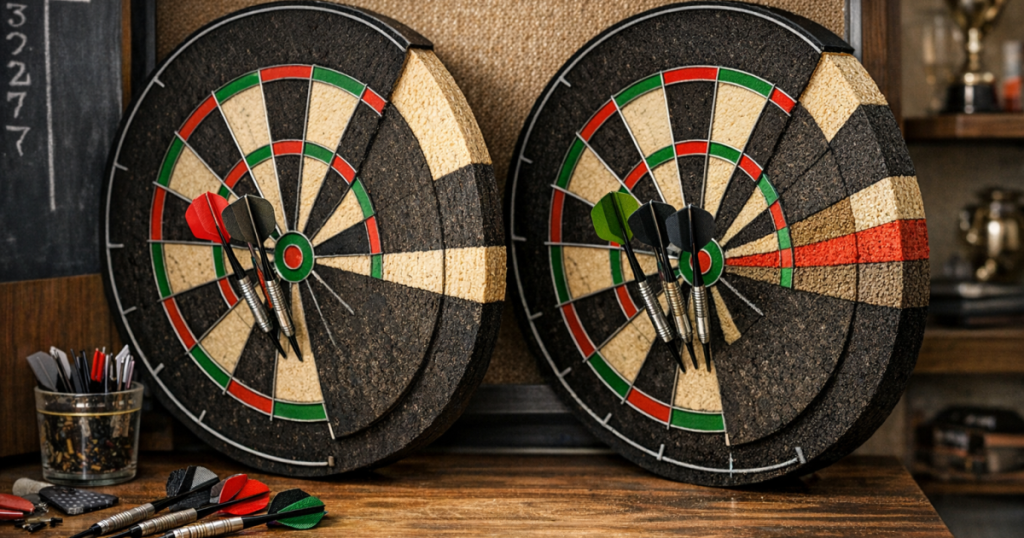
A premium bristle board does not always look dramatically different from a standard one once it is on the wall. The appeal of dual-core and triple-core dartboards is mostly hidden inside the sisal bed: how the fibres are layered, compressed and supported so the board can hold darts well while coping with repeated impact.
For a home setup, the useful question is not whether more layers automatically make you a better player. It is whether the board feels cleaner to throw at, wears more evenly, and suits how often you play.
The short version
- Single-core boards use one main sisal playing bed and can be perfectly fine for casual home darts.
- Dual-core boards usually combine different sisal densities or layers to balance dart entry with support behind the scoring surface.
- Triple-core boards add another layer or construction approach, typically aimed at premium durability, feel and consistency.
- The core is only one part of board quality. Wiring, sisal grade, staple-free construction, rotation habits and room setup all matter.
- For heavy home practice, a better board can be worth it. For occasional games, a well-made standard bristle board may be enough.
What “core” actually means on a bristle dartboard
On a steel-tip bristle dartboard, the playing surface is made from compressed sisal fibres. When a dart enters the board, those fibres part around the point and then close again when the dart is removed. This is why bristle boards are often described as self-healing, although all boards still wear over time.
The “core” wording is a manufacturer’s way of describing the internal construction of that sisal bed. A single-core board has one main compressed sisal structure. A dual-core board uses two layers or density zones. A triple-core board uses three layers or a more complex multi-layer build. The exact construction is not standardised across every brand, so it is worth reading the manufacturer’s description rather than assuming every label means the same thing.
In practical terms, the core affects how the dart enters, how firmly it stays in, and how the board responds after thousands of throws. It works alongside the wire profile and spider design, so a premium core on its own is not the whole story.
How single, dual and triple-core boards differ in play
Single-core boards
A single-core bristle board is the traditional baseline. Good examples can still give reliable home play, especially if the sisal is dense enough, the wires are thin, and the board is rotated regularly. They are common in starter setups and casual family games because they keep things simple.
The trade-off is that the scoring surface may feel less refined under heavy use. Some boards can harden in busy segments, develop looser areas, or show wear sooner around the treble 20 and treble 19. That does not make them poor boards; it just means they are built for a different level of use.
Dual-core boards
Dual-core boards are designed to give a more controlled feel than a basic single-layer board. Typically, the front layer is intended to accept the dart cleanly, while the rear support helps the dart hold and reduces the board feeling too soft or too dead. The result many players notice is a more consistent landing feel across the scoring bed.
For home players who practise several evenings a week, this is often the point where the upgrade starts to make sense. The board still needs normal care, but it may cope better with repeated grouping in popular trebles than an entry-level board.
Triple-core boards
Triple-core boards sit at the premium end of the bristle-board market. The extra layer is not there for show; it is usually part of a design intended to improve consistency, compression and long-term performance. Some players describe these boards as having a cleaner entry and a more solid feel, though the difference is not always dramatic on the first few throws.
The benefit tends to show up over months of regular practice rather than in a single match. If your darts setup is used daily, or you care about making your home board feel closer to a serious practice environment, a triple-core model is easier to justify.
Where the differences actually show up at home
A better core construction is most noticeable when the rest of the setup is already reasonably accurate. If the board is slightly too high, the oche is guessed, or the throw line moves from session to session, those layout issues will have a bigger effect than the core itself. Before judging any board, it is worth checking your measurements against a proper guide to marking dartboard height and oche distance accurately.
- Dart entry: A good board lets the point enter cleanly without excessive force or a spongy feel.
- Dart hold: Darts should sit securely without dropping out too easily, assuming the points are in reasonable condition.
- Segment wear: Busy areas should not break down quickly if the board is rotated properly.
- Noise and feel: Denser boards can feel firmer, while softer-feeling boards may sound duller. Personal preference matters.
- Bounce-outs: The core can help, but wire shape, dart angle, point condition and grouping are often bigger factors.
Real examples you will see in the market
Winmau is one of the clearest examples because its Blade range includes different construction levels. The Winmau Blade 6 Dual Core Dartboard is a recognisable example of a dual-core bristle board aimed at players who want a more premium feel than a basic board without going to the very top of the range.
At the higher end, the Winmau Blade 6 Triple Core Carbon Dartboard is an example of a triple-core premium board. The important point is not just the name on the box, but the full board design: sisal construction, wiring, mounting system, number ring, and how easy it is to rotate in normal home use.
Other brands may use different terms for similar ideas, or may focus more on wire design and sisal quality than on core wording. Treat the label as a helpful clue, not a complete specification.
Bounce-outs, surrounds and the wider setup
It is easy to blame every bounce-out on the board, but many bounce-outs happen because the dart hits wire, arrives at a poor angle, or strikes another dart in a tight group. Thin wiring and a well-made sisal bed can reduce frustration, but they will not remove bounce-outs entirely.
Wall protection is a separate issue. A premium board does not protect plaster, paintwork or nearby furniture if a dart misses the scoring area. If your board is in a spare room, garage, hallway or shared family space, a surround is one of the simplest upgrades. The useful starting point is understanding dartboard surround thickness, coverage and bounce-out protection before assuming every surround gives the same level of cover.
Lighting also changes how a board feels to play on. Shadows across the treble bed can make doubles harder to read and can exaggerate the impression that one board is better than another. If the board is already good quality but the room feels awkward, improving the light around the target may make a bigger difference than changing the core. The home setup notes on lighting a dartboard properly are a useful next step.
Why players disagree about whether the upgrade matters
Some players notice the difference between standard, dual-core and triple-core boards straight away. Others feel the gap is overstated. Both reactions can be reasonable because dartboard feel depends on throw style, dart weight, point condition and how worn the old board was.
A player moving from a tired budget board to a premium triple-core model may feel a huge improvement. Someone moving from a fresh, good-quality single-core board may notice only a small change. A player with aggressive points may also wear the board differently from someone using smooth standard points.
There is also the issue of expectations. A premium board should feel well made and last well under sensible use, but it cannot fix poor grouping habits, incorrect setup measurements or darts that are unsuitable for your throw. It is one part of a complete home darts environment.
When a premium core is worth paying attention to
A dual-core or triple-core board makes most sense when you play regularly, practise scoring areas repeatedly, and want your home setup to feel consistent from week to week. It is also worth considering if several people use the board, because shared play can put a lot of darts into the same popular segments.
If you only play occasional legs with friends, a decent bristle board with thin wiring and regular rotation may be the more sensible route. Put the saved budget towards a stable oche area, a surround, spare flights and shafts, or better lighting. Those upgrades often affect the whole playing experience more than the internal board construction alone.
For serious home throwers, the core becomes more important because small differences in feel and wear add up over time. The board is the surface you interact with on every throw, so consistency matters.
FAQ
Are triple-core boards always better than dual-core boards?
Not automatically. A well-designed dual-core board can be excellent, and a triple-core label still depends on the full construction, wiring and sisal quality. It is a premium clue, not a guarantee on its own.
Do multi-core boards reduce bounce-outs?
They can help with dart entry and hold, but most bounce-outs are also affected by wire shape, dart angle, point condition and tight grouping. Do not judge bounce-outs by core construction alone.
How often should I rotate a dual-core or triple-core board?
Rotate it regularly, especially if you practise the same trebles and doubles. The exact rhythm depends on use, but frequent players should not leave the 20 segment taking all the wear.
Can soft-tip players use these boards?
Dual-core and triple-core bristle boards are for steel-tip darts. Soft-tip players normally use electronic or soft-tip boards designed for plastic points.
Will a premium board make me score higher?
It will not improve your aim by itself. What it can do is provide a more consistent target surface, which makes practice feel cleaner and more reliable.
Main lessons
Core construction matters, but it is best understood as part of the whole dartboard design. Dual-core boards aim to improve the balance between dart entry and support. Triple-core boards push that idea further for players who want a premium, durable and consistent practice surface.
For most home setups, the smartest approach is to match the board to your playing frequency. Casual players can be happy with a solid bristle board and good room setup. Regular practice players are more likely to feel the value of a dual-core or triple-core upgrade over time.