A good board light can make a temporary setup feel far more settled, but dartboard lighting for rented homes needs a different approach from a permanent games-room install. The aim is simple: clear vision across the trebles, doubles and bull without putting holes where your tenancy agreement, landlord or future self will notice them.
Mains electrical wiring, fused spurs and any alteration to fixed lighting circuits should be carried out by a qualified electrician to meet UK electrical safety requirements and the standards expected in rented accommodation.
At a glance
- Best renter-friendly principle: light the board, not the whole room. A bright ceiling light can still leave shadows over the scoring bed.
- Lowest commitment option: a freestanding lamp aimed carefully at the board, provided it is stable and kept outside the throwing path.
- Cleanest darts-specific option: a purpose-made board light or ring light, as long as it attaches without altering the wall and suits your board area.
- Biggest mistake: relying on adhesive fixtures without thinking about paint, wallpaper, heat, cable strain or end-of-tenancy removal.
- Room planning matters: lighting, oche position, furniture and safe walking routes all need to work together.
Why rented setups need a different lighting plan
In a home you own, it is easy to think in terms of fixed brackets, dedicated sockets, wall-mounted light arms and permanent cable routes. In a rented flat or house, the better question is: what can be improved without changing the property?
That usually rules out drilling for a separate light bracket, chasing cables, adding hardwired fittings or relying on anything that could pull paint from the wall. It does not rule out a very playable darts area. Many rented setups work well when the lighting is treated as part of the whole board zone rather than as an afterthought.
The board itself needs to be safely located first. Before thinking about lamps or ring lights, check that the throwing line, surrounding wall, doorways and furniture layout make sense. If you are still deciding where the board should go, the guide on how to choose the safest wall for a dartboard is a sensible place to start.
What good dartboard lighting actually needs to do
Good lighting is not just about brightness. A dartboard has thin wires, dark segments, a small bull and areas that are often partly hidden by the barrels already in the board. The useful light is the light that reaches the face evenly from enough angles to reduce shadows.
For most home players, the goal is to make three things easy to see: where the dart landed, what is blocked, and whether the next route is realistic. Poor lighting tends to create one of four problems: a shadow from the dart barrel, glare from a shiny surround or cabinet, a dark lower half of the board, or a bright spot that makes the rest of the scoring bed feel dull.
A single ceiling pendant in a UK living room often sits behind or above the thrower rather than in front of the board. That can throw the player’s own shadow towards the dartboard. Downlights can be better, but only if their position happens to suit the board. Rented homes rarely give you the luxury of moving fixed lights, so renter-friendly solutions have to work around the room as it already exists.
No-drill lighting routes that can work
Freestanding lamps
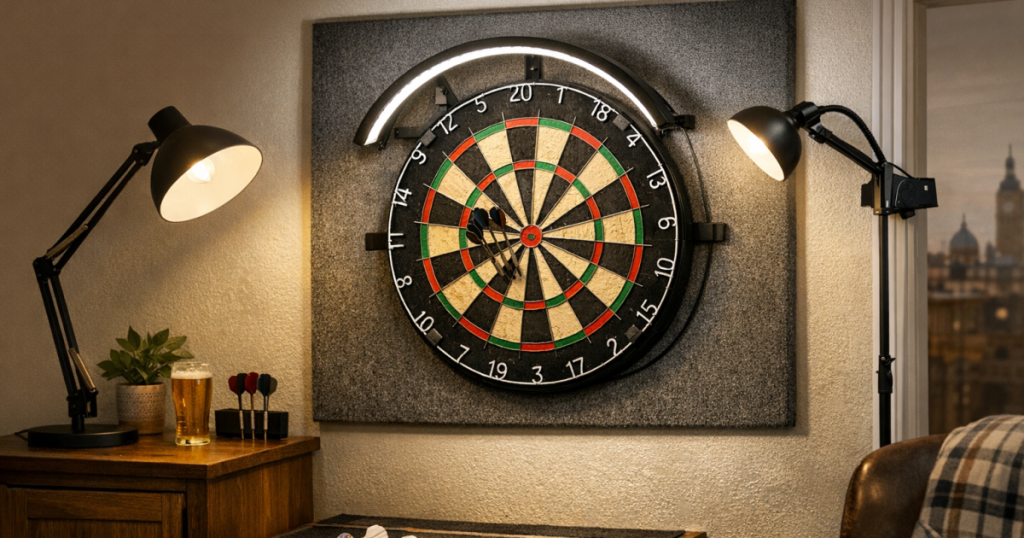
A floor lamp is the least invasive route because it does not need the wall at all. The key is choosing a stable position and aiming the light so it washes across the board rather than shining into the player’s eyes. A lamp to one side of the board can help, but one-sided lighting often creates shadows from darts in the board. Two modest light sources placed symmetrically can be more effective than one very bright source.
Keep the lamp base away from the oche and walking path. A standard darts throw is measured from the board face to the oche, so the floor area between the thrower and the board should stay clear. If the lamp has a flexible neck or adjustable head, set it once and leave it alone where possible; constantly moving it increases the chance of knocking it or changing the light pattern.
Clamp lights on furniture, not the wall
Clamp lights can be useful in rented rooms when they attach to a bookcase, shelving unit, desk edge or other sturdy furniture near the board. The important point is that the furniture must be solid, not a narrow unit that wobbles when touched. A clamp light that shifts during play can be more annoying than no dedicated light at all.
Aim for angled light from above and slightly in front of the board if the room layout allows it. Avoid clamping to fragile shelves, curtain poles, thin cabinet doors or anything that was not designed to take sideways pressure. Also check that the cable hangs freely and is not stretched across a route where someone might catch it.
Board-mounted and surround-mounted lights
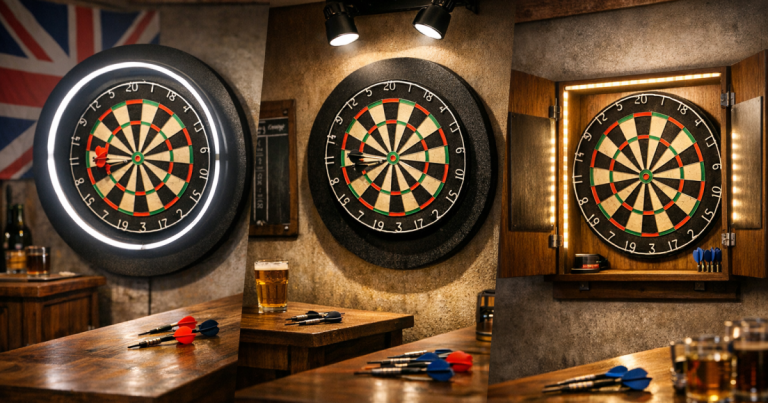
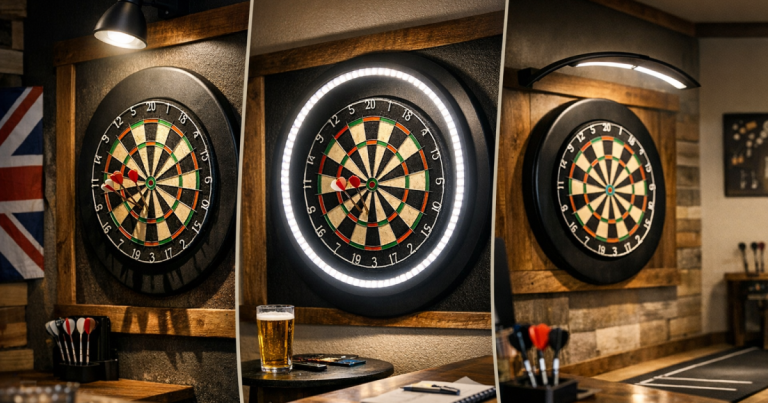
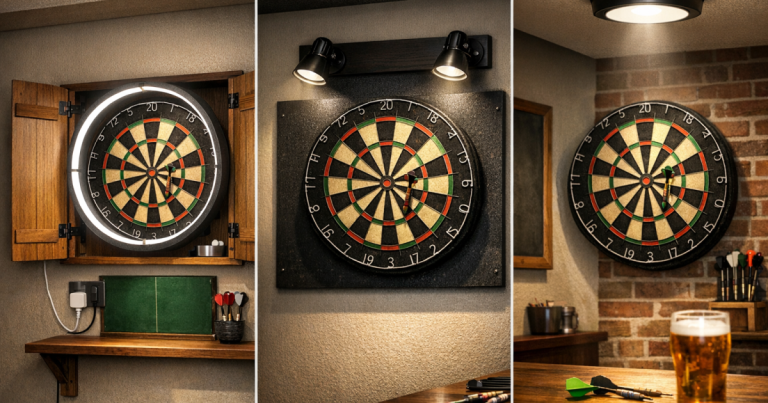
Purpose-made dartboard lights can be a neat option because they focus on the board rather than trying to illuminate the whole room. Familiar examples include Target Corona Vision and Winmau Plasma, but renters should verify the exact attachment method, board compatibility, clearance around the surround and whether the system needs any wall fixing before choosing one.
These systems can be especially helpful where the board is already on a secure stand or a removable mounting arrangement. The practical questions are simple: will it stay secure during normal play, does it leave space for missed darts and retrieval, and can it be removed without marking the room?
Existing room lighting used more intelligently
Sometimes the answer is not a new fitting but a better combination of existing lights. A ceiling light, a side lamp and a small directional task lamp may produce a more even board than one strong source. Try testing the board at the time you usually play, because daylight through a nearby window can hide problems that appear at night.
Stand at the oche and look for glare as well as darkness. Then stand beside the board and check whether light is reaching the lower numbers and the doubles evenly. If the board is clear only when the rest of the room is uncomfortably bright, a more targeted light is usually worth planning.
Adhesive lights: useful, but not risk-free
Adhesive strips and stick-on lights look attractive for no-drill setups, but they are not a magic answer in rented accommodation. Paint quality, wallpaper type, wall texture, humidity and how long the adhesive has been in place all affect removal. A strip that comes away cleanly from one wall can lift paint from another.
If you do use adhesive-backed lighting, avoid placing it directly above expensive wallpaper, fresh paint or surfaces that already feel flaky. Keep weight low, do not hang extra cable strain from the adhesive point, and remove it slowly according to the strip manufacturer’s instructions. For many darts setups, adhesive lights are better treated as supplementary lighting than as the main source holding a fixture in place.
Heat is another practical consideration. Modern LED fittings generally run cooler than older lamps, but any light should still have sensible airflow and should not be pressed against fabric, foam surrounds, curtains or decorative panels. In a compact rented room, small clearances matter.
Reducing shadows without overcomplicating the setup
Shadows are the main reason darts lighting becomes frustrating. A dart standing proud of the board can block light across the segment you want next. The fix is usually not just “more brightness”; it is better direction.
- Use more than one angle: two balanced light sources can soften barrel shadows more effectively than one intense lamp.
- Keep light in front of the board face: lighting from behind the thrower often pushes shadows towards the board.
- Avoid low side lighting: it can make the wires look dramatic but may cast long shadows across doubles and trebles.
- Check the bottom of the board: the 3, 17 and 19 areas are often where weak lighting becomes most obvious.
- Test with darts in place: an empty board can look well lit, then feel poor once three darts are grouped around a treble.
If you are planning a more flexible room where darts shares space with a sofa, dining table or desk, the wider dartboard lighting planning guide for multi-use spaces covers the balance between playability and everyday room use in more detail.
Making the cables renter-friendly too
No-drill lighting often succeeds or fails because of cable management. A lamp in the right place is no good if its lead crosses the oche or trails behind the player. Keep cables along skirting lines where possible, use removable cable clips cautiously, and avoid routing leads under mats where they can create lumps or wear points.
Extension leads should not become a permanent tangle around the darts area. If the only socket is on the wrong side of the room, it may be better to rethink the lighting position than to run a long cable through the playing space. In shared homes, also think about guests, children and pets who may not expect a cable near the board area.
For a cleaner look, some players use furniture placement to hide the practical bits: a narrow shelving unit beside the board, a side table for a lamp, or a cabinet below the board for darts and accessories. In a rented home, that can make the setup feel intentional without altering the property.
When a no-drill setup is not enough
There are times when no-drill lighting becomes a compromise too far. If the room is very dark, the board is in a deep alcove, or every possible lamp position creates glare, a temporary setup may never feel quite right. That does not mean you need to abandon the idea, but it does mean the board location deserves another look.
A different wall, a board stand, or a less cluttered corner can solve more lighting problems than an extra lamp. Open-plan rooms are a good example: the board may technically fit in several places, but only one of them gives you a safe throw, usable lighting, and a clear route for other people moving through the space. For that wider layout question, it is worth reading how to plan a darts area in an open-plan room.
A simple testing routine before you settle on a layout
Before committing to a particular light position, run a quick evening test. Put the board where you expect it to live, mark the throw line temporarily, and place the lighting roughly where it would sit during normal play. Then throw a few visits at treble 20, treble 19, doubles around the lower board, and the bull.
After each visit, pause and look at the board from the oche. Can you see the grouping clearly? Is the wire visible? Does a dart in the treble block the target more than expected? Are you squinting, leaning or walking forward to check scores? These small annoyances matter because they interrupt practice rhythm.
Also test the room as other people will use it. Can someone walk behind the oche without catching a cable? Does the lamp block a cupboard, radiator, doorway or television view? A rented darts setup often has to pack away or blend in, so everyday convenience is part of the lighting decision.
Main lessons
The best no-drill lighting setup is the one that gives you even visibility without making the room awkward or risking damage to the property. Start with board position, then solve shadows, then tidy the cables. That order keeps the setup practical rather than letting a single lamp dictate the whole room.
For many renters, a stable freestanding lamp or a darts-specific board light will be enough. Adhesive solutions can help, but they deserve caution. Fixed electrical changes and hardwired lighting belong in the hands of a qualified electrician, and any permanent alteration should fit the expectations of the property and tenancy.
Things readers ask
Can I use a dartboard ring light in a rented flat?
Yes, if it attaches to the board setup without drilling into the wall and leaves no marks when removed. Check the current fitting method, clearance and compatibility with your surround or cabinet before relying on it.
Will a normal floor lamp be bright enough for darts?
It can be, but position matters more than raw brightness. A stable adjustable lamp aimed at the board may work well, while a bright lamp behind the thrower can still create shadows.
Are stick-on LED lights safe for painted rental walls?
They can mark or lift paint when removed, especially on older, textured or poorly prepared walls. Treat adhesive lights as a risk to the finish unless you have tested the surface carefully.
How do I stop glare on the dartboard?
Move the light off the direct eye line and avoid pointing it squarely at glossy surfaces. Softer angled light from more than one direction usually reduces glare and makes the scoring bed easier to read.
Should I light the oche as well as the board?
The board needs priority, but the throwing area should not be in darkness. You need enough ambient light to stand safely, retrieve darts and move around without cables or furniture becoming trip hazards.