A dartboard can look perfectly placed on the wall and still feel awkward once someone starts throwing. Getting dartboard ceiling clearance right before you drill helps you avoid clipped follow-throughs, awkward body positions, shadows from light fittings and a setup that only works for shorter players.
The aim is not just to measure the wall above the board. You need to check the full space from the board face to the throw line, including ceilings, beams, pendant lights, sloped sections and anything that sits above a player’s throwing arm.
The short version
- Set your bullseye height first: for a standard steel-tip setup, the centre of the bullseye is 1.73 m from the floor.
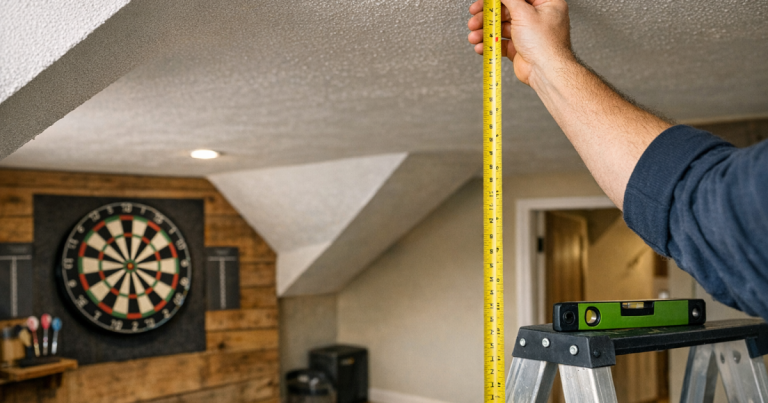
- Measure the ceiling height at the board, halfway to the oche, and at the throw line.
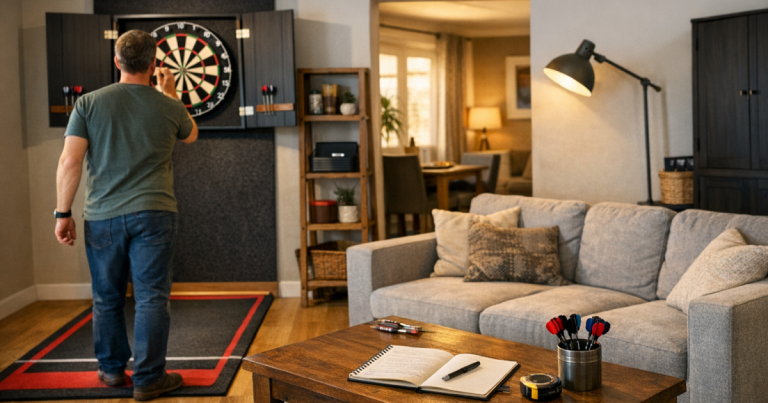
- Stand where the oche will be and make a full, natural throwing motion without a dart to check arm clearance.
- Watch for pendant lights, exposed beams, sloping ceilings, curtain poles, shelves and cabinet doors.
- Allow extra room if taller friends or family will play, not just the person installing the board.
Why ceiling clearance matters more than it first appears
There is no single official ceiling-height rule for home darts in the way there is for bullseye height and throwing distance. That makes the check more practical than theoretical: can a player stand comfortably, bring the dart back, release naturally and follow through without altering their throw?
A low ceiling rarely causes trouble at the board itself. The more common problem is above the thrower, especially in garages, loft rooms, garden rooms, converted understairs spaces and older rooms with beams. A pendant light in the centre of a living room can also sit directly over the throw line, which is exactly where a player’s hand may rise during the throw.
Ceiling clearance also affects lighting. A low pendant or uneven light source can create a shadow across the board, making trebles and doubles harder to read. If you are still planning the room, it is worth checking dartboard lighting that avoids glare and shadows at the same time as your clearance checks, because lighting and ceiling obstructions often overlap.
Step 1: Mark the board height before judging the ceiling
Start with the correct board position. For standard steel-tip darts, mark the centre of the bullseye at 1.73 m from the finished floor surface. Measure from the floor you will actually stand on, not from bare boards if carpet, laminate, tiles or a mat will be added later.
Once the bullseye mark is in place, sketch the board outline lightly with masking tape or a pencil mark you can remove. A regulation bristle board is 451 mm in diameter, so the top of the board will sit roughly 225 mm above the bullseye. If you plan to add a surround, cabinet or lighting ring, the overall footprint may be taller and wider than the board itself.
This matters because a board fitted below a picture rail, shelf or low ceiling bulkhead might technically fit, but leave no sensible room for a cabinet, scoreboard or lighting. Do the height check with the complete setup in mind, even if you are only fitting the board first.
Step 2: Measure the ceiling along the whole throw line
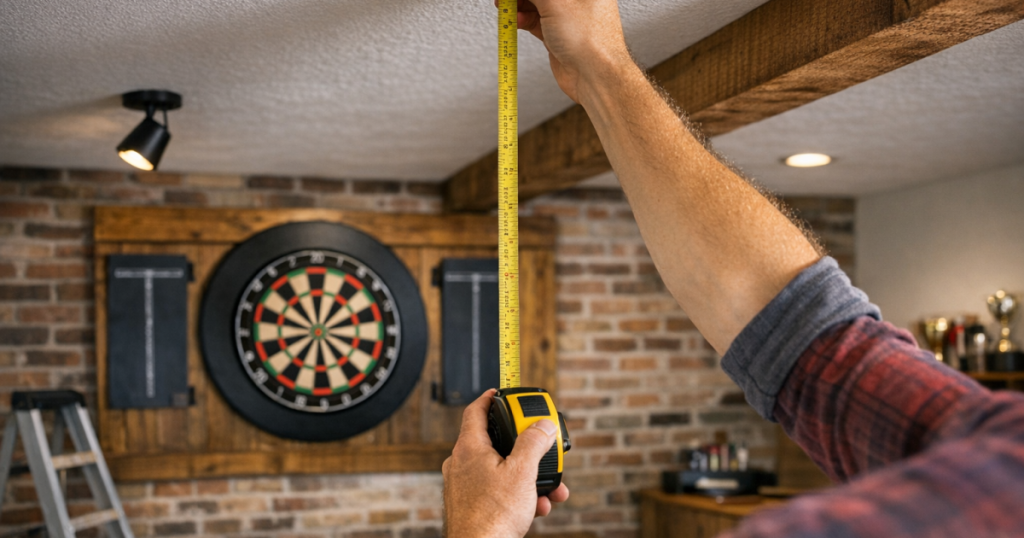
Do not take one measurement at the wall and assume the rest of the room is fine. Use a tape measure to check the ceiling height in at least three places:
- Directly in front of the dartboard wall.
- Halfway between the board and the throw line.
- At the exact spot where the player will stand.
For a standard steel-tip home setup, the throw line is 2.37 m from the face of the dartboard, not from the wall behind it. Soft-tip electronic boards are commonly set at a longer throwing distance, so check the requirements for the format you play before marking the floor.
Ceilings are not always level. In a loft conversion, garage or older property, the lowest point may be a beam, pipe boxing, sloped ceiling edge or light fitting rather than the ceiling plaster itself. Measure to the lowest obstruction a player could realistically hit or feel crowded by.
Step 3: Test the throwing motion, not just the tape measure
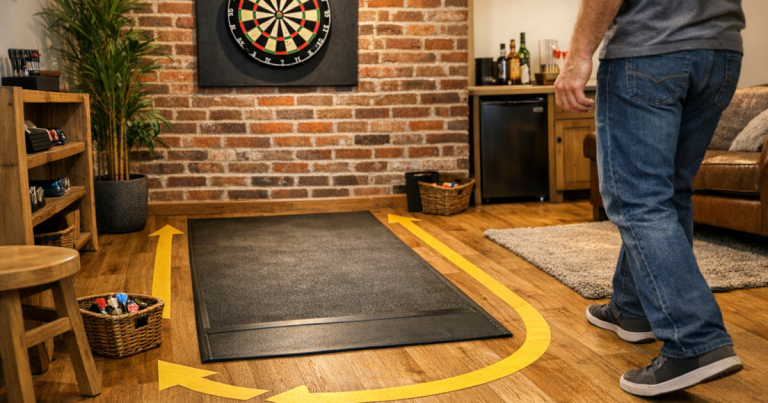
A tape measure tells you the available height, but it does not tell you how a throw feels. Mark the planned throw line with masking tape, stand behind it, and make several slow throwing motions without holding a dart. Use your normal stance, normal elbow height and normal follow-through.
Then repeat the check with the tallest person who is likely to play regularly. Taller players often stand more upright and may bring the dart higher during their setup. A ceiling that feels fine for one player can make another shorten their action, drop their elbow or lean forward unnaturally.
Pay attention to more than contact. If your hand does not hit anything but you instinctively hesitate, dip your shoulder or shorten the follow-through, the space is probably too tight for comfortable play. A good home setup should let you throw without thinking about the room.
Step 4: Check the danger spots around the throw area
Most ceiling-clearance problems come from fittings rather than the ceiling itself. Before fixing anything permanently, look for these common issues:
- Pendant lights: These often hang near the centre of a room and may sit above the oche.
- Exposed beams: They can be low enough to distract the thrower even when the main ceiling is high.
- Sloping ceilings: A board on a straight wall may still leave the player under the slope.
- Ceiling-mounted drying racks or storage: Common in utility rooms and garages, and easy to forget until someone throws.
- Curtain poles and tall shelves: These are not ceiling fixtures, but they can intrude near the board or along the throw path.
- Open cabinet doors: If you fit a cabinet, check that open doors do not interfere with lights, shelves or sloping walls.
If you are installing a cabinet as part of the setup, also think about weight, level and fixings. Clearance is only one part of the job; a separate check on how to mount a dart cabinet level on plasterboard is useful if the wall is hollow or the cabinet is larger than the board alone.
Step 5: Allow for the oche and floor finish
Ceiling clearance and oche position are linked. If the oche shifts forward or back because of a sofa, doorway or rug, the thrower may end up under a different part of the ceiling. That is why you should mark the oche before deciding the room works.
Use masking tape first rather than screwing down a raised oche immediately. Stand behind the line, check your throwing motion, and confirm that there is still enough room behind you to step back safely after collecting darts. If the layout works, you can make the line more permanent later.
For multi-use rooms, a removable oche is often tidier than a fixed strip on the floor. If that suits your space, see how to build a removable darts oche so the throwing position stays repeatable without turning the room into a permanent darts area.
Room examples and what to watch for
Standard living room with a flat ceiling
A typical living room with a flat ceiling usually offers enough headroom for casual play, but the centre light fitting can be the real problem. Check whether the pendant sits over the throw line, not just whether it is near the board. If it does, you may need to reposition the setup, change the light fitting, or use a different wall.
Garage or utility room
Garages often have decent length but awkward overhead obstacles. Watch for up-and-over garage doors, rails, beams, storage hooks and pipework. A board mounted at the back of a garage can feel fine until the thrower stands under a low door track.
Loft room or sloped ceiling
Loft spaces need the most careful check. The board wall may be full height, but the throw line can land under the slope. In that case, the setup may only work if the player stands in a very specific spot, which is not ideal for relaxed home matches.
Foldaway living-room setup
When the board is not permanently on display, check both the playing position and the stored position. A foldaway board can solve visual clutter, but it still needs enough ceiling and arm clearance when opened. For more layout ideas, a foldaway dartboard setup in a living room can help you plan around furniture, walkways and storage.
A simple clearance check you can do in ten minutes
- Mark the bullseye at 1.73 m from the finished floor.
- Mark where the board face will sit, including any cabinet or surround.
- Measure the throwing distance from the board face and tape the oche position on the floor.
- Measure ceiling height at the wall, midway point and throw line.
- Identify the lowest overhead obstruction in the throwing area.
- Make a natural throwing motion from the oche without holding a dart.
- Ask the tallest regular player to repeat the motion.
- Check the room with lights on to spot shadows from overhead fittings.
- Only drill or fit permanent fixtures once the throw feels comfortable.
Common questions
Is there an official minimum ceiling height for a dartboard?
There is no common official ceiling-height measurement for ordinary home setups. The key fixed measurement is the bullseye height, while ceiling clearance is checked by making sure the thrower can stand and follow through naturally.
Can I install a dartboard under a sloped ceiling?
Yes, but only if the throw line does not put the player under a cramped part of the slope. Mark the oche first and test the throwing action before fitting the board.
What if a pendant light hangs over the oche?
If it sits close to the throwing motion or creates board shadows, treat it as a layout problem. Moving the board position or changing the light arrangement is usually better than adapting your throw.
Should I measure from the wall or the board face for the oche?
Measure from the face of the dartboard. The board has depth, and measuring from the wall can leave your throw line slightly too far away.
Do taller players need a different dartboard height?
No. Keep the bullseye at the standard height for the format you are playing. Instead, use taller players to test whether the ceiling and fittings allow a comfortable throwing motion.
Final thoughts
Ceiling clearance is easy to overlook because the board itself takes up very little vertical space. The real test is the complete throwing zone: board height, oche position, player movement, overhead fittings and the way the room feels during an actual throw.
Before installing anything permanent, tape the layout, stand at the oche and test the motion properly. If your arm path feels clear, the lighting is not in the way, and the tallest regular player can throw without adjusting their action, the setup is far more likely to feel right once the board is on the wall.