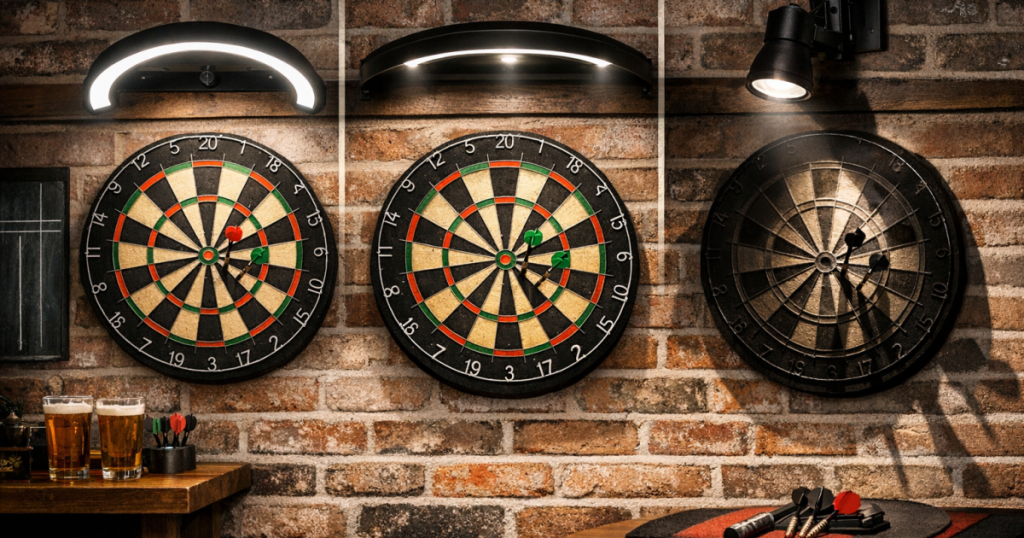
A well-lit board should make the treble bed easy to read without leaving your eyes fighting reflections. Good dartboard lighting is about beam angle, coverage, mounting position and the surfaces around the board, not simply making the room brighter.
Fixed mains electrical work for wall lights, ceiling lights or hard-wired circuits should be carried out by a qualified electrician to comply with UK electrical safety standards and local building requirements.
The short version
For most home players, the best choice is a dedicated dartboard light that throws even light across the whole face of the board from close range. It should sit forward enough to reduce dart and hand shadows, but not so far forward that it shines back into the thrower’s eyes.
Avoid relying on a single ceiling pendant behind the oche. It often lights the room nicely but leaves shadows across the board as soon as you step up to throw. Also be careful with glossy surrounds, glass-fronted cabinets and pale painted walls, because these can reflect light back towards you.
Before buying, check three things: how the light mounts, whether it works with your surround or cabinet, and whether the beam reaches the outer doubles without creating bright hotspots around the bull.
Where glare and shadows usually come from
The most common mistake is placing the main light source behind the player. Your body, throwing arm and darts can all interrupt the light path, which is why a board that looks clear from the sofa can become patchy once you stand at the oche.
Glare usually comes from one of four places:
- A light positioned too low, shining directly towards the player.
- A bare bulb or exposed LED strip in the thrower’s sightline.
- Reflective surfaces around the board, such as gloss paint, picture glass or shiny cabinet doors.
- Over-bright lighting concentrated on the centre of the board rather than spread evenly.
Shadows tend to appear when light comes from one direction only. A classic example is a ceiling spotlight above and behind the player, which can cast a clear dart shadow across the scoring beds. Side-mounted lamps can do the same, particularly on doubles near the edge of the board.
Step 1: Decide which lighting type suits your setup
Dedicated ring or surround lights
Dedicated dartboard lights are usually the cleanest answer for a permanent home board. They sit around or close to the board and aim light directly at the playing surface from several angles. That helps reduce shadows because the light is not coming from a single point.
Well-known examples worth comparing include Target Corona Vision, Mission Torus 270 and Winmau Plasma Dartboard Light. Do not assume they all fit your board area in the same way. Check how each one attaches, whether it works with your surround or cabinet, and how much clearance it needs around the board.
Ceiling spotlights
Ceiling spotlights can work in a dedicated darts room, but they need careful placement. A single spotlight is rarely ideal because it creates a strong light direction and a matching shadow. Multiple adjustable spots can perform better if they are aimed to wash the board evenly without pointing into the player’s eyes.
Cabinet-mounted lights
Cabinet lights can be tidy, especially in a living room or spare bedroom, but they need testing for shadows across the lower half of the board. Lights fixed to the top of a cabinet often look neat, yet they can leave the bottom doubles slightly darker. If you are building around a cabinet, it is worth checking your mounting plan against the basics in mounting a dart cabinet level on plasterboard.
Step 2: Check the angle before you worry about brightness
Brightness matters, but angle matters more. A very bright light in the wrong place can make the board harder to read. You want light that lands on the sisal face evenly and avoids direct eye contact from the throwing line.
Use this simple check before committing to a layout:
- Stand at the oche and look at the board from your normal throwing position.
- Check whether any bulb, LED strip or reflected hotspot is visible in your line of sight.
- Hold a dart up at throwing height and see whether it casts a strong shadow across the treble ring.
- Look at the top, bottom and both side doubles, not just the bull.
- Step slightly left and right, because casual home players rarely stand in exactly the same place every throw.
If the board looks bright but the wires throw heavy shadows, the light is too directional or too far from the board. If the bull looks washed out while the doubles look dull, the beam is too concentrated.
Step 3: Match the light to the room, not just the board
A setup in a garage, spare bedroom or shared living room will have different lighting problems. In a garage, the issue is often harsh overhead lighting and dark walls. In a living room, it is more likely to be reflections from framed pictures, glossy paint, television screens or glass-fronted furniture.
For shared rooms, choose something that does not dominate the space when the board is not in use. A dedicated board light can be easier to live with than extra wall lamps, provided it can remain safely fitted and does not clash with cabinet doors or surrounds. If the board needs to disappear between sessions, the planning notes in a foldaway dartboard setup for a living room will help you think through clearance and storage.
Noise and lighting often get planned together because both affect where the board can realistically go. If your best wall is a party wall or shared internal wall, combine your lighting checks with the advice on reducing dartboard noise through shared walls before drilling or buying extra fittings.
Step 4: Look for practical features before you buy
You do not need to chase the most powerful light. The better buy is the one that works cleanly with your board area and stays out of the way during normal play. Use these checks when comparing options:
- Board coverage: The full face should be readable, including the outer doubles and number ring.
- Glare control: The LEDs or bulbs should not be directly visible from the oche.
- Shadow reduction: Multi-directional or wraparound lighting usually performs better than a single narrow beam.
- Mounting method: Check whether it attaches to the board, surround, wall, cabinet or bracket.
- Surround compatibility: Thick surrounds, cabinets and backboards can affect fit.
- Cable route: A tidy cable is safer and looks better, especially in a family room.
- Colour appearance: Neutral light is usually easier on the eyes than very warm or very cold light.
- Replacement and maintenance: Check how easy it is to clean, remove or replace parts if needed.
If you are also upgrading the board itself, lighting can reveal issues such as uneven colour, heavy wire shadows or poor number-ring visibility. It is sensible to pair your lighting decision with the checks in checking dartboard quality before you buy, especially if you are refreshing the whole setup at once.
Step 5: Test it like a player, not a decorator
Room lighting can look excellent from the doorway and still be poor for darts. Test from the oche, at playing height, with darts in hand. If more than one person uses the board, ask a shorter and taller player to stand at the line too, because glare can change with eye level.
A quick home test is to throw a few practice visits at twenties, nineteens, bull and lower doubles. You are not testing scoring; you are checking whether your eyes hesitate before aiming. If you keep leaning, squinting or adjusting your stance to see a segment, the lighting is not doing its job.
Also check the board at the time of day you actually play. Daylight from a nearby window can create side glare in the afternoon, while evening play may rely entirely on artificial light. Curtains, blinds and matte wall finishes can make a bigger difference than expected.
Common questions
Is a normal room light enough for a dartboard?
Sometimes, but it is rarely the best option. A room light is designed to illuminate the space, not the board face. If it sits behind the player or off to one side, it can create shadows during the throw.
Should the light be above the dartboard?
It can be, but it should not act like a single narrow spotlight from above. The goal is even coverage across the whole board, so purpose-made wraparound lighting or carefully positioned multi-point lighting usually works better.
Can dartboard lighting work with a cabinet?
Yes, but check door clearance, attachment points and whether the cabinet top blocks light from reaching the lower board. Some lights suit open board-and-surround setups better than enclosed cabinets.
What light colour is best for playing darts at home?
A neutral white appearance is usually comfortable because it keeps board colours clear without feeling too yellow or too harsh. The exact preference varies by room, wall colour and eyesight.
How do I know if glare is the problem?
If the board is bright but you find yourself blinking, squinting or noticing shiny hotspots near the number ring or surround, glare is likely. Move your eyes to the oche position when judging it, not close to the board.
The big picture
The best dartboard lighting makes the board easier to read without drawing attention to itself. Start with beam direction, shadow control and compatibility with your surround or cabinet, then think about brightness. A tidy, even light that stays out of your sightline will do more for your home matches than simply adding the strongest lamp you can find.