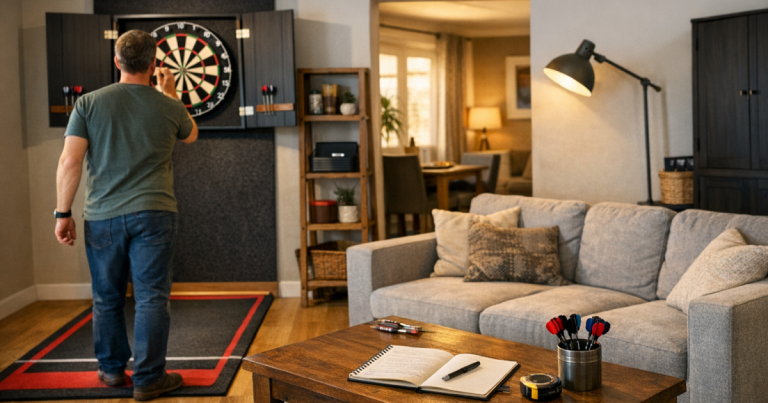
A foldaway dartboard setup can make a living room work for proper home darts without leaving the space feeling like a permanent games room. The aim is simple: keep the official throwing position, protect the room, and make everything quick enough to put away after a match.
The best lounge setups are planned around movement, furniture and storage first, not just where the board looks neat on the wall. If the setup takes ten minutes to clear every time, it will soon stop being used.
The short version
- Use a clear throwing lane of 2.37 m from the face of the board to the oche, plus enough room behind the thrower to stand naturally.
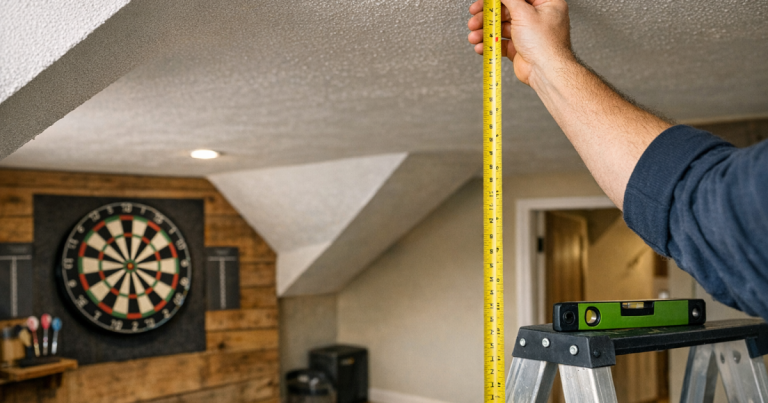
- Mount the bull at 1.73 m from the floor for a standard steel-tip setup.
- Choose a wall position that does not put darts across a doorway, TV area, walkway or seating position.
- Plan how the oche, mat, darts, scoreboard and lighting will disappear when the room returns to normal.
- Protect both the wall and floor, even if you only play casually.
Step 1: Pick the wall before thinking about storage
Start with the wall that gives you the safest, straightest throw. In most UK living rooms, the obvious wall is not always the best one. A chimney breast, alcove, bay window, radiator, bookcase or TV unit can all interrupt the throwing lane or make the board feel awkward.
Stand where the oche would be and look back towards the board position. You want a clean, central line where your arm can follow through without feeling boxed in by a sofa, coffee table or sideboard. The throw should not cross a route people use to reach the kitchen, hallway or stairs.
Measure from the board face, not the wall. A dartboard in a cabinet or on a backing panel sits forward slightly, so mark the throwing distance after deciding how the board will be mounted. If you are working in a tight lounge, it is worth using the same disciplined measuring approach you would use when checking whether a room has enough space for a dartboard setup, even if the room is not a spare bedroom.
Step 2: Decide what “foldaway” really means in your room
Foldaway can mean several different things. For one home, it might be a dartboard cabinet with doors that close over the board. For another, it might be a board on a removable wall bracket, a roll-up mat, a portable oche and a storage basket behind the sofa. The right answer depends on how visible you want the setup to be when nobody is playing.
Low-visibility option
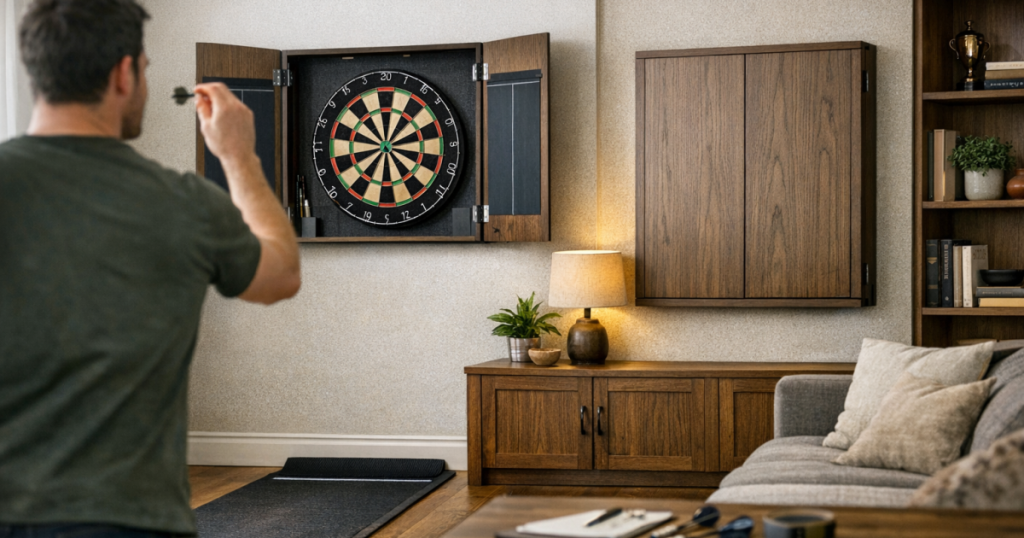
A cabinet is the neatest everyday look because the board disappears behind doors. It suits living rooms where the wall is shared with pictures, shelving or general decoration. The trade-off is that the cabinet still remains visible and needs enough side clearance for the doors to open fully.
Quick-play option
A permanent board with a removable surround is faster to use. You take the darts out, put down the mat or oche, and play. This works well if the room already has a relaxed games-night feel, but it leaves the dartboard visible between sessions.
Hidden storage option
If you want the board fully out of sight, plan a storage spot for the board itself as well as the accessories. That could be a tall cupboard, under-stairs storage or a dedicated shelf in a sideboard. Make sure the board can be carried and rehung without knocking furniture or scraping the wall.
Step 3: Keep the throw line repeatable
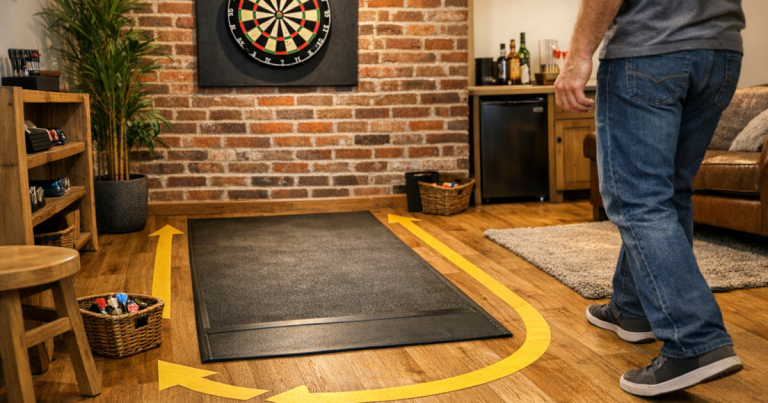
The most common problem with lounge darts is an oche that moves every time the room is tidied. A strip of tape on the carpet might work for a week, but it rarely stays smart in a shared living space. A repeatable throw line makes the setup feel proper without making the room look cluttered.
For carpet, a roll-out dart mat can be useful because it gives you both floor protection and a consistent standing point. On hard flooring, check that the mat does not creep as you step forward. If you prefer a cleaner look, a removable oche that slots into position can be a better fit; the process is similar to planning a removable darts oche at home, but adapted so it stores neatly in a cupboard or under a sofa.
Before committing, practise the routine: move the coffee table, lay down the mat, set the oche, throw a few darts, then put it all back. If the process feels awkward during a test, it will feel worse during a match night.
Step 4: Protect the room without making it look temporary
A living room setup needs more care than a garage or dedicated darts corner because missed darts are not the only issue. Flights can brush painted walls, points can nick skirting boards, and regular setup can mark wallpaper or flooring over time.
A surround is the simplest way to catch near misses around the board. It should fit snugly, come off without fighting the board, and store flat enough that it does not get bent or damaged. If you have wallpaper, painted panelling or a feature wall, think beyond the immediate ring around the board. A wider backing panel can look intentional and protect more of the wall, but it has to suit the room rather than looking like a temporary patch.
For decorated walls, the neatest solutions are usually planned rather than improvised. A removable or framed backing area can help, and there are more ideas for protecting finishes cleanly in this guide to protecting wallpaper around a dartboard.
Do not forget the floor. Steel-tip bounce-outs are less common with a decent board in good condition, but they still happen. A mat protects carpet pile and helps prevent small marks on laminate, engineered wood or vinyl flooring.
Step 5: Make lighting part of the plan
Good lighting is easy to overlook in a foldaway layout. Living rooms often have ceiling lights behind the thrower, side lamps at low level, or picture lights that look nice but cast uneven shadows across the board. If you cannot see the treble bed clearly, the setup will feel frustrating no matter how tidy it looks.
The aim is even light on the board face, with as little glare as possible from the player’s position. A dedicated dartboard light can work well, but only if it fits the foldaway plan. Ask where the light will sit, whether it remains on the wall, and whether it makes the board look too dominant when not in use.
If you are using a cabinet, check whether the doors interfere with any lighting ring or overhead fitting. If the board is near a TV, mirror or framed print, stand at the oche and check for reflections before fixing anything permanently. For more detail, use the separate guide on lighting a dartboard without glare or shadows.
Step 6: Plan the tidy-away routine
A foldaway dartboard setup works best when every item has a home. That includes darts, spare flights, shafts, chalk or marker pens, a scoreboard, mat, oche and surround. If these end up scattered across shelves, the setup becomes untidy even when the board is hidden.
Use one dedicated storage zone close to the board if possible. A drawer in a TV unit, a lidded basket, a cabinet shelf or a small organiser box can all work. Keep sharp darts in a case rather than loose in a drawer, and avoid storing flights where they will be crushed under heavier items.
Think about the order of use as well. The mat or oche should be easy to reach first, then darts and scoring. If you use a tablet for scoring, decide where it sits during play and where it charges or stores afterwards, without leaving leads across the walking route.
Example layouts for common living rooms
Small terrace lounge
In a narrow terrace living room, the best dartboard wall is often the end wall rather than the long wall. Moveable furniture is key: a lightweight coffee table, nesting tables or a footstool that slides aside can create enough throwing space without changing the room permanently.
Open-plan living and dining room
In an open-plan layout, use the dining end if it gives a straighter lane and fewer interruptions. A cabinet can help the board blend into the room, while the dining table can sometimes act as a natural boundary that keeps people out of the throwing area during games.
Living room with a chimney breast
A chimney breast can look like an ideal centre point, but check the throwing lane carefully. Alcoves, hearths and nearby furniture may push the oche off-centre. If the line feels cramped, a side wall with a cleaner lane may play better, even if it looks less symmetrical.
Key checks before you fix anything
- Can you measure 2.37 m from the board face to the oche without crossing a doorway or main walkway?
- Is the bull position at 1.73 m from the finished floor level?
- Can the tallest regular player stand and throw without hitting a lampshade, shelf or low ceiling feature?
- Will the board, cabinet or backing panel look acceptable when the room is not being used for darts?
- Can the mat or oche be placed in exactly the same position each time?
- Is there enough wall and floor protection for realistic missed darts, not just perfect throws?
- Can accessories be stored safely and neatly within a minute or two?
Things readers ask
Can a dartboard go above a radiator?
It is better to avoid it. Heat, awkward positioning and limited wall protection can all make the setup less reliable. A different wall is usually cleaner and easier to protect.
Is a cabinet better than a surround in a living room?
A cabinet hides the board more neatly, while a surround is quicker and often less visually heavy. Choose based on how much of the setup you want visible every day.
How much space is needed behind the oche?
There is no single fixed amount for casual home layouts, but allow enough room to stand naturally, step back and let another player pass without entering the throwing lane.
Can I use soft-tip darts to reduce wall damage?
Soft-tip darts reduce some risks, but they are not a direct substitute for a standard steel-tip board. If you prefer steel-tip darts, proper wall and floor protection is the better answer.
What if the living room is slightly too short?
Do not shorten the throw just to make it fit if you want consistent practice. Look at a different wall, moveable furniture, or another room before compromising the distance.
What to remember
A good living room darts setup is not just about hiding the board. It is about making the playing position accurate, the room safe to use, and the tidy-away routine simple enough that you will actually play regularly.
Measure first, protect the surfaces, keep the oche repeatable and give every accessory a storage place. Once those basics are sorted, a foldaway arrangement can feel like part of the room rather than something awkward that has been squeezed into it.