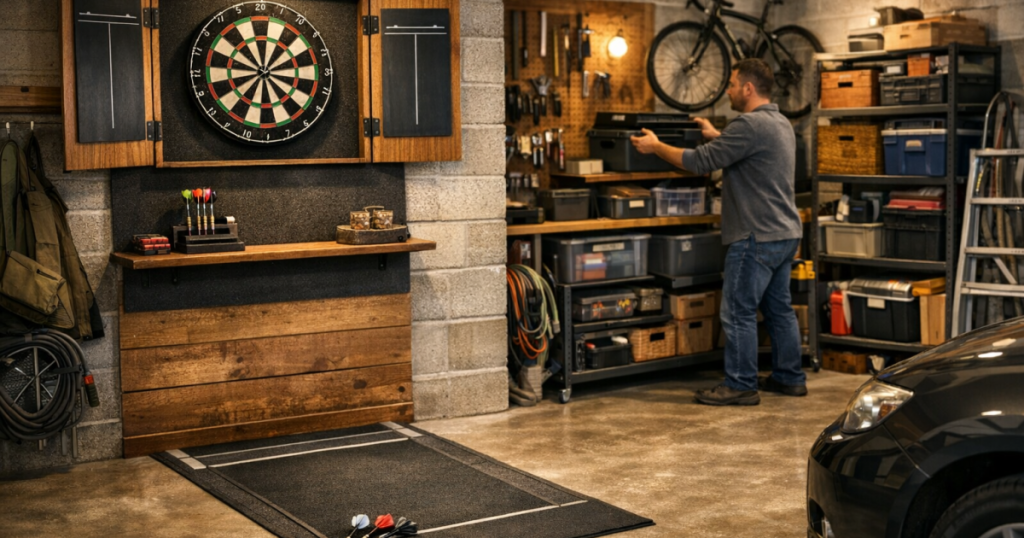
A garage can be one of the easiest places to fit a board, but it can also become the quickest room to clutter with bikes, tools and laundry. Planning a garage darts area properly means treating the oche as a usable zone rather than a gap left over after storage.
Fixed electrical work, such as adding sockets or hard-wired lighting in a garage, should be carried out by a qualified electrician to meet UK electrical safety requirements and relevant building standards.
The short version
A usable garage darts setup needs three things: a clear throwing lane, storage that does not creep into that lane, and lighting that lets you see the board without shadows. Start with the measurements, then plan what moves, what stays fixed, and how the space works when the garage is being used for normal household jobs.
- Keep the board position fixed and make everything around it easy to move or tidy.
- Allow the full steel-tip distance from the face of the board to the oche, not from the wall.
- Protect the wall and floor, especially if the garage is used for tools, bikes or car storage.
- Use storage zones so darts gear does not mix with paint tins, garden tools or muddy kit.
- Check the space at the time you normally play, not just when the garage is freshly cleared.
Start with the true playing footprint
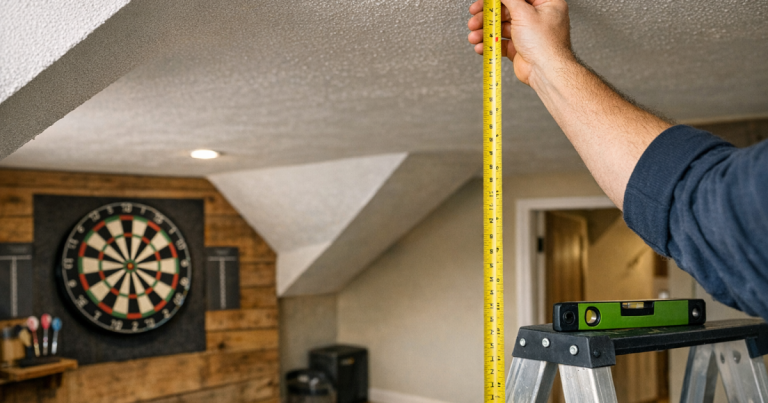
For a standard steel-tip setup, the bullseye should be 1.73 m from the floor and the throwing line should be 2.37 m from the face of the dartboard. The key detail in a garage is the board face: if your board sits in a cabinet, surround or on a backing board, measure from the front playing surface, not from the wall behind it.
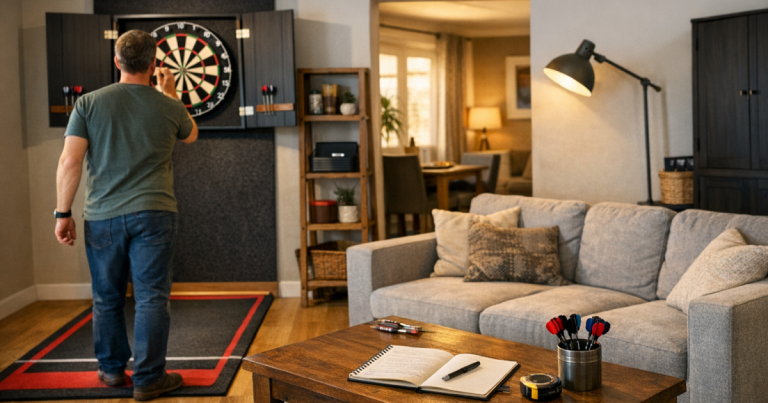
Before fixing anything, tape the oche line on the floor and stand there with your normal throwing stance. You need enough room for your feet, arm movement, a second player standing back, and safe access around the thrower. If the garage door, freezer, tumble dryer or side door cuts across the lane, the setup will feel annoying even if the measurements are technically correct.
It is worth checking the full measurement process before committing to a wall position. Our guide to how to measure dartboard height and throwing distance correctly covers the standard heights, oche distance and common measuring mistakes in more detail.
Choose a wall that will still work next month
The best garage wall is not always the biggest blank wall. It is the wall that stays accessible when the garage fills up again. Think about the normal rhythm of the space: bins going out, bikes being wheeled through, tools being pulled from shelves, or a car being parked in bad weather.
A good board wall usually has these qualities:
- Low traffic behind the thrower: nobody should need to walk through the throwing lane during a leg.
- Stable wall space: avoid areas where shelves, hooks or seasonal storage are likely to expand.
- Decent sightline: the board should not be tucked behind a hanging bike, boiler cupboard or tall shelving unit.
- Enough side clearance: missed darts and bounce-outs should not be landing near glass, stored tools or fragile items.
- Simple reset: if the space has to be cleared before every session, it should take minutes, not a full tidy-up.
If two walls look possible, choose the one that makes everyday movement easier. A slightly less obvious board position often works better than a perfect-looking wall that blocks access to half the garage.
Keep walkways separate from the oche
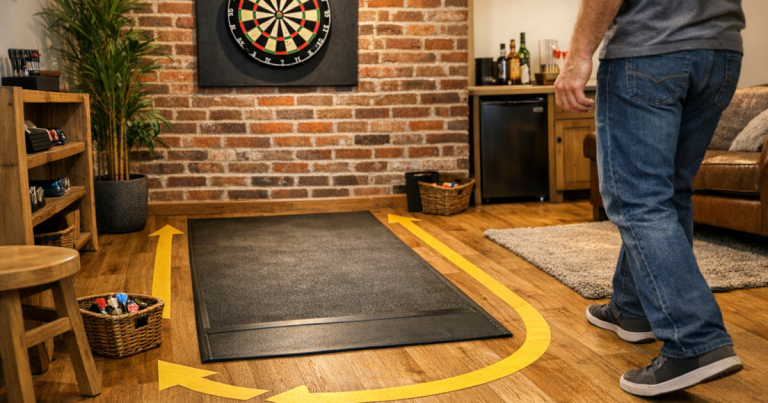
A garage setup fails when the throwing lane becomes a corridor. Mark out the playing footprint and then draw an imaginary walkway around it. You should be able to reach storage shelves, the garage door, the house door and any appliances without stepping across the oche during play.
For narrow garages, place the board on the end wall rather than along the long side if the depth allows it. That keeps the throw running with the length of the garage and often leaves one side for storage. In wider garages, a side-wall layout can work well, but only if the route past the thrower remains clear.
If your garage is part games space, part utility area, our advice on how to plan a darts corner without blocking walkways is useful for thinking through furniture, doors and movement patterns before you commit.
Use zones so storage does not invade the board
Garages attract loose items. A darts space stays usable when every regular item has a zone and the oche has a clear boundary. Do not rely on memory or good intentions; use shelves, hooks, labelled boxes and floor markings so the area resets naturally.
Board zone
This is the fixed area around the dartboard. Keep it clean and visually simple. A backboard, surround or cabinet can help define the space and reduce wall marks. Avoid storing long-handled tools, ladders or fishing rods next to the board, as they tend to drift into the scoring area and can make retrieving darts awkward.
Throwing lane
This should stay clear from the board to behind the oche. If you use a dart mat, choose a position where it can lie flat without curling under a door track or garage threshold. If the car sometimes needs to come in, use a mat or removable oche marker that can be lifted and put back in the same place.
Storage zone
Put household storage along the side that does not interfere with the throw. Tall shelving works well if it is stable and kept out of the dart path. For mixed-use garages, the most useful habit is keeping frequently moved items, such as bikes and bins, away from the oche side so they do not become a constant obstacle.
Plan for damp, dust and temperature changes
Garage conditions are different from a spare room or dining area. Cold air, dust, damp patches and concrete floors can make a setup feel neglected even when the board is mounted correctly. You do not need to turn the garage into a living room, but you do need to protect the parts that affect play.
- Check the wall first: avoid mounting a board on a visibly damp or crumbling surface.
- Keep darts gear boxed: flights, shafts and chalk can pick up dirt quickly in a garage.
- Use a small shelf or cabinet: keep score chalk, spare flights and a checkout card away from tools and paint.
- Control floor grit: sweep the lane so bounce-outs do not land in debris.
- Think about winter use: if the garage becomes uncomfortable after ten minutes, the setup may look good but rarely get used.
A simple rubber-backed mat or clean oche mat can make the area feel more deliberate and reduce the amount of grit dragged into your stance. Just make sure it sits flat and does not create a trip point at the edge.
Get the lighting right before decorating the space
Lighting is often the difference between a garage setup that feels sharp and one that feels like an afterthought. The board face needs even light, with minimal shadow from your throwing arm and no glare from a bare bulb behind you. Garages can be tricky because the main ceiling light is often placed for parking or storage, not for darts.
Check the board at the time you normally play. Stand at the oche and look for shadows across the treble bed. If the top half of the board is bright but the lower half is dull, or if your body blocks the main light, the board position or light position needs work.
Plug-in lighting can be a flexible option where the socket position already suits the room. For more layout ideas, including awkward rooms and offset lights, see our darts lighting design guide.
Make the setup quick to reset
The best garage darts areas have a reset routine. At the end of a session, everything returns to a known place and the lane is ready for the next throw. If setup and pack-away become a chore, the board will be used less.
A simple reset checklist works well:
- Darts back in their case or holder.
- Flights and shafts in one small organiser, not loose on a shelf.
- Scoreboard wiped or chalk stored away.
- Oche mat lifted only if the garage needs parking space.
- Bikes, bins and tools returned outside the throwing lane.
- Floor checked for bounce-outs before anyone walks through in outdoor shoes.
If several people use the garage, make the boundaries visible. A strip of floor tape, a mat edge, or a clearly labelled shelf can prevent the darts space from slowly becoming general storage again.
Common garage layouts that work
Single garage with no car inside
This is usually the easiest arrangement. Put the board on the end wall if the depth works, keep one side for storage, and leave the central lane clear. The main risk is clutter creep, so use shelves rather than floor piles.
Single garage that sometimes stores a car
Use a removable mat and avoid fixed objects in the parking path. The board can stay on the wall, but anything at floor level should be easy to move. Mark the oche position so it returns accurately after the car is moved out.
Garage with bikes and family storage
Wall-mounted bike hooks can help, but only if the bikes do not hang into the dart path. Keep children’s scooters, sports bags and garden items away from the board zone. A closed storage box is better than open piles near the oche.
Garage used as a workshop
Separate sharp tools and darts gear. Dust from sanding or drilling can settle on the board, so cover the board or close the cabinet when doing messy jobs. Do not place the board above a workbench unless the bench is clear, low-risk and not in the way of retrieving darts.
Things readers ask
Can I put a dartboard in a cold garage?
Yes, provided the wall is dry, the board is kept away from damp, and the space is comfortable enough to use. Store darts accessories in a case or box so flights and shafts do not get dirty or knocked about.
What if the garage floor slopes?
Many garage floors slope slightly towards the door. If your stance feels uneven, try a flat mat in the throwing area and check that it does not slide or curl. Do not build the oche measurement from the mat edge unless the mat is positioned accurately from the board face.
Can I still use the garage for storage?
Yes, but storage needs to sit outside the throwing lane. Put fixed shelving to one side, keep floor items away from the oche, and avoid storing anything fragile or sharp near likely bounce-out areas.
Should the scoreboard go beside the board or near the thrower?
In most garages, beside the board is neater and keeps scoring in one zone. Place it where players can read it without standing in the dart path or squeezing between stored items.
How do I stop the darts area becoming cluttered again?
Give every darts item a home and make the lane boundary obvious. If the setup can be reset in under five minutes, it is far more likely to stay usable through normal garage life.
What to remember
A garage darts setup works best when it is planned as part of the room, not squeezed into whatever space is left. Measure from the board face, protect the wall and floor, keep walkways separate, and make storage do its job instead of drifting into the oche.
The goal is not a showroom garage. It is a space that can handle real home life and still be ready when someone says, “fancy a few legs?”