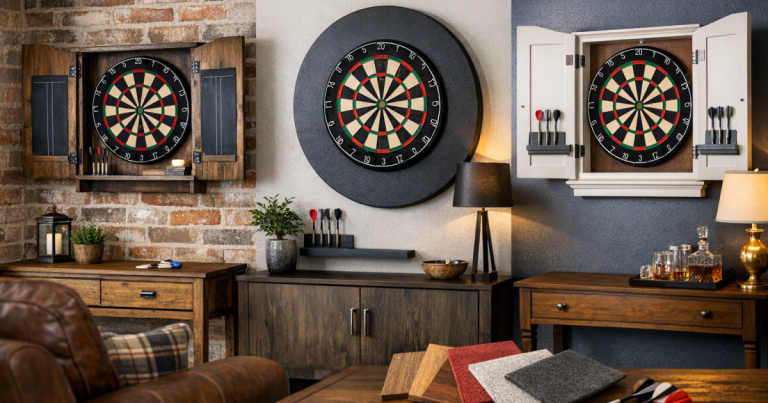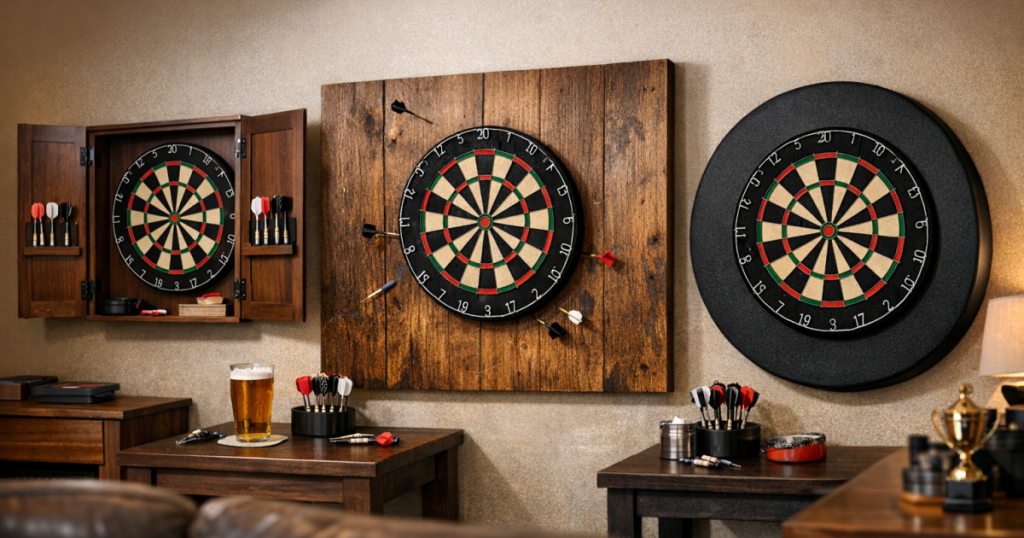
Good dartboard wall protection stops stray darts from turning a spare-room setup into a patchwork of holes, but the right answer is not the same for every home. A slim foam surround, a smart wooden cabinet and a wider backboard all solve slightly different problems. The best choice depends on how accurate the throwers are, how visible the setup needs to be, how much wall area is at risk, and whether you want storage as well as protection.
For most UK homes, the most practical setup is a bristle board with either a close-fitting surround or a cabinet, then extra backing only if beginners, children or visitors will be throwing regularly. In narrow rooms, rented homes and multi-use spaces, the neatest solution is often the one that protects enough wall without making the darts area feel bulky.
At a glance
- Foam surrounds are the simplest way to protect the area immediately around a bristle dartboard.
- Wooden cabinets add doors, storage and a more furniture-like look, but protect less area when the doors are open unless they include extra side coverage.
- Backboards give broader coverage and can be decorative, but need more planning because they sit behind the whole setup.
- Combination setups work well for busy family homes: for example, a foam surround over a larger backing panel.
- Floor protection still matters, because bounce-outs and dropped darts can mark laminate, vinyl and softwood flooring.
Why walls get damaged around a home board
Most wall marks come from three situations: missed doubles, loose release angles and bounce-outs. The danger zone is usually not spread evenly across the wall. It tends to cluster around the outside of the scoring area, with more marks near the numbers frequently aimed at during practice. Beginners often miss wider, while experienced players usually only need protection close to the board.
Room shape matters too. In a garage or dedicated games room, a few wall marks might not matter. In a dining room, hallway, rented flat or home office, even a small cluster of holes can become irritating quickly. Protection is not just about damage; it also helps the setup feel intentional rather than temporary.
There is also a confidence benefit. When visitors know the wall has a buffer, they tend to throw more naturally. That is useful if your darts space is shared by family, friends or occasional players who are not yet consistent around doubles.
Foam surrounds: the neatest close-range buffer
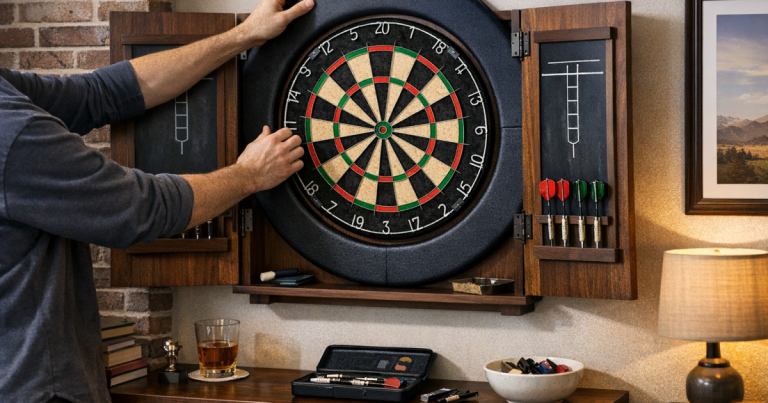
A dartboard surround is a padded ring that fits around the outside edge of a bristle board. It is popular because it is quick to fit, removable, and does not usually require permanent changes to the wall. For many home players, it is the cleanest solution because it protects the most common missed-dart area without visually taking over the room.
The key limitation is coverage. A surround protects the wall near the board, not the wider wall beyond it. If most misses are only just outside the scoring surface, that is fine. If people are missing by a long way, a surround alone can feel too narrow.
Fit is another detail worth checking. Surrounds are normally designed around standard bristle dartboards, but real-world fit can vary slightly depending on the board, wall bracket, rotation, and how snugly the surround grips. Before choosing one, check whether it is meant to be used with a regulation bristle board and whether it sits flat enough for your wall. For more detail on size, material and fit, see the dartboard surround size guide.
Recognisable examples in this category include the Winmau Pro-Line Dartboard Surround and the Target Pro Tour Dartboard Surround. Treat named examples as a way to understand the category rather than a guarantee of suitability for your room; the important checks are fit, coverage, colour, thickness, and how easily the surround can be removed when rotating the board.
Where a surround works best
- Dedicated practice setups where the throwers are reasonably consistent.
- Small rooms where a wide backboard would look too heavy.
- Homes where the board needs to look tidy between sessions.
- Players who rotate their board regularly and want simple access.
Wooden cabinets: tidy, traditional and useful for storage
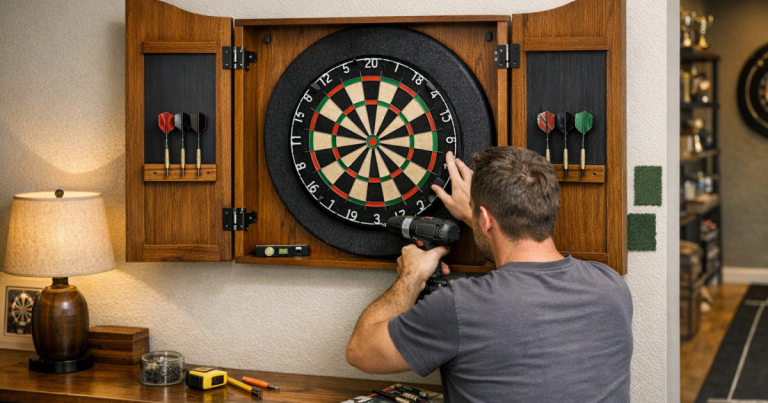
A wooden dartboard cabinet frames the board and usually provides doors that close over the playing area when it is not in use. That makes it a strong choice for living rooms, studies and multipurpose spaces where the board should not always be on show. Cabinets can also keep darts, chalk, wipes or a small scoreboard together, which helps stop accessories drifting around the room.
The trade-off is that a cabinet is not automatically better protection. When the doors are open, the cabinet protects the area directly behind and around the board, but stray darts can still hit outside the door span. In some rooms, open doors also make the setup feel wider, which can be awkward near shelves, doorways or light switches.
Cabinets are also more visually assertive than foam surrounds. That can be a positive if you want a classic pub-style look, but less ideal if the room has a minimalist finish. If you are deciding between a cabinet and a surround, the practical differences are covered in more depth in wooden dartboard cabinets vs foam surrounds.
When a cabinet makes sense
- You want the board hidden or softened visually when not in use.
- You like having darts and small accessories stored at the board.
- The room suits a framed, furniture-like look.
- The wall area at risk is mostly close to the board rather than widely spread.
Backboards: broader coverage with more design freedom
A backboard is any larger panel placed behind the dartboard to protect a wider section of wall. It might be cork, timber, felt-covered board, acoustic-style panel, plywood, MDF, or a purpose-made darts backing panel. The big advantage is coverage: you can protect more width and height than a standard surround or cabinet.
Backboards are especially useful when several ability levels use the same setup. A confident league player might barely need one, while a beginner practising doubles can miss the board entirely. In that kind of household, a wider backing panel is more forgiving and can save repeated wall filling and repainting.
The design options are broader too. Some players create a framed feature panel, while others use a dark backing to make the board stand out. In garages and sheds, a simple functional panel may be enough. In a living space, the finish matters more because the board becomes part of the room rather than a loose accessory.
The main drawback is commitment. A backboard usually needs more wall space, careful positioning and secure mounting. It can also make the setup feel deeper, particularly if combined with a cabinet or lighting ring. Before fitting one, think about door swings, furniture, walking routes and whether the wall still feels balanced when the board is not being used.
Combining protection without overbuilding the setup
Layering can work very well, but only when each layer has a job. A surround on its own is neat. A backboard on its own is broad. A cabinet on its own is tidy. Combining all three can look cluttered unless the room is large enough and the design is planned carefully.
For beginners, the most forgiving combination is often a larger backboard with a foam surround in front. The backboard catches wider misses, while the surround protects the immediate outer ring and gives the board a finished look. For a more traditional room, a cabinet mounted on a broader decorative panel can be a good compromise, provided the doors still open comfortably.
A useful rule is to match protection to the worst regular thrower, not the best one. If the board is only used by experienced players, a close surround may be enough. If guests, younger players or complete beginners will use it, wider backing is more realistic. This is where dartboard wall protection becomes less about neat accessories and more about how the space is actually used.
What to check before fixing anything to the wall
Wall protection works best when it is planned with the whole darts area, not added as an afterthought. A few checks can prevent an awkward setup:
- Board height and throw line: set the board and oche position correctly before judging where protection needs to sit.
- Clearance around the board: leave enough room for board rotation, surround removal and cabinet doors if used.
- Wall surface: painted plaster, exposed brick, timber panelling and wallpaper all respond differently to missed darts and mounting hardware.
- Lighting: make sure the chosen protection does not cast shadows across the board or clash with a lighting ring.
- Noise: a solid backing panel can change the sound of dart impact, which may matter in flats or shared walls.
- Room use: consider whether the board sits near a desk, sofa, doorway, radiator or television.
It is also worth checking whether your throw line solution helps keep people in the right place. A clear mat, raised oche or floor marker reduces casual creeping forward and keeps practice consistent. The darts mat and throw line guide covers the floor layout side of the setup.
Wall protection in small UK rooms
Small rooms create a different set of compromises. A wide backboard may protect more wall, but it can also dominate the space visually. A cabinet may look smart when closed, but the open doors can feel intrusive. A surround is usually the least bulky option, although it may not be enough for mixed-ability throwing.
In a box room or spare bedroom, think vertically as well as horizontally. The area just above and below the board can still take marks, particularly during casual play. A taller backing panel with a restrained finish can sometimes look cleaner than lots of separate protective pieces.
Colour makes a difference too. Black surrounds hide marks well and frame the board clearly. Lighter backboards may blend into a decorated room but can show scuffs more quickly. In a shared living space, the most successful setups often use simple colours that match existing furniture rather than trying to make the darts area look like a pub corner.
Keeping the setup tidy over time
Wall protection is not fit-and-forget. Foam can collect point marks, dust and chalk residue. Wooden cabinets can show small chips or hinge movement after regular use. Backboards can become scuffed in the common miss zones. None of this is unusual, but occasional maintenance keeps the area looking deliberate rather than neglected.
- Rotate the dartboard regularly so wear is spread across the scoring segments.
- Remove the surround carefully rather than dragging it across the board edge.
- Check cabinet doors still open cleanly and do not rub against the board or wall.
- Wipe dust from shelves, score areas and the top edge of backing panels.
- Inspect the wall around the protected zone occasionally, as very wide misses can still leave marks.
If you use steel-tip darts with sharp points, also check the floor below the board. Bounce-outs do happen, and floor marks can be just as annoying as wall damage in a finished room.
FAQ
Is a dartboard surround enough to protect the wall?
For accurate adult players, often yes. For beginners, children or social games, a surround may be too narrow because it only protects the area close to the board.
Can I use a cabinet and a surround together?
Sometimes, but check clearance carefully. Many cabinets are designed to frame the board closely, so a thick surround may stop the doors closing or make the setup look cramped.
What is the best backing material for a dartboard?
There is no single best material. Cork, timber, felt-covered board and purpose-made backing panels can all work if they are large enough, securely mounted and suitable for the room finish.
Will a backboard stop all wall damage?
Only within the area it covers. Very wide misses can still hit the surrounding wall, so choose the backing size based on who will be throwing, not just how neat it looks.
Do I need wall protection for an electronic dartboard?
It can still be useful, especially for casual players. Electronic boards use soft-tip darts, but missed throws can still mark paintwork or damage delicate wall finishes over time.
What stands out
The right solution is the one that matches your room and the people using it. A foam surround is clean and simple for regular practice. A wooden cabinet suits a room where appearance and storage matter. A wider backboard is the most forgiving option when misses are less predictable.
For many home setups, the sweet spot is not the biggest possible protective area, but the most sensible one: enough coverage to relax while throwing, without making the room feel overbuilt. Start with the likely miss pattern, then choose the protection that fits the wall, the look of the room and the way the board will be used week after week.