A neat home darts setup needs more than a good board. The right surround protects your wall, frames the board properly and makes a spare room, garage or dining area feel more like a proper throwing space. Getting dartboard surround size right is mainly about coverage, fit and the way your room is used, rather than simply choosing the biggest ring you can find.
Most UK home players are working around real-life constraints: skirting boards, radiators, sockets, picture rails, door swings and limited throwing space. A surround will not save every wild dart, but it can stop the most common misses from peppering plaster, wallpaper or painted walls around the trebles and doubles.
The short version
- A standard steel-tip bristle dartboard is around 451 mm in diameter, so most slip-on surrounds are designed to fit that size.
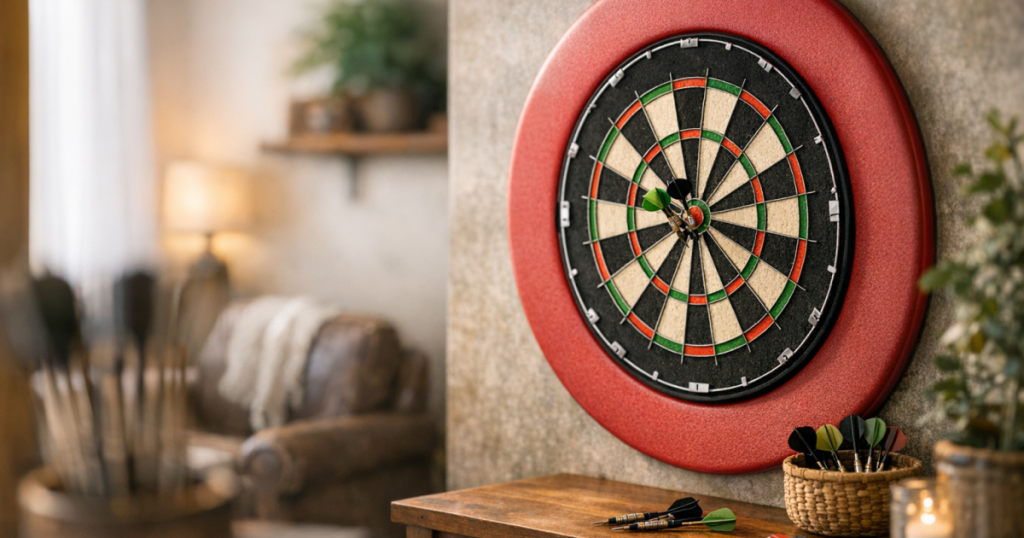
- Common one-piece foam surrounds usually measure roughly 675 mm to 700 mm across the outside, giving useful protection around the board edge.
- Dense EVA-style foam is the usual material for simple home setups because it is light, easy to fit and self-gripping around the board.
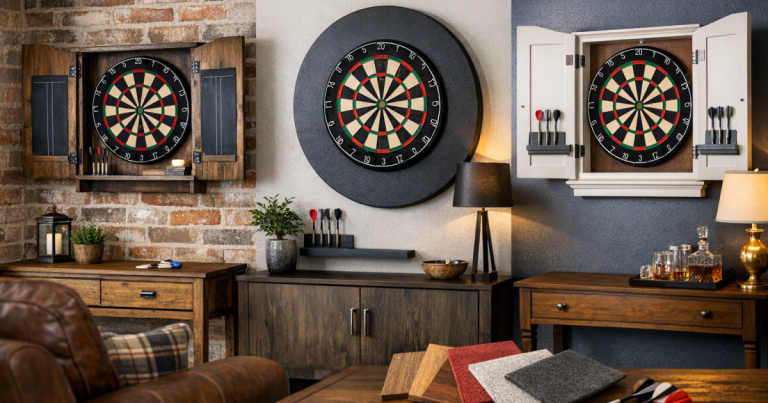
- Cabinets give a tidier furniture-style look, but they protect less wall area unless paired with extra backing or a surround-compatible design.
- For tight UK rooms, check total wall width, door clearance and lighting space before deciding on a surround, cabinet or combined setup.
Why a surround matters in a UK home setup
On a pub wall, a few dart marks are part of the scenery. At home, they become much more noticeable. A standard board leaves the wall immediately around the doubles exposed, which is exactly where many beginner, casual and tired-session misses land. Even confident throwers can drift wide when practising doubles or playing around the clock.
A surround is also useful for shared spaces. If your board is in a kitchen-diner, hallway end, home office or converted garage, a clean ring around the board helps the setup look intentional rather than temporary. It can make the difference between leaving the board up and taking it down after every session.
If the room itself is the challenge, it is worth checking your layout before choosing accessories. For cramped alcoves, box rooms and multi-use spaces, the advice in choosing the right dartboard for a small UK room is a useful next step alongside surround planning.
How much wall coverage do you actually need?
The key measurement is not just the outside diameter of the surround. It is the amount of protective material beyond the board edge. With a 451 mm board and an outer surround size of about 680 mm, you get roughly 115 mm of protection around the board. That is enough for many ordinary misses, particularly around the double ring.
It is not complete wall armour. A dart can still miss beyond the surround, especially if children, visitors or complete beginners are throwing. If your wall finish is delicate, or the board is in a rented property, consider a larger backing panel behind the board area. A painted MDF panel, cork-style backing board or purpose-made wall protector can sit behind the board and surround, giving a wider sacrificial surface.
Think about the type of misses you see most often. If darts are only landing just outside the doubles, a standard surround is usually sensible. If they are spreading far left and right, the issue may be stance, oche position or throwing angle rather than surround width. In that case, sorting the throw line may help as much as adding more wall protection; the guide to setting up a darts oche at home in a UK room covers the practical spacing side.
Material choices and how they behave
Most modern surrounds for bristle boards are made from dense foam, often described as EVA or polyurethane-style foam. The appeal is simple: it is light, grips the outside of the board without fixings, and usually closes around dart holes well enough that the marks are not obvious from normal viewing distance.
Foam surrounds
Foam is the default choice for many home players. A one-piece ring slides over the board and sits snugly against the outer edge. It is quick to remove if you rotate the board, repaint the room or move the setup. The better examples feel dense rather than spongy, with a clean front face and enough depth to catch typical steel-tip impacts.
Named examples include the Winmau Pro-Line Dartboard Surround and the Target Pro Tour Dartboard Surround. Treat these as recognisable examples of the type rather than proof that any one model will suit every wall or board. Always verify the stated compatibility with your board size and check the outer dimensions against your available wall space.
Cabinets
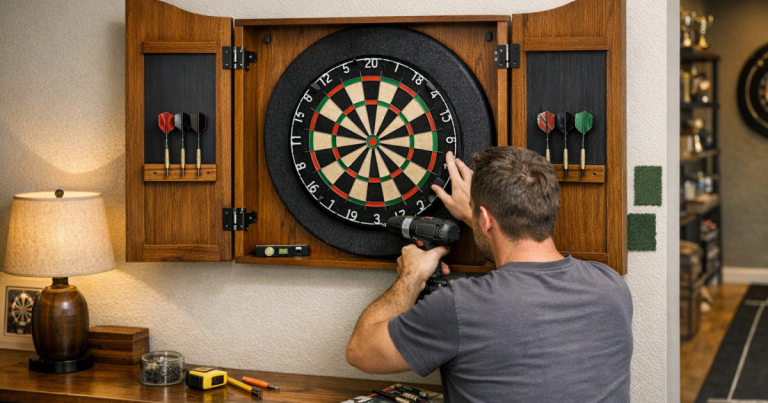
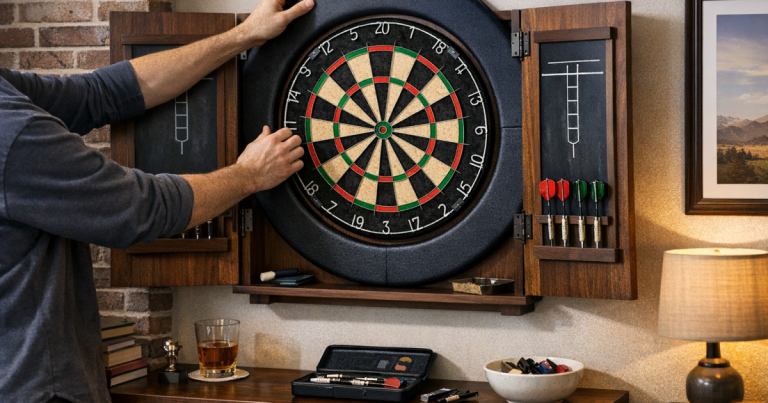
A cabinet changes the look of the setup. It hides the board when not in use, gives you somewhere to display scores or store darts, and can suit living spaces better than a permanent open board. The trade-off is coverage. Cabinet doors protect the board area when closed, but when open they do not usually shield the same round area as a foam surround.
Some players use a cabinet with extra backing behind it, while others choose a cabinet for presentation and accept a little less impact protection. For a deeper look at the differences between enclosed and open setups, see the guide to dartboard cabinets and surrounds for UK home setups.
Backboards and panels
A backing panel is worth considering where the wall matters more than the styling. This might be a garage wall you want to keep tidy, a freshly decorated spare room, or a rental home where filler and repainting would be a nuisance. Panels can be larger than a standard surround and shaped to suit the room, but they require more careful mounting and may look more permanent.
Fit: what to check before you rely on it
The phrase dartboard surround size can be misleading because fit depends on both the board and the wall area around it. A surround made for a standard bristle board should grip the outer edge of a regulation steel-tip board. It will not necessarily fit electronic boards, non-standard training boards or boards with unusual outer profiles.
Check these points before assuming a surround will work:
- Board diameter: standard bristle boards are around 451 mm, but always verify your board if it is unusual or older.
- Board depth: the surround should sit neatly around the outer edge without pushing the board forward or rocking against the wall.
- Wall clearance: allow space beyond the outer surround for your hand when removing darts, plus clearance from shelves, door frames and light fittings.
- Mounting system: some board brackets leave the board slightly proud of the wall, which can affect how flush the surround appears.
- Rotation access: if you rotate a bristle board regularly, choose a surround that can be pulled off and refitted without becoming loose or damaged.
If a surround feels too tight, do not force it so aggressively that the foam splits or the board shifts on the bracket. If it feels loose, it may sag, rotate or leave gaps around the edge. A snug fit is what you want: firm enough to stay in place, easy enough to remove when needed.
One-piece, two-piece and four-piece surrounds
One-piece surrounds are the cleanest visually. They look tidy, have no visible joins and are quick to fit over a board that is already mounted. The downside is that they need enough space to slide over the board, which can be awkward if your setup is boxed tightly into an alcove or surrounded by shelving.
Two-piece or four-piece surrounds are more modular. They can be easier to fit in restricted spaces and easier to store if the board only comes out occasionally. The trade-off is that the joins may be visible, and cheaper versions can move slightly if the pieces do not interlock firmly.
For most permanent UK home setups, a one-piece surround is the simplest option. For temporary boards, shared rooms or tight corners, a sectional design can be more practical than it first appears.
How room layout affects the decision
Surrounds are often chosen after the board is already on the wall, but the best results come from planning the whole zone. Start with the correct bull height and throw distance, then look at what sits around the board at shoulder height and above. Light switches, thermostats, glass picture frames and narrow shelves are all poor neighbours for a dartboard.
Lighting also affects surround choice. A ring light or overhead dartboard light may need clearance around the outer edge of the board. Some lighting systems clamp to, sit around or frame the board, and not every combination works neatly with every surround. Before buying or fitting anything, check whether the light and surround compete for the same space.
Colour matters more than many players expect. Black surrounds are popular because they frame the board cleanly and hide marks well. Red, blue or branded designs can brighten a games room, but they may stand out too strongly in a living area. In a small room, darker surrounds can make the board feel more compact; bold colours make it more of a feature.
Common fitting mistakes
- Mounting the board first, then discovering the surround hits a shelf: measure the full outside diameter before drilling or committing to a position.
- Assuming a cabinet gives enough protection: cabinets are tidy, but they do not automatically protect the wall around the open board.
- Ignoring the oche line: if the throw line is slightly angled because of furniture, misses may cluster to one side of the surround.
- Forgetting board rotation: a surround that is awkward to remove may discourage regular rotation, shortening the useful life of the board.
- Using a surround as a substitute for safe spacing: keep the throwing area clear and avoid placing fragile items close to the board.
What to remember
A good surround should feel like part of the setup, not an afterthought. For most steel-tip home boards, a dense foam ring around 675 mm to 700 mm across the outside gives sensible everyday protection without overwhelming the wall. If the space is used by beginners, guests or younger players, think beyond the ring and consider a wider backing area.
Material is mainly about how you use the room. Foam is practical and easy to live with. Cabinets look more discreet and can suit shared spaces. Backing panels offer broader protection where the wall finish is the priority. None is automatically right for every UK home, so measure the board zone, check the fit and choose the approach that matches the room rather than the other way round.
If you are refining the whole setup rather than just protecting the wall, browse the wider home darts setup guides on the blog for practical room-planning ideas.