A tidy darts mat setup does three useful jobs: it marks the throw line, protects the floor and makes a home board feel more like a proper playing area. The key is not simply rolling out a mat and hoping it lines up. You need the correct board height, an accurate throw distance, enough room behind the line and a surface that stays flat when people are stepping forward and back.
What to know first
For a standard steel-tip home darts setup, the centre of the bullseye should be 1.73 m from the floor. The throwing distance is 2.37 m, measured horizontally from the face of the dartboard to the front edge of the throw line. That last part matters: do not measure from the wall, cabinet door, surround or backboard. Measure from the board face, because that is where the darts land.
A mat is there to make that measurement repeatable. Once the line is correct, the mat gives you a consistent toe position and helps protect carpet, laminate, vinyl or wooden flooring from dropped darts. It also stops the setup drifting into “roughly there” territory, which is where casual home games often become inconsistent.
If you want a deeper room-by-room explanation of oche position, diagonal checks and home spacing, the detailed home darts oche setup guide is a useful companion to this mat-focused walkthrough.
The measurements that matter
Start with the dartboard, not the mat. Fit the board at the correct height first, then work forwards to the throw line. For steel-tip darts, use these core measurements:
- Bullseye height: 1.73 m from the floor to the centre of the bull.
- Throw distance: 2.37 m from the face of the board to the front edge of the line.
- Diagonal check: approximately 2.93 m from the centre of the bull to the front edge of the oche.
The diagonal check is handy in awkward UK rooms where skirting boards, uneven walls or board mounts make the horizontal measurement fiddly. It should not replace careful measuring, but it helps confirm that the height and distance are working together.
For soft-tip or electronic boards, the throw distance can differ, commonly around 2.44 m depending on the board and rules being followed. Always check the board instructions or the format you play most often before fixing a line permanently.
Where the mat should sit
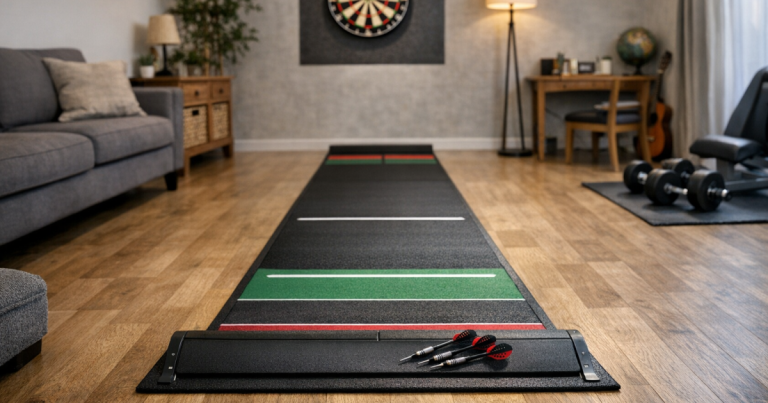
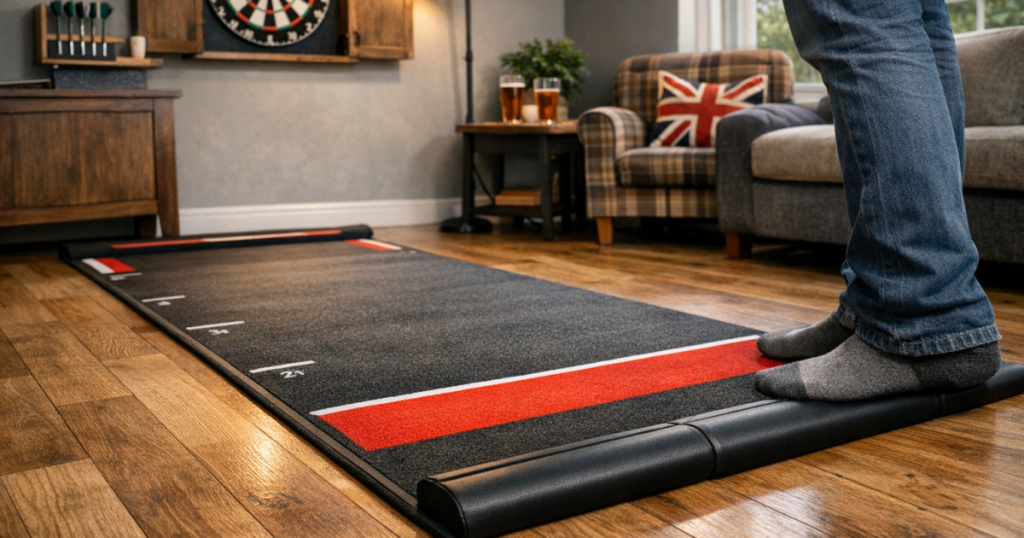
The front edge of the throw line is the point players must not step beyond. If your mat has a printed oche line, that line needs to land exactly at the correct distance from the board face. If your mat has several printed distances, use the mark that matches your board type and game format.
In many homes, the mat will sit slightly away from the wall because the board itself protrudes. A cabinet, surround or mounting bracket can make the board face several centimetres forward of the wall. That is normal, but it means measuring from the wall will put the throw line too far back.
Use a tape measure held level from the board face to the floor line. If doing this alone, place a straight edge against the board face and measure from that vertical plane. Mark the front edge of the line lightly with masking tape first, then roll the mat into position and adjust before committing to anything more permanent.
Step-by-step home setup
A careful first setup saves a lot of annoyance later. Work in this order:
- Fix or confirm the dartboard height, with the bull at 1.73 m.
- Check that the board is level and seated securely in its bracket.
- Measure 2.37 m from the face of the board to the floor, keeping the tape straight and aligned with the centre of the board.
- Mark the front edge of the throw line with low-tack tape.
- Roll the mat out so its printed line or front oche edge matches the mark.
- Stand at the line and check that your throwing stance feels natural without furniture blocking your arm or follow-through.
- Throw a few gentle practice darts, then recheck that the mat has not crept forward or twisted.
If the mat moves on hard flooring, use a non-slip underlay suitable for that floor type. On carpet, heavier rubber mats tend to sit better than very thin roll-out mats, but thick pile can still make the line feel slightly spongy underfoot.
Examples for common UK rooms
Spare bedroom or box room
Small rooms can work well if the door swing, bed frame and furniture do not interrupt the throwing lane. You need the 2.37 m playing distance plus space for your stance and a small step back after throwing. If the toe line sits directly against a wardrobe or bed, the setup may measure correctly but still feel cramped.
In a box room, a narrower mat can be more practical than a wide pub-style mat, provided the line is visible and the floor under the board has protection. Pay attention to bounce-outs too: dropped darts rarely fall neatly in one place.
Living room or dining area
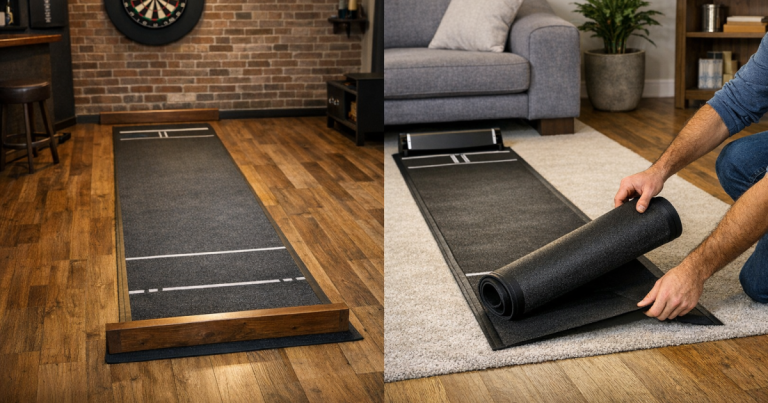
Shared rooms need a setup that can be made safe and tidy quickly. A rollable mat is useful here because it can be moved when the board is not in use. Avoid placing the throw line where people naturally walk through the room, and make sure sofas, table legs and rugs do not create a trip point near the oche.
If your board is set into a cabinet or surrounded by wall protection, measure from the actual board face after everything is fitted. A surround can also affect how much wall and floor protection you need beneath the scoring area. For the wall side of the setup, see the dartboard surround size and fit guide.
Garage or garden room
Garages and outbuildings often give you more space, but the floor can be colder, harder and less even. A heavier rubber mat is usually more stable on concrete than a thin fabric mat. Check for slopes, door thresholds and stored items behind the thrower. Good lighting also matters because shadows can make the treble segments harder to read; the dartboard lighting setup guide covers practical home lighting angles in more detail.
Floor protection and feel underfoot
A darts mat is not just a measuring tool. It also protects the area where darts are most likely to land after bounce-outs, missed doubles or dropped darts while retrieving from the board. The most vulnerable floors are soft wood, laminate edges, vinyl and light-coloured carpet.
Rubber mats give good impact protection and tend to stay put, though they can be heavier to move and may need airing when new. Carpet-style mats feel softer and can look more discreet in a living space, but they may slide on smooth floors unless backed properly. Thin roll-out mats are convenient for temporary setups, but they should lie flat with no curled corners near the player’s feet.
Whatever style you use, the mat should be long enough to cover the throw line and the landing zone beneath the board. If it stops short of the board area, you may still need a separate floor protector or a more generous mat position.
Checks before you start scoring
Before treating the setup as finished, run through a few simple checks:
- Can the thrower stand naturally with both feet comfortable at the line?
- Is the front edge of the line clearly visible under normal room lighting?
- Does the mat stay flat when stepping on and off it?
- Is there enough space behind the player for a relaxed stance and follow-through?
- Are pets, children and walkways kept away from the throwing lane while darts are in use?
- Does the line still measure correctly after the mat has settled?
It is worth rechecking the distance after a few sessions, especially with roll-up mats. Small movements are easy to miss, and a line that creeps forward by a few centimetres can change the feel of your throw without you noticing straight away.
Keeping the line accurate over time
Home setups get moved, cleaned around and adjusted. If the mat is rolled away between games, mark a discreet reference point on the floor with low-tack tape, a small floor-safe marker or a removable alignment strip. That gives you a quick way to put it back without measuring from scratch every time.
Make one edge your “true” reference edge and use it the same way every time. Some mats have printed lines that are not perfectly square to the sides, especially after being rolled tightly, so check the oche line against the board centre rather than relying only on the mat edges. If your stance is slightly to the left or right of centre, that is fine, but the line itself should still sit square to the board face.
A quick monthly check is sensible in a busy home setup, and more often if the mat is lifted for cleaning or moved between rooms. Measure from the board face again, then check that the centre of the line still points towards the centre of the bull. Small twists are common on smooth floors, and they can make the setup feel subtly wrong even when the distance looks close.
- After vacuuming, smooth the mat from the board end back towards the oche so it does not creep forward.
- If the board is removed from its bracket, recheck the height and distance once it is refitted.
- Keep a note of the correct measurement and any floor reference points, especially in shared rooms.
- Replace worn tape or markers before they become fuzzy, dirty or hard to line up accurately.
In garages, garden rooms and conservatories, temperature changes can make some mats expand, contract or stiffen slightly. Let the mat settle flat before judging the line, particularly on cold days, rather than throwing straight away from a curled or rippled surface.
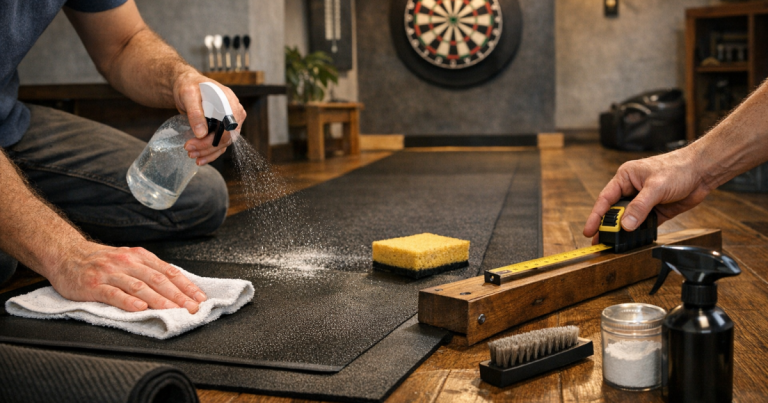
Clean the underside occasionally, because dust and grit can reduce grip on hard floors. If the corners curl, lay the mat flat in a warm room and avoid forcing it down with anything that creates a raised edge. A raised corner at the oche is more than annoying; it can affect foot placement and make the setup feel less settled.
Final thoughts
The best home throw line is the one you can trust every time you step up. Set the board height first, measure from the board face, align the mat carefully and check that the room still works in real use. A good darts mat setup should feel stable, protect the floor and make your home games more consistent without taking over the room.