Choosing a cabinet is partly about protecting the wall, but it is just as much about how your darts area behaves day to day. The main dartboard cabinet types differ in how they store darts, how their doors open, how they frame the board, and how comfortably they fit into a room that may also be used for work, family life or TV. For a UK home oche, the right choice usually comes down to three things: available wall space, how tidy you want the setup to look when play stops, and whether the finish feels at home in the room.
Main points
A dartboard cabinet is most useful when you want the board area to look contained rather than permanently exposed. It can hide the board when not in use, hold spare darts or accessories, and soften the visual impact of a full darts setup in a living room, spare room, garage or garden room.
The trade-off is that a cabinet does not protect as wide an area as a surround, and its doors need enough side clearance to open without hitting shelves, curtains, radiators or adjacent walls. If wall protection is your main concern, it is worth reading our guide on whether you need a dartboard cabinet, surround or both before settling on the look.
- Choose a cabinet for a tidier, more furniture-like darts area.
- Choose a surround for broader wall protection around the board.
- Use both only if you have the depth, clearance and visual space for a larger setup.
- Check door swing, board fit and accessory storage before worrying about colour.
Why cabinet style matters in a home setup
A cabinet changes the feel of a darts area more than many players expect. An exposed board on a plain wall looks like a practice station. A cabinet makes the same area feel more deliberate, almost like a small games corner. That matters when the oche shares space with a dining room, home office, hallway or family room.
There is also a practical rhythm to consider. Some players leave darts in the board, chalk nearby and flights scattered on a shelf. Others want everything shut away after a few legs. A good cabinet supports whichever habit you actually have, rather than the tidy routine you imagine you might follow.
For regular players, cabinet depth and access are just as important as appearance. If the board sits too recessed, the door frame can feel visually intrusive. If the cabinet is too shallow for your board and fixing system, the fit can feel awkward. If the storage is too cramped, you will stop using it and the cabinet becomes purely decorative.
The common cabinet formats
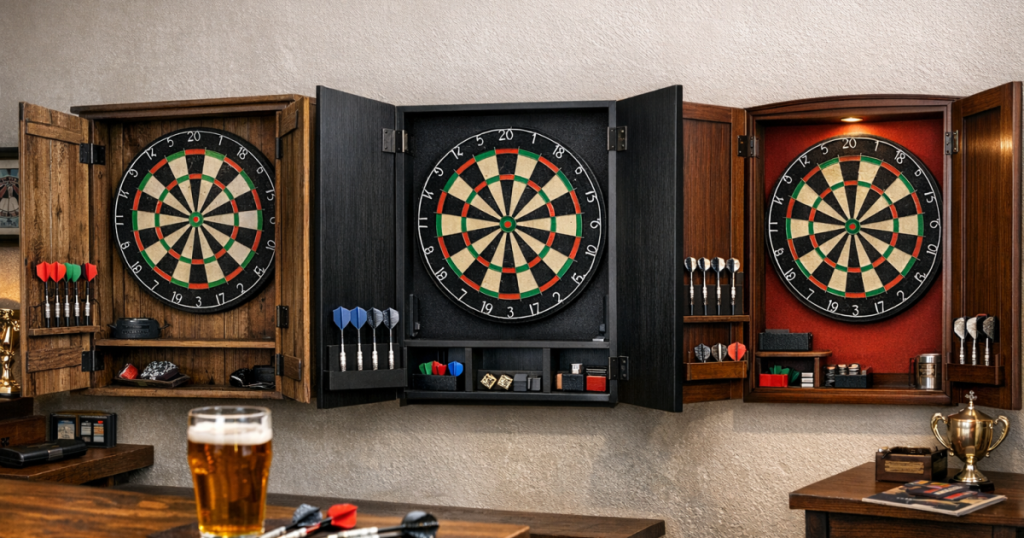
Traditional two-door cabinets
The classic format is a wall-mounted wooden or wood-effect cabinet with two hinged doors. When open, the doors often provide space for score panels or small storage areas. When closed, the board is hidden completely.
This style suits rooms where you want darts to feel tidy between sessions. It is also familiar, understated and easy to match with other furniture. The main thing to watch is width: the doors need room to open fully, so this format can be frustrating in a narrow alcove or beside a bookcase.
Compact cabinets
Compact versions keep the same basic idea but reduce the visual bulk. They may have slimmer side panels, less storage or a simpler internal layout. These are useful where the board is in a smaller spare room, garage wall or multipurpose corner.
The compromise is that compact cabinets often feel less generous for accessories. If you routinely keep multiple sets of darts, spare stems, flights, chalk or a checkout card nearby, check that the internal storage is not just decorative. Small shelves are handy only if they suit the items you actually use.
Cabinet sets
Some products are sold as a complete set with a board, cabinet and basic accessories included. These can be convenient for casual home play, but quality varies, and the included board may not be what a regular player would choose for long-term practice.
If you already care about board feel, staple-free wiring, sisal recovery or bounce-outs, treat the cabinet and board as separate decisions. A cabinet set can still be fine for occasional use, but a more committed home player may prefer choosing the board first and then finding a cabinet that fits it properly.
Decorative and furniture-style cabinets
Some cabinets are designed to blend into a room rather than look like sports equipment. They may use darker finishes, framed doors, cleaner lines or more furniture-like detailing. These are often chosen for lounges, dining rooms and garden rooms where appearance matters as much as function.
The risk with decorative styles is prioritising the outside and ignoring the throwing area. The interior still needs enough clearance around the board, secure mounting points and a layout that does not distract your sightline. A cabinet that looks excellent closed but feels cramped open will annoy you every time you play.
Storage: useful space or wasted space?
Cabinet storage is helpful only when it matches your darts routine. A casual household might need space for one or two sets of darts and a chalk pen. A regular player might want room for spare flights, stems, a flight punch, checkout notes and a small cloth for board maintenance.
The most useful storage features are simple rather than clever. A shallow shelf, small dart holders and a place for chalk or a marker can keep the oche tidy without making the cabinet bulky. Deep compartments are less common and can encourage clutter, especially if several people use the setup.
- Dart holders: useful if they grip securely and do not force darts to sit at awkward angles.
- Small shelves: good for flights, stems and chalk, but check they do not block the board or door movement.
- Score panels: handy for casual legs, though many players prefer a separate scoreboard or app-free paper system.
- Door storage: convenient, but only if items do not rattle or fall when the doors close.
- Hidden storage: neat when closed, but less convenient if you have to move items before every session.
Before choosing a style, picture the end of a normal night of darts. Will you put everything away properly, or will you leave match darts, spare shafts and flights on a nearby table? If the latter sounds familiar, choose a cabinet with quick-access storage rather than tiny compartments that demand perfect organisation.
Door design and clearance
Doors are the defining feature of a cabinet, but they are also the part most likely to cause everyday irritation. A cabinet can look ideal online and still be awkward if one door hits a side wall, mirror, curtain pole or shelf.
Two-door hinged designs are the norm. They open wide and create a balanced look, but they need clear space to both sides. In a narrow recess, a cabinet may be better positioned slightly away from the corner, even if that means changing the room layout. The board should still sit at the correct height and leave a clear throwing lane.
Pay attention to what is on the inside of the doors as well. Scoreboards, clips and storage inserts can be useful, but they add visual detail around the board. Some players like that traditional pub feel. Others prefer a cleaner sight picture with fewer distractions near the treble ring.
Door closure also matters in shared spaces. Magnets, catches or simple closing mechanisms should keep the cabinet shut without needing a slam. If the cabinet is in a hallway or family room, smooth closing and neat alignment will matter more than it does in a dedicated garage oche.
Finishes: matching the room without compromising the board area
The finish is the first thing most people notice, but it should be the last thing you finalise. Start with fit, storage and wall coverage, then choose the look that best suits the room.
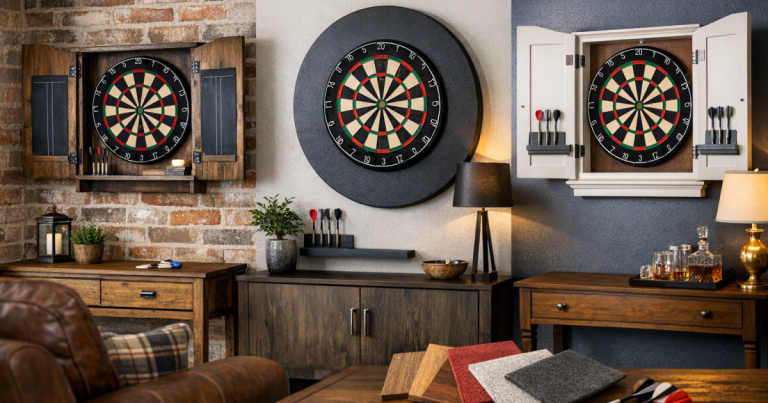
Wood-effect finishes are popular because they make a darts setup feel more like furniture. Darker finishes can suit pubs, games rooms and garden rooms, while lighter or plainer finishes may work better in modern interiors. Painted or black cabinets can look sharp, but they may show dust, chalk marks or knocks more clearly depending on the surface.
Glossy finishes can catch light. That does not automatically make them unsuitable, but it does mean you should think about glare. A cabinet door that reflects a ceiling light or nearby window can be distracting when open. Matt or satin-style finishes usually feel calmer around the board, particularly in smaller rooms.
The inside finish deserves attention too. A very dark interior can frame the board nicely, while a pale interior may brighten the area but show marks more easily. Neither is automatically better. The right choice depends on your lighting, wall colour and whether you want the cabinet to stand out or disappear into the background.
How the cabinet works with the board, surround and room
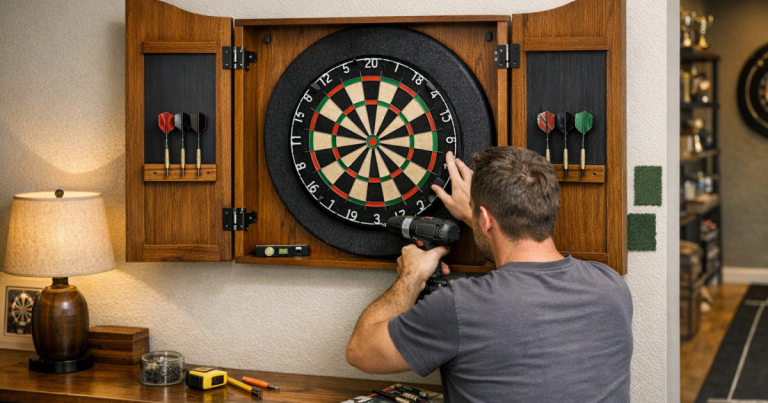
A cabinet is only one part of the wall setup. It has to work with the dartboard, fixings, lighting and any wall protection around it. The board should sit securely, with the bull at the correct height, and the cabinet should not make rotation or maintenance awkward.
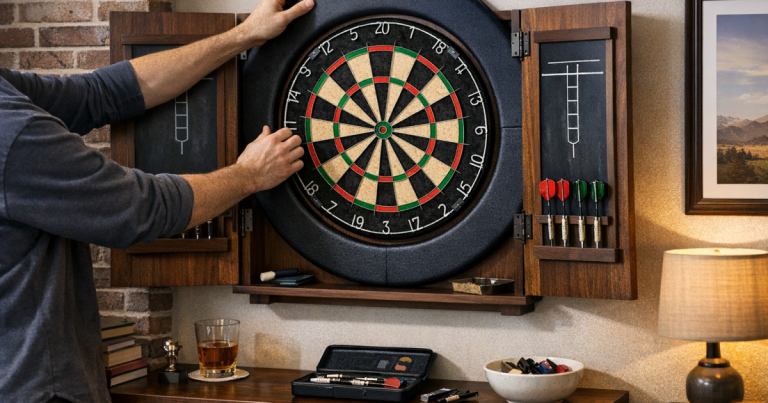
If you use a quality bristle board, check that the cabinet does not make regular rotation difficult. Board rotation helps spread wear, especially around popular scoring areas. A cabinet that gives easy access to the number ring and mounting area will make this routine less of a chore.
For more detail on practical cabinet details, the separate guide to dartboard cabinet features that matter goes deeper into fit, construction, scoring panels and everyday usability.
Lighting is another overlooked factor. A cabinet creates edges and shadows around the board, particularly if the room relies on a single ceiling light. Even a good-looking setup can become frustrating if the treble bed falls into shadow or the door casts uneven light across one side of the board. Our explanation of darts lighting zones is a useful next step if your cabinet is part of a broader room upgrade.
Different rooms, different priorities
Living rooms and dining rooms
In shared rooms, the cabinet’s closed appearance often matters most. A clean finish, tidy doors and hidden storage help the darts area feel intentional rather than temporary. Door clearance is important because these rooms usually have furniture, picture rails, lamps or curtains competing for wall space.
Garages and utility spaces
In a garage, durability and practicality may matter more than finish. You may be less concerned with hiding the board and more concerned with keeping darts, chalk and accessories in one place. Watch for damp conditions, uneven walls and clutter near the throwing lane.
Garden rooms and home bars
These spaces often suit larger or more decorative cabinets because the darts area is part of the room’s character. A darker cabinet can look at home in a bar-style setup, while a cleaner finish may suit a modern garden office that doubles as a practice space.
Bedrooms and spare rooms
Compactness is usually the priority. A smaller cabinet with modest storage can work well, provided the doors do not clash with wardrobes or shelving. If the room is also used for guests, a cabinet that closes neatly helps the board disappear when not in use.
Common mistakes to avoid
- Choosing on finish alone: a good-looking cabinet can still be awkward if the doors hit nearby furniture or the storage is poor.
- Ignoring the surround question: a cabinet frames the board, but it does not give the same wide protection as a separate surround.
- Forgetting board rotation: make sure you can access the board easily enough to rotate it and maintain it.
- Underestimating visual clutter: busy score panels, bright interiors and exposed accessories can distract some players.
- Mounting too close to a corner: leave enough space for the doors to open and for the throwing area to feel natural.
Questions people ask
Can any bristle dartboard fit in a cabinet?
Many standard bristle boards will fit many standard cabinets, but do not assume universal compatibility. Check the cabinet’s internal space, mounting method and depth against your board before committing.
Does a cabinet protect the wall as well as a surround?
No. A cabinet protects and frames the immediate board area, but a surround usually covers more wall space around the scoring area. Less accurate throwers may benefit from broader protection.
Are scoreboards inside cabinet doors worth having?
They are useful for casual play and quick legs at home. Regular players may still prefer a separate scoreboard if they want more space, clearer writing or a less cluttered view around the board.
Should the cabinet match the furniture in the room?
It helps, especially in shared living spaces, but fit and usability should come first. A matching finish will not compensate for poor door clearance or awkward storage.
Can I use a cabinet with a dartboard light?
Often, yes, but check how the light mounts and whether the cabinet doors can still open freely. Also watch for shadows from the cabinet frame or reflections from the door finish.
Key takeaways
The right cabinet is the one that makes your darts area easier to live with, not just better to look at. Traditional two-door cabinets suit tidy shared spaces, compact cabinets help in smaller rooms, and decorative styles work well when the oche is part of a finished games room or home bar.
Storage should be judged by real habits: where your darts, flights, stems and chalk will actually go after a session. Door design should be judged by clearance and sightline, not just appearance. Finishes should complement the room while avoiding glare and unnecessary visual distraction.
If you already have the board, measure and plan around it. If you are building the whole setup from scratch, decide first how much wall protection you need, then choose a cabinet style that supports the way you play, store and maintain your darts gear.