A good league-night routine starts before you reach the oche. The aim is to pack a dart case so your match darts, spares, scoring items and small essentials are easy to find without overloading your pockets.
Think of your case as a match kit, not a storage drawer. It should carry what you are likely to use during one evening, with enough backup to handle broken flights, loose shafts and scoring duties calmly.
Main points
- Keep your match darts assembled and protected wherever the case design allows.
- Carry spares that match your usual setup, not random leftover parts.
- Separate scoring items, repair bits and personal essentials into clear sections.
- Check the case before leaving home, then reset it after the match.
- A slim, tidy case is usually more useful on league night than a bulky case full of rarely used gear.
Step 1: Start with your match darts
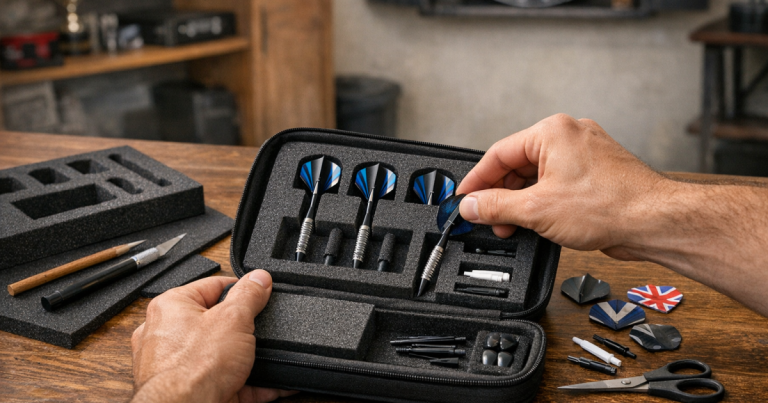
Your first priority is the set you actually throw with. Put your three match darts in the main protected section of the case, ideally with flights kept in shape and points covered by the case insert. If your case needs the darts to be broken down, keep the barrels, shafts and flights together in the same section so you are not rebuilding them from memory in a busy pub or club.
Check the darts before they go in. Look for a loose point, cracked flight, bent shaft, damaged stem thread or dirt in the grip. Small faults feel much bigger when you are already under match pressure, so deal with them at home rather than at the venue.
League night is not the best time to experiment with a completely different setup. If your barrels, grip or balance still feel unsettled, spend time refining them between fixtures; our guide on choosing darts for your grip and throwing style is a useful next step before changing your match kit.
Step 2: Add spares by likely failure points
Do not fill the case with every accessory you own. Pack spares based on what commonly fails during a match: flights get torn, shafts can snap, rings go missing, and points can occasionally need attention depending on your setup.
Spare flights
Carry at least one full spare set of the same flight shape and thickness you normally use. If you prefer standard flights, do not rely on a spare set of slim flights just because they happen to be in the drawer. A different shape can change the feel of the dart enough to distract you.
Spare shafts
Take a matching set of shafts in the same length and style as your match setup. If you normally use Harrows Supergrip Shafts, for example, pack a like-for-like spare rather than a mismatched stem that alters the balance of the dart.
Rings, flight protectors and small bits
If your flights and shafts use rings or punch systems, keep a few extras in a tiny resealable bag or small compartment. Loose rings scattered around the case are easy to lose, especially under pub lighting or on a dark table.
Point-related items
Only carry point tools or spare points if they genuinely apply to your darts and you know how your system works. For most players, the more useful routine is simply checking point condition at home and making sure the darts grip the board reliably before leaving.
Step 3: Include a compact scoring kit
Many league venues provide boards and scoreboards, but it is still sensible to carry a small scoring backup. A pencil, chalk, dry-wipe marker or small cloth can save time if the home setup is incomplete or shared between boards.
Keep scoring items separate from flights and shafts. Chalk dust, pen marks and eraser crumbs do not belong in the same pocket as your spare flights. A small sleeve or zipped side pocket keeps everything cleaner.
If your league uses chalkboards regularly, it is worth having a tidy method rather than scribbling over old scores. The same habits that keep a home board readable apply at venues too, and our advice on keeping a chalk scoreboard neat during longer matches is handy for markers as well as players.
Step 4: Lay the case out so it works under pressure
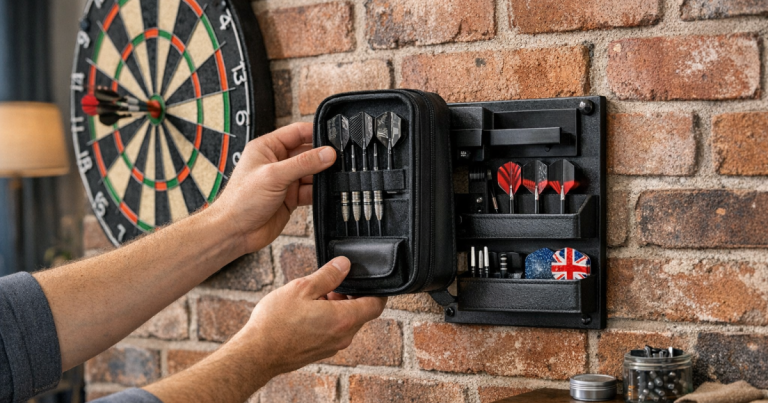
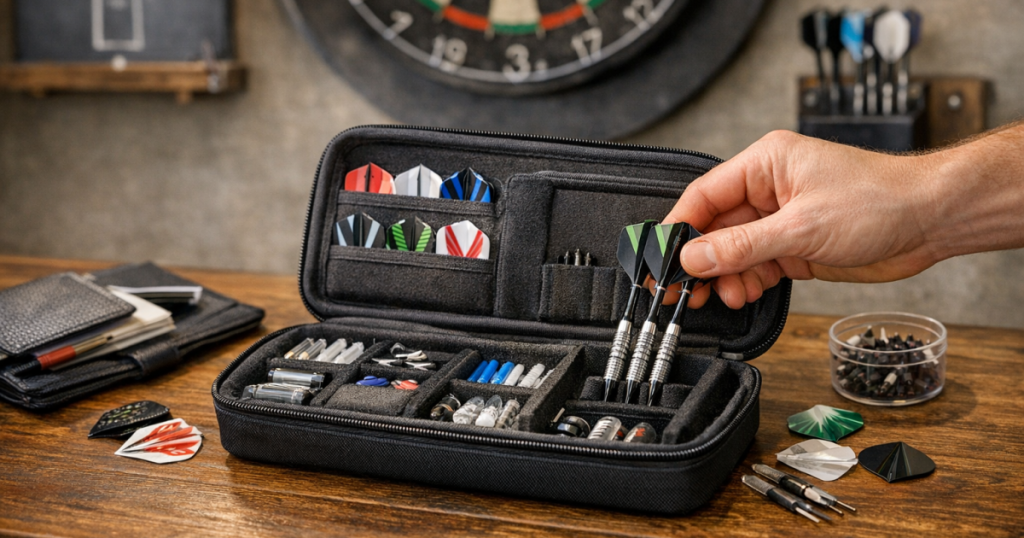
The best case layout is the one you can use quickly between legs. Put the items you touch most often in the easiest places to reach. Match darts should be obvious, spare flights should be visible, and small repair parts should not be loose at the bottom.
- Main section: match darts, kept assembled if the case supports it.
- First small pocket: one spare set of flights and one spare set of shafts.
- Mini pouch or tin: rings, spare flight protectors, washers or small repair parts.
- Side pocket: chalk, marker, pencil, cloth or scoring card.
- Back pocket: fixture sheet, league card or venue notes if you use them.
Make the case usable in low space. League matches are often played around crowded tables, coats, drinks and other players’ kit. If you need to empty the entire case to find one shaft, the layout is too complicated.
Step 5: Do a two-minute check before leaving
A quick pre-match check prevents most case problems. Build it into the same routine as picking up your keys and phone, so it becomes automatic.
- Are all three match darts in the case?
- Are the points clean and secure?
- Are the flights seated properly and not badly split?
- Is there at least one matching spare flight set?
- Is there at least one matching spare shaft set?
- Are tiny parts sealed in a pouch rather than loose?
- Have you packed any scoring item your league night usually needs?
- Is the case closed properly, with no flights being crushed?
If you share transport or walk to local fixtures, also think about weather. A fabric case inside a coat pocket or bag is usually better protected than one carried loose in heavy rain.
What to leave at home
Overpacking sounds safe, but it often makes the case harder to use. Leave bulky extras at home unless you know you will need them.
- Multiple untested dart sets: they invite mid-match tinkering and uncertainty.
- Random old flights: damaged or unfamiliar flights rarely help under pressure.
- Loose sharp accessories: keep anything pointed or abrasive contained.
- Full accessory boxes: useful at home, awkward on a pub table.
- Non-matching shafts: emergency spares are only helpful if they keep the dart feeling familiar.
Keep the bigger stock of accessories at home and treat the league case as a smaller travelling version. That way, your match kit stays lean while your home setup remains properly stocked.
Reset the case after the match
The best time to fix the case is when you get home, not five minutes before the next fixture. Open it, remove any damaged parts, wipe down the darts if needed and replace whatever you used during the evening.
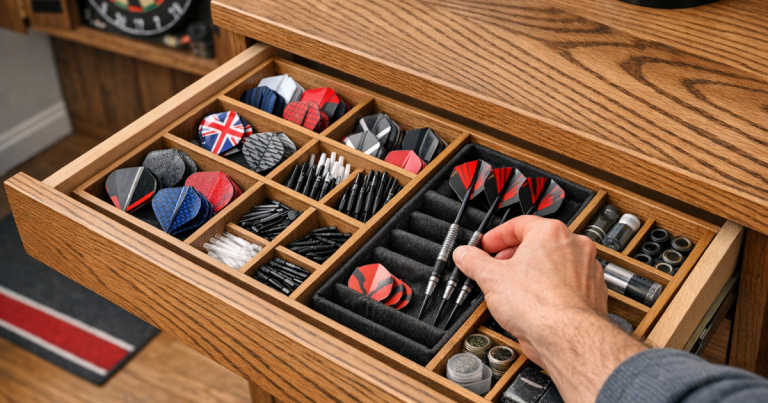
This is also when a simple home storage system pays off. If spare flights, shafts and points are already sorted, restocking the case takes seconds rather than turning into a drawer search. For a better home routine, see our guide to organising spare flights, shafts and points at home.
Make a note if you repeatedly use the same spare. For example, if you often replace flights but never touch the extra shafts, keep the shaft count modest and increase the number of matching flights. Your case should reflect your actual match-night habits.
Helpful questions
What is the easiest way to pack a dart case for a first league night?
Start with your match darts, one matching spare flight set, one matching spare shaft set, a pencil or marker, and any league card or fixture details you need. Keep everything in separate pockets so you can find it quickly.
Should I carry a second full set of darts?
Only if you already practise with that second set and trust it. A backup set can be reassuring, but switching to unfamiliar darts mid-match often creates more problems than it solves.
How many spare flights should I take?
One full matching set is enough for many players, but two sets are sensible if you play long evenings, use softer flights, or regularly damage flights through tight grouping.
Is a hard case better than a soft case for league nights?
A hard case gives better protection for assembled darts and flight shape. A soft case can be lighter and easier to carry. The better choice is the one that protects your setup and fits neatly in your bag or pocket.
Should I clean my darts before every match?
A quick wipe is enough for most players. Keep the grip free from chalk, sweat and dust, and check that the points and shafts are secure before the darts go back into the case.
Final thoughts
A league-night dart case should make you calmer, quicker and more organised. Keep the contents focused on your real match setup, carry sensible spares, separate scoring items, and reset the case after every fixture. Once the routine is set, you can arrive, warm up and play without rummaging for a missing flight or borrowed pencil.