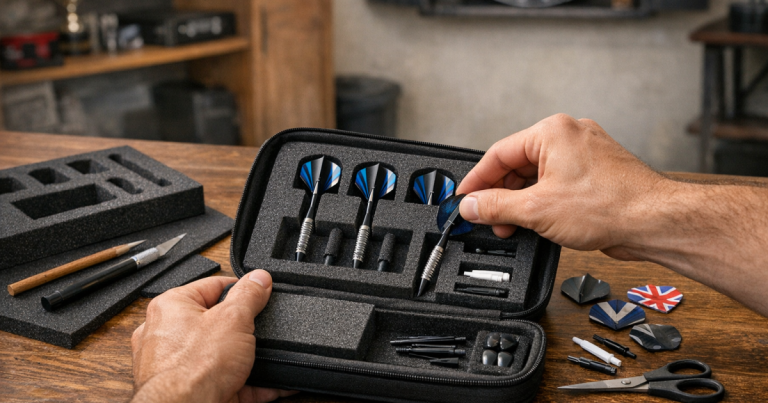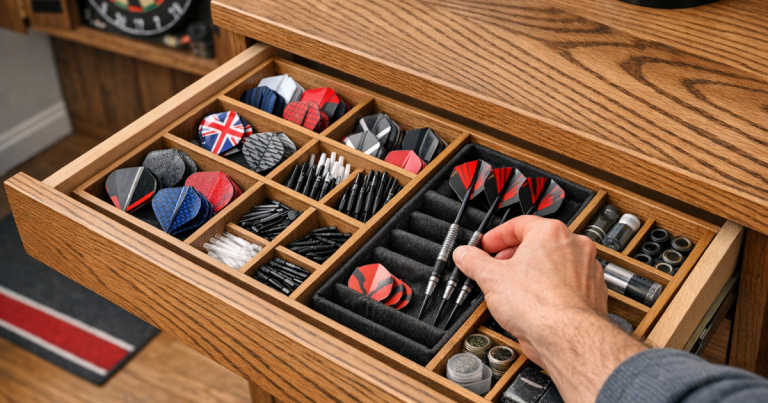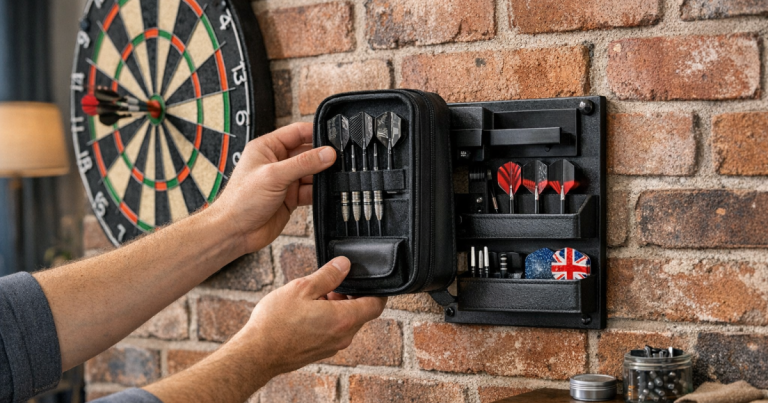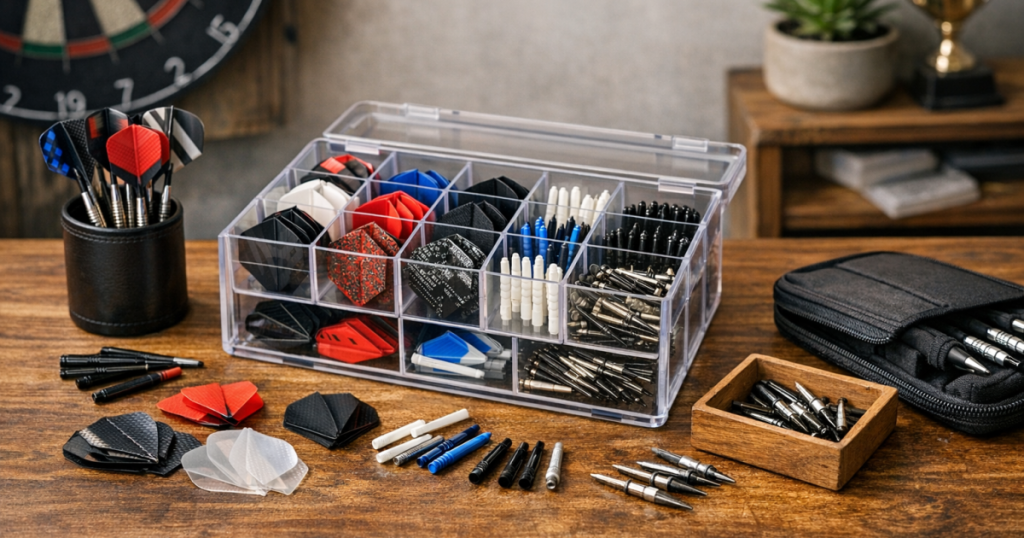
A simple system to organise spare darts accessories stops small parts disappearing just when you want a quick throw. Flights get bent, shafts crack, and spare points are easy to misplace, so the aim is to keep every item visible, protected and close to the board without cluttering the oche.
The best setup is not necessarily a large one. For most home players, a small drawer, a few labelled compartments and a match-night pouch will do more good than a box full of loose packets.
The short version
- Keep flights, shafts and points in separate sections so you can find a full matching set quickly.
- Store new, used and damaged parts apart from each other to avoid fitting worn spares by mistake.
- Use small compartments, grip-seal bags, tubes or a darts wallet rather than one loose tin.
- Keep only match-ready spares near the board; store bulk extras away from the throw line.
- Review the box monthly and remove bent flights, cracked shafts and blunt or damaged points.
Step 1: Empty everything and sort by part type
Start by tipping your spare parts onto a clear table, not the floor. Separate them into three main piles: flights, shafts and points. Add a fourth pile for small extras such as flight protectors, stem rings, spare O-rings, point cones or tools if you use them.
Within each pile, sort again by practical use. Flights can be grouped by shape, thickness or set. Shafts can be grouped by length and material. Points should be grouped by type and condition, with sharp or unused points kept capped or in a sealed container.
This first sort is where most clutter disappears. A surprising number of spare parts in a home darts setup are not really spares at all: they are bent flights kept out of habit, shafts with tiny cracks, or odd single pieces from sets you no longer throw. Keep anything still useful, but be honest about what is only taking up space.
Step 2: Build three clear storage zones
A tidy darts drawer works best when each part has its own zone. You do not need specialist furniture; a shallow organiser, a small tackle-style box, a drawer insert or a darts wallet can all work well. What matters is that parts cannot slide into each other.
Flights zone
Flights should be stored flat where possible. Keep sets together in their original sleeves, small envelopes or separate compartments. If you use several shapes, label them in plain language such as standard, slim, kite or pear. Avoid overfilling a tight compartment because curled or crushed flights will not sit properly in the shaft.
Shafts zone
Shafts are easier to manage when grouped by length and thread type. Most home players mainly need a few matching sets, not a drawer full of odd singles. Keep each set of three together, and store spare rings or collars in a tiny bag beside the shafts they belong with.
Points zone
Spare points need more care because they are small, sharp and easy to drop. Use a rigid tube, small screw-top container or lidded compartment. Keep used points separate from unused ones, and do not leave loose points in a drawer where they can scratch other gear or prick your fingers.
Step 3: Separate match-ready spares from bulk spares
One of the most useful habits is to create two levels of storage: a small match-ready kit and a larger home stock. The match-ready kit should hold only the parts you would actually fit during a game: one or two sets of flights, one or two sets of shafts, and any small fitting accessories you regularly use.
The larger stock can live in a drawer, cabinet or storage box away from the board. This is where you keep unopened flight packs, alternative shaft lengths, spare points and less-used setups. Keeping bulk storage out of the playing area stops the board space turning into a general dumping ground.
If your board sits in a cabinet, use it carefully. Cabinets are great for the items you reach for often, but they should not become overloaded with every spare part you own. For ideas on keeping board-area storage tidy without making the setup feel cramped, the Dart World dartboard storage cabinet review is a useful reference point.
Step 4: Label by use, not just by name
Labels work best when they help you make quick decisions. Instead of only labelling a section “flights”, add a use-based note such as “match flights”, “practice flights”, “old but usable” or “try later”. This stops your best spares being mixed with test parts you are not yet sure about.
For shafts, a simple label such as “short nylon”, “intermediate aluminium” or “current setup” is usually more useful than a brand name. For points, labels should focus on condition: “new”, “removed”, “check before fitting” or “discard”.
If more than one person uses the home oche, give each player their own small pouch or compartment. Family darts nights quickly create confusion when similar black shafts, clear stems or standard flights end up mixed together. A player-by-player section keeps the peace and makes it obvious when someone is running low on spares.
Step 5: Keep a small repair and changeover area
Changing flights and shafts in a rush is when parts get lost. Set up a small changeover spot beside, not on, the playing area. A tray, shallow dish or section of the cabinet shelf gives you somewhere to put the dart, the old part and the new part while you make the swap.
Do not place loose parts on the floor near the oche. They are easy to tread on, and they can distract players during a throw. If you are refining the area around the toe line, it is worth checking your setup against the oche measurements, toe line rules and mat alignment guide so storage, mats and accessories do not creep into the throwing space.
A small parts tray also helps with post-game resets. At the end of a session, return full sets to their compartments and put damaged items into a separate “check” section. That small habit prevents the familiar problem of finding a broken shaft only when you are about to start playing.
Step 6: Use a simple condition system
Spare parts do not all age in the same way. Flights usually show visible damage first: split edges, soft corners, creases or a shape that no longer sits flat. Shafts can look fine until a prong cracks or the thread starts to feel unreliable. Points may become blunt, marked or awkward to fit depending on how they have been used.
Create three condition groups:
- Ready: clean, matching parts you would use immediately in a game.
- Practice: usable parts with minor wear that are fine for casual throwing.
- Remove: bent, cracked, split, blunt or mismatched parts that should not go back into your kit.
This system is particularly helpful if you test different setups. You can keep experimental parts without letting them contaminate your match-ready spares. It also makes it easier to spot genuine gaps, such as having plenty of flights but no complete shaft sets left.
Step 7: Choose storage that fits your room
The right storage depends on where your board lives. A spare bedroom setup may only need a neat drawer and a compact darts wallet. A garage or garden room setup may need a lidded organiser to keep dust and damp away from flights and metal parts. A living-room board usually benefits from concealed storage so the area looks tidy when not in use.
For wall-mounted setups, think about where storage sits in relation to the board, scoreboard and lighting. Parts should be close enough to reach between legs, but not so close that they crowd the scoring area. If your board area is also used for marking games, the guide to placing a darts scoreboard for easy match scoring can help you avoid clashes between storage and scoring position.
Whatever room you use, keep the system realistic. If a storage box has to be opened, unpacked and rebuilt every time you need a flight, you will stop using it properly. The best system is the one you can reset in under a minute after a session.
A monthly reset routine
Once a month, give the organiser a quick check. It does not need to be a full clear-out every time; five minutes is enough if the system is already in place.
- Put loose flights back into complete sets of three.
- Remove cracked shafts and any single shafts you are unlikely to match again.
- Check points are capped, contained and not mixed with flights.
- Move worn but usable parts into a practice section.
- Restock the match-ready pouch from your main storage.
- Wipe dust from the storage tray, drawer or cabinet shelf.
This routine keeps your darts area feeling intentional rather than cluttered. It also makes it easier to tell when you genuinely need more spares, instead of buying duplicates because you cannot find what you already own.
Common mistakes to avoid
- Keeping everything in one tin: it feels simple, but flights bend, points scratch other parts and matching sets become hard to find.
- Saving every damaged part: a cracked shaft or split flight is not a useful spare if it will fail during play.
- Storing points loose: keep them in a rigid, closed container so they do not cause damage or injury.
- Mixing test setups with regular spares: experimentation is useful, but match-night spares should stay separate.
- Letting storage spread onto the oche: accessories belong beside the playing area, not on the throw line or mat.
Common questions
How many spare flights should I keep at home?
Keep enough for your regular setup and a few practice sets. For most home players, several complete sets are more useful than a large pile of odd single flights.
Should I store flights assembled or flat?
Flat storage is usually tidier and helps prevent crushing. If you keep a spare set assembled for quick changes, protect it in a wallet or separate compartment.
What is the safest way to store spare dart points?
Use a small rigid container with a secure lid, and keep points away from loose flights and shafts. Store used and unused points separately.
How do I stop shafts and flights getting mixed between players?
Give each player a labelled pouch, drawer section or small bag. It is the easiest way to keep personal setups intact in a shared home darts area.
Do I need a dedicated darts cabinet for spare parts?
No. A cabinet can help, but a small organiser or drawer works well if it keeps parts separated, visible and easy to reset after play.
What to remember
Good darts storage is about speed, protection and consistency. Keep full sets together, separate match-ready parts from bulk spares, and give sharp points their own secure container. Once your flights, shafts and points have clear homes, your board area feels calmer and your setup is easier to maintain.
The simplest test is whether you can replace a flight or shaft during a game without rummaging. If you can open one compartment, find a matching part and return the old one to the right place, your system is doing its job.