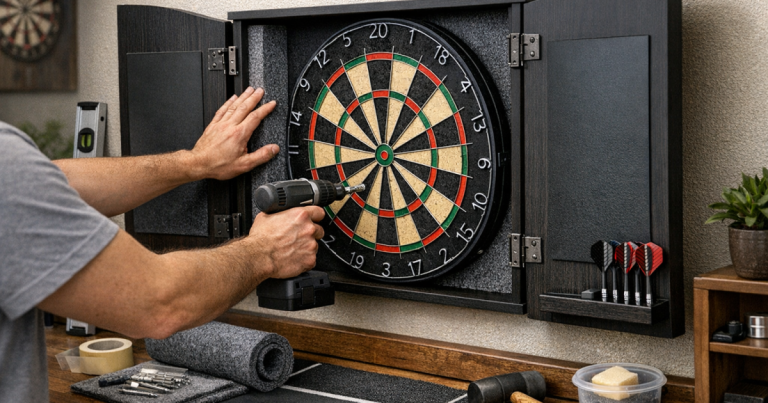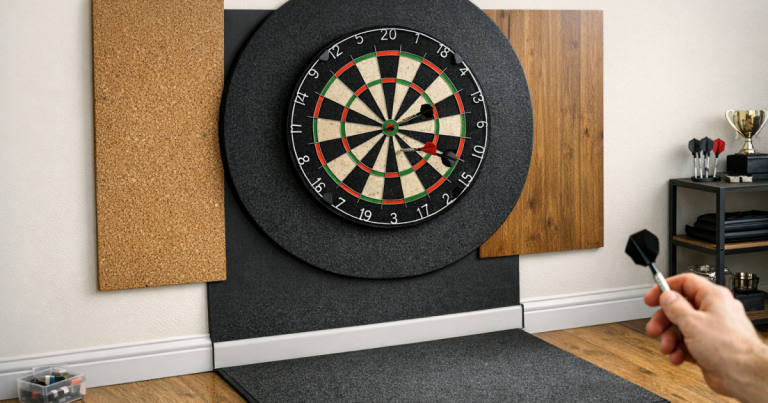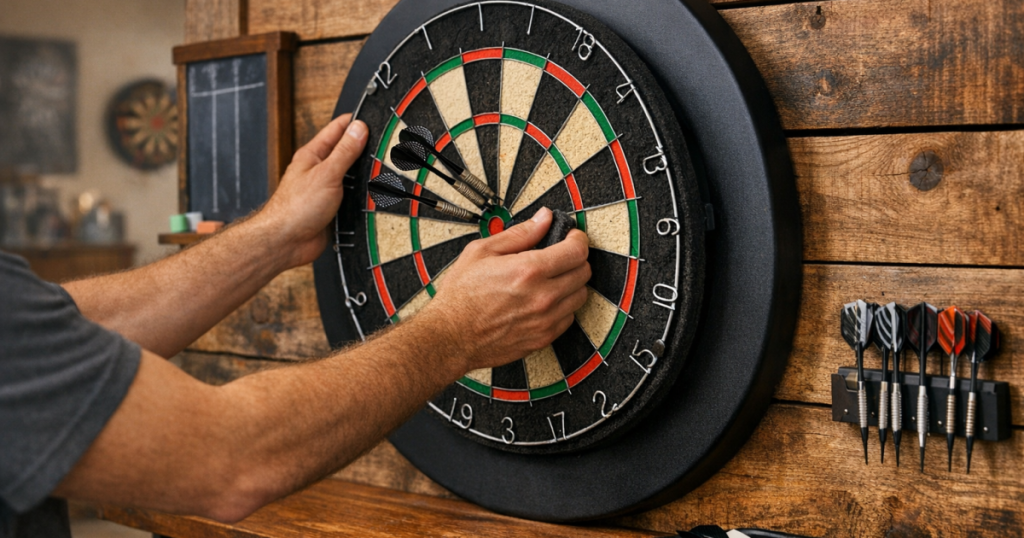
A bristle board wears fastest around the treble 20, 19 and bull, so a small maintenance habit can add months of cleaner play. The simple answer is to rotate a bristle dartboard regularly, while leaving the number ring in the correct position.
Done properly, rotation spreads dart impact across fresh sisal fibres without changing the height, oche distance or feel of your home setup. It takes less than a minute once you know what to move and what to leave alone.
At a glance
- Turn the dartboard body, not the whole wall fitting.
- Move the removable number ring back so 20 is at the top.
- Rotate little and often, rather than waiting until one treble bed is badly worn.
- Check for loose fibres, raised wires and soft spots while the board is in your hands.
- Avoid soaking, brushing hard or sanding the face; bristle boards need dry, gentle care.
What rotation actually does
A bristle dartboard is made from compressed sisal fibres. When a dart enters the board, those fibres part and then close again after the dart is removed. Over time, the most-used segments receive more impact than the rest of the board, especially if you practise trebles or play standard 501 legs.
Rotation gives the heavily used scoring zones a rest by moving a less-worn section into the high-traffic position. The number ring is then moved separately so the board still reads correctly, with 20 at the top and 3 at the bottom.
This matters because most home players do not wear a board evenly. Treble 20, treble 19, treble 18 and the bull usually take far more hits than low-value single areas. Without rotation, you can end up with one ragged treble bed while the rest of the board still looks almost new.
How often should you turn the board?
For a casual home setup used a few times a week, rotate the board every two to four weeks. If you practise daily, run home league nights, or spend long sessions on treble 20 drills, rotate it weekly. The exact timing matters less than consistency.
A good rule is to turn the board before visible damage becomes obvious. If darts start falling out of one treble section, or the fibres look flat and dark compared with neighbouring areas, you have left it too long.
If you are using a cheaper or older board, inspect it more often. Softer sisal, poorly fitted wires and loose staples can all make wear show sooner. If you are unsure whether a board is worth keeping or replacing, the checks in checking dartboard quality before you buy are also useful when judging an existing board at home.
Step-by-step: the clean way to rotate it
1. Remove the darts and clear the area
Take all darts out of the board first. Do not rotate the board with darts still in place, as you can drag points through the sisal or catch a wire. Clear the floor below the board as well, especially if you use a cabinet, surround or mat.
2. Take off the number ring
Most modern bristle boards have a removable metal number ring clipped around the outer edge. Lift it away gently and put it somewhere flat. Do not bend it, force it, or use it as a handle for the board.
If the number ring is stiff, ease it off evenly rather than pulling hard from one point. A bent ring can sit unevenly later, which makes the board look messy and can distract your eye at the oche.
3. Turn the board body on its bracket
Keep the wall bracket or cabinet fitting where it is. Hold the board securely with both hands and turn the board body by a few segments. Many players move the 20 segment down to where 8, 11, 14 or another lower-use segment was sitting. The aim is simply to move worn areas away from repeated impact.
Do not worry about following a perfect mathematical sequence. What matters is that the worn treble areas are no longer sitting at the top, and that no single section is left in the main scoring position for too long.
4. Refit the number ring with 20 at the top
Once the board has been turned, clip the number ring back on so 20 is at the top centre. Check that 3 is at the bottom and the order runs correctly around the board. This is the part beginners sometimes miss: the numbers move independently from the board face.
Stand back at the oche and confirm the board looks square. If your cabinet doors, surround or light make the board appear slightly off, adjust the ring rather than twisting the whole setup out of alignment.
5. Check height and stability
Rotation should not change the bull height if the bracket stays fixed. Still, it is worth checking that the board has seated properly and is not rocking. The centre of the bull should remain 1.73 m from the floor in a standard steel-tip setup.
If the board wobbles, check the rear screw and any stabilising feet or wedges. A board that moves when darts land will wear unevenly and can make bounce-outs more likely.
Small checks to do while the board is off-centre
Rotating the board is also the best time to catch maintenance issues early. You are already looking closely at the face, so take ten seconds to inspect the areas that usually fail first.
- Treble beds: look for flattened sisal, gaps, lifting wires or sections where darts no longer grip well.
- Bull area: check for heavy pitting, especially if you practise doubles and bull finishes often.
- Outer edge: make sure the number ring clips still sit securely and do not scrape the face.
- Mounting point: check the board is sitting flush on the bracket and not leaning forward.
- Surround or cabinet: check that nothing rubs against the rotating board body.
Good lighting makes these checks far easier. Shadows across the treble bed can hide raised fibres and loose wires, so if your setup is hard to inspect, it may be worth improving how you light a dartboard without glare or shadows.
What not to do to a bristle board
Do not soak, spray or steam a bristle dartboard. Modern sisal boards are designed to be used dry, and adding moisture can swell fibres unevenly, soften the board, stain the surface or affect the glue and backing.
Do not sand the surface either. It may seem like a quick way to tidy loose fibres, but it can damage the printed face and disturb the compressed sisal. If a few fibres are standing proud, leave them alone unless they are clearly interfering with play.
Avoid twisting darts out aggressively. Pull them straight out with a slight controlled turn if needed, rather than levering them sideways. Sideways force widens holes and can stress the wires.
Finally, do not use the same worn section as a permanent practice target just because it is already damaged. That only speeds up failure. Rotate early, spread the load, and your board will stay more consistent.
A simple rotation routine for home players
For most home darts setups, the easiest system is to build rotation into another habit. Turn the board at the start of each month, after every few long practice sessions, or whenever you clean around the cabinet.
If several people use the same board, rotate it more often. Family games, casual visitors and mixed practice routines can create scattered wear, but the top trebles still usually take the most punishment.
In a living room or shared space, combine board care with end-of-play checks. Put darts away, close the cabinet if you use one, make sure the floor is clear, and confirm the area is safe between sessions. For homes with children around, the advice on how to childproof a dartboard area between games pairs naturally with a regular maintenance routine.
When rotation is no longer enough
Rotation extends the useful life of a bristle board, but it cannot rescue one that has fully broken down. If darts fall out across several segments, the bull is badly cratered, or the wires are lifting enough to affect play, the board is probably near the end of its life.
Watch for inconsistent grip. A board can look acceptable from a distance but still feel dead in certain areas. If darts land firmly in one segment but barely hold in another after repeated rotations, the sisal may be tired.
Also check whether bounce-outs are coming from board wear or from your setup. Harsh lighting, a loose mount, a tilted cabinet or a damaged wire can all make the board feel worse than it is. Sort those issues before assuming the board needs replacing.
Helpful questions
Can I rotate a bristle dartboard without removing it from the wall?
Usually, yes. Most boards can be turned on their centre mounting screw or bracket. Remove the number ring first, hold the board with both hands, turn the board body, then refit the ring correctly.
How far should I turn it each time?
Move it by a few segments so the most worn treble areas are no longer in the main scoring positions. You do not need an exact pattern, but avoid tiny adjustments that leave the same damaged area near the top.
Should the number 20 move when I rotate the board?
No. The board face moves, but the number ring should be refitted so 20 stays at the top. That is what spreads wear while keeping the board layout correct for play.
Does rotating help with bounce-outs?
It can help if bounce-outs are caused by a worn or flattened section. It will not fix bounce-outs caused by blunt dart points, raised wires, poor mounting, or darts striking previous darts.
Can I rotate a paper or electronic dartboard in the same way?
No. This advice is for traditional bristle steel-tip boards with a removable number ring. Paper-wound, magnetic and electronic boards have different construction and should be cared for according to their own design.
Key takeaways
The best time to rotate a bristle dartboard is before one section looks ruined. Remove the number ring, turn the board body, put the ring back with 20 at the top, and check the mount is still stable.
Keep the routine simple and regular. A minute of maintenance every few weeks can keep the treble beds fresher, reduce uneven wear and make your home board feel more consistent for longer.