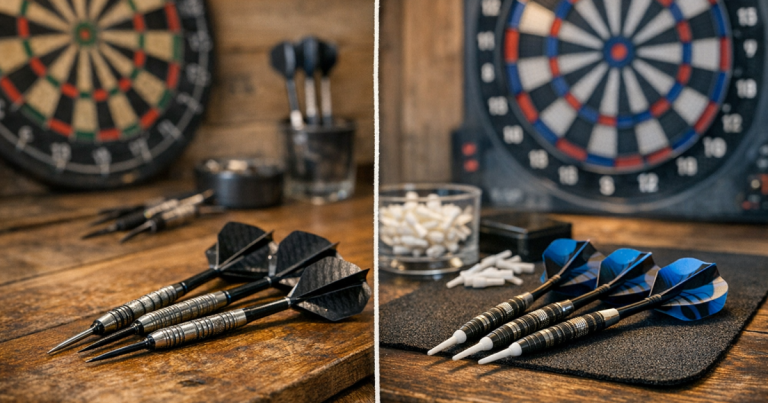
A good board should grip darts cleanly, recover well between sessions and sit flat enough to mount without fuss. Checking dartboard quality before you buy means looking past the packaging and judging the sisal, wiring, number ring and finish with the same care you would give the rest of your home setup.
Whether you are buying online or handling a board in a UK shop, a few quick checks can separate a board that feels satisfying for regular practice from one that starts to look tired far too quickly.
At a glance
- Choose a proper sisal bristle board for regular steel-tip darts, not a paper or toy-style board.
- Look for an even playing surface with no obvious raised lumps, soft patches, cracks or loose fibres.
- Check the wire profile, bullseye area and segment dividers because these affect bounce-outs and scoring clarity.
- Make sure the number ring is readable, secure and easy to rotate if the design allows it.
- Confirm the board suits your room, lighting and wall protection plans before you buy.
Step 1: Start with the board type
For a proper home darts setup, the first filter is simple: buy a sisal bristle dartboard if you intend to use steel-tip darts regularly. Sisal boards are made from compressed natural fibres, which is why the surface can close around dart holes better than cheaper paper-style boards.
Paper wound boards and novelty boards can be fine for occasional casual use, but they are rarely the best choice for a player who wants consistent practice. If the product listing is vague about the material, treats the board mainly as a party game, or avoids close-up photos of the playing surface, take that as a reason to inspect further.
Before spending money on a better board, also check that your throwing area can use it properly. If the board is going into a spare bedroom, alcove or shared living space, it is worth taking a few minutes to measure your spare room properly so you are not buying a board before you know the setup will work.
Step 2: Inspect the sisal face
The sisal face tells you a lot about dartboard quality once you know what to look for. A new board should look firm, compact and evenly pressed. The colour may vary slightly because sisal is a natural material, but the playing area should not look patchy in a way that suggests loose or uneven compression.
If you can see the board in person, look across the surface from a slight angle rather than only straight on. This makes raised areas, dents and uneven segments easier to spot. Press very gently with a fingertip in a few different areas if the shop allows handling; you are looking for consistent firmness, not a board that feels spongy in one section and overly hard in another.
When buying online, zoom in on product photos and customer images. Do not judge only by the front-on marketing image. Look for clear close-ups of the treble ring, bullseye and outer doubles. A seller that shows the board from several angles gives you more to work with than one that relies on a single perfect studio shot.
Step 3: Check the wiring and segment dividers
The wiring is not just a cosmetic detail. It affects how cleanly darts enter the board and how clearly each scoring segment is defined. Modern boards often use thinner, angled or blade-style dividers, while cheaper boards may use chunkier round wire or more visible staples. The right choice depends on budget and playing level, but the wiring should always be neat, straight and firmly seated.
Look closely at the treble 20 and bullseye areas first because these take the most attention during practice. The dividers should not wander across segment boundaries or look bowed out from the face. Any obvious misalignment in a new board is a warning sign, especially if you are buying for serious practice rather than occasional games.
Use named boards as reference points rather than automatic answers. A recognised sisal board such as Winmau Blade 6 Triple Core can show what a tidy premium-style finish looks like, while a lower-cost board such as Viper Shot King is still worth judging by the same basics: clear segment separation, secure wirework and a surface that looks evenly finished.
Step 4: Examine the bullseye and treble ring
The bullseye area is where poor finishing often shows up. Check that the inner and outer bull look centred, round and cleanly divided. If the bull looks off-centre in the product photo, or the wire appears to pinch one side more than the other, the board may feel frustrating even if the rest of the face looks acceptable.
Then look at the treble ring. The trebles should appear even around the board, with no obvious segment that looks squeezed or wider than the others. You are not measuring engineering tolerances at home, but you can spot obvious inconsistency with the naked eye. For a home player practising doubles and trebles regularly, those small frustrations add up quickly.
Step 5: Check the number ring and print finish
A quality board should be easy to read at normal throwing distance. The numbers should be clear, correctly positioned and firmly attached. If the number ring looks flimsy, uneven or difficult to rotate, that can make routine maintenance more annoying than it needs to be.
Rotation matters because regularly turning the board helps spread wear across the sisal. Some boards make this straightforward; others are less convenient. Before buying, check whether the number ring is removable or rotatable and whether the product photos show how it sits on the board. You do not need a complicated system, just a ring that does not feel like an afterthought.
Also look at the ink and colour separation. Heavy ink bleeding between colours, fuzzy segment edges or dull printing on a new board can point to weaker finishing. It will not automatically ruin play, but it is a sign to compare alternatives before committing.
Step 6: Think about fit, protection and accessories
A board can be well made and still be the wrong buy for your room. Check the depth of the board, how it mounts, and whether it will sit neatly with the cabinet, surround or backing you plan to use. This is especially important in rented homes or decorated rooms where wall damage and presentation matter.
If you are deciding between a traditional cabinet and a simpler protective ring, compare whether a cabinet or surround is the better fit before choosing the board. A surround can make a modern setup feel cleaner, while a cabinet can hide the board when the room is used for something else.
Lighting is another quality check that many buyers leave too late. A board with clear print and tidy dividers can still be awkward to play on if shadows sit over the trebles or a ceiling light creates glare. If your room has uneven lighting, plan how you will light the dartboard without glare or shadows before deciding whether a darker or heavily printed board face is right for you.
Step 7: Read reviews with the right questions in mind
Customer reviews are useful, but only if you read them for evidence rather than star ratings alone. Ignore vague praise such as “great board” unless the reviewer explains why. Look instead for comments about bounce-outs, surface wear, wire movement, mounting fit and how the board looks after repeated sessions.
Give more weight to reviews from people using steel-tip darts at home several times a week. A board that seems fine for a few party games may not suit a player practising doubles every evening. Also check whether repeated complaints mention the same issue, such as cracked sisal, loose number rings or poor packaging on delivery.
For online purchases, make sure the retailer’s return process is clear before ordering. You should be able to inspect a new board on arrival and act quickly if it arrives warped, damaged, badly marked or noticeably misaligned.
Step 8: Inspect the board as soon as it arrives
Do not mount a delivered board straight away. Open the packaging carefully and check it in good light. Look for crushed edges, dents, water marks, raised wires, loose fixings and any damage to the hanging hardware. Spin or rotate the number ring if the board is designed for that and make sure it moves without catching.
Lay the board flat on a clean surface and check that it does not rock heavily. A very slight variation can happen with many physical products, but a board that sits obviously uneven before mounting is worth questioning. Take photos before installation if you think you may need to contact the retailer.
Once mounted, throw gently at different areas before settling into full practice. Darts should enter cleanly without the surface sounding hollow or rejecting darts unusually often. Early testing helps you catch problems before the board is marked heavily through normal play.
Common warning signs
- Vague material descriptions that do not clearly state sisal or bristle construction for a steel-tip board.
- Very limited product photos, especially no close-ups of the wire, bullseye or side profile.
- Obvious gaps, lumps or loose fibres in the playing surface.
- Misaligned wires, uneven trebles or a bullseye that looks off-centre.
- A number ring that appears flimsy, poorly seated or hard to read.
- Repeated buyer complaints about fast wear, damaged delivery or poor mounting fit.
Things readers ask
Is a heavier dartboard always better?
Not always. Weight can suggest a dense construction, but it does not prove the sisal is well finished or the wires are aligned. Judge the face, dividers, bullseye and mounting quality together.
Should beginners buy a premium board straight away?
A beginner who plans to practise regularly is usually better served by a decent sisal board than a very cheap novelty board. You do not need the most expensive option, but avoid anything that will make scoring or dart retention frustrating.
Can I judge a dartboard properly from online photos?
You can make a good shortlist online, but you need clear close-ups and sensible reviews. Once the board arrives, inspect it before mounting and keep the packaging until you are satisfied.
How often should a good board be rotated?
Rotate it regularly enough to spread wear away from popular targets such as treble 20. The exact timing depends on how often you play, but visible wear in one area is a sign you have waited too long.
Does the dartboard matter if I only play casually?
Yes, but the balance changes. Casual players may not need a premium board, yet a tidy sisal board still makes games more enjoyable and avoids the soft, messy feel of very cheap alternatives.
Final thoughts
The best way to check a dartboard before buying is to treat it as part of the whole playing area, not just a round item on the wall. A quality board has an even sisal face, tidy dividers, a clean bullseye, readable numbers and a mounting setup that suits your room.
If you cannot inspect the board in person, rely on detailed photos, specific reviews and a clear return process. If you can handle it before buying, look across the surface, check the wirework and make sure the board feels solid rather than rushed. Those few minutes of checking can save you from living with bounce-outs, uneven wear and a setup that never feels quite right.