Good dartboard lighting should make the numbers, doubles and treble bed easy to see without creating a bright spot on the wire or a shadow across the scoring area. The aim is simple: even light from the front or sides of the board, not a single room bulb behind the thrower.
If you are fitting a hard-wired light, adding a new socket, or altering fixed electrical points, that work should be carried out by a qualified electrician in line with UK electrical safety requirements and local building regulations.
What to know first
The best setup is usually one that lights the board from close to the wall and slightly in front of the face, so the darts, wires and segments are lit evenly. A ceiling light in the middle of the room often feels bright enough when you walk in, but it can still cast the thrower’s shadow over the board or reflect off the metal spider.
For most home boards, you are trying to solve three problems at once:
- Glare: a bright reflection on the wire, number ring or cabinet edge.
- Shadows: dark areas caused by the darts, the thrower, a cabinet door or light from one side only.
- Uneven contrast: a board that looks bright at the top but dull around the lower doubles.
You do not need a complicated darts room to fix this. Start by getting the board position right, then test the light from the throwing line, not just from beside the board.
Step 1: Start with the board position
Lighting is much easier when the board is already mounted in a sensible spot. If the board is squeezed into a dark corner, directly below a pendant light, or tight against a reflective surface, even a decent light can struggle.
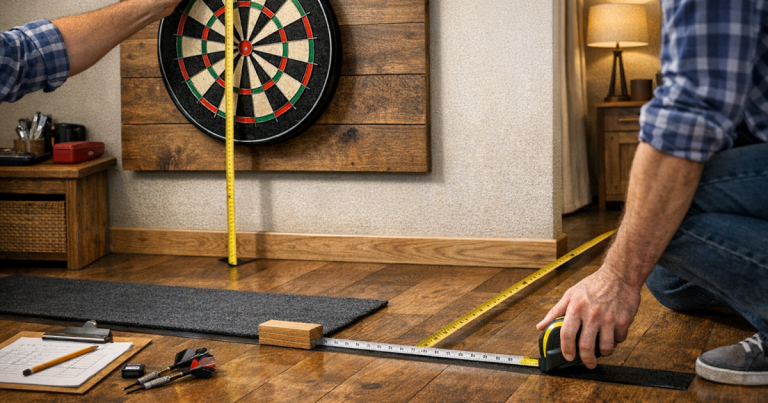
Before changing the light, check that the board is at the correct height and the oche is measured accurately. If you are still setting up the playing area, use this guide to measure dartboard height and throwing distance correctly before you fine-tune the lighting. It prevents you from solving a lighting issue around a board position that may need moving anyway.
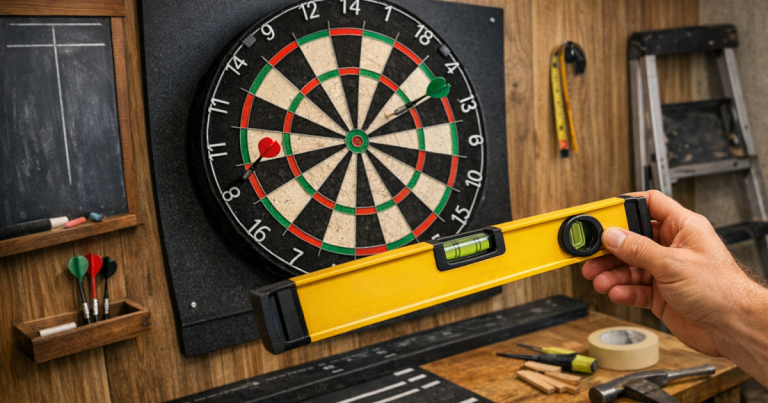
Look for a wall where the light can sit around the board without blocking play. Leave enough space for a surround, cabinet or backboard if you use one, and check that the thrower’s head and shoulders are not directly between the main light source and the board.
Step 2: Switch off the room assumptions
A common mistake is judging the setup with the main room light on and assuming it will be fine. Instead, stand at the oche and look at the board under the conditions you actually play in: evening light, curtains closed, garage door down, or the room lamp you normally use.
Then check three viewing positions:
- From the oche: can you read the numbers and see the treble bed clearly?
- From slightly left and right: do shiny wires or cabinet edges flare into your eyes?
- From close to the board: are the lower doubles and bull area as visible as the top half?
If the board only looks good from one angle, the light is probably too directional. If it looks clear close up but dull from the oche, you may need a brighter or more even spread rather than simply moving the lamp nearer.
Step 3: Put the main light where shadows cannot dominate
The safest rule is to keep the main light source close to the board rather than behind the player. Light that comes from behind the thrower will often cast a body shadow across the board, especially in smaller spare rooms and narrow garages.
There are three common ways to do it:
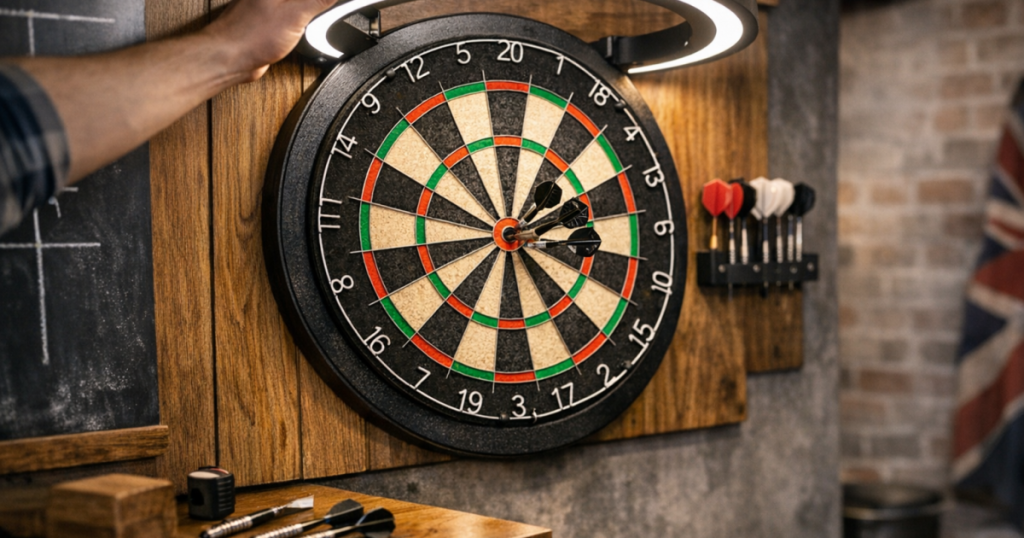
- A ring-style board light: this surrounds the board area and gives a fairly even spread across the face. It is usually the neatest approach when you want fewer shadows.
- Two side lights: these can work well if they are balanced and angled towards the board, not into the player’s eyes. They need careful positioning to avoid one side looking stronger than the other.
- A short light bar above the board: this can be tidy, but it must sit far enough forward to stop the darts and top wire throwing shadows down the board.
Whichever approach you use, avoid placing a single bare bulb directly above and behind the oche. It may brighten the room, but it rarely gives the board the clean, flat visibility you want for scoring.
Step 4: Control glare before chasing brightness
More brightness is not always better. If a light is too direct, too close, or aimed straight at the metalwork, the board can become harder to read. Glare often shows up on the number ring, the wire around the trebles, or glossy cabinet surfaces.
To reduce it, make small adjustments rather than rebuilding the setup straight away:
- Angle the light slightly across the board instead of straight onto one shiny area.
- Move the light a little further forward if darts are casting long shadows down the face.
- Use a diffuser or softer lamp style where the light source is visibly harsh.
- Keep reflective picture frames, mirrors and bright gloss surfaces out of the board’s immediate line of sight.
- If using a cabinet, check whether the open doors are reflecting light back towards the oche.
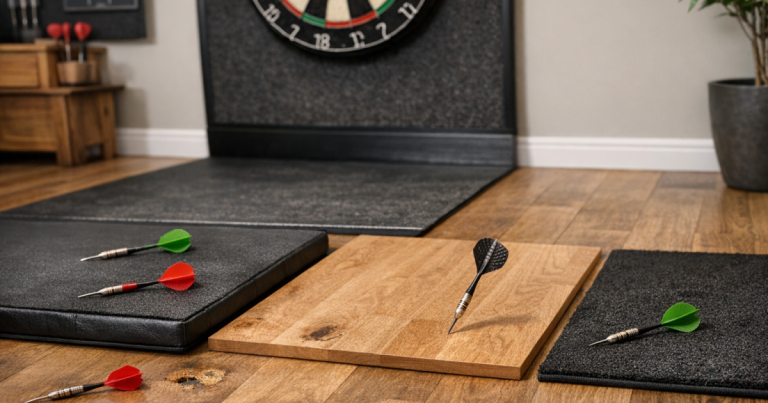
A matte wall area around the board often helps too. If you are adding protection, a surround can make the area look cleaner and reduce distracting edges around the board. For a tidy wall-friendly fit, see how to fit a dartboard surround without wall damage.
Step 5: Test with darts in the board
An empty board can look perfectly lit, then develop awkward shadows as soon as a few darts land around the treble 20 or bull. A proper test means throwing or placing darts in different areas and checking visibility from the oche.
Place or throw darts into:
- treble 20, where top shadows are most noticeable;
- treble 19 and treble 17, to check the lower half;
- the bull, where glare and contrast problems are easy to spot;
- both outer doubles, to see whether the number ring is evenly lit.
If each dart casts a strong shadow in the same direction, the light is coming too much from one side. If the shadows are short and faint, the spread is usually working well. Do this test at the time of day you normally play, because daylight through a nearby window can change the result.
Step 6: Make the setup work in a real room
Home darts areas are rarely perfect. You may be working with a low ceiling, a garage wall, a shared living space or a room that still needs to function when the board is not in use. The lighting should make play clearer without creating a trip hazard or a permanent obstacle.
Keep cables routed away from the oche and walking route. If you use a plug-in light, run the cable neatly down the wall or behind furniture rather than across the floor. In a garage, avoid putting lights where they will be knocked by bikes, tools, ladders or storage boxes. If your board sits in a multi-use garage, it is worth planning the whole area so the light, oche and storage still work day to day; this guide on how to plan a garage darts area that stays usable covers the wider layout decisions.
Quick checks before you call it done
Once the light is fitted or positioned, run through a final match-style check rather than judging it in isolation.
- Stand at the oche and make sure you can read every number without leaning.
- Check that no light shines directly into your eyes during your throw.
- Look for shadows across the treble 20, bull and lower doubles.
- Open and close cabinet doors if you use a cabinet, and check both positions.
- Throw a short practice leg and see whether the lighting feels natural, not distracting.
- Ask another player to test it, especially if they are a different height.
If you feel yourself squinting, stepping sideways, or pausing to confirm where a dart has landed, the setup still needs adjustment. Good lighting should disappear into the background and let you focus on the throw.
Common questions
Is a ceiling light enough for a dartboard?
Sometimes, but it depends where it sits. A ceiling light behind the thrower often creates shadows, while one close to the board may still cause glare. Dedicated light around or near the board is usually more consistent.
Why do my darts cast big shadows?
The light is probably coming from one strong direction. Move the light closer to the board area, bring it slightly forward, or add a more even spread from both sides to soften the shadows.
Can I light a dartboard in a garage without making the whole garage bright?
Yes. Focus the light on the board face and immediate wall area rather than the whole room. This is usually more comfortable and avoids wasting brightness on storage areas.
Should the light be warm or cool?
Use a clear, comfortable white light that lets you distinguish the board colours easily. Very warm light can make the board look dull, while very harsh cool light can feel clinical or glare-prone.
Do cabinets make glare worse?
They can do if the doors or finish reflect the light back towards the oche. Test with the cabinet open, as it would be during play, and adjust the angle if the doors catch the light.
Why it matters
Lighting is one of those setup details that quietly affects every visit to the oche. When the board is evenly lit, scoring is easier, bounce-outs are simpler to judge, and longer practice sessions feel less tiring. Start with the board position, keep the main light out of the thrower’s shadow path, soften any glare, then test the result with darts actually in the board. That small amount of fine-tuning can make a home setup feel much closer to a proper playing space.