A safe, tidy childproof dartboard area is less about one clever gadget and more about a repeatable closing-down routine. The goal is to remove the sharp, tempting and movable parts of your setup as soon as the last leg finishes, without making the board so awkward that nobody bothers putting it away.
Wall fixings for dart cabinets, heavy back panels or board mounts that may involve weak plasterboard, hidden pipework or hidden electrical cables should be carried out by a qualified tradesperson to meet UK building and electrical safety requirements.
What to know first
Darts equipment is not child-safe simply because the board is high on the wall. Children may climb, pull furniture across, open drawers, pick up fallen darts, tug at mats or copy throwing actions with toys. Your aim between games is to make the area boring, closed, and difficult to access.
Think in three zones: the wall area, the throwing lane, and the storage point. The wall area includes the board, cabinet, surround and any lighting. The throwing lane includes the oche, mat and floor space where darts may land. The storage point is where darts, spare flights, shafts, points, chalk and tools go when the game is over.
For many family homes, the safest routine is: remove the darts first, check the floor, close or cover the board, clear the oche, then block casual access to the space. It should take less than two minutes once it becomes a habit.
Step 1: remove every dart before doing anything else
The darts are the highest-risk item, so start there. Do not leave steel-tip darts in the board, on a shelf, in a cabinet tray or sitting on a nearby table. Even if the board is mounted at regulation height, darts left in the treble bed can still be reached by a child using a chair, sofa arm or toy box.
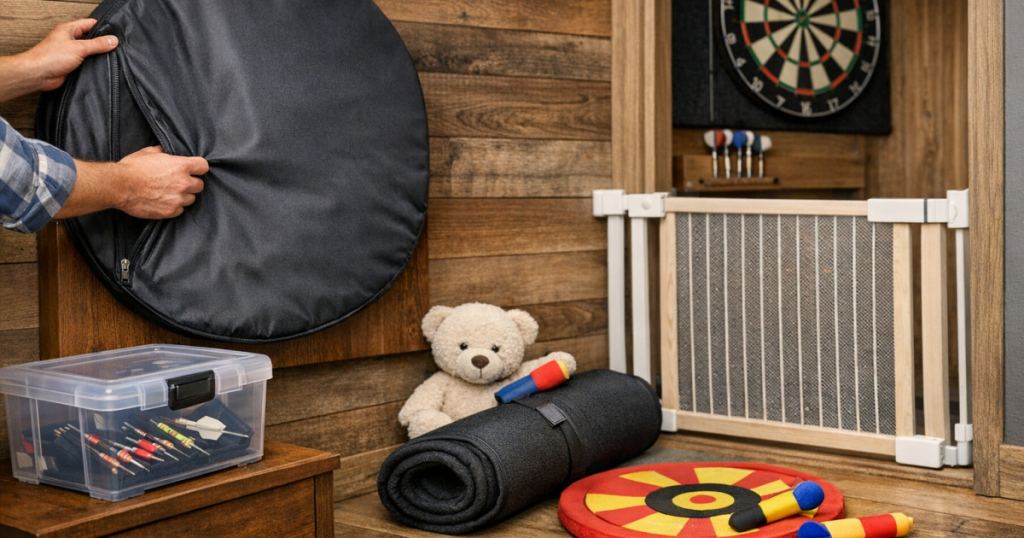
Use a storage case that closes properly and keep it high up or inside a locked cupboard. A zipped case is better than leaving loose darts in a drawer because flights, points and barrels stay together and are easier to count. If more than one person plays, make a quick count part of the end-of-game routine: three darts out, three darts stored, spares accounted for.
Also check the floor under and around the board. Bounce-outs can slide under a cabinet, mat edge, radiator cover or sofa. A small torch helps in living rooms with patterned carpet or darker flooring.
Step 2: close off the board visually
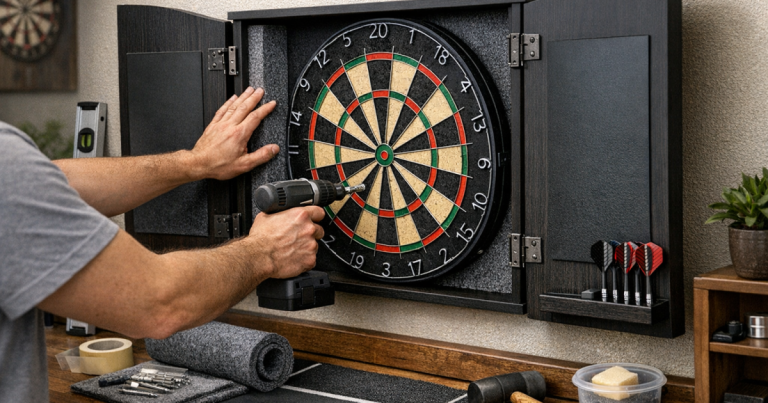
A visible dartboard invites curiosity. If your board is in a shared room, a cabinet with closing doors can make the setup look less like a target between games. It will not make the area childproof by itself, but it removes the obvious visual prompt and gives you somewhere tidy to keep scoreboards, chalk and light accessories away from small hands.
If the dartboard is in a lounge or dining area, a foldaway approach can work well because the room returns to normal when play is finished. For layout ideas that keep the board accessible for adults but discreet between sessions, see planning a foldaway dartboard setup in a living room.
If you use a cabinet, make sure it closes securely and does not swing open easily. Avoid storing darts inside the cabinet unless the cabinet is locked or out of reach; a cabinet is tidy, but it is not automatically secure storage.
Step 3: control the throwing lane
The oche is easy to forget, but it matters. Raised oches, loose strips, tape edges and rolled mats can all create trip hazards or become toys between games. If you use a removable oche, take it away once play ends and store it flat or upright where it cannot fall.
A full-length dart mat should be rolled or lifted if it sits in a family walkway. On hard floors, check that any anti-slip backing has not curled at the edges. On carpet, check that the mat has not rucked up where people walk through the room. If the oche is marked with tape, make sure the tape is smooth and not peeling.
For home setups where the throwing line needs to disappear after each session, building a removable darts oche is usually tidier than relying on loose objects to mark the distance.
Step 4: make the wall area less climbable
Most dartboards are mounted above a tempting patch of floor space. Look at the area as a child would: is there a low stool, toy chest, pouffe, dining chair or side table nearby? Could a child drag something over to reach the cabinet or board? Removing climbing aids is just as important as storing the darts.
Keep furniture away from the board wall where possible. If the board is in a spare bedroom, avoid placing it above a bed, desk or chest of drawers. If it is in a living room, make sure a sofa arm or window ledge does not create an easy step-up route.
Cables and lighting accessories also deserve a check. Keep trailing leads out of reach and avoid leaving plug-in lights or extension leads dangling near the board. If you use a dartboard light, switch it off and tidy the cable route after play.
Step 5: protect the surround without creating a new hazard
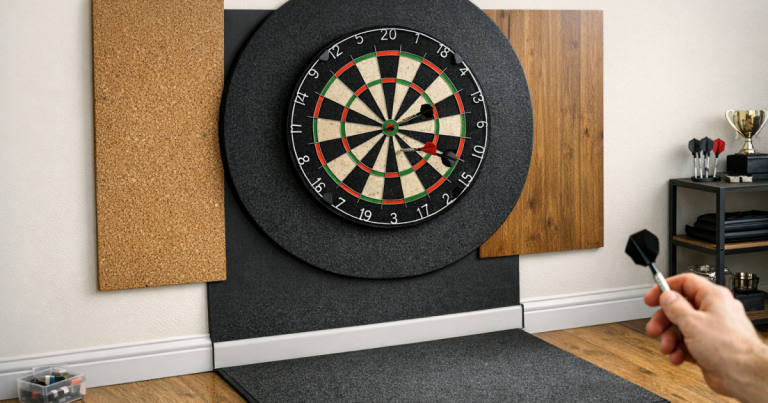
A surround helps protect walls from stray darts during play, but it should still be checked between games. Make sure it is seated firmly around the board and not sagging, loose or easy to pull away. A loose foam surround can attract picking, pulling and climbing.
If wall protection is part of your setup, choose a method that stays neat and secure. Poorly fixed panels, temporary boards and leaning backers can fall or shift if a child grabs them. For a cleaner approach, it is worth reading about how to fit a dartboard surround without wall damage.
Do not rely on the surround to stop children reaching the board or darts. Its job is wall protection, not access control.
Step 6: set a simple closing-down routine
A routine works better than a vague house rule. Put the steps in the same order every time so nothing is missed after a late game or a quick practice session.
- Remove all darts from the board and floor.
- Count the darts and place them in a closed case.
- Store the case high up or in a locked cupboard.
- Close the cabinet doors or cover the board.
- Lift or roll away the mat if it sits in a walkway.
- Remove the oche if it is raised or loose.
- Check under furniture for bounce-outs.
- Move stools, chairs and boxes away from the board wall.
If older children are allowed near the room, make the rule clear: the board area is not for play unless an adult has set it up and is supervising. Do not leave practice darts out as a compromise; mixed messages make the routine harder to enforce.
Step 7: choose the right level of access control
Different homes need different controls. A spare room with a door is easier to manage than an open-plan lounge. A board in a hallway needs stricter end-of-game clearing because children, guests and pets pass through without thinking.
- Lowest access: a spare room with the door closed, darts stored separately, and the oche removed.
- Medium access: a living room cabinet setup with darts locked away and the mat lifted after games.
- Higher access: an open-plan or hallway setup where the board remains visible and people pass through regularly.
For higher-access spaces, consider whether the board should be covered, closed behind cabinet doors, or located somewhere with a closable door. If that is not practical, be stricter about removing furniture that can be climbed and storing all accessories away from the board wall.
Common questions
Can I leave soft-tip darts out instead of steel-tip darts?
No. Soft-tip darts are still pointed objects and can injure eyes, skin or furniture. Store them with the same care as steel-tip darts.
Is a dartboard cabinet enough for childproofing?
Not on its own. A cabinet helps hide the board and tidy the area, but darts should be removed and stored separately unless the cabinet is genuinely secure.
Should I take the dartboard down between games?
Usually no, provided it is securely mounted, out of reach and the darts are stored away. In a very accessible space, a foldaway or closed cabinet setup may be a better everyday solution.
What should I do after a bounce-out?
Pause the game and find the dart straight away. At the end of play, check under mats, sofas, cabinets and skirting gaps before leaving the room.
Can older children use the area if they understand the rules?
Only with adult supervision and clear boundaries. The closing-down routine should still happen immediately after play, even when older children have been sensible.
What to remember
Between games, the safest home darts setup is one that looks ordinary again: no darts visible, no loose oche, no tempting mat, no easy climbing route and no forgotten bounce-outs. You do not need to dismantle the whole setup every time, but you do need a consistent routine that removes the sharp parts and clears the access points.
Start with dart storage, then deal with the board, floor and furniture around it. Once the routine is quick enough to do without thinking, your dartboard can stay part of family home life without becoming an everyday temptation.