A good darts corner should feel easy to use, not like something everyone has to step around. The aim is to keep the throw, scoring area and dart retrieval route compact while leaving normal household movement clear.
Start by treating the board, oche, player stance and nearby furniture as one layout. A neat setup in a spare room, garage, dining area or snug is usually possible, but the details matter when doors, radiators, sofas and storage units are close by.
The short version
- Keep the throw line out of main routes between doors, stairs, kitchens and seating.
- Allow enough depth for the throwing distance, player stance and a small pause space behind the oche.
- Place the board on a wall where missed darts and retrieval will not interrupt people walking past.
- Use low-profile marking, mats or removable oche solutions where the floor is shared.
- Check cupboard doors, cabinet doors, chairs and lighting before fixing anything permanently.
Step 1: Map the room before choosing the board wall
Walk the room as it is used on a normal evening. Notice the routes people take from door to door, from sofa to kitchen, from utility area to garden, or around stored bikes and tools. The board should not sit at the end of a route where someone naturally walks across the throwing lane.
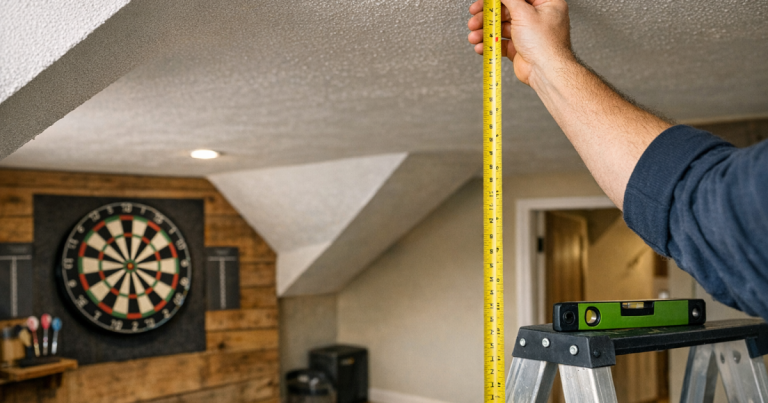
Measure from the proposed board face, not just the wall, because the board has depth once mounted. For steel-tip darts, the standard throwing distance is 2.37 m from the face of the board to the oche, with the bullseye 1.73 m from the floor. If you are setting up from scratch, use a proper measuring routine rather than guessing from skirting boards or furniture edges; the full process is covered in how to measure dartboard height and throwing distance correctly.
Once the measured line is marked, add real-life space. A player needs room to stand squarely, lean slightly, step away and let another player approach. In a shared room, a few extra centimetres behind the oche can be the difference between a tidy setup and a constant bottleneck.
Step 2: Separate the throwing lane from the walking lane
The easiest way to avoid blocking walkways is to make the throwing lane run along a quiet edge of the room rather than across it. A board on the end wall of an alcove, garage bay or spare-room wall often works better than one placed centrally on a wall that people pass all evening.
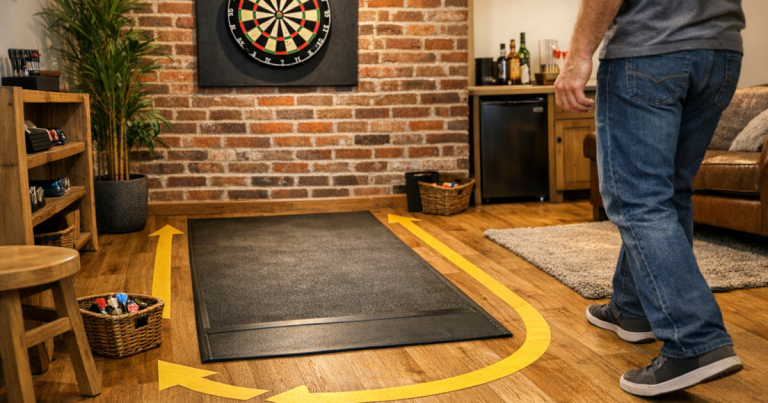
Avoid layouts where the oche cuts straight across a doorway. Even if the measurements technically fit, the setup will feel awkward because someone has to step over the line or wait for a thrower to finish. The same applies to routes between a sofa and the kitchen, a washing machine and back door, or a hallway and downstairs loo.
Think of the playing strip as a temporary no-walk zone. When someone is at the oche, nobody should need to cross between the player and the board. When darts are being collected, nobody should need to squeeze behind the player or around the board surround.
Step 3: Choose the best wall orientation
Best option: board on a quiet end wall
An end wall is usually the cleanest layout. The thrower faces into the wall, the oche runs back into the room, and other movement can pass behind the playing area. This works well in spare bedrooms, garden rooms, garages and larger living spaces where one end can be kept relatively clear.
Usable option: board on a side wall
A side-wall layout can work if the throwing lane runs parallel to the main walkway rather than across it. Keep furniture close to the opposite wall and avoid placing chairs where people naturally pull them back into the lane. This layout often suits dining rooms or multi-use rooms, provided darts are not thrown while the space is being used for meals or busy family traffic.
Risky option: board in a hallway
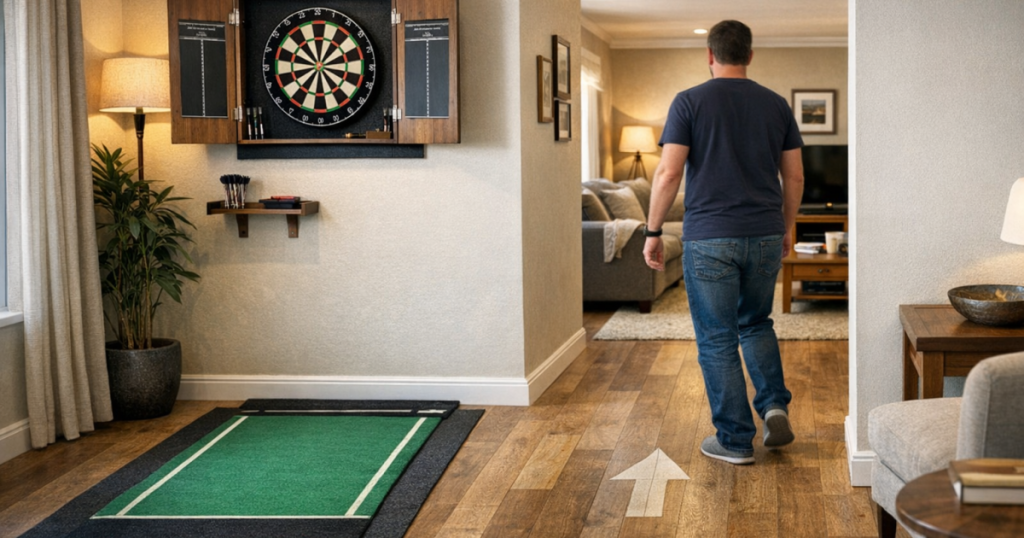
Hallways look tempting because they are long and narrow, but they are rarely ideal. They are designed for movement, not pausing, throwing and collecting darts. If a hallway is the only possible space, use it only when the route is genuinely quiet and make sure the oche can be removed or flattened when not in use.
Step 4: Plan the oche so it does not become a trip point
The oche is where many compact setups go wrong. A raised toe line feels proper underfoot, but in a shared room it can catch shoes, slippers, chair legs and vacuum cleaners. A darts mat, thin floor marker or removable strip is often better where the route is used for anything other than darts.
Make sure the marker is exactly aligned with the board centre. If it is skewed to dodge furniture, the whole setup will feel wrong and players will naturally stand off-centre. For the detailed measurement rules and alignment checks, see darts oche measurements, toe line rules and mat alignment.
In carpeted rooms, check whether a mat moves when someone steps on and off it. On laminate, wood or tiled floors, check that any mat sits flat and does not curl at the corners. In garages or utility spaces, avoid placing the toe line where it clashes with stored boxes, bikes, tumble dryer access or the route to a door.
Step 5: Keep the retrieval route short and predictable
A good darts corner is not just about the throw itself. Players also need to walk to the board, remove darts, step back and let the next player throw. If that repeated movement cuts across the household walkway, the layout will soon become irritating.
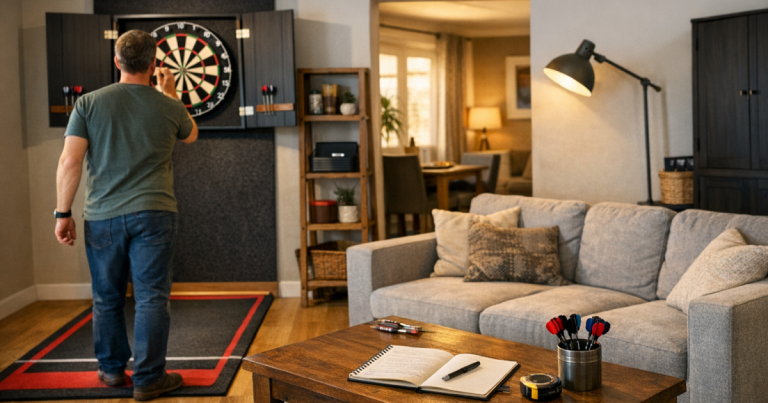
Try this simple test: stand at the oche, throw an imaginary visit, walk to the board, remove the darts and return. Now ask someone else to walk through the room carrying a mug, washing basket or bag. If either person has to stop, twist sideways or step over the mat, the layout needs adjusting.
It may be enough to rotate the setup to another wall, move a chair by 30 cm, or shift a storage unit away from the retrieval side. Small changes are usually more realistic than trying to create a perfect dedicated darts room in a typical UK home.
Step 6: Protect the walls without widening the obstruction
Wall protection matters most in compact spaces because missed darts are more likely when players feel cramped or distracted. A surround, cabinet or protective panel can save paintwork, but it should not project so far into a walkway that people catch shoulders or bags on it.
If the board is near a doorway, check the swing of the door and the edge of any cabinet doors before fixing anything. Open the cabinet fully, stand where people will pass, and make sure it does not create a hard corner at head or shoulder height. For painted rooms, the most useful prevention ideas are covered in how to stop darts marking painted walls around the board.
Storage should stay vertical and contained. Spare flights, shafts, chalk, point tools and score pens should not end up on the floor beside the oche. A small shelf, cabinet shelf or wall organiser keeps accessories close without spreading the setup into the route through the room.
Step 7: Put scoring and seating where they do not pull people into the lane
A scoreboard is easiest to use when it is visible from the oche but not placed where the scorer has to stand between the thrower and the board. In a small room, the best scoring position is usually to one side of the board or just outside the throwing lane, not directly beside the player’s arm.
If you use chairs, stools or a small table, keep them behind or to the side of the oche rather than along the walking route. A chair that is fine when tucked in can become a problem once someone sits with feet forward. Leave enough room for people to watch without edging into the thrower’s peripheral vision.
Lighting needs the same thought. A lamp stand or plug-in light can improve visibility, but trailing leads and bulky stands should not sit across the path people use to enter or leave the room. Keep cables tight to walls and avoid placing anything at ankle height near the oche.
Room examples that usually work
Spare bedroom or office
Place the board on the wall opposite the door if the throwing line does not block entry. Keep the desk chair tucked away from the oche and use a mat that can be rolled or lifted when the room returns to work use.
Garage or utility area
Use the longest clear wall, but keep access to appliances, storage shelves and the external door open. Avoid a layout where someone has to cross the lane to reach the freezer, bins or tools during play.
Living room end wall
Choose a wall that does not sit between the sofa and the kitchen or hallway. A board near a TV wall or main seating route can become annoying quickly, even if the measurements look fine on paper.
Dining area
This can work if the table is moved fully clear before play and the oche does not cross the route to another room. If chairs remain near the lane, measure with them pulled out, not neatly tucked in.
A five-minute walkway check before you commit
- Stand at the proposed oche and check whether anyone entering the room would pass in front of you.
- Open every nearby door, cupboard and cabinet to see whether it clashes with the board, mat or player stance.
- Walk from the oche to the board and back three times, as you would during a real leg.
- Ask another person to move through the room while you stand at the toe line.
- Check whether a mat, raised oche or cable creates a trip point when darts are not being played.
- Look for hard corners, low shelves or protruding storage near shoulder height.
- Confirm that wall protection, scoring and accessories are reachable without spreading into the route.
Things readers ask
How much extra space should I leave behind the oche?
Leave enough room for the player to step back naturally without hitting furniture or standing in a doorway. In a tight room, aim for a clear pause area rather than having the oche end directly at a wall, sofa or cabinet.
Can I put a dartboard behind a door?
It is usually awkward. The door swing, handle and foot traffic can all interfere with play. If it is the only wall available, check the door fully open and fully closed before fitting anything.
Is a hallway darts setup a bad idea?
It depends on how the hallway is used. A quiet, dead-end passage may work for occasional play, but a main household route is poor because people will naturally cross the throwing lane.
Should I use a raised oche in a shared room?
Only if it will not sit in a walkway when darts are not being played. For multi-use spaces, a flat mat or removable toe marker is usually easier to live with.
What is the biggest planning mistake?
Measuring only the throwing distance and ignoring movement around it. The setup also needs space for collecting darts, scoring, opening doors and everyday traffic.
Key takeaways
Plan the darts area as a flow problem, not just a measurement problem. The best home layouts keep the board on a quiet wall, the oche out of normal routes, and the retrieval path short and predictable.
If the setup makes people step over mats, dodge cabinet doors or cross in front of the thrower, adjust the room before fixing the board permanently. A little extra planning keeps the space safer, tidier and much more enjoyable to use.