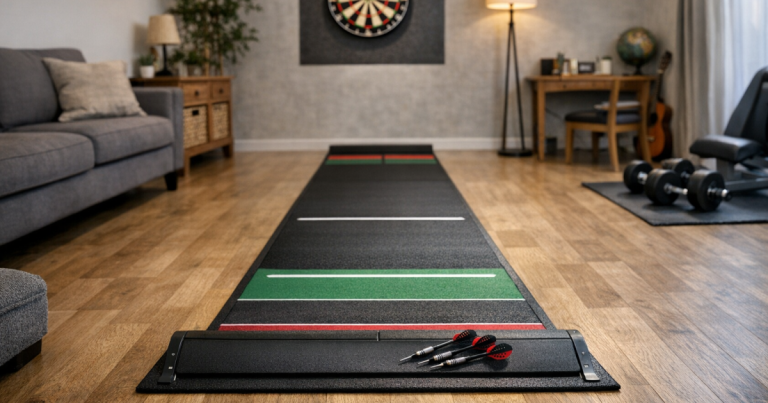
A match-ready darts mat and oche area gives your home setup a proper playing feel without turning the room into a pub-style permanent fixture. The goal is simple: a clear throw, a reliable toe line, protected flooring and enough space for people to move around safely between visits to the board.
For most UK homes, the challenge is not knowing the rules; it is fitting them into a spare room, garage, dining area or shared living space without creating trip hazards or awkward furniture shuffling every time you play.
The short version
A good home oche zone should do five things well: mark the throwing distance clearly, keep the player balanced, protect the floor, leave safe clearance around the throw and make resetting the area quick. It does not have to be expensive or built-in, but it does need to be consistent.
- Use a mat that lies flat and reaches the correct throwing position without curling at the edges.
- Keep the throw line fixed, visible and easy to return to after cleaning or moving furniture.
- Leave enough width for a natural stance, not just the bare minimum for the mat.
- Check the route from oche to board so players are not stepping around chairs, doors or cables.
- Match the mat position to the board height and throw distance before you worry about accessories.
Start with the board position, not the mat
The mat should confirm your setup, not define it. First check that the dartboard is mounted at the standard height, with the bullseye at 1.73 m from the floor. Then measure the steel-tip throwing distance from the face of the board to the oche line at 2.37 m. For soft-tip play, check the distance required for your board type, as many home electronic boards use a longer throw.
Measure from the board face, not the wall. This matters because cabinet depth, board thickness and backing panels can all shift the real throwing distance. If the wall is uneven or you use a surround, take the measurement from the actual playing surface.
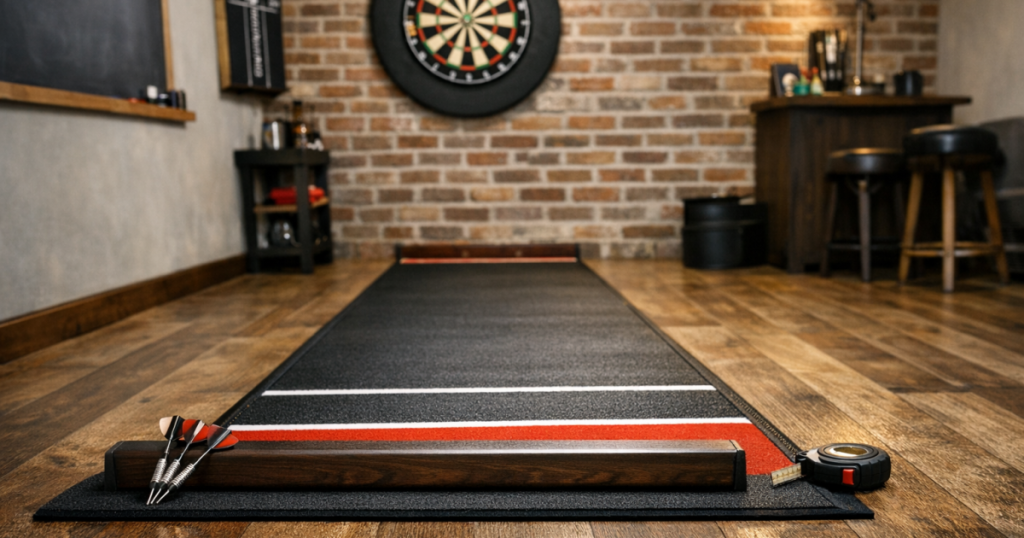
Once the board is right, lay the mat down and see whether its printed or raised oche lands exactly where it should. If it does not, do not assume the mat is wrong or the room is impossible; it may simply need moving forwards or backwards until the toe line matches the measured distance.
Choose a mat position that works during real play
A mat can look perfect when the room is empty but become annoying once two players, a scorer and everyday furniture are in the same space. Stand at the oche and go through a normal visit: set your feet, throw three darts, step forward, collect them and return. If you have to twist around a sofa arm, avoid a door swing or step over the mat edge, the layout is not quite ready.
Allow usable space either side of your stance. Some players stand square, some angle their lead foot, and left-handed players may naturally occupy a different part of the mat. A narrow strip that only suits one stance can feel restrictive during longer practice sessions.
If the room doubles as a living area, it is worth planning the throw zone around everyday movement rather than pretending the space will stay clear. For more detail on this side of the layout, see our guide to planning a darts mat zone around everyday furniture.
Make the oche line impossible to misread
The oche is the reference point that turns casual throwing into proper practice. A printed line on a mat is fine if it is clear, flat and in the right place. A raised oche can feel more match-like because it gives your lead foot a physical stop, but it must be stable and low enough not to become a trip point when walking back from the board.
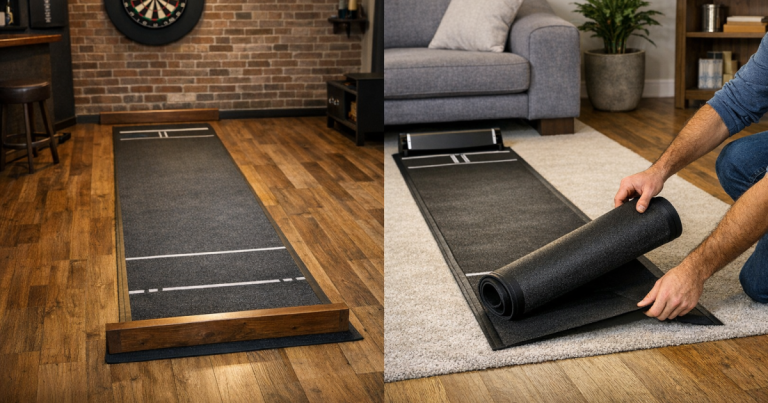
If you use a roll-out mat, mark the mat’s final position discreetly on the floor with removable tape or small reference marks at the corners. That way, if it gets moved for cleaning or family use, you can put it back accurately without remeasuring the full setup every time.
Avoid relying on furniture edges, rug patterns or floorboard lines as your throwing reference. They can shift, be misread from an angle or encourage a creeping toe line during practice. The more visible and repeatable the line is, the more useful your home practice becomes.
Check the floor surface under the mat
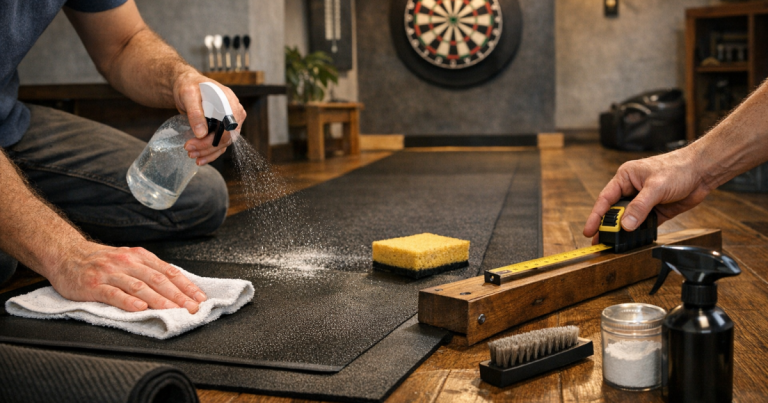
The floor underneath affects how secure the mat feels. On carpet, a heavier mat may settle well, but a thin mat can ruck or move as players step forward. On laminate, tile or vinyl, grip is the main concern. The mat should stay flat under normal foot pressure and should not slide when you push off gently from your throwing stance.
Floor protection also depends on what you are protecting against. A mat mainly protects the oche area from foot traffic and dropped darts, but bounce-outs can land outside the mat, especially near the board. If you are using steel tips over a hard or delicate floor, consider whether you need extra protection closer to the board as well.
Check the mat edges after a few sessions. Curling corners are easy to ignore until someone catches a toe on the way to retrieve darts. If an edge keeps lifting, the mat may need repositioning, flattening or replacing with a more suitable type for that floor.
Leave space for doors, windows and people
A match-ready setup is not just accurate; it is comfortable and predictable. Doors should not open into the throwing path or the collection route. Windows near the board can affect glare, and curtains or blinds can get in the way if the board is mounted too close to them.
Think about spectators too. In home darts, people often stand where there happens to be room, which may be beside the thrower or close to the board. Create an obvious waiting spot away from the throwing lane, especially if children, pets or non-players share the room.
Rooms with awkward openings need extra care. If your board is near a doorway, bay window or narrow alcove, use the checks in our guide to planning a darts area around doors and windows before making the layout permanent.
Build in the match details that change the feel
Small details make a home oche feel more like a proper playing area. Keep the scoreboard visible from the throw line, whether it is a wall-mounted board, whiteboard or tablet stand. Place spare flights, stems and a point sharpener somewhere reachable but outside the throw path. If players are constantly walking across the mat to find accessories, the setup will feel messy.
Lighting matters more than many people expect. Shadows across the treble bed make practice less realistic and can encourage players to lean or adjust their stance between throws. The board should be evenly lit without glare in the thrower’s eyes. If your mat and oche are set up neatly but the board is hard to read, the whole area still feels unfinished. Our guide to lighting a dartboard properly at home covers the practical placement points.
Noise is another match-feel issue. A mat can soften footsteps and make the oche zone feel more contained, but it will not solve all impact noise from the board. If you share a wall or play in the evening, pay attention to backing, wall contact and room choice as well as the floor area.
A quick match-readiness checklist
Before you call the setup finished, run through these checks with the room arranged as it will be during a real game, not as it looks after clearing everything away.
- The bullseye height is correct and has not been changed by adding a cabinet, backing board or surround.
- The throwing distance is measured from the board face to the oche line.
- The mat lies flat, with no curled corners or sliding under foot pressure.
- The oche line is obvious from above and does not move during play.
- There is a clear walking route from oche to board and back.
- Doors, drawers, chairs and tables do not intrude into the throwing lane.
- The scoreboard is visible without the thrower needing to turn away awkwardly.
- The board is lit evenly, with minimal shadowing from darts or the player.
- Darts, spares and drinks are kept away from the mat edges and walking route.
Common questions
Can I use a normal rug instead of a darts mat?
You can, but it will not usually give you a reliable oche line. A rug may also move, curl or hide dropped darts. If you use one, mark the throw line separately and check that it stays flat.
Should the mat run all the way to the wall?
Not necessarily. The important point is that the oche line is at the correct distance from the board face. Some mats extend towards the board for floor protection, while others mainly define the standing area.
Is a raised oche worth having at home?
It can be, especially if you want a more match-like feel and a consistent foot position. Make sure it is secure, not too bulky, and easy to remove if the room has to return to everyday use.
How often should I recheck the measurements?
Recheck after moving the board, changing the cabinet or surround, replacing the mat, redecorating, or shifting furniture. For a fixed setup, a quick check every so often is enough to catch gradual movement.
The big picture
A strong home setup is less about filling the room with kit and more about making the essentials repeatable. If the board height, throw distance, mat position, lighting and walking route are all sorted, your practice will feel cleaner and your games will run more smoothly.
The best darts mat and oche area is the one you can set up the same way every time. Get that right, and even a modest spare-room or garage setup can feel properly match-ready.