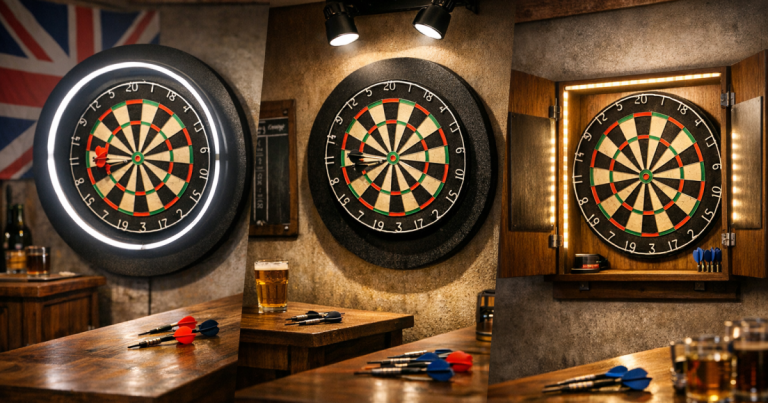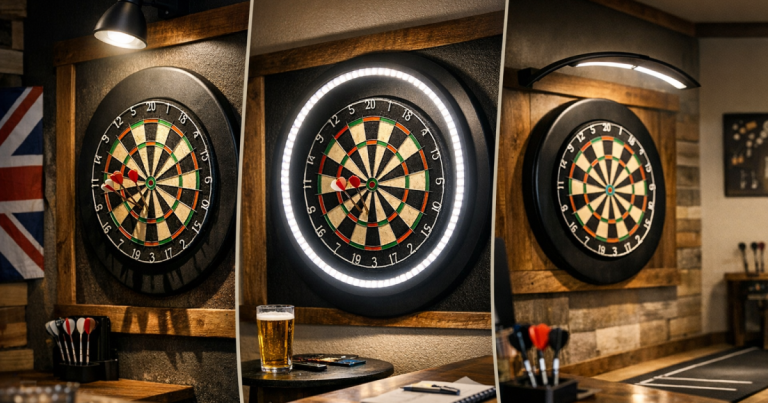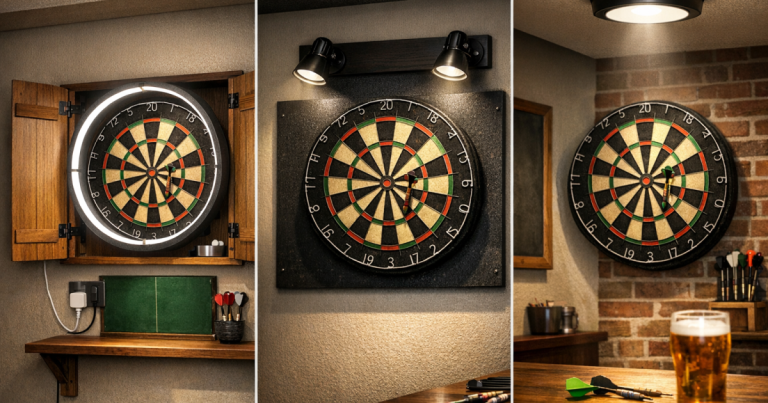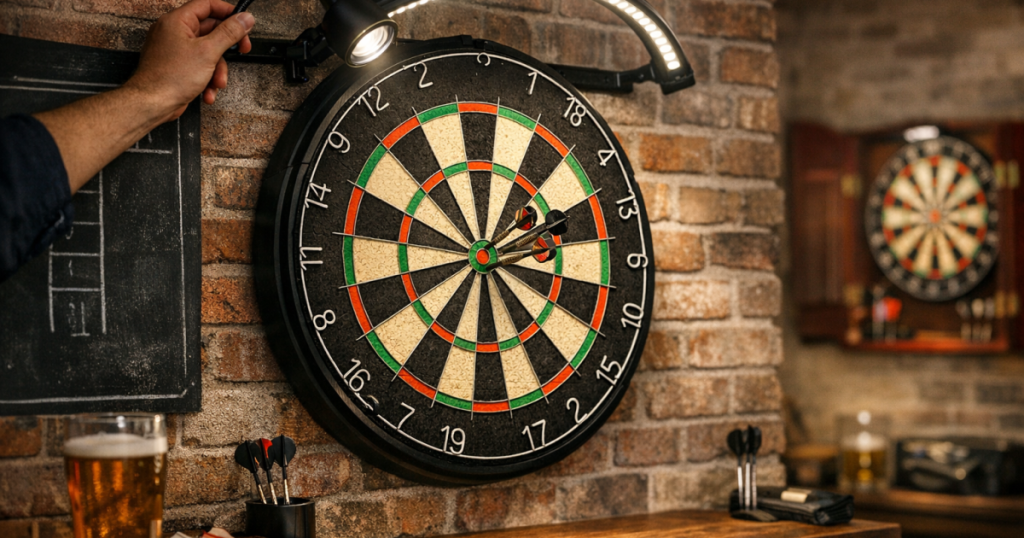
Good lighting makes the board easier to read, reduces eye strain and keeps your throw more consistent. The aim is simple: light a dartboard so every segment is readable from the oche without glare, harsh shadows or a lamp shining into your eyes.
A good setup does not have to look like a pub stage. In a spare room, garage, hallway or living-room corner, the best result usually comes from even light across the board face, sensible cable routing and a layout that still works when people are moving around the space.
Any mains electrical wiring for fixed dartboard lighting should be carried out by a qualified electrician to comply with UK electrical safety standards and local requirements.
What to know first
- Even coverage matters more than raw brightness. A very bright lamp in the wrong place can make the board harder to see.
- Shadows usually come from the thrower, not the board. If the light sits directly behind or above your throwing line, your arm and darts can cast shadows across the scoring area.
- Glare is just as distracting as darkness. Watch for reflections on number rings, cabinet hinges, glossy walls and electronic soft-tip segments.
- The room matters. Doors, windows, furniture and ceiling height can all change where a lamp can safely and comfortably sit.
- Test from the oche, not just beside the board. A setup can look fine close-up but feel uneven when you are actually throwing.
Start with the board position, then add the light
Lighting should be planned around the actual playing position. For a standard steel-tip setup, the bull is commonly set 1.73 m from the floor and the oche is 2.37 m from the board face. Once those two points are fixed, stand at the oche and look at the board as you would during a throw. That view is the one that matters.
If the board is squeezed into a corner or mounted close to a door frame, the light may need to work harder because one side of the board can be shaded by the room itself. Before deciding on a fitting, check the surrounding area using the same approach you would use when you plan a darts area around doors and windows. A well-lit board is not much use if the throw line clashes with a door swing or a bright window causes glare at certain times of day.
Where the light should sit
The most reliable position is usually in front of the board face and slightly above it, aimed back towards the board rather than down the wall. This helps the light reach the doubles, trebles and bull evenly without creating a strong shadow from the number ring or cabinet lip.
For a single lamp, avoid placing it directly behind the throwing line. That often creates a moving shadow from your hand and dart as you aim. If you use two lamps, keep them balanced left and right rather than letting one side dominate. The board should look flat and readable, not like one half is under a spotlight and the other half is in a corner.
A quick oche test
- Stand at the oche and look at treble 20, treble 19, the bull and both side doubles.
- Raise your throwing arm and check whether your hand casts a shadow over the target area.
- Throw a few darts and see whether the flights create distracting movement on the board face.
- Step slightly left and right, as guests often will, and check whether the light becomes dazzling.
- Turn off any unnecessary room lights to see what the dartboard fitting is doing on its own.
Common home lighting setups
There are several workable ways to illuminate a home board. The right one depends on whether the board is permanent, hidden away after play, mounted inside a cabinet or used in a rented property.
Purpose-built dartboard lights
Dedicated dartboard lighting is popular because it is designed to sit close to the board and spread light across the scoring surface. Examples include Target Corona Vision Dartboard Light, Mission Torus 270 Dartboard Light and Winmau Plasma Dartboard Light. Rather than assuming any one design will fit every space, check how it attaches, whether it works with your surround or cabinet, where the cable exits and whether it leaves enough clearance around the board.
These lights are usually the neatest route for a dedicated darts corner because they reduce the guesswork. They are also useful in rooms where the ceiling light sits behind the player and causes a shadow on every throw.
Ceiling lights and spotlights
A ceiling light can make the room usable, but it rarely solves the board on its own. If the fitting is central in the room, the player may stand between the light and board. Adjustable spotlights can help, but they need to be angled so they wash the board rather than blast the number ring or shine into the thrower’s eyes.
If you already have a ceiling track or adjustable heads, try using the room light as background illumination and a smaller board-focused light for the actual target. That combination often feels more natural than playing in a dark room with only a bright board.
Cabinet and picture-style lighting
A cabinet can make a home setup look tidier, especially in a living room, but the doors and top rail can cast shadows if the light is too high or too close to the wall. Slim picture-style lamps can work, but they need careful positioning because they often light the upper half of the board more strongly than the lower half.
If your board needs to disappear between sessions, think about the cabinet and lighting together rather than treating them as separate jobs. A setup that looks tidy but makes double 3 gloomy will become annoying quickly. For layout ideas, see our guide on how to hide a dartboard with a cabinet or surround.
Freestanding and clip-on lamps
A freestanding lamp can be useful for temporary play, garages and shared rooms. The trade-off is stability and glare control. The lamp should not sit where it can be clipped by a player, knocked by furniture or shine directly across someone’s line of sight. Clip-on lamps can work on shelving or furniture near the board, but they are more sensitive to small angle changes.
For rented homes, temporary setups often make more sense than drilling into walls or ceilings. If you need a removable approach, our advice on no-drill dartboard lighting for rented homes covers the main ways to keep the setup practical without turning it into a permanent installation.
Brightness, colour and glare
The best dartboard light is bright enough to make the wires, colours and segment boundaries clear, but not so fierce that the board feels washed out. If a fitting has brightness settings, start lower than maximum and increase only until the whole board is easy to read from the oche.
Neutral-looking light is usually easier to play under than very warm or very cool light. A very warm lamp can make colours look muddy, while a very cool lamp can feel harsh in a small room. The exact preference is personal, so judge it by how clearly you can separate singles, trebles and doubles during a normal leg.
Glare often comes from surfaces around the board, not just the lamp. Gloss paint, shiny cabinet finishes, framed pictures and reflective number rings can bounce light back towards the player. If the board is readable but uncomfortable, try changing the angle before changing the lamp. A few degrees can make a surprising difference.
How to check whether the board is evenly lit
Once the light is fitted or placed, do a proper playing check. Do not rely on how the board looks while standing next to it. The thrower’s view is lower, further back and affected by arm movement.
- Check the top of the board. Treble 20 and double 20 should be clear without the light shining straight back at you.
- Check the lower board. Double 3, double 17 and the bottom singles should not fade into shadow.
- Check side doubles. Left and right edges often reveal uneven lighting first.
- Check the bull. The centre should be clear without a bright hotspot.
- Play a short leg. Real throwing shows up shadows and distraction better than standing still.
If one area is noticeably darker, move the light further forward, adjust the angle or add balanced fill from the opposite side. Avoid solving a shadow by adding a single harsh lamp from one side, as that can simply move the problem elsewhere.
Lighting for different rooms
Living rooms
In a living room, the priority is usually a setup that works for darts without taking over the space. A dedicated board light with tidy cabling can be less intrusive than a large floor lamp. Watch for reflections from televisions, framed prints and glossy furniture near the board.
Garages and outbuildings
Garages often have stronger shadows because the general lighting is basic and the walls may be darker. A board-specific light can make a big difference, but also think about background light around the oche so players are not standing in a dark space aiming at a bright target. Keep cables away from walkways and stored items.
Hallways and narrow rooms
Narrow setups can be tricky because the lamp may sit close to the player’s eyeline. Avoid side lighting that shines along the corridor. A compact board-focused fitting is usually cleaner than trying to angle a lamp from the side wall.
Small adjustments that improve a setup
- Keep the board surround dark and matte. Strong colours or glossy surfaces can reflect light and distract the eye.
- Route cables away from the throw line. Use sensible cable management so nobody catches a lead when retrieving darts.
- Clean dusty fittings. Dust can dull the light and make an otherwise decent setup feel flat.
- Recheck after moving furniture. A bookcase, sofa or cabinet door can change shadows around the board.
- Use background room light when hosting. Guests need to see where they are walking, not just where they are throwing.
FAQ
Can I just use the main ceiling light?
You can, but it often casts a shadow because the player stands between the ceiling light and the board. It works best when paired with a board-focused light or adjustable spotlight.
Should the dartboard light be above or around the board?
Either can work, but the aim is even coverage. Around-the-board lights are usually easier to balance, while overhead lights need more careful angling to avoid shadows.
How do I stop glare on the number ring?
Change the light angle first. Move the beam slightly forward or sideways, reduce brightness if possible, and avoid glossy finishes immediately around the board.
Is dartboard lighting different for soft-tip boards?
The principle is the same, but plastic segments and display areas can reflect light differently. Test from the oche and make sure the scoring face is clear without glare.
Do I need to light the oche as well?
Yes, at least lightly. The board should be the clearest point, but players still need enough room light to stand safely, retrieve darts and move around furniture.
Final thoughts
Good dartboard lighting is about control rather than brute brightness. Put the board in a sensible position, light the face evenly, test from the oche and adjust until the whole scoring area is clear without glare. Once the shadows disappear, the setup feels calmer, the board is easier to read and home games become much more enjoyable.