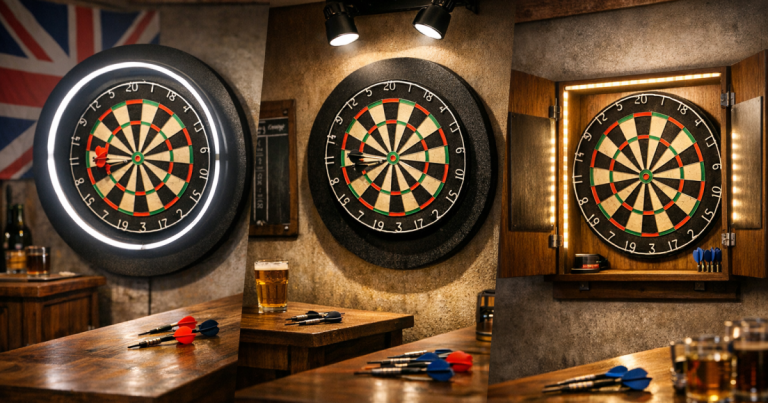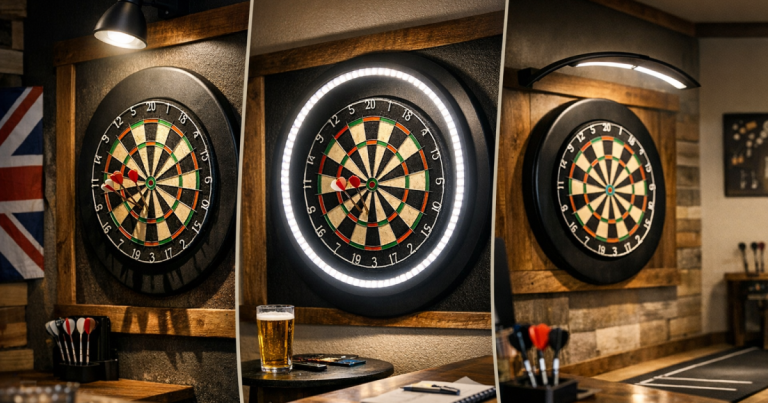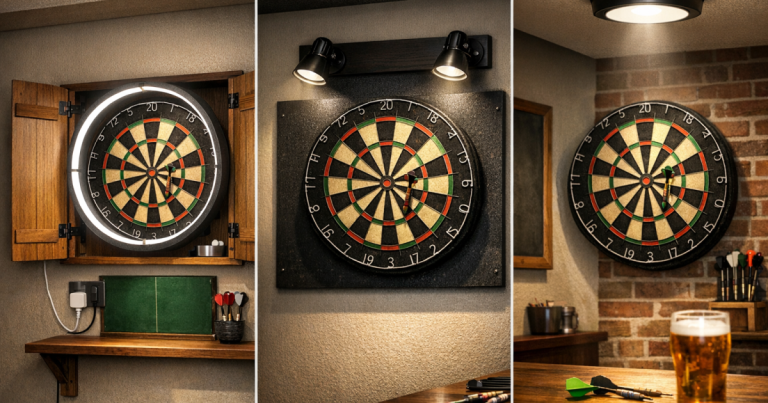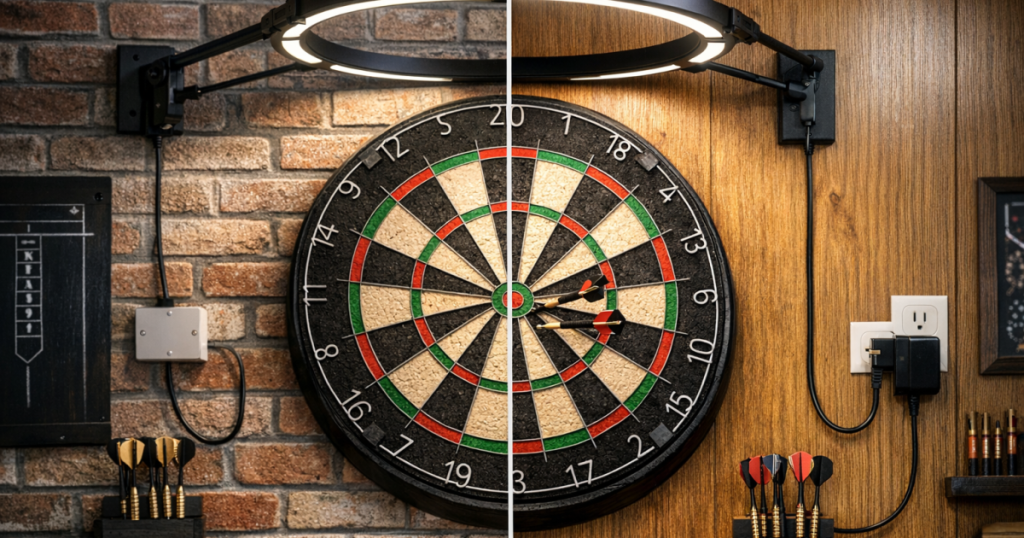
Good lighting does more than make the treble bed easier to see. It decides how tidy the setup feels, how often you leave the board ready to play, and whether cables become an annoyance. For many home players, the choice between mains-wired dartboard lighting and a plug-in light is really a choice between permanence, convenience and flexibility.
Mains electrical wiring for fixed dartboard lights should be carried out by a qualified electrician to ensure compliance with UK electrical safety requirements and applicable Building Regulations.
The short version
Choose a plug-in dartboard light if you want the simplest route, you rent your home, you move the board around, or you want to test a layout before committing. Choose a fixed mains-wired setup if the board has a permanent position, the room is being renovated, or you want a clean finish with fewer visible leads.
Neither option is automatically better for scoring. A neatly fitted plug-in ring light can give a clearer view than a poorly positioned wired fitting, and a fixed installation can still create shadows if it is aimed badly. The deciding factor is how well the light covers the board, avoids glare, and fits the room.
What each option really means
Plug-in dartboard lighting
A plug-in setup uses a standard UK plug socket, usually with a cable running from the light to the nearest socket or extension point. Many dedicated dartboard lights are designed this way because they are easy to add to an existing board without altering the wall or ceiling.
Popular dedicated board lights such as Target Corona Vision, Winmau Plasma Dartboard Light and Mission Torus 270 Dartboard Light show the kind of purpose-made units many home players consider. Before relying on any one model, check how it fixes around your board, how the cable exits, whether it suits your cabinet or surround, and whether it leaves enough clearance for your throwing area.
Mains-wired lighting
A mains-wired setup is connected into the home’s electrical system rather than plugged into a socket each time. It might be a ceiling light positioned over the board, a wall-mounted fitting above the cabinet, or a dedicated circuit-controlled light in a converted garage, games room or outbuilding.
The main appeal is neatness. Once installed, you can switch the board light on like any other room light, without loose leads crossing the wall or trailing near the oche. The trade-off is that it takes planning, costs more to change, and needs qualified electrical work when wiring is involved.
Where plug-in lighting makes most sense
Plug-in lighting is usually the better starting point for a typical home oche. It suits spare rooms, bedrooms, conservatories, rented homes, and shared spaces where the dartboard is not the only purpose of the room. You can reposition it, remove it when decorating, and take it with you if the board moves.
It also works well when you are still testing the room. Many players change their first setup after a few weeks: the oche shifts to avoid a doorway, the surround is added later, or a cabinet proves deeper than expected. A plug-in unit lets you learn what the room needs before making permanent changes.
The weakness is cable management. A lead running down the wall can look untidy, and a cable near the throwing area is a nuisance if it is not clipped, routed or tucked away properly. If a socket is in the wrong place, avoid stretching a lead across a walkway. That is not just messy; it can become a trip hazard during casual games when people step in and out of the playing area.
Where a wired setup earns its keep
A fixed lighting arrangement makes sense when the board has a long-term home. That might be a garage conversion, a garden room, a dedicated darts corner, or a pub-style setup where the board, surround, cabinet and oche all stay in place.
The biggest advantage is finish. You can position switches sensibly, hide cables, and make the setup feel like part of the room rather than something added afterwards. For a clean home darts room, that can matter as much as the board itself.
A fixed setup can also be useful when plug sockets are awkwardly placed. In many UK homes, sockets are low on the wall and not always close to the dartboard. If the nearest socket forces a visible lead across a fireplace wall, under a cabinet, or around furniture, a properly planned wired light can solve the problem cleanly.
The downside is commitment. Once a fitting is installed, changing board height, moving the cabinet, or switching to a different surround can affect how the light lands. Plan the board location carefully before the electrical work is done, especially if the room is being plastered, decorated or fitted out at the same time.
Visibility matters more than the power source
The best power choice will not rescue poor light placement. Darts lighting has to make the segments clear without throwing distracting shadows from the dart barrels, wires or cabinet doors. It should also avoid shining into the player’s eyes from the oche.
A good dartboard light should do three things:
- Light the full face of the board evenly, including the outer doubles.
- Reduce strong shadows from darts already in the board.
- Keep glare away from the thrower and anyone standing nearby.
If your current setup has bright spots on one side and a dull patch on the other, the issue is probably placement or beam spread rather than whether the unit is plugged in or wired. For a deeper look at board visibility and glare control, read our guide to choosing safe, glare-free lighting for darts.
How room type changes the decision
Living room or dining room
A plug-in light usually suits mixed-use rooms because it is less intrusive. If the board lives inside a cabinet, the light needs to work with the cabinet doors open and avoid casting a hard shadow from the top edge. Cable routing matters here because the setup is visible even when no one is playing.
Garage or utility space
A wired light can be appealing in a garage because the board often has a fixed wall and the room is less decorative. However, garages can be colder, dustier or more humid than the rest of the home. Any fitting used in a less protected space should be suitable for that environment, and electrical work should be planned accordingly.
Garden room or outbuilding
If the darts area is part of a finished garden room, fixed lighting can look excellent, but the electrical side needs proper planning. The board light, general room lighting and sockets should work together rather than competing. A bright board in a dark room can feel harsh, while a well-lit room with a dull board can make scoring awkward.
Dedicated darts wall
For a permanent setup, think in zones: the board face, the oche, and the surrounding room. A bright board is important, but players also need to step safely, retrieve darts comfortably and read the room without harsh contrast. Our breakdown of darts lighting zones for the board, oche and room explains how those areas work together.
How cabinets, surrounds and mats affect the choice
Lighting rarely exists on its own. A cabinet can limit where a ring light sits. A surround can change the clearance around the board. A raised oche or mat can affect how cables are routed along the floor or skirting.
If you use a cabinet, check whether the doors open fully without hitting the light or throwing shadows over the outer board. Some players like a classic cabinet for storage and wall protection, but it can make lighting trickier than a plain surround. If you are still deciding between wall protection options, our guide to whether you need a dartboard cabinet, surround or both is a useful next step.
With mats, the key point is cable discipline. A plug-in light cable should not run across the walking path, under a curling mat edge, or through the oche area. If the only workable route creates a trip risk, that is a strong argument for changing the socket arrangement or considering a professionally installed fixed solution.
A simple decision framework
Use these questions before deciding:
- Is the board staying on this wall for the long term? If yes, a fixed setup becomes more attractive. If no, plug-in is safer and more flexible.
- Do you rent or expect to move the setup? Plug-in lighting is usually the more sensible choice because it avoids permanent alterations.
- Is there a nearby socket in a sensible place? If yes, a plug-in light can be neat. If no, visible cables may spoil the setup or create hazards.
- Are you refurbishing the room anyway? If plastering, decorating or adding sockets, it is a good time to plan fixed lighting properly.
- Does the board sit in a cabinet? Check clearance, door movement and shadows before choosing any light style.
- Will other people use the room? In family spaces, cable tidiness and easy switching matter more than they do in a private darts room.
Common questions
Is plug-in dartboard lighting good enough for regular practice?
Yes, it can be. A well-positioned plug-in dartboard light is good enough for regular home practice if it gives even board coverage, controls glare and has its cable routed safely.
Does a wired light make the board look more professional?
Usually, yes. A wired setup can look cleaner because cables are hidden and switching is integrated, but the final result still depends on placement, beam angle and how the board area is finished.
Can I use normal room lighting instead?
Sometimes, but it is rarely ideal on its own. Ceiling lights often leave shadows on the board or create glare from behind the thrower. A dedicated board light is usually clearer.
Should I choose a ring light or an overhead fitting?
A ring-style light is often easier to add to an existing home board. An overhead or wall-mounted fitting can work well in a planned room, but it needs careful positioning to avoid shadows and glare.
What should I check before fixing anything permanently?
Confirm the board position, cabinet or surround clearance, oche line, nearby furniture, socket locations and how the room will be used when darts are not being played.
What to remember
Plug-in lighting is the practical choice for most home darts setups because it is flexible, easy to trial and less disruptive. It is especially useful when the room is shared, rented or likely to change.
A mains-wired setup is worth considering when the darts area is permanent and you want a neater, more integrated finish. It comes into its own in dedicated rooms, garage conversions and well-planned darts walls, but it should be treated as part of the room design rather than an afterthought.
The right answer is not simply wired or plug-in. It is the option that gives you a bright, even board, keeps the oche safe, avoids glare and fits naturally into the way you use the room.