A dartboard cabinet can make a home oche look tidier, but it is not always the simplest answer to wall damage, bounce-outs or awkward room layouts. The right choice depends on what you need to protect, how much space you have around the board, and whether you want your darts area to feel like a permanent feature or something you can keep visually quiet between sessions.
The short answer
For most home players, a surround is the most practical first layer of protection. It sits close to the board, catches many near-misses and keeps the wall around the scoring area in better condition.
- Choose a surround if your main worry is stray darts marking plaster, wallpaper or paint around the treble and outer single areas.
- Choose a cabinet if you want a neater-looking setup, simple storage for darts and accessories, or a way to close the board away between games.
- Use both only when your wall space, board bracket, lighting and door clearance all work together. Not every ring surround fits neatly with every cabinet.
- Consider a larger backboard or feature panel if your misses are wide, the wall is delicate, or the board sits in a busy family room.
What a surround actually solves
A dartboard surround is there for impact protection. Most home surrounds are made from a dense foam or similar forgiving material and fit snugly around a standard bristle board. Their job is simple: catch darts that just miss the board and reduce the chance of visible marks on the wall.
That makes a surround useful in rented homes, spare bedrooms, garages, garden rooms and living spaces where a few accidental marks would be annoying. It is not a complete safety barrier, and it will not catch every badly thrown dart, but it deals with the most common near-miss zone better than cabinet doors alone.
The main limitation is visual. A surround leaves the board on show, so it feels more like a dedicated darts area than a piece of furniture. That is ideal in a games room, but less subtle in a lounge or dining room. If the wall finish matters, read more about wall protection around a dartboard before settling on the smallest possible setup.
What a cabinet adds
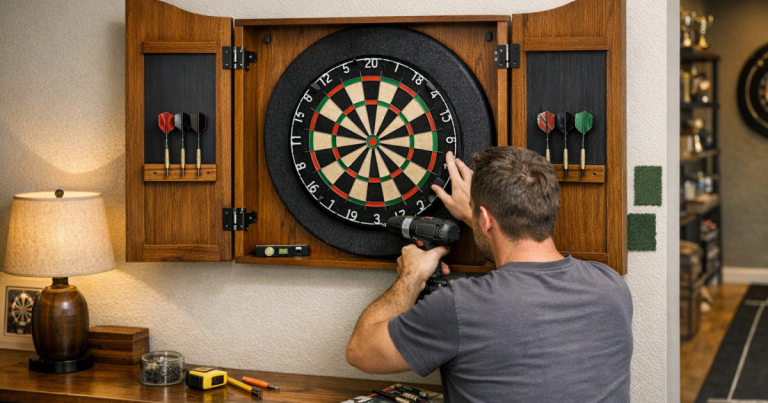
A cabinet is more about presentation, storage and tidiness than pure protection. It frames the board, usually gives you somewhere to keep darts and accessories, and can hide the board when the doors are closed. For a shared room, that makes a big difference: the oche can feel intentional rather than improvised.
A dartboard cabinet can also help define the wall visually. Instead of a board floating on a blank surface, you get a centred feature with doors, side panels and often a scoring area. That is why cabinets work well in studies, snug rooms, bars, converted garages and multi-use spaces where the setup needs to look finished.
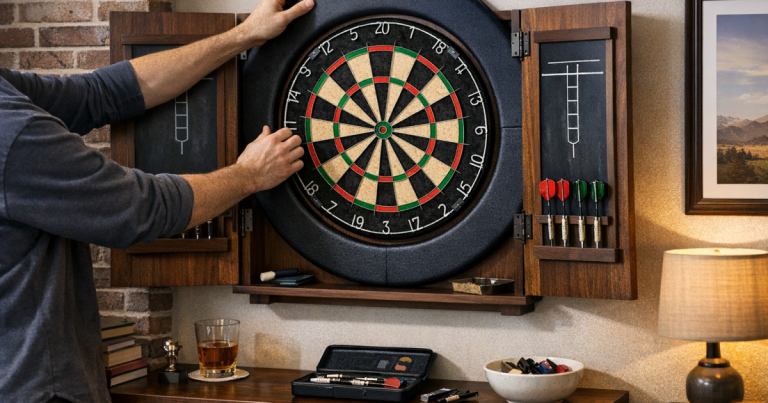
The trade-off is that cabinet doors do not always protect the areas most likely to be hit. When the doors are open, they sit to the sides of the board, so a very wide miss may strike wood, hinges or the surrounding wall. A cabinet can reduce clutter, but it is not the same as a soft impact zone around the board.
When both make sense
Using both can be a smart solution, but it needs a bit of planning. A surround gives the practical protection, while the cabinet gives the setup structure and storage. The problem is fit: many full-size ring surrounds extend beyond the board enough to interfere with cabinet doors, side panels or built-in scoreboards.
If you want both, think of the wall as a complete arrangement rather than separate accessories. Check that the board sits far enough forward, the surround does not crush against the cabinet frame, and the doors can open fully without rubbing. If you use a lighting ring, check how it sits in front of the cabinet and whether it blocks door movement or scoring areas.
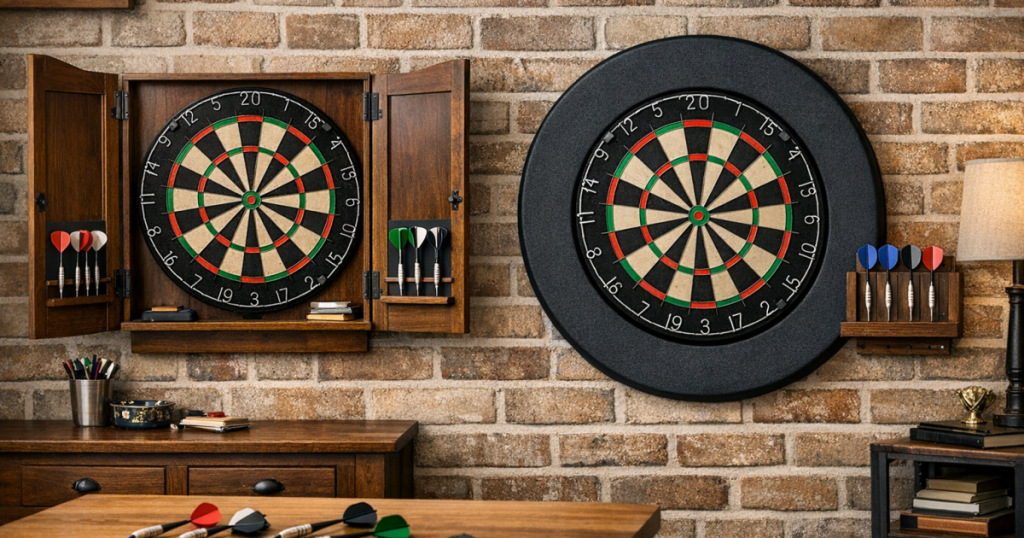
Some players solve this by using a cabinet-style backboard, a wider feature panel, or a surround that sits outside the cabinet rather than inside it. Others keep the cabinet and add separate wall protection below or beside it, where occasional bounce-outs or low misses are more likely to mark the wall.
Room-by-room examples
Spare bedroom or office
A cabinet often works nicely here because the board can be closed away when the room is being used for work or guests. If the wall behind the board is painted plaster, a compact surround or larger backboard is still worth considering. Darts practice can be surprisingly hard on a freshly decorated wall.
Garage or utility space
A surround may be enough if the wall finish is less precious and the setup is mainly for regular throwing. Cabinets can still be useful for keeping darts, chalk, flights and shafts in one place, but they are less essential if the room is already clearly a hobby space.
Living room, dining room or bar area
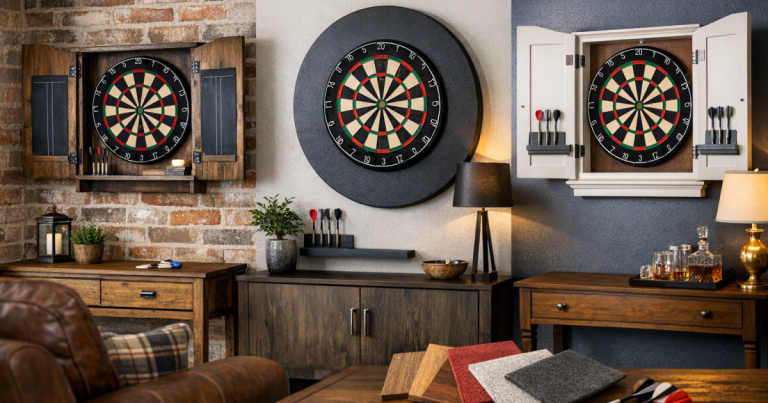
This is where a cabinet earns its keep visually. Closed doors make the board less dominant, and a wood finish can tie in with shelving, flooring or furniture. For a more polished look, it is worth taking time to plan a stylish darts wall with cabinets and surrounds rather than adding pieces one by one.
Family games room
A surround or backboard is usually the priority because more people means more varied throwing styles. If the board is used by beginners, children under supervision, or occasional guests, the extra soft coverage around the scoring area tends to matter more than storage.
Checks before you decide
Start with the wall, not the accessory. A solid brick or block wall with a durable painted finish can tolerate more than a thin partition wall, wallpapered wall or decorative panel. If you are mounting into plasterboard, use fixings suitable for the surface and keep the board stable. A loose board makes scoring less consistent and can increase wall wear over time.
- Board position: Set the board at the correct height and distance before judging how much wall area needs protection. If the throw line is wrong, the whole setup feels off. Use the standard board height and throwing distance as your starting point.
- Miss pattern: Beginners often miss around the outer ring and lower sections. More experienced players may still cause damage through bounce-outs rather than wild throws.
- Door clearance: Cabinet doors need space to open without hitting shelves, light fittings or adjacent walls.
- Lighting: Cabinets can create shadows if room lighting is weak or comes from one side. Check the board face with the doors open, not just when the setup looks tidy.
- Storage needs: If you only keep one set of darts nearby, a cabinet may be more about looks than necessity. If several people play, storage becomes more useful.
- Wall style: A slim surround looks practical; a cabinet looks more like furniture; a larger backboard can become a design feature.
Common combinations that work well
Surround only
This is the clean, practical choice for many home oches. It gives useful protection with minimal fuss and keeps the setup focused on throwing. It suits garages, spare rooms and anyone who wants function before furniture.
Cabinet only
This suits confident throwers and rooms where neatness matters more than heavy-duty protection. It is best when the wall behind and around the board is not too delicate, or when the cabinet sits on a wider backing panel.
Cabinet with extra backing
A backing panel behind the cabinet can protect a wider area and create a more deliberate feature wall. This can look cleaner than trying to squeeze a bulky surround into a cabinet frame that was not designed for it.
Surround with separate storage
If you like the protection of a surround but do not want doors around the board, use a small shelf, drawer unit or wall-mounted accessory holder nearby. It keeps darts equipment organised without changing the throwing area itself.
Maintenance and day-to-day use
Whichever route you take, small habits make the setup last longer. Rotate a bristle board regularly, remove darts cleanly, and keep the area dry and stable. A surround can hide early wall marks, but it should not be treated as a cure for an unstable or worn board.
Cabinets need occasional checks too. Make sure hinges remain secure, doors close squarely and the board bracket has not loosened. If you use chalk or marker scoring inside the doors, clean the surfaces gently so they do not become permanently smudged.
Think about the whole throwing zone as well. Wall protection is only one part of a home setup; the floor, oche position and lighting all affect how comfortable the area feels over a longer practice session.
Common questions
Will a cabinet stop darts damaging the wall?
Only partly. A cabinet frames the board and may shield some side areas, but open doors are not the same as a soft surround. For frequent near-misses, a surround or larger backing panel usually protects better.
Can you fit a surround inside a cabinet?
Sometimes, but not always. Many surrounds are too wide or deep for standard cabinet frames. Check door movement, board depth, lighting clearance and whether the surround presses against the frame.
Is a surround enough for beginners?
Often, yes, provided the board is mounted correctly and the surrounding wall is not extremely delicate. Very wide misses may still go beyond the surround, so a larger backboard can be useful in family spaces.
Do cabinets affect dartboard lighting?
They can. Open doors and side panels may cast shadows if the room light is off-centre. Test the board face from the throw line, because a setup can look fine up close but uneven from the oche.
Which is better for a small room?
A surround is usually simpler because it adds little visual bulk and has no doors to swing open. A cabinet can still work if the wall has enough side clearance and the room benefits from hiding the board between games.
Main points
If your priority is wall protection, start with a surround or a larger backing panel. If your priority is a tidy, furniture-like finish with storage, a cabinet makes more sense. If you want both, plan the board, surround, doors, lighting and scoring area together before fixing anything permanently.
The best home setup is not always the most elaborate one. It is the one that protects the room, feels good to throw at, and suits how visible you want the board to be when the darts are packed away.