Sharp points do more than stick in the board; they also protect sisal, reduce bounce-outs and keep your throw feeling consistent. The easiest way to store steel tip darts is to stop the points touching hard surfaces or each other, then keep the barrels, shafts and flights in a stable, dry spot between sessions.
Most blunting happens away from the board: in loose tins, kit bags, drawers, pockets and cluttered shelves. A neat home setup prevents those small knocks before they turn into rounded tips, bent points or damaged flights.
What to know first
- Keep each point separated, covered or held in foam so it cannot scrape against metal, glass, tile or another dart.
- Avoid dropping darts onto hard floors, radiator covers, window sills or worktops while setting up.
- Do not store damp darts straight after play; wipe the points and barrels first.
- Use a case that holds the darts securely rather than one that squeezes the flights or lets the points rattle.
- Keep tools, spare points and loose accessories away from the main dart points unless they have their own compartment.
Step 1: Check the points before you put the darts away
Storage starts before the case is closed. After a session, look at each point under decent light and check for flattened tips, tiny burrs or visible bends. You do not need to obsess over microscopic marks, but a point that catches on a cloth or feels rough when touched lightly is worth dealing with before it goes back into storage.
Wipe the points with a dry cloth to remove board dust, moisture from hands and small fibres from the sisal. If the darts have landed on a hard floor, inspect them straight away. A small flat spot caused by one drop can make a point skate around the board face or chew into the wire instead of entering cleanly.
Avoid aggressive sharpening as a routine habit. The aim is not to create needle-like tips every week; overly sharp points can be harsh on a board and may still weaken quickly if they are stored badly. Keep the point clean, smooth and evenly shaped, then protect it from impact.
Step 2: Use a case that supports the whole dart
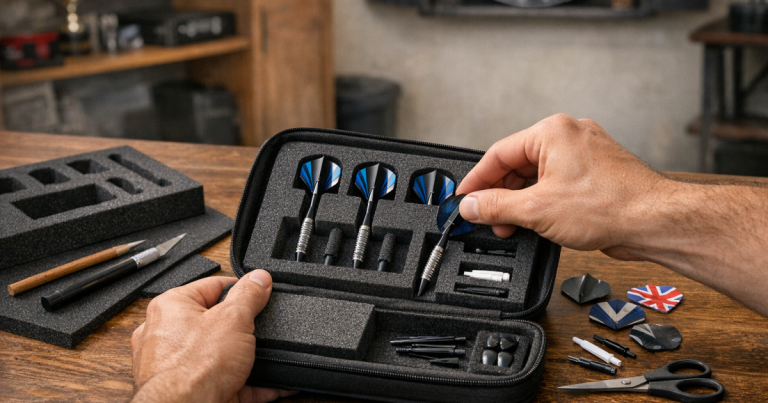
A good darts case does two jobs: it keeps the point away from hard surfaces and it stops the whole dart moving around. If the case is too loose, the darts can knock into each other while carried. If it is too tight, the flights may bend and put pressure through the shafts every time the lid closes.
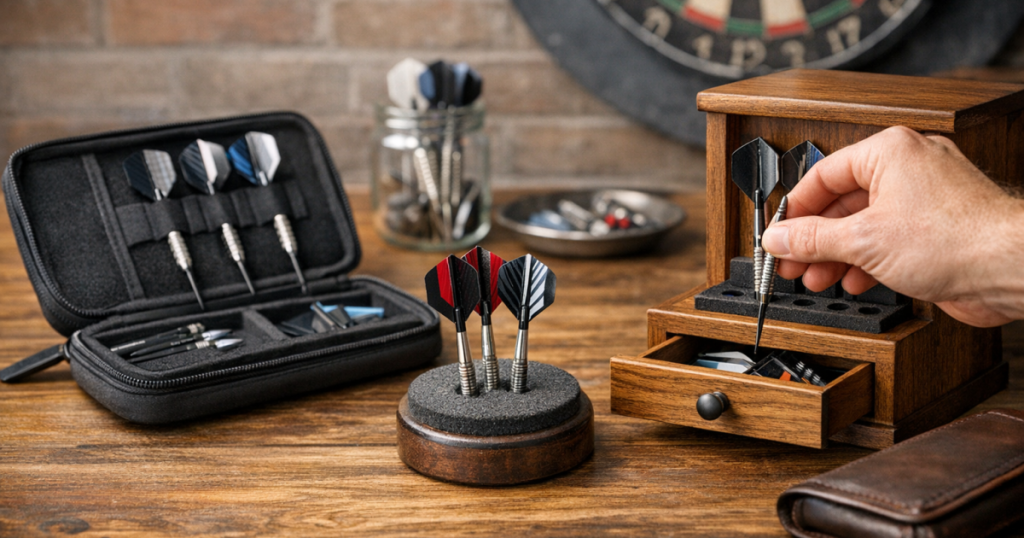
For fully assembled darts, look for a case with separated dart channels, a firm inner tray or a protected point section. A case such as the Target Takoma Darts Wallet is a familiar example of the assembled-dart style, while compact hard cases such as the Mission Freedom Slim Darts Case show the same basic principle: the darts should be held in position rather than left to roll around loose. Before relying on any case, check that your barrel length, shaft length and flight shape fit without forcing the lid.
If the point touches the inside of the lid, a zip, a metal hinge or another dart, the case is not doing its job. A cheap soft pouch can be fine for short-term use if it has a proper point protector, but a plain drawstring bag is poor storage for steel tips because everything moves together.
Step 3: Cover loose points between legs and sessions
Not every dart goes straight into a case. At home, many players leave darts on a side table, shelf or scoreboard area between legs. That is where point guards, a small foam block or a dedicated dart stand can help. The key is to give the points a soft, consistent landing place rather than sticking them into furniture, carpet or the edge of a cabinet.
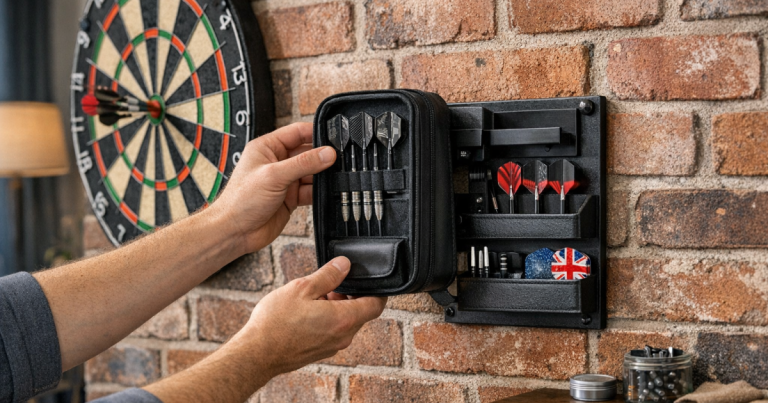
Rubber or silicone point protectors are useful if you carry darts to a mate’s house, a league night or a different room. They also stop the points catching on fabric inside a bag. For a home darts corner, a small accessory tray with a foam insert can be enough, provided it is stable and kept away from drinks, keys and loose tools.
If your darts area is gradually filling up with spare flights, stems, chalk, point tools and score pads, it is worth giving those items a proper home. A compact wall ledge keeps sharp items away from the floor and makes the setup easier to reset; the guide to creating a wall-mounted shelf for darts accessories is a useful next step if you want everything tidy without taking over the room.
Step 4: Decide whether to store darts assembled or dismantled
For daily or weekly play, storing darts fully assembled is convenient and usually fine if the case is designed for it. It keeps your setup consistent, protects the flights from being misplaced and means you are ready to throw quickly. The case must hold the dart without compressing the flight or letting the point move.
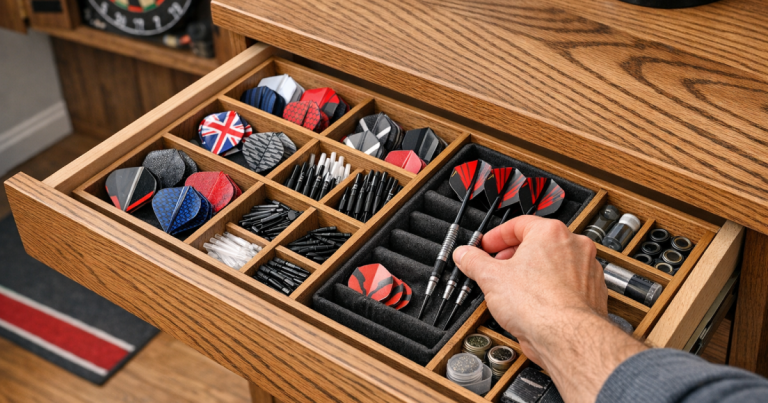
For longer storage, or if you have limited case space, dismantling the setup can make sense. Keep the barrels with their points covered, store shafts together and keep flights flat so they do not curl. Small grip-seal bags, divider boxes or labelled compartments can stop spares from becoming a mixed pile of plastic, metal and sharp edges.
Shaft condition matters too. A bent or split shaft does not directly blunt the point, but it can change how the dart lands and increase awkward impacts. If you are reorganising your kit and noticing inconsistent flight angles, read the guide on choosing dart shafts that suit your throw before replacing spares at random.
Step 5: Keep darts dry and away from temperature swings
Steel tips do not like damp storage. In many UK homes, the risky spots are garages, sheds, conservatories, utility rooms and window ledges where condensation appears overnight. Even if the point does not visibly rust, moisture can leave marks and make the dart feel less clean as it enters the board.
Store your darts in a dry cupboard, drawer or accessories shelf away from radiators and direct sunlight. A small silica gel sachet in a case can help with general moisture, but it does not replace wiping the darts after play. If the points are visibly wet or greasy, clean and dry them before they touch the board again.
Avoid coating points in oily products before normal home use. A trace of oil may seem protective, but it can transfer to your fingers, flights, case lining and board face. Clean and dry beats slippery and over-treated.
Step 6: Stop damage during carrying and setup
Many points are dulled in transit rather than storage. Do not carry steel tip darts loose in a hoodie pocket, coat pocket or rucksack compartment. The points can hit keys, coins, zips, phone cases and hard plastic. They can also work through fabric, which is bad for both the darts and your hands.
When moving darts between rooms, close the case fully and keep it separate from heavy items. If you use a toolbox-style organiser for darts accessories, give the darts their own protected section rather than laying them among point tools, spare barrels or metal flight protectors.
At the board, have a simple routine: open the case, take out the darts, throw, retrieve, then return them to the same place. Leaving darts on the floor beside the oche is asking for stepped-on shafts, chipped points and lost flights. A reliable mat and clear oche zone also help keep accessories out from underfoot; the guide to building a reliable darts mat and oche area covers that part of the setup in more detail.
Common storage mistakes that blunt points
- Using a mug or tin: The points knock against ceramic, metal and each other every time the container moves.
- Leaving darts in the board for days: It is convenient, but accidental knocks can twist points and mark the sisal.
- Throwing darts into a drawer: Spare tools, coins and metal accessories can flatten tips quickly.
- Overfilling a case: Extra flights, stems and tools can press into the darts if they are forced into the same space.
- Storing damp darts: Moisture and board dust left on the point can make future cleaning harder.
- Ignoring dropped darts: One impact on tile, concrete or laminate can be enough to change the tip shape.
A simple storage routine that works
Once you know how to store steel tip darts safely, the routine becomes quick. After playing, retrieve the darts carefully, wipe the points and barrels, check for obvious damage, then place each dart into a separated case or protected holder. Put accessories back into their own compartments, close the case and keep it in a dry, consistent spot.
For most home players, that habit does more than preserve points. It keeps the whole darts area calmer: fewer missing flights, fewer loose shafts, fewer sharp items on the floor and less clutter around the board. You will also notice problems sooner, because every session ends with a brief check rather than a rushed tidy-up.
Questions people ask
Is it bad to leave steel tip darts in the dartboard?
For a short break between legs, it is usually fine. For overnight or longer, it is better to remove them, wipe them and store them in a case so the points are not knocked or left stressing the board face.
Should dart points face up or down in a case?
The direction matters less than the support. Points should sit in a protected section, foam, rubber guard or separated channel where they cannot touch hard materials or another dart.
Can I store darts in a drawer if I use point guards?
Yes, if the point guards stay firmly on and the darts are not crushed by other items. A small tray or case inside the drawer is safer than leaving the darts loose among tools and spares.
Do I need to remove flights before storing darts?
Only if your case bends or squeezes them. If the case is made for assembled darts and the flights sit freely, leaving them fitted is convenient and helps keep your setup consistent.
What should I do after dropping a dart on a hard floor?
Check the point before throwing again. If it looks flattened, bent or rough, deal with the point first rather than risking board damage or inconsistent entry.
Main lessons
Point protection is mostly about preventing small, repeated impacts. Use a case that holds each dart still, cover loose points, keep the storage area dry and stop accessories from becoming a sharp-edged jumble. Do that consistently and your steel tip darts will stay cleaner, safer and more reliable between sessions.