Doubles games get messy when the scoreboard only shows two totals and everyone has to remember the throwing order. The easiest way to score doubles matches is to separate the team score from the player rotation, so each visit is clear before the next thrower steps up.
For most home darts setups, you do not need a complicated system. You need a layout that shows who is throwing, what each pair has left, who started the leg, and how many legs or sets each side has won.
The short version
Use one scoring column per pair, not one column per player. Then add a small player-order note beside or above the scores, such as “A1, B1, A2, B2”. That keeps the match readable without turning the scoreboard into a notebook.
- Team columns: write one remaining score for each pair.
- Player order: list the four players in the exact throwing rotation.
- Visit scores: mark each three-dart score against the correct side.
- Legs and sets: keep these separate from the live 501 score.
- Checkout notes: write the winning double or finish if it helps avoid debate.
Step 1: Decide what the scoreboard needs to show
A doubles scoreboard has to answer four questions at a glance: which team is on the oche, what score they have left, which player throws next, and what the match score is. If any of those are left to memory, mistakes creep in quickly, particularly in a busy kitchen, garage or open-plan games space.
For a standard 501 doubles leg, each pair shares one total. Player A1 and Player A2 are not on separate 501 scores; they are taking alternate turns for the same side. The same applies to the other pair. That shared total is the main number to keep large and readable.
If you are still settling on the right surface for your setup, the differences between chalk, dry-wipe and electronic formats are worth understanding. The guide to choosing between chalk, dry-wipe and electronic scoreboards is a useful next step if your current board feels cramped or awkward for pairs matches.
Step 2: Set up two main scoring columns
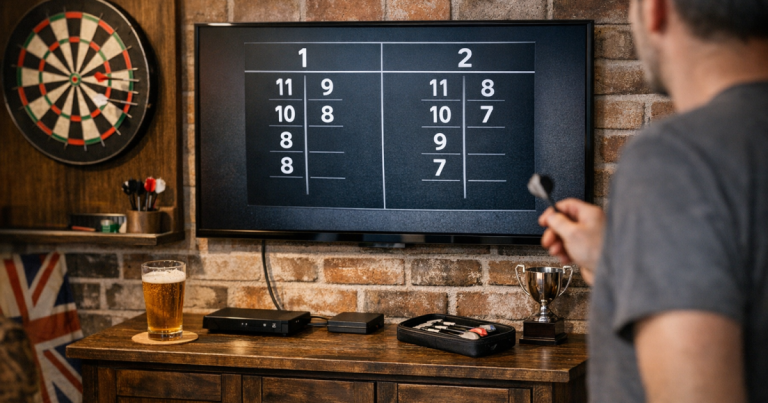
At the top of the board, write the team names or player pairings clearly. Avoid squeezing four names across the scoring area if space is tight. A clean layout might look like this:
- Left column: Sam / Rob
- Right column: Jas / Mike
- Small note above: Order: Sam, Jas, Rob, Mike
- Live score: one remaining total under each pair
- Leg tally: small marks underneath or to the side
The key is to make the current remaining score the largest thing on the board. Visit scores, checkout notes and leg tallies can be smaller, but the remaining total should be readable from the throw line. If players have to walk forward to check the score, the layout is not doing its job.
Step 3: Write the throwing order before the first dart
Doubles scoring usually goes wrong because the order is assumed rather than written down. Before the leg begins, agree the order and put it somewhere visible. A simple “1, 2, 3, 4” order beside the names is enough.
For example, if the order is Sam, Jas, Rob, Mike, the teams still alternate properly: Sam throws for the left team, Jas for the right, Rob for the left, Mike for the right, then back to Sam. Writing this down helps when people are chatting, switching chalkers or taking a break between legs.
If your group rotates the starting player each leg, mark that too. Some casual home games keep the same internal order for the whole match; others rotate within the pair so both players get chances to start. Either is fine as long as it is agreed before the first visit of the leg.
Step 4: Record each visit without clutter
There are two common ways to keep a doubles scoreboard tidy. The first is to write the visit score and new remaining score underneath the team column. The second is to write only the new remaining score and say the visit aloud as it is deducted. For friendly home matches, the second method is quicker, but the first is better if the game is competitive.
A tidy chalk or dry-wipe sequence might show:
- 501
- 60 → 441
- 45 → 396
- 100 → 296
Bold is not something you would literally use on a chalkboard, but the principle is useful: make the remaining score stand out. If you are writing on a narrow board, write the visit score smaller and the new remaining score larger.
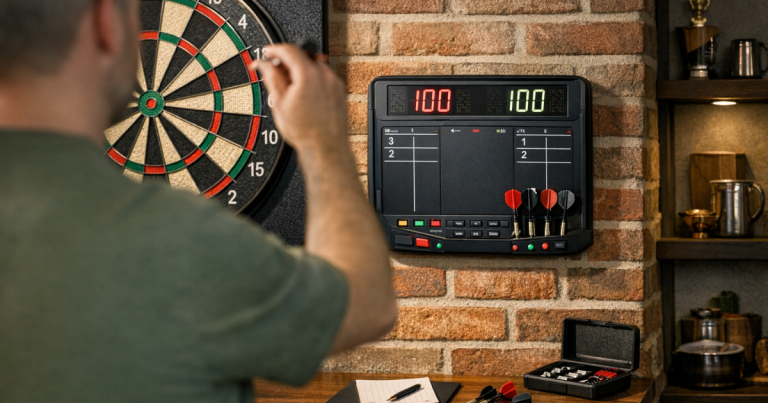
For electronic scoring, check that the mode supports two-player teams or four-player rotation in the way you intend to play. Some boards and scorers handle team totals differently, so it is worth reading the game mode notes before match night. The explainer on electronic dartboards, scoring and game modes covers the kind of settings that matter when the device is doing the arithmetic for you.
Step 5: Mark busts and missed finishes consistently
In 501, a bust means the team’s score goes back to what it was at the start of that visit. In doubles play, that can be confusing if one partner is already walking away and the next player is getting ready.
Use one simple mark for a bust, such as “B” or “bust”, and leave the previous remaining score in place. Do not write the failed deduction and then erase it later unless the board is large enough to make the correction obvious. The goal is to prevent the next thrower from starting from the wrong number.
Checkout attempts are also worth keeping clear. If a player leaves 40, misses tops, then hits single 20 and single 10, the team has not finished and now needs 10. Say the new score aloud and write it immediately. Doubles partners often discuss routes together, but the written score should be the final reference.
Step 6: Keep legs and sets away from the live score
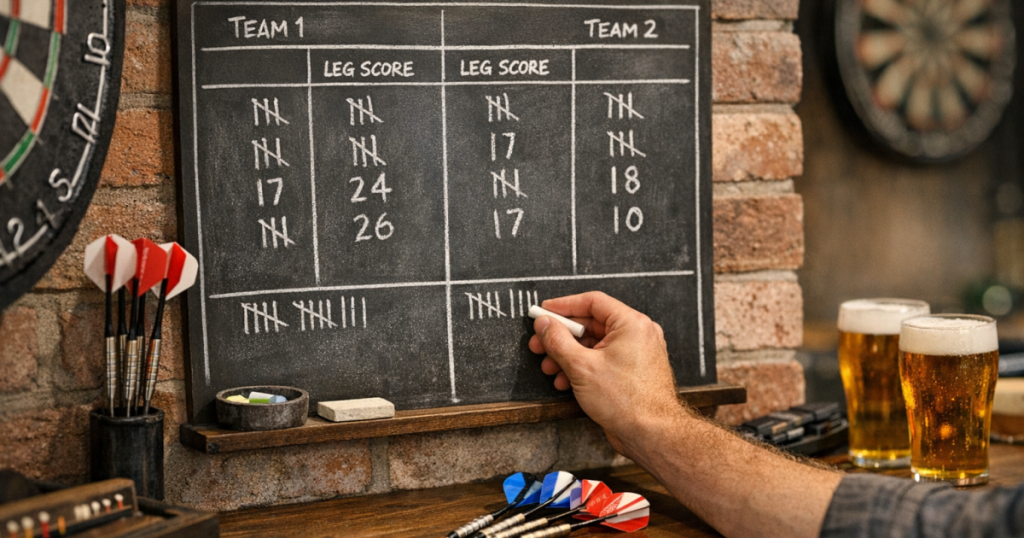
Do not put leg tallies directly under the remaining 501 score unless the board has plenty of room. A leg tally can look like part of the score when people glance quickly. Put match scoring in a separate box or corner.
A clear match area might use:
- Legs: one stroke per leg won, grouped in fives if needed.
- Sets: a separate line if you are playing set play.
- Starter: a small dot or arrow next to the team that began the leg.
- Format: write “best of 5 legs” or “first to 3” before play starts.
This matters more in doubles because there are more people involved in every decision. A clean match-score area stops the classic “is it 2–1 or 1–1?” discussion halfway through a session.
Step 7: Make the board easy to read from the oche
A scoreboard that is technically correct but hard to see still causes delays. Place it where the thrower can check the number without stepping across someone else’s line. In many home rooms, the best position is slightly to the side of the dartboard rather than directly below it.
Lighting matters as well. Shadows, glossy dry-wipe surfaces and dim garage lighting can all make scores harder to read, especially when four players are sharing the space. If visibility is a regular issue, the dartboard lighting planning guide for multi-use spaces will help you think through glare, positioning and shared-room practicalities.
A simple doubles scoreboard template
For a home 501 pairs match, this layout is easy to copy onto a chalkboard, dry-wipe board or large paper sheet:
- Top left: Team 1 names.
- Top right: Team 2 names.
- Centre top: throwing order for the leg.
- Main left column: Team 1 remaining score.
- Main right column: Team 2 remaining score.
- Small side area: legs won and set score.
- Bottom note: format, such as first to 3 legs.
If you are chalking, keep a cloth or eraser nearby and wipe only the live leg area between legs. Leave the match score and player order visible until the match ends. If you are using dry-wipe, use a pen that contrasts strongly with the board and avoid writing names so small that they blur from the oche.
Common scoring mistakes in doubles
Most mistakes are not mathematical; they are layout problems. The scoreboard should make the correct action obvious.
- Four separate 501 totals: this is wrong for normal pairs play. Each pair shares one score.
- No written order: players forget who follows whom, especially after a bust or long checkout discussion.
- Leg scores mixed with live scores: small tally marks can be mistaken for digits.
- Erasing too much: wiping the starter or order note creates avoidable confusion.
- Unclear bust handling: always return to the score at the start of the visit.
Things readers ask
Do both players in a pair need separate scores?
No. In standard 501 doubles, the pair shares one running score. Individual visit scores can be noted if you want detail, but the main scoreboard should show one total per team.
Who throws after a bust in doubles?
The turn still passes to the next player in the agreed rotation. The busted team’s score returns to what it was at the start of that visit.
Should the same player start every leg?
Only if your match format says so. Many home games rotate the starting player or alternate which team starts each leg. Write the starter down before each leg begins.
What is the clearest scoreboard type for doubles?
A large chalk or dry-wipe board is often easiest because you can adapt the layout. Electronic scoring can work well too, provided the game mode supports the way your group plays pairs.
How much detail should you record?
For casual games, the remaining score, player order and leg tally are enough. For league-style practice, add visit scores so any mistake can be checked quickly.
In brief
Clear doubles scoring comes down to separation: team score in one place, throwing order in another, and match score away from both. Once those three areas are obvious, the game flows better, the chalker has less to remember, and all four players can focus on the darts rather than the arithmetic.