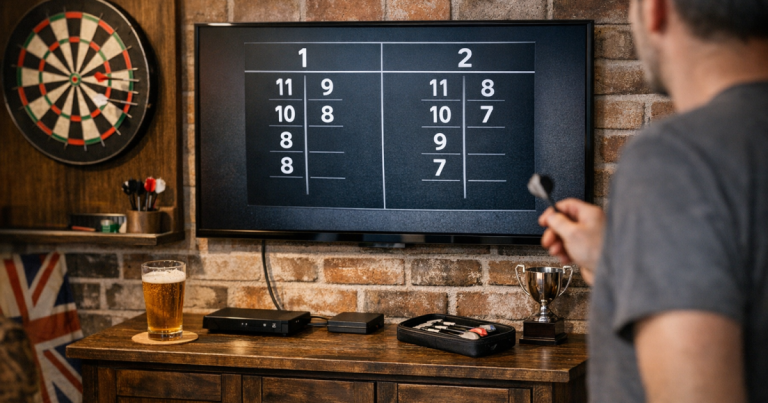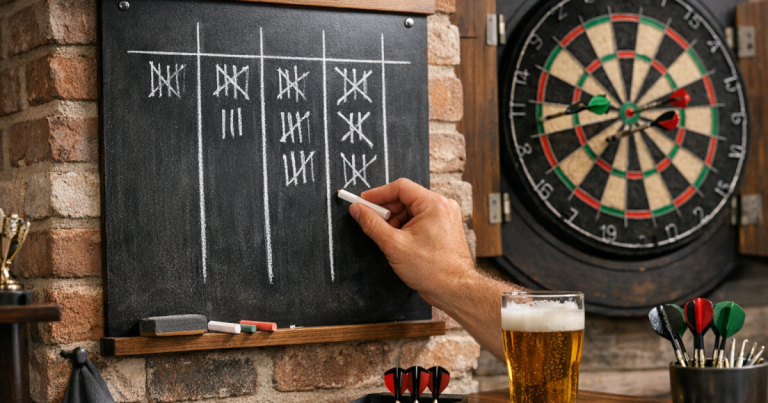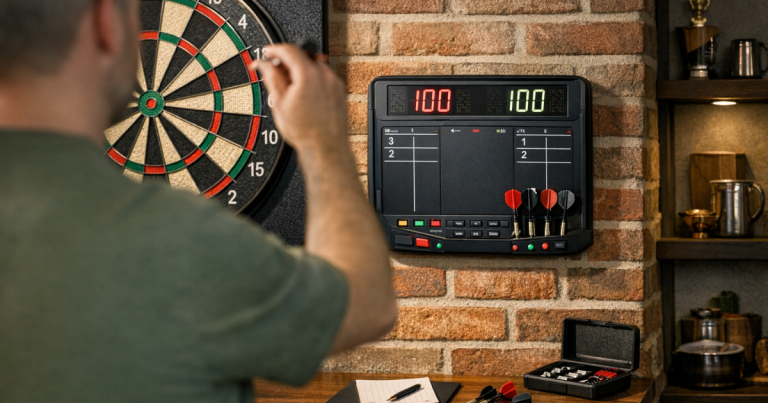
Longer legs, doubles practice and round-robin nights can turn a tidy board into a smudged puzzle. Keeping a chalk scoreboard neat is mostly about routine: write in the same zones, clear only what you need, and make each mark easy to read from the oche. A few small habits also stop arguments over scores when the room is busy.
Chalk is still a great choice for home darts because it is quick, simple and easy to correct. The trick is to treat the scoreboard as part of the playing area rather than an afterthought squeezed beside the cabinet.
The short version
- Use fixed columns for player names, remaining score, previous visit and checkout notes.
- Write larger than feels necessary; small chalk numbers blur quickly during long matches.
- Rub out one small area at a time rather than wiping the whole board between every turn.
- Keep a separate corner for match format, legs and sets so the main score stays uncluttered.
- Clean the board properly before a longer session, then use light corrections during play.
Set the board up before the first throw
A neat scoreboard starts before anyone has chalk in hand. If the board is too low, too far away, poorly lit or partly hidden by the cabinet door, the scorer will rush the writing and the players will lean in to check the numbers. That is when smudges and crossed-out scores begin to build up.
Place the scoreboard where the scorer can write without stepping into the thrower’s line or blocking the walkway. For a home oche, a side position close to eye level usually works better than a board tucked behind the player. If your scoring area feels awkward, use the layout principles in placing a darts scoreboard for easy match scoring before changing your scoring habits.
Before the match starts, draw the basic structure clearly. Leave enough space between columns so a 180, a bust, a missed double and a corrected subtraction do not all end up in the same crowded strip. A useful layout for longer games is:
- Player names at the top, written once and left alone.
- Current remaining score in the largest central area.
- Previous visit or last three-dart score in a smaller side area.
- Legs and sets in a clearly separated box.
- Checkout reminders only when they are genuinely useful, not for every visit.
Use bigger numbers and fewer marks
The most common cause of messy chalk scoring is trying to fit too much information into too little space. During a short casual leg, that might not matter. Over a longer match, small numbers become grey patches, especially once several corrections have been made.
Write the remaining score as the main number and make it large enough to read without squinting. The scorer should not need to add decorative lines, circles or repeated arrows. If a player is on 121, the important information is the remaining score and, if useful, a simple checkout note. Avoid filling the board with every possible route unless the players have agreed that checkout help is part of the session.
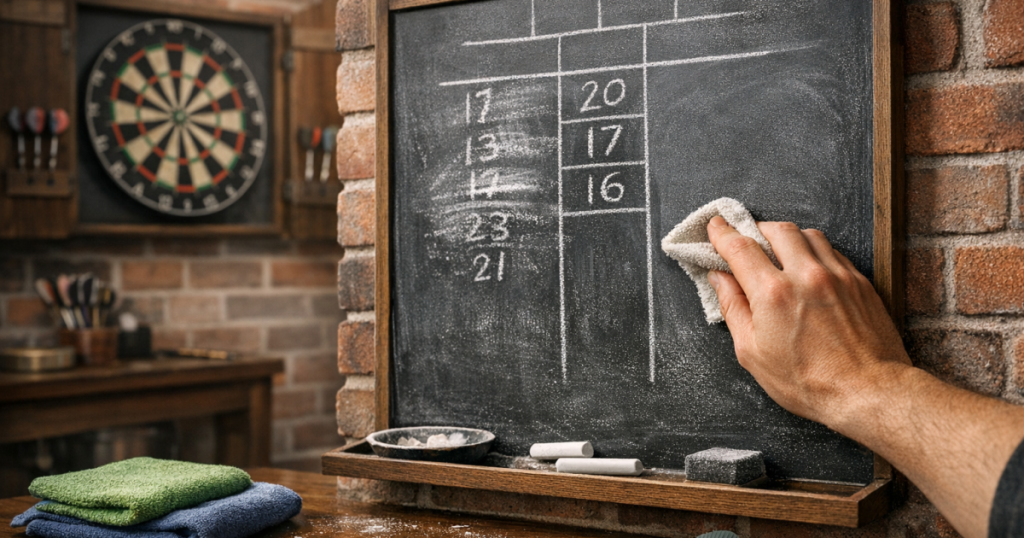
For casual home matches, one clean correction is better than several tiny amendments. If the scorer writes 78 instead of 87, rub out the whole number and rewrite it. Do not squeeze the correct digit over the old one. Chalkboards are forgiving, but only if you remove the error properly.
Rub out small sections, not the whole board
Longer matches often get untidy because the scorer wipes too much away. A full-board wipe spreads chalk dust across the surface and can leave a pale film that makes fresh numbers harder to see. It also increases the chance of losing leg scores or player names.
Use a small eraser, cloth or felt pad and clear only the number that needs changing. Work from top to bottom where possible so chalk dust does not fall over a newly written score. If the board has a wooden or MDF frame, keep the wiping motion inside the scoring surface rather than pushing dust into the edges.
It helps to agree a simple routine: after each visit, the scorer writes the new remaining score, checks it aloud if needed, then clears the previous working area. The aim is not to make the board look freshly cleaned after every throw; it is to keep the live information readable.
Separate match information from scoring information
A scoreboard can become confusing when it tries to do two jobs in the same space. The running score changes every visit, while match information changes much less often. Keep them apart.
For example, in a best-of-9 legs match, put the leg tally in a small box away from the main score columns. If you are playing sets, give sets their own line as well. Do not keep rewriting the format in the middle of the board; write it once at the top or bottom and leave it there.
For practice games such as around-the-board doubles, cricket-style routines or checkout drills, label the game clearly before you begin. A short heading such as “Doubles 1–20” or “121 checkout ladder” stops the board becoming a mix of scores, targets and half-erased notes.
Keep the scorer’s hand out of the chalk
Right-handed and left-handed scorers smudge boards in different ways. A right-handed scorer often drags the side of the hand across the left player’s column when writing on the right. A left-handed scorer may do the reverse. Over a longer match, those small brushes become a cloudy surface.
There are three easy fixes. First, write from the outside edge of the board towards the middle where the layout allows. Second, keep the active score slightly lower than the player name so the hand does not repeatedly cross the same heading. Third, avoid resting the palm on the surface while doing subtraction.
If two people are taking turns scoring, keep the same layout throughout the match. Different handwriting is manageable; different systems are what make boards untidy. Agree whether the latest remaining score goes at the top, middle or bottom of each player column and stick to that pattern.
Watch the light as the match goes on
Chalk can look crisp from one angle and washed out from another. In many UK homes, the darts area sits in a spare room, garage, dining space or alcove, where ceiling light does not always fall evenly across the scoreboard. Shadows from the thrower, cabinet door or scorer can make neat writing look poor.
Check the board from the oche before play begins. If players cannot read the remaining score without walking forward, the writing will be questioned more often and corrected more messily. For room-specific ideas, the darts lighting design guide for different room layouts is a useful next step.
Lighting matters more during long matches because concentration drops. A clearly lit scoreboard reduces mental friction: players can see the target, the scorer can check the maths, and nobody has to pause the rhythm just to ask what is left.
Build a simple chalk and cleaning kit
The best scoring routine falls apart if the chalk is crumbling, the rubber is filthy or there is nowhere to put accessories. Keep a small kit near the board so the scorer is not searching drawers between legs.
A sensible home setup includes:
- Two or three pieces of clean white chalk, rather than one worn-down stub.
- A small dry eraser or soft cloth for in-leg corrections.
- A separate cloth for deeper cleaning after the session.
- A small tray, shelf or pot so chalk dust is not spread across the cabinet.
- A spare pencil or notepad if you like checking close match totals away from the board.
Do not use a damp cloth mid-match unless the board surface is designed for it and you have time for it to dry. Moisture can turn chalk into a paste, which smears more than dry dust. Save deeper cleaning for the end of the night.
If your darts corner already has spare flights, shafts and points scattered around the scoring area, the chalk will pick up grime quickly. Tidying the small items makes a bigger difference than most players expect; the ideas in organising spare flights, shafts and points at home also help keep the scoreboard area calmer.
Use a consistent scoring rhythm
Neat scoring is partly visual and partly behavioural. The scorer should not be trying to subtract while a player is already throwing the next dart. For longer matches, use a steady rhythm that protects both accuracy and board clarity.
A good sequence is:
- Call or confirm the visit score.
- Subtract before writing, not while writing.
- Write the new remaining score clearly.
- Pause briefly so both players can see it.
- Clear only the previous working mark if it is no longer needed.
This rhythm is especially helpful when players are tired or the match has become close. It gives everyone a clear reference point and reduces the temptation to scribble quick corrections over half-erased figures.
Examples for common longer home formats
Best-of-11 legs
Use one main column per player and a small leg box underneath the names. Mark won legs with simple vertical strokes or numbers, but keep that box away from the running score. At the end of each leg, wipe the running scores clean and leave the leg tally untouched.
Sets and legs
For set play, use two small boxes: one for sets and one for legs in the current set. Reset only the leg box when a set ends. The main scoring area should still show only the active leg, otherwise the board starts to look like a results sheet.
Checkout practice
Write the target number at the top, then use ticks or brief notes underneath. Avoid writing full routes for every attempt. If someone wants to practise 121, 122 and 123, clear each target before moving on rather than building a long chalk history down the board.
Group night rotation
When several players rotate in and out, write initials in a separate order list. Do not keep changing the main player-name line unless the match itself changes. A fixed rotation list prevents the top of the board from becoming the messiest area in the room.
End-of-session clean-down
Once the match is finished, clear the board fully rather than leaving ghost scores overnight. Use a dry cloth first to remove loose chalk. If the board surface allows a slightly damp clean, use minimal moisture and dry it afterwards. Avoid household cleaners unless the manufacturer specifically says the surface can take them, as some finishes can become shiny or patchy.
Check the edges and tray as well. Chalk dust gathers along the bottom of the board and can transfer back onto the scorer’s hand during the next session. A thirty-second clean-down keeps the board darker, the numbers sharper and the scoring area more pleasant to use.
Questions people ask
Should I use white or coloured chalk for darts scoring?
White chalk is usually clearest on a dark board and keeps the layout simple. Coloured chalk can work for headings or set tallies, but too many colours make a busy board harder to read during a match.
How often should I wipe the whole scoreboard?
Wipe the full surface between legs or at natural breaks, not after every visit. During a leg, clear only the section that has changed so the board stays readable without spreading dust everywhere.
What is the best way to stop ghost numbers?
Use light pressure when writing, clean the board fully after longer sessions, and avoid grinding corrections into the surface. If ghosting remains, the board may need a proper dry clean before the next match.
Should the scorer write the visit score as well as the remaining score?
For casual home play, the remaining score is the priority. A small previous-visit note can help with checking maths, but it should not crowd the main number players need to see.
Can a chalk scoreboard work for league-style practice at home?
Yes, provided the layout is disciplined. Keep legs, sets, names and live scores in separate areas, and agree the scoring routine before the first dart is thrown.
What stands out
A tidy chalk scoreboard is not about perfect handwriting. It comes from a repeatable layout, a calm scoring rhythm and small cleaning habits that stop chalk dust taking over. Keep the live score large, give match details their own space, and clear only what needs clearing. Longer matches feel smoother when everyone can trust the board at a glance.