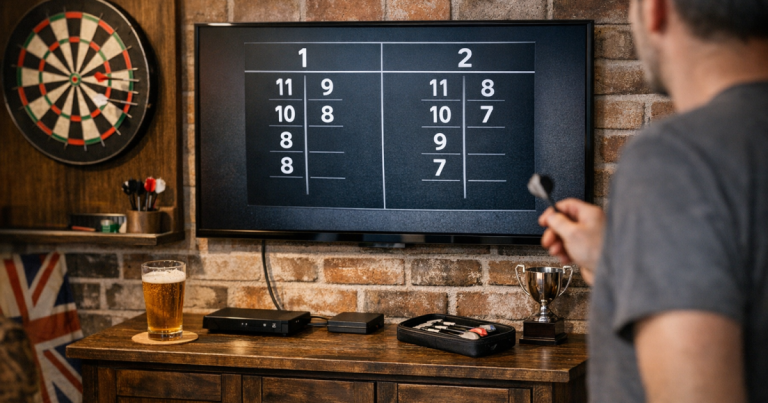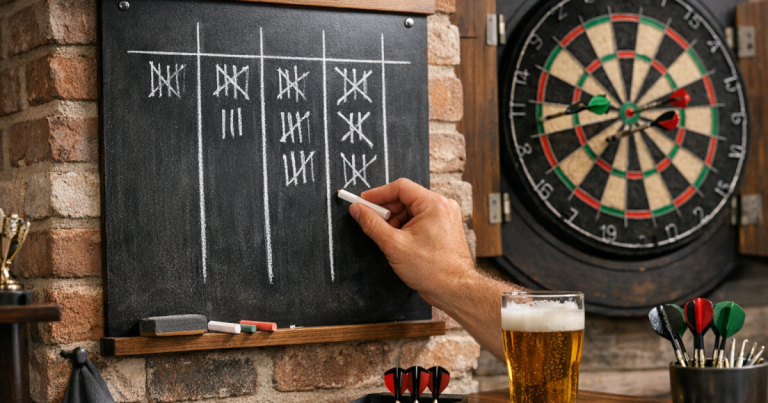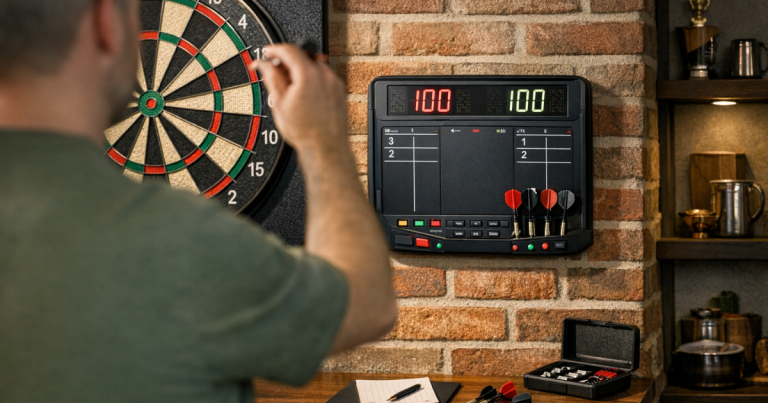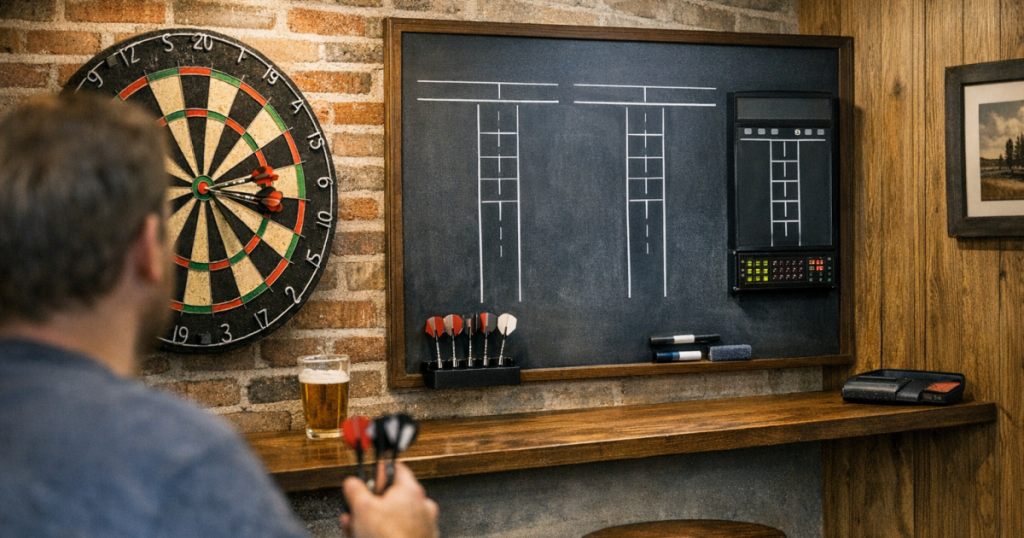
A scoreboard that is awkward to see or reach slows a match, causes score disputes and makes casual games feel messier than they need to. Good darts scoreboard placement gives the thrower, marker and spectators a clear view without putting anyone in the throwing lane or forcing players to step across the oche.
For most home setups, the best position is just to the side of the dartboard, at a comfortable writing height, with enough clearance from cabinet doors, lighting and the throwing path. The exact side depends on your room layout, but the aim is always the same: readable, reachable and safely out of the way.
Permanent fixing that involves drilling near electrical cables, pipework or uncertain wall construction should be carried out by a qualified professional to meet UK safety requirements and the fixing manufacturer’s instructions.
What to know first
- Place the board and oche before the scoreboard. The scoring area should support the match layout, not dictate it.
- Keep the scoreboard visible from the throw line. Players should be able to check the score without walking forward.
- Give the marker easy access. The person writing should not need to stand in the thrower’s eyeline or step into the lane.
- Avoid glare and shadows. A perfectly placed scoreboard is frustrating if the writing is washed out by a light fitting.
- Test it with a real leg. A position that looks fine when empty can feel awkward once two players and a marker are moving around.
Step 1: Start with the board, oche and walking route
Before choosing a scoreboard position, set the dartboard and throwing line correctly. The scoring area only works well when the board height, oche distance and approach route are already settled. If the mat or toe line is still shifting, the scoreboard may end up too far away, too close to a player’s shoulder, or hidden by someone standing at the line.
Use the wall face around the dartboard as your reference point, then check how players enter and leave the throw. In a small spare room, the natural route may be straight back from the oche. In a garage or garden room, players might step sideways to collect darts or mark scores. The scoreboard should sit where that movement already happens, not where it creates an extra crossing point.
If you are still refining the throwing area, it is worth checking the oche measurements, toe line rules and mat alignment before committing to a permanent scoreboard position.
Step 2: Choose the side that keeps the throw clean
The easiest home setup usually has the scoreboard on the left or right of the dartboard rather than directly underneath it. A side position lets the marker write without standing below the board, and it keeps the score visible during play.
There is no single correct side for every room. Use these checks:
- Door and furniture clearance: avoid putting the scoreboard where a door, cupboard or chair blocks access.
- Player movement: choose the side where people naturally move after throwing, not the side that forces them through the throwing lane.
- Marker comfort: a regular marker should be able to stand side-on to the board and write without leaning across the dartboard area.
- Spectator view: if people sit behind or beside the oche, place the scoreboard where they can follow the match without standing up.
For right-handed and left-handed players, the important point is not the throwing hand itself but the space around the throw. A scoreboard that is too close to the player’s shoulder can feel distracting, especially in a narrow room.
Step 3: Set a comfortable writing height
A home darts scoreboard should be readable from the oche and comfortable to mark repeatedly. As a practical starting point, place the main writing area around chest to eye height for the people who score most often, then adjust after testing.
A scoreboard mounted too low makes the marker stoop and can be hidden by people standing near the board. Too high, and the lower rows may be fine but the top line becomes awkward to update, especially during longer games with sets, legs and checkouts.
For chalkboards and dry-wipe boards, leave enough room above and below for your hand to move freely. If you use a cabinet-mounted scoreboard, open the doors fully and check that the scoring panel is not cramped by the board surround, hinges or shelves.
Step 4: Keep the score readable from the oche
The thrower should be able to glance at the score without leaving the line. This matters most in legs where checkout maths changes the next three darts. If the numbers are too small or angled away, players end up walking forward, asking for repeats or losing rhythm.
Stand at the oche and check whether you can read a typical score line, not just a large heading. Write a few realistic examples such as 501, 326, 170 and 32, then view them from the throw line. If the writing is unclear, the answer may be a better angle, stronger contrast or a slightly larger scoring surface rather than moving it closer.
Lighting can make or break readability. A side-mounted board may catch glare from a ceiling light or sit in the shadow cast by a surround. If the score looks patchy or reflective, use the advice in dartboard lighting mistakes and how to avoid them to tidy up shadows before blaming the scoreboard position.
Step 5: Allow space for the games you actually play
Not every home match needs the same scoring space. A simple 501 leg needs player names, running totals and maybe checkout notes. Round the Clock, cricket-style games and casual doubles can need more columns or more frequent updates.
Before fixing anything permanently, sketch the layout you use most. Check whether the scoreboard has enough room for:
- two player names or team names;
- running scores for 301 or 501;
- sets and legs, if you play match formats;
- checkout reminders or missed-dart notes;
- practice drills, such as doubles hit, scoring visits or target segments.
If you often host friends, leave enough space for clear, tidy writing rather than squeezing every line into the smallest possible area. Messy scoring creates more arguments than a scoreboard being a few centimetres further to one side.
Step 6: Work around cabinets, surrounds and storage
Many home setups use a cabinet, surround or storage unit around the board. These can make the area look neater, but they also affect where a scoreboard can sit. Cabinet doors need room to open, wall-mounted accessories need clearance, and a score panel inside a door may be hidden from some angles.
If your scoreboard is part of a cabinet, test it with the doors open and closed. Make sure the open door does not narrow the throwing area or block the view from the oche. If you are planning the wall space more broadly, the dartboard cabinet dimensions, clearance and mounting guide is a useful next step before you drill or rearrange the room.
In compact rooms, a separate side scoreboard can sometimes work better than a cabinet-door board because it stays visible while people move around. In a larger darts room, a cabinet scoreboard may be neater and perfectly practical as long as the viewing angle is clear.
Step 7: Test the position with a full scoring routine
Do not judge the position from the wall alone. Run through a short match routine before final fixing. One player stands at the oche, another marks, and both players collect darts as they normally would.
During the test, ask these questions:
- Can the thrower read the score without stepping forward?
- Can the marker write without blocking the dartboard?
- Does anyone have to cross the throwing lane at the wrong time?
- Is the writing still clear under your normal room lighting?
- Can the board be wiped or cleaned without reaching awkwardly?
If any answer feels awkward, adjust the position before fixing it permanently. Small changes are easier at this stage than after a board has been screwed into the wall.
Common placement examples
Small spare room
In a narrow room, the best scoreboard position is often on the wall side that has the least foot traffic. Keep it close enough to mark easily, but not so close that the marker stands beside the thrower. A slim dry-wipe or chalk scoreboard can be easier to manage than a wide panel.
Garage darts setup
Garages often have shelving, tools and uneven lighting. Place the scoreboard where it is away from clutter and visible from the oche under the lights you actually use in the evening. Avoid putting it on a surface that is frequently covered by coats, boxes or stored equipment.
Cabinet-led setup
If the scoreboard is inside a cabinet door, treat the open cabinet as part of the playing footprint. Check that the open door does not make the board feel crowded or force the marker into the thrower’s line of sight. If it does, a separate side board may be a cleaner scoring solution.
Questions people ask
Should a darts scoreboard go on the left or right of the dartboard?
Use whichever side gives the clearest view and safest movement. The better side is usually the one with fewer obstructions, easier marker access and no need to cross the throwing lane.
Can the scoreboard go below the dartboard?
It can, but it is rarely the most comfortable position. It may be harder to read from the oche, and the marker can end up standing too close to the dartboard area.
How high should I mount a darts scoreboard?
Aim for a comfortable writing height for the usual marker, with the main scoring lines around chest to eye level. Test it from the oche before making the position permanent.
Is a cabinet-door scoreboard good enough for home darts?
Yes, if it is easy to read and mark with the door open. The main thing is checking the viewing angle, door clearance and whether the marker has enough space to write naturally.
What if the score is hard to read from the throw line?
Try improving contrast, reducing glare, increasing writing size or changing the angle slightly. Moving the scoreboard is only one fix; lighting and writing layout often matter just as much.
What stands out
The best scoreboard position is not simply the nearest empty patch of wall. It is the spot that lets the thrower check the score, the marker update it cleanly, and everyone move around the oche without interruption.
Set the dartboard and oche first, choose a side with sensible access, mount the scoring area at a natural writing height, and test it during a real leg. Get those basics right and darts scoreboard placement becomes one of the simplest upgrades you can make to the flow of a home match.