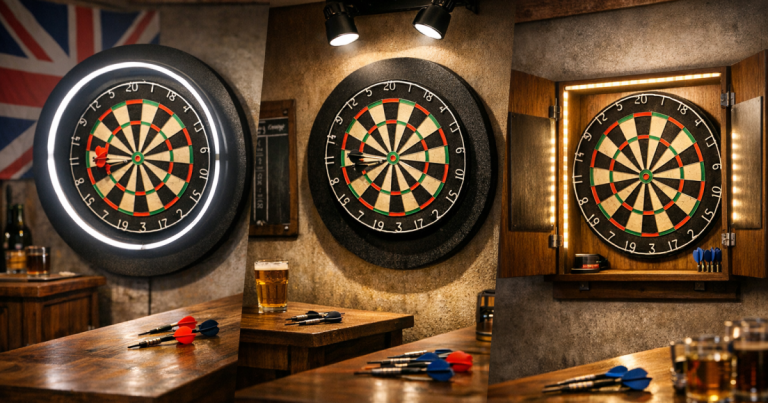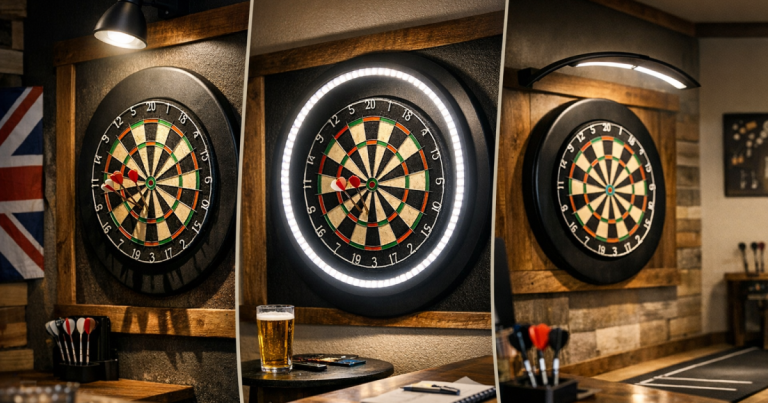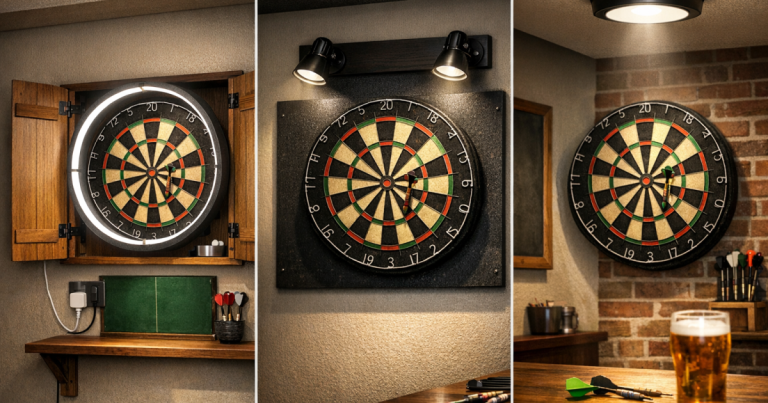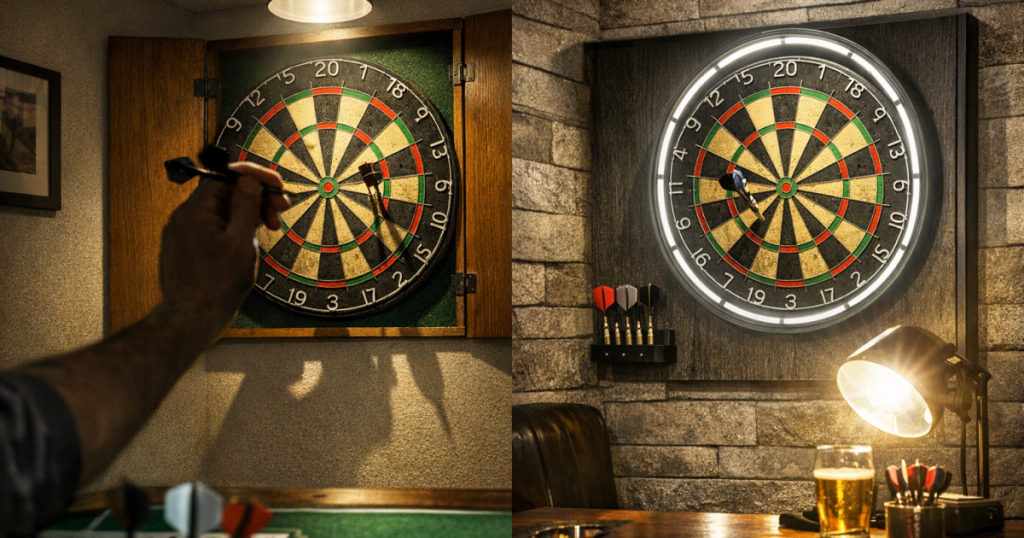
Poor lighting can make a good home oche feel frustrating: trebles blur, shadows cut across the bed and the room looks harsher than it needs to. The most common dartboard lighting mistakes are usually simple setup errors rather than expensive equipment problems, so a few careful checks can transform visibility without overcomplicating the space.
Mains electrical wiring for fixed dartboard lights should be carried out by a qualified electrician to ensure the installation complies with UK electrical safety requirements and relevant Building Regulations.
The short version
Good dartboard lighting should make the whole scoring area easy to read without glare in your eyes, harsh reflections on the board, or shadows from your throwing arm. The light should suit the room, the board surround, the cabinet or wall area, and the way people move around the oche.
- Aim for even light across the full board, not one bright patch on the 20 segment.
- Avoid placing a single ceiling light directly behind or above the thrower, as it often creates arm shadows.
- Keep fittings clear of cabinet doors, surrounds and dart paths.
- Think about cable routes before fitting plug-in lighting.
- Do not let decorative room lighting do the job of task lighting.
Mistake 1: relying on the room’s main ceiling light
A standard ceiling pendant or downlight might make the room look bright, but that does not mean the dartboard is properly lit. In many UK homes, the ceiling light sits behind the throwing position or off to one side of the room. That can cast a shadow over the board at the exact moment you lift your arm.
The fix is to treat the board as its own task area. The scoring surface needs dedicated, even illumination from around the board or from a carefully positioned fitting. The room can still have softer background light, but it should not be doing all the work.
If you want to plan the space more deliberately, it helps to separate the board, oche and room lighting zones. Thinking in zones makes it much easier to spot why a setup looks bright from the doorway but still feels poor when you are actually throwing.
Mistake 2: creating shadows across the scoring bed
Shadows are the classic darts lighting problem. They can be caused by the thrower, the cabinet, a deep surround, a shelf above the board, or a light source positioned too far to one side. Even a small shadow can make the treble ring harder to read during a fast practice session.
A quick test is to stand at the oche, raise your throwing arm and look at the board before releasing a dart. If a dark shape moves across the scoring area, the light position is working against you. Also check from left-handed and right-handed throwing positions if more than one person uses the setup.
To reduce shadows, use lighting that wraps evenly around the board or position the light so it falls towards the board without crossing the thrower’s arm. Avoid mounting a single bright lamp low on one side, as that often creates a sharp shadow on the opposite side of the board.
Mistake 3: making the board too bright
More brightness is not always better. A harsh light aimed straight at the board can wash out segment colours, reflect from metal number rings, and make the white areas feel uncomfortable to look at. Over-bright lighting can also make the surrounding room feel darker by contrast, which is tiring during longer practice sessions.
The aim is clarity, not glare. You want the doubles, trebles, wire edges and numbers to be easy to distinguish without squinting. If the board looks dazzling from the oche, try softening the angle, increasing background room light slightly, or using a fitting designed to spread light evenly rather than blast one central spot.
Mistake 4: ignoring the cabinet, surround or wall setup
Lighting that works on a bare wall might not work once you add a cabinet or surround. Cabinet doors can block side-mounted fittings, deep surrounds can create small edge shadows, and decorative wall panels can affect where cables or brackets can sit. It is much easier to plan lighting after you know the full board area, not just the board itself.
Before drilling, open cabinet doors fully and check whether the proposed light position still works. Look at the top clearance, side clearance and the space needed to remove or rotate the board. If your setup includes a cabinet, the cabinet clearance and mounting guide is a useful next check before deciding where the light should sit.
For compact rooms, low-profile lighting can be neater than a bulky fitting above the board. For larger rooms, a dedicated board light plus gentle ambient room lighting usually feels more comfortable than relying on one intense source.
Mistake 5: choosing the wrong colour feel for the room
Colour temperature affects how the board looks. Very warm lighting can make the board feel cosy but slightly dull, while very cool lighting can feel clinical in a small spare room or garage. The right choice is partly personal, but the key is consistency: the board should look natural, with good contrast between segments.
Avoid mixing several strong colour tones around the board. For example, a cool board light paired with very warm lamps close by can make the setup feel visually uneven. If the room doubles as a living space, keep the board lighting practical and use separate ambient lighting for atmosphere when you are not playing.
Mistake 6: underestimating wiring and cable routes
Plug-in dartboard lights can be very convenient, but the cable still needs a sensible route to a socket. A trailing lead near the oche, across a walkway, or behind a loose mat creates an avoidable nuisance. It can also make an otherwise tidy darts corner feel temporary and cluttered.
Fixed lighting can look cleaner, but it brings the electrical considerations mentioned earlier. The choice is not just about appearance; it is about how the room is used, where the sockets are, and whether you want the light controlled with the room lighting or separately. For a fuller breakdown, read the guide to mains-wired and plug-in dartboard lighting.
For plug-in setups, route cables along the wall where possible, keep them away from the throwing line, and avoid pinching them behind cabinets or furniture. If you use an extension lead, keep it positioned where it will not be kicked, pulled or covered by soft furnishings.
Mistake 7: fitting the light before checking board height and throw position
Lighting should be planned around the finished playing position. If the board height changes, the cabinet is moved, or the mat shifts forward, the light may no longer fall where you intended. This is a common issue when someone fits lighting first and then fine-tunes the oche afterwards.
Set the board and throwing line correctly before deciding the final lighting position. Stand at the oche, check the sightline, then test the light from the actual throwing spot. If you practise with different stances, check each one. A setup that looks perfect from straight on may cast a shadow when you stand slightly left or right.
Mistake 8: forgetting other people in the room
Home darts spaces are often shared. Someone may be keeping score, watching from a sofa, opening a cupboard, or walking past the board area. A light that is comfortable for the thrower can still shine directly into someone else’s eyes if it is poorly angled.
Check the common viewing spots as well as the oche. Sit where spectators usually sit, stand by the scoreboard, and look towards the board from the side of the room. If the fitting is visible and glaring from those positions, adjust the angle or consider a more shielded light source.
Simple checks before you settle on a lighting layout
You do not need specialist measuring tools to catch most problems. A few practical checks will tell you whether the lighting is helping or hindering your throw.
- Board coverage: every number, double and treble should be easy to read from the oche.
- Shadow test: raise your throwing arm and check whether it crosses the scoring area.
- Glare test: look at the board from the oche and from the side of the room; the light should not feel harsh.
- Clearance check: open cabinet doors, rotate the board if needed, and confirm the fitting is not in the way.
- Cable check: make sure leads do not run across walking routes, under unstable mats, or near where darts are retrieved.
- Room balance: keep enough background light so the board is not a bright island in a dark room.
Helpful questions
What dartboard lighting mistakes cause the most shadows?
The biggest causes are ceiling lights behind the thrower, single side-mounted lamps, deep cabinets, and fittings placed too low or too far from the board. Test with your throwing arm raised before fixing anything permanently.
Can I use normal room lighting for darts?
You can, but it is rarely ideal on its own. Room lighting helps atmosphere and general visibility, while the board usually needs dedicated, even task lighting for clearer scoring.
Should the oche itself be brightly lit?
It should be visible enough for safe footing and alignment, but it does not need to be as bright as the board. Over-lighting the oche can distract the thrower and create unnecessary contrast.
Is glare worse on some boards than others?
Glare can vary with wire shape, number ring finish, board wear and light angle. If a board looks shiny under direct light, changing the angle of the fitting often helps more than increasing brightness.
Do cabinets make lighting harder?
They can do. Doors, top panels and side depth all affect where light can sit, so check clearance with the cabinet fully open before choosing a final position.
Final thoughts
The best dartboard lighting feels almost invisible: the board is clear, the room is comfortable, and you stop noticing the light altogether. Most problems come from treating lighting as an afterthought rather than part of the full home setup.
Start with the finished board position, check shadows from the actual oche, and keep wiring, clearance and glare under control. Once those basics are right, your darts area will feel sharper, safer and far more enjoyable to use.