A good throwing line is one of the simplest upgrades you can make to a home board. A home darts oche setup keeps your stance consistent, protects the floor, and stops every practice session turning into a guessing game with a tape measure. The key is not just putting a line in the right place, but making sure the room around it actually works for throwing, collecting darts and staying safe.
For a standard steel-tip setup, the bullseye should be 1.73 m from the floor, and the oche should be 2.37 m from the face of the dartboard, not from the wall. That small detail matters because board depth, cabinets and mounting hardware can shift the true throwing distance.
The measurements that matter
Start with the board height. Measure vertically from the finished floor surface to the centre of the bullseye. The standard height is 1.73 m. If you have thick carpet, a raised mat or uneven flooring, measure from the surface you will actually stand on when throwing.
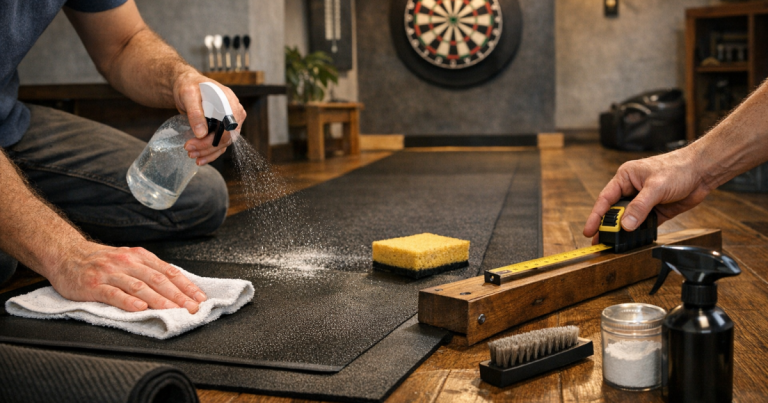
Next, measure the throw distance. For steel-tip darts, the official distance is 2.37 m from the face of the dartboard to the front edge of the oche. The board face means the playing surface, not the wall behind it. If the board is inside a cabinet or mounted on a bracket, put the tape measure against the front of the board and measure straight out along the floor.
A useful cross-check is the diagonal measurement from the bullseye to the oche. For a standard steel-tip setup, that diagonal is about 2.93 m. This is handy if skirting boards, furniture or an awkward alcove make floor measuring fiddly, but it should not replace a careful horizontal measurement where possible.
Soft-tip electronic boards may use a different throw distance, commonly around 2.44 m depending on the board and rules being followed. If you are using an electronic board, check the manufacturer’s setup instructions and the format you normally play. There is a clear difference between traditional bristle boards and powered scoring boards, so it is worth reading more on bristle or electronic dartboards for UK home players before committing the room layout.
How much room do you really need?
The minimum usable depth is more than the official throwing distance. You need the board on the wall, the measured oche position, and a little standing space behind the line. In a typical UK spare room, garage or dining area, aim for roughly 3.0 m to 3.2 m of clear depth from the wall behind the board to the space behind your feet. More is better if several people will be playing.
Width matters too. A board is narrow, but a thrower’s stance and arm movement are not. Around 1.5 m of clear width can work for a compact setup, but closer to 2.0 m feels more natural and gives room for left- and right-handed players. Avoid placing the oche where a door opens across the throwing area, or where people naturally walk between the player and the board.
Ceiling height is rarely a problem in a standard UK room, but loft rooms, garden offices and garages with beams deserve a quick check. Stand at the oche, go through your normal throwing motion without a dart, and make sure your hand and follow-through feel unrestricted.
Marking the oche properly
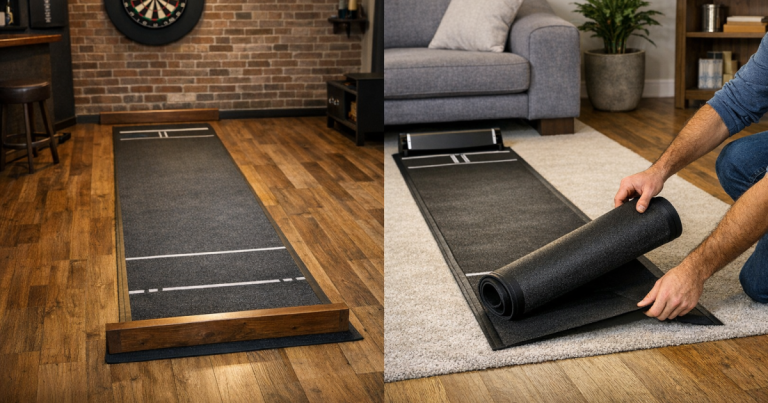
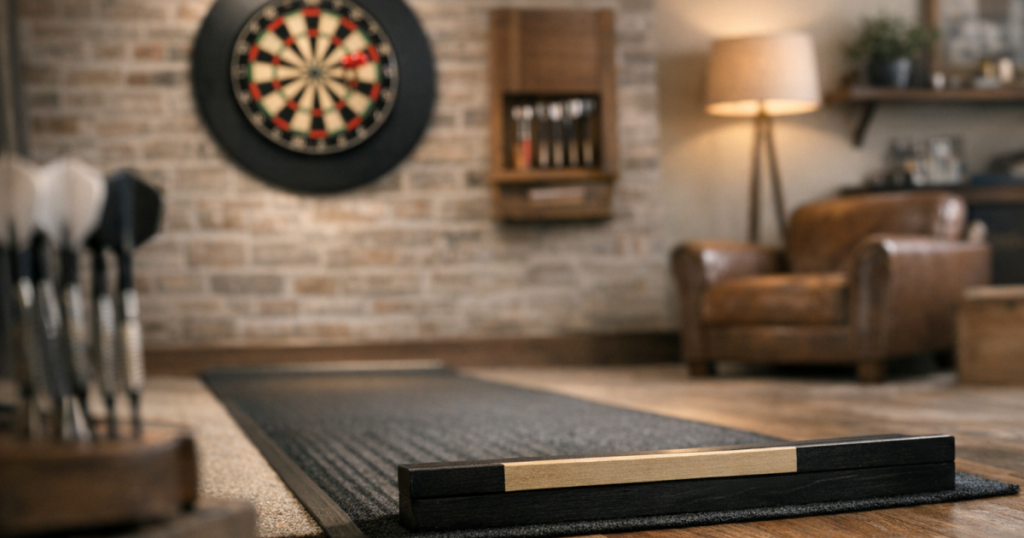
There are three common ways to mark the throwing line at home: tape, a raised oche, or a darts mat. Tape is cheap and neat, but it can peel, collect dust or leave adhesive marks on flooring. A raised oche gives a physical stop for your front foot, which can help consistency, but it needs to sit securely so it does not slide during play.
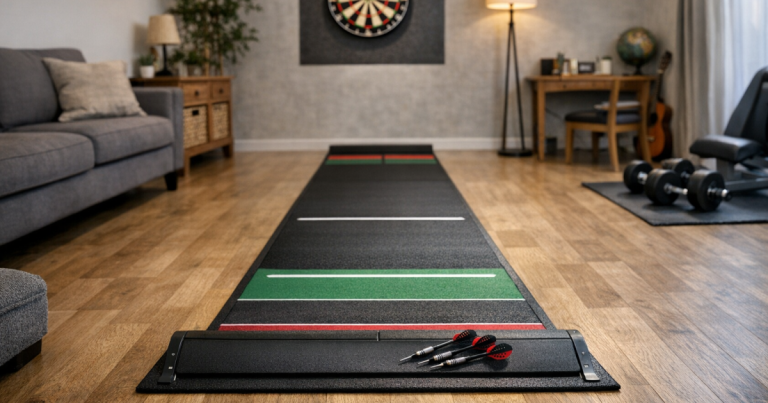
A full-length darts mat is the most practical answer for many homes. It gives a clear line, protects the standing area, and can often be rolled away after a session. Look for a mat that lies flat, grips the floor safely, and has markings that match your board type. If the room has smooth laminate, tiles or polished boards, pay close attention to slip resistance. On carpet, make sure the mat does not creep forward over time, as even a small shift changes the throw distance.
If you prefer a permanent mark, use masking tape first and live with the position for a few sessions. Check that furniture, lighting and foot traffic all feel right before using anything more permanent. In rented accommodation, avoid fixings or adhesives that could damage floors or walls.
Wall, floor and skirting protection
Steel-tip darts are sharp, and misses are part of practice. A bare wall around the board will quickly show holes, scuffs and bounce-out marks. A surround or cabinet makes the setup look tidier and protects the area most likely to take punishment, especially when beginners or guests are playing.
Surrounds are simple and quick to fit around a standard bristle board. Cabinets add doors, storage and a more furniture-like look, but they need enough side clearance to open properly. If the board is in a shared room, a cabinet can make the setup feel less intrusive when not in use. For more detail on choosing protection that fits a British home setup, see this guide to dartboard cabinets and surrounds for UK home setups.
Floor protection is just as important. Dropped darts can mark laminate, vinyl and wooden floors, while bounce-outs can chip tiles. A mat helps, but it should extend far enough to catch darts that fall short of the board. If the board is above skirting, remember that darts can glance downwards and hit the floor close to the wall, so do not only protect the area at your feet.
Lighting and visibility
Poor lighting makes a correct oche feel worse than it is. Shadows across the treble bed can make aiming inconsistent, and strong side lighting can be distracting. The aim is even light across the board without shining into the thrower’s eyes.
A ceiling light may be enough in a small room, but many home players benefit from dedicated board lighting. The key is to avoid anything that protrudes into the throwing path or makes the surrounding wall glare. If you use a cabinet, check that the doors, shelves or scoreboard area do not block the light when open.
Also think about background contrast. A dark board on a dark wall can make the outer doubles less clear in lower light. A surround, backing panel or lighter wall colour can improve visibility without changing the playing area.
Real-room layout examples
Spare bedroom
A spare bedroom often gives the neatest home setup, but beds, wardrobes and door swings can interfere with the line. If the room is tight, mount the board on the clearest wall and check whether the oche lands beside the bed rather than in front of it. You need a straight throwing lane, not a room that only works when furniture is pushed aside every time.
Garage or utility space
Garages are popular because they offer distance and tolerate the odd scuff. The trade-off is temperature, lighting and floor condition. Concrete floors can be hard on dropped darts, so a decent mat becomes more important. Make sure the board is away from damp areas and that the mounting surface is solid enough to keep the board level.
Living room or dining area
Shared rooms need a setup that can disappear visually when not in use. A cabinet, removable mat and tidy dart storage help. The biggest issue is usually safety and interruption: do not set the throwing line across a walkway, near a TV stand, or where someone might step out from a doorway.
Fine-tuning your throwing position
Once the measurements are right, focus on repeatability. The front edge of the oche is the limit, not the centre of the line. Your leading foot can touch it, but should not cross it. If you use tape, make the front edge of the tape the measured point and stand behind that edge. If you use a raised oche, measure to the front face of the raised block.
Some players stand square, others angle the front foot. Either is fine as long as the position is repeatable and fully behind the line. If more than one person uses the setup, keep the oche marking obvious enough that nobody has to interpret where the true line is.
Board quality also affects how a home setup feels. A stable bristle board with clean segment definition makes practice more satisfying, particularly if the rest of the room is already measured carefully. If you are building a more serious steel-tip area, the Winmau Blade 6 Triple Core review is a useful next read for understanding what a premium board adds to a home wall.
Pre-throw checks before you call it finished
- Measure the bullseye height at 1.73 m from the standing surface, not from an uneven or unfinished floor.
- Measure 2.37 m from the face of a steel-tip dartboard to the front edge of the oche.
- Check the diagonal from bullseye to oche if the floor measurement is awkward.
- Leave enough space behind the line for a natural stance and safe movement.
- Keep the throwing lane clear of doors, walkways, pets and fragile items.
- Use wall protection around the board if beginners, children or occasional guests will play.
- Choose a mat or floor protection that will not slide during a throw.
- Check lighting from the oche, not just from beside the board.
- Recheck the distance after moving mats, cabinets or mounting hardware.
The big picture
A good home oche is accurate, visible and easy to use without rearranging the room. The official measurements give you the starting point, but the room decides how comfortable the setup feels day to day. In most UK homes, the best results come from combining a correctly mounted board, a clear throwing lane, a non-slip mat, and sensible wall and floor protection.
Take the time to measure from the board face, mark the front edge of the oche clearly, and test the space with a few real throws before making anything permanent. Once the line is right and the room feels natural, practice becomes much more consistent — and a lot more enjoyable.