A home oche only feels right when your feet land in the same place every visit. The choice between darts mats, raised oches and simple floor markers affects comfort, room layout, floor protection and how confidently you settle into your throw.
For UK homes, the decision is rarely just about looking professional. It is about whether the setup lives in a spare room, folds away after a match, sits on carpet, shares space with furniture, or needs to survive regular bounce-outs without marking the floor.
In brief
- A roll-out mat gives you a visible throw line and some floor protection, while still being easy to store.
- A raised oche gives the most positive toe reference, because you can feel it without looking down.
- A floor marker is the simplest and neatest option, but it does not protect the surrounding floor.
- The best choice depends on permanence, room size, floor surface and how often you play.
Why the oche area matters more than it seems
The board gets most of the attention, but the floor area controls your repeatability. If your front foot drifts forward by a few centimetres, your angle to the board changes. If your stance shifts sideways because the line is unclear, your grouping can feel inconsistent even when your throw itself has not changed.
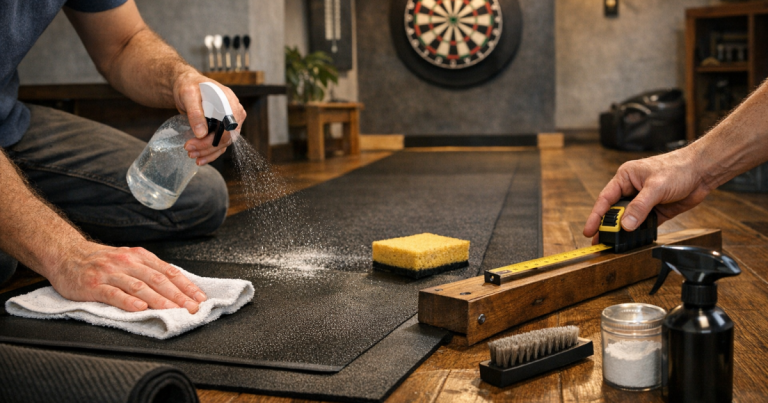
For a standard steel-tip home setup, players usually measure from the face of the board to the front edge of the oche line. The common steel-tip distance is 2.37 m, with the bull positioned 1.73 m from the floor. For a fuller measurement walkthrough, including how to avoid measuring from the wall by mistake, use the home oche setup guide.
The floor solution then becomes part of the playing routine. It tells you where to stand, protects the area most likely to take dropped darts, and helps the room feel set up rather than improvised.
Where mats earn their space
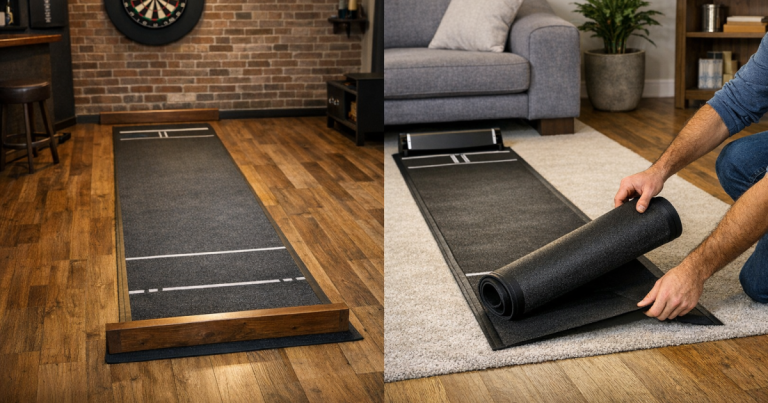
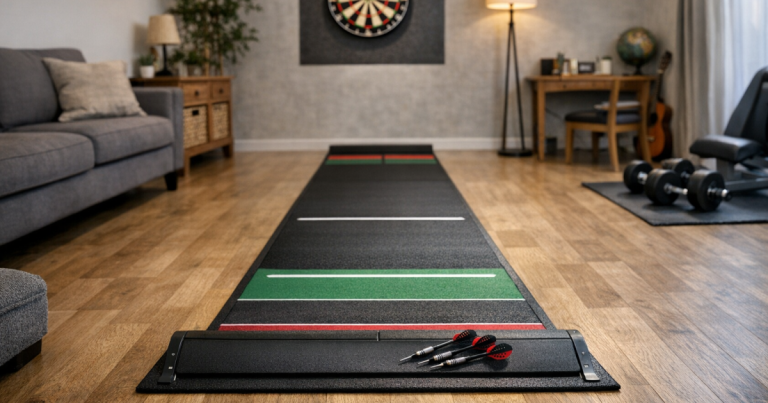
Roll-out darts mats are popular because they solve several small problems at once. They mark the throwing distance, create a defined standing zone and add a protective layer between the board area and your floor. That makes them useful in living rooms, garages, spare bedrooms and garden rooms where the setup may not be permanently dedicated to darts.
The main benefit is practicality. A mat can be rolled out for a session, lined up with the board and put away afterwards. That suits shared rooms better than a fixed oche strip. It also helps visiting players find the line quickly, which is handy when you are playing casual legs with friends rather than explaining where the toe line is every time.
There are limits, though. A soft or thin mat may move on smooth flooring, while a heavier mat can be awkward to store in a small room. On thick carpet, the edge of a mat may not sit as crisply as it does on laminate or vinyl. Some mats also develop curled ends if stored tightly rolled, so it is worth allowing them to lie flat before a match rather than fighting the edge with your foot.
Good use of a mat comes down to alignment. The throw line should sit square to the board, and the mat should not twist during play. If you want more detail on mat length, line placement and room fit, the darts mat and throw line guide goes deeper into the setup process.
What a raised oche changes
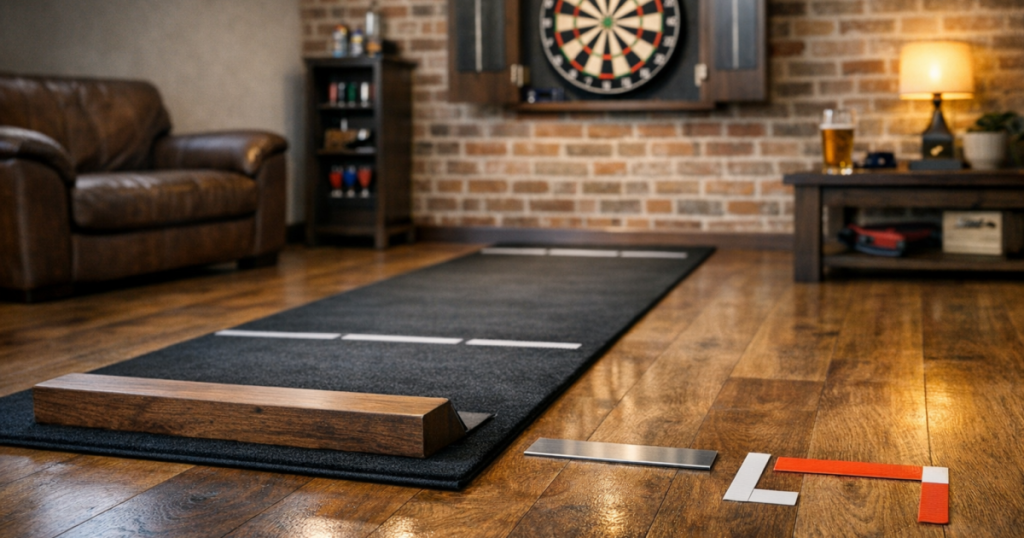
A raised oche is a physical stop at the throw line. Instead of relying on a printed line or a strip of tape, your leading foot meets a small raised edge. That tactile feedback is the reason many regular home players like it: you can settle into your stance without looking down, and you are less likely to creep forward during a leg.
It also changes the feel of the room. A raised oche makes a home setup feel closer to a club or competition environment, particularly when paired with a level board, clear lighting and enough space behind the thrower. For players practising doubles, scoring routines or match rhythm, that small detail can make a session feel more deliberate.
The trade-off is that a raised oche is less discreet. In a dedicated darts space, that is not a problem. In a living room or multipurpose garage, it can become a trip point or simply get in the way when the board is not in use. Some raised oches are freestanding; others are fixed to a mat or floor surface. Before using one, think about who else uses the room, how people walk through the space, and whether the oche needs to disappear between sessions.
A raised oche also does not automatically protect your floor. Unless it is part of a full mat, it gives you a better toe reference but leaves the bounce-out zone exposed. That is why many home players pair a raised edge with a mat, or use a mat that has an integrated raised oche section.
When a floor marker is enough
Floor markers are the simplest answer. They can be as basic as a neat adhesive line, a purpose-made oche sticker, a small strip, or a low-profile marker placed at the correct distance. They are best for players who want a clean, minimal setup and already have a floor surface they are not worried about marking.
The strength of a marker is that it does not dominate the room. In a hallway-style space, small spare bedroom or rented home where you do not want a bulky mat lying around, a marker keeps the toe line visible without adding clutter. It is also useful when the board is mounted in a cabinet and the playing area needs to look tidy once the darts are put away.
The weakness is that a marker gives no cushion against bounce-outs. Steel tips landing on wood, laminate or tile can leave marks, and even carpet can suffer over time if darts repeatedly hit the same area. If you use a marker only, consider what is directly below and in front of the board, not just where your foot stands.
Matching the option to the room
In a dedicated darts room, a raised oche or a mat with a raised section is usually the most satisfying arrangement. It gives repeatable foot placement and creates a clear playing lane. Add good lighting and wall protection, and the space starts to feel purpose-built rather than temporary.
In a shared living area, a roll-out mat usually makes more sense. It protects the floor during play, then disappears behind a sofa, inside a cupboard or under a bed. The main thing is to choose a storage spot that does not crush or sharply bend the mat, because uneven edges can become annoying underfoot.
In a very small room, a low-profile floor marker may be the only option that does not make the space feel cramped. If there is limited clearance around the thrower, avoid anything that causes people to step awkwardly. The oche should make the setup clearer, not add another obstacle.
Floor type matters too. On laminate or smooth vinyl, check that a mat grips well and does not slide as your rear foot moves. On carpet, make sure the line remains accurate and the mat does not ripple. On garage floors, think about dust, grit and moisture, because these can affect how cleanly a mat sits and how pleasant it feels underfoot.
Floor protection is only half the story
Most people think about mats because of bounce-outs, but the setup around the board should be considered as a whole. Darts can miss the scoring area, hit the wall, drop from the board or fall from a player’s hand. A mat deals with the floor; it does not protect plaster, skirting boards or nearby furniture.
If your board sits in a busy home space, combine the floor decision with sensible wall coverage. A surround is often the cleanest answer around the board itself, while cabinets suit players who want the board hidden when not in use. For wall coverage alongside your floor setup, see the dartboard surround size and fit guide.
Common setup mistakes
- Measuring from the wall: the playing distance is taken from the face of the board, not the wall behind it.
- Ignoring the mat position: a mat that is slightly skewed can make the toe line feel right while your stance is actually angled.
- Using tape that lifts: raised corners and loose edges are irritating underfoot and can become a trip hazard.
- Forgetting storage: a large mat is only convenient if you have somewhere sensible to keep it flat or loosely rolled.
- Choosing permanence too early: try the room layout for a few sessions before fixing anything in place.
What to remember
A mat, raised oche and floor marker all do the same basic job: they define where your front foot belongs. The difference is how much feedback, protection and permanence you want.
Use a mat when floor protection and easy setup matter. Use a raised oche when you want a firmer, more repeatable toe reference and the room can handle a more permanent feel. Use a floor marker when space is tight, the setup needs to stay discreet, or you simply want the cleanest possible line.
The most reliable home setup is not necessarily the most elaborate one. It is the one that stays measured correctly, feels comfortable underfoot and is easy enough to use every time you fancy a throw.