A well-planned home oche feels easier to use because the board is clear, the thrower is comfortable and the room does not fight against the setup. Good darts lighting design is mainly about controlling shadows, glare and usable space, not simply making the area as bright as possible.
Any mains electrical wiring for fixed dartboard lighting should be carried out by a qualified electrician to meet UK electrical safety requirements and applicable Building Regulations.
What to know first
The short answer is simple: light the face of the dartboard evenly from around the board or from a carefully positioned front source, then check the result from the oche rather than from beside the board. A light that looks fine close up can still cast a dart shadow across the treble bed when you are throwing.
For most home setups, the safest design aim is even board illumination, low glare in the thrower’s eyeline, and no fitting that obstructs the throw or cabinet doors. The best layout depends on whether your board is in a spare room, garage, alcove, lounge, shed or multi-use space.
How room shape changes the lighting plan
The dartboard itself is small, but the usable zone around it is not. You need the board face, the surrounding wall or cabinet, the oche area and the route between them to work together. Lighting that is too narrow makes the board bright but leaves the floor and toe line gloomy. Lighting that is too broad can spill into the thrower’s eyes or reflect from glossy doors, picture frames or painted walls.
Start by standing at the throw line and looking at the board in normal playing conditions. If you play in the evening, test at night. If the room has a window, test when daylight is strongest and weakest. A home darts setup in Britain often has to work around short winter afternoons, ceiling pendants, low garage roofs and rooms that also serve as offices, gyms or storage areas.
The board should remain readable without you squinting at doubles and trebles. If the number ring is clear but the segment wires disappear, the light may be too flat or too weak. If the board is bright but every dart creates a hard black line across the scoring area, the source is too directional or too far to one side. For a deeper look at common problems, the site’s guide to dartboard lighting mistakes is a useful next step.
Spare room or home office layouts
A spare room is often the easiest place to light well, because the ceiling is usually finished, sockets are accessible and the board can sit on a clean wall. The main challenge is avoiding a single ceiling pendant behind the thrower. When the main room light sits between the oche and the board, the thrower’s body can become the shadow source.
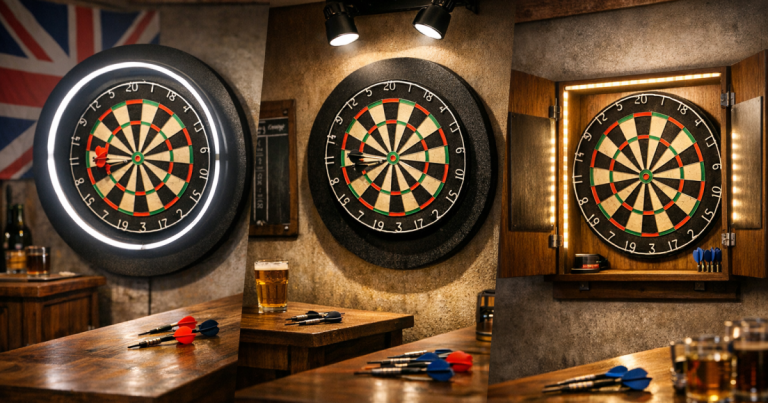
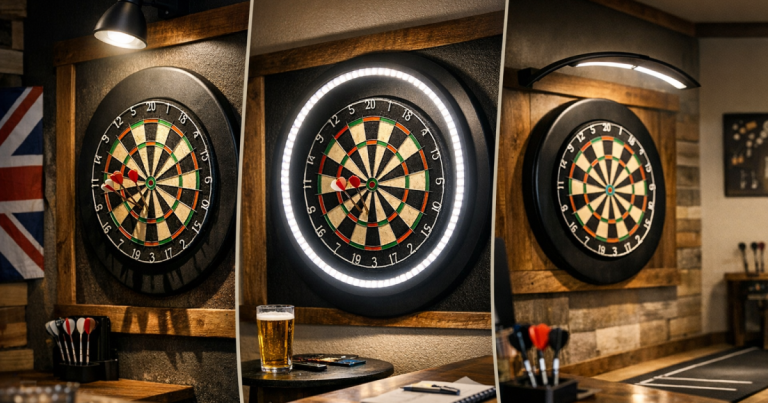
In this layout, a board-mounted or board-surround light is usually the neatest solution. Circular and halo-style systems are popular because they put light close to the scoring area and reduce the effect of the thrower blocking the room light. Examples include Target Corona Vision and Winmau Plasma, though you should always verify fit, fixing method and clearance with your own dartboard, surround or cabinet before committing.
If the room is also an office, consider how the light behaves when not playing. A very bright dartboard light can feel harsh during video calls or desk work if it faces into the room. Being able to switch the darts lighting separately from the main ceiling light makes the room much more flexible.
Garage and shed setups
Garages and sheds create a different set of lighting problems. Surfaces are often darker, ceilings may be lower, and exposed beams or shelving can block light. You may also have colder temperatures, dust and uneven walls to think about. The goal is still the same: an evenly lit board without a bright fitting shining directly towards the thrower.
A single batten or strip light running down the centre of the garage can work for general visibility but may not light the board evenly. If it is behind the thrower, it can produce body shadows. If it is directly above the board, it can make the top half clearer than the lower doubles. Supplementing the room light with a dedicated board light is often the cleaner approach.
Be careful with shiny garage doors, metal cabinets and glossy painted surfaces. These can reflect light back towards the oche and create a distracting bright patch beside the board. Matte wall finishes and a non-reflective surround tend to make the board easier to read. If your garage setup uses fixed lighting rather than plug-in equipment, compare the practicalities in the guide to mains-wired and plug-in dartboard lighting.
Lounge and multi-use room layouts
Lighting a dartboard in a lounge is less about raw output and more about balance. You want the board bright enough for accurate scoring, but not so bright that it dominates the room when people are watching television or using the space socially.
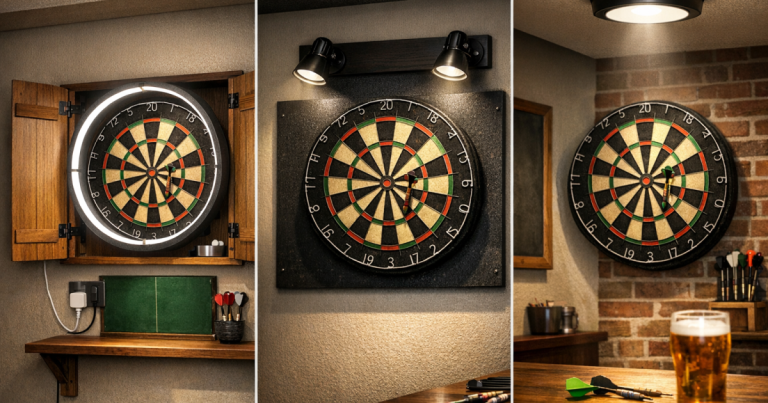
Cabinets are common in living spaces because they hide the board and protect the wall visually. The trade-off is that cabinet doors can restrict where lights can sit. A light mounted too close to the cabinet may block the doors from opening fully. A fitting mounted too far forward may intrude into the room or sit in the thrower’s sightline.
Warm white room lighting can make a lounge feel comfortable, but the board still needs enough clarity for the fine scoring areas. If your general lights are dimmable, test the board both at normal social brightness and at playing brightness. Many poor lounge setups happen because the board was checked during the day, then turns out to be difficult to read under evening lighting.
Alcoves, corners and narrow rooms
An alcove can look ideal because it gives the board a dedicated zone, but side shadows are a common issue. If the wall returns are close to the board, they can block light from one side or make the outer singles look darker. The deeper the alcove, the more important it is to put the main light close to the board face rather than relying on the room light.
In a corner layout, avoid placing the board so one side is much closer to a wall than the other. Apart from throwing comfort, this can make the lighting feel uneven and make missed darts more likely to strike a side wall or awkward edge. A corner can work well, but only if the player has proper stance space and the board is not visually squeezed.
Narrow rooms also need careful oche planning. A light may be perfect for the board, but if the throw line is pushed into a doorway, radiator or furniture gap, the setup will still feel poor. Confirm the throw distance, toe line and mat position before finalising light placement; the guide to oche measurements and mat alignment will help you keep the playing area accurate.
Ceiling height and fitting position
Ceiling height affects how forgiving your lighting can be. In a room with a generous ceiling, overhead lighting has more distance to spread, though it can still cast shadows if it sits behind the player. In a low-ceiling room, a pendant or bulky shade can feel intrusive and may sit in the wrong visual line between thrower and board.
Flush or low-profile fittings are usually easier to live with in compact rooms, but the board still benefits from dedicated illumination. Avoid putting a strong directional spotlight directly above and in front of the board unless you have tested it with darts in the board. The angle can throw shadows downwards across the lower beds.
For board-mounted lighting, check the clearance around the number ring, surround and any cabinet. The light should not make it harder to retrieve darts, rotate the board or close doors. It should also leave enough room for the board to be mounted at the correct height without forcing the whole setup lower.
Quick layout checks before you fix anything
- Stand at the oche: judge the light from the throwing position, not from beside the board.
- Put darts in the board: check whether shadows fall across trebles, doubles or the bull.
- Test evening conditions: daylight can hide problems that appear when the room lights are on.
- Open cabinet doors: make sure lights, cables and doors do not clash.
- Check glare: look for bright reflections from number rings, cabinet finishes, windows and wall décor.
- Walk the route: the area from the oche to the board should be safe and visible, not just the board face.
- Think about storage: darts mats, stools, bikes, gym kit and boxes can all change how a room works once play begins.
Examples by layout
Small spare bedroom
Use the main ceiling light for general room visibility and a dedicated board light for scoring clarity. Keep the board away from wardrobes and door swings, and check that the thrower does not stand directly under a pendant that casts a body shadow.
Single garage wall
Use broad room lighting for safe movement and a focused board light for the dartboard. Avoid relying only on a central strip light if it leaves the board face patchy. Watch for reflections from tools, shelving and metal doors.
Lounge cabinet setup
Keep the fitting discreet and check cabinet door movement before mounting. Separate switching is helpful so the board can be lit for play without making the whole lounge feel overly bright.
Garden room or shed
Plan lighting alongside insulation, wall finish and board mounting. Dark timber interiors can absorb light, so the board may need more focused illumination than it would in a pale spare room.
FAQ
Is a normal ceiling light enough for darts?
Sometimes, but it depends on its position. If it sits behind the thrower or to one side, it can cast shadows across the board. A dedicated board light is usually more consistent.
Should dartboard lighting be above the board?
It can be, but the angle matters. A light that is too high or too directional may create shadows from darts already in the board. Even, close board lighting is usually easier to control.
Can I use darts lighting in a cabinet setup?
Yes, but check door clearance, cabinet depth and fixing points first. Some lights suit open board-and-surround setups better than enclosed cabinets.
What colour light is best for a home darts room?
Choose a light that makes the board segments clear without feeling harsh in the room. The exact preference depends on wall colour, room use and whether you play mainly in the evening.
How do I know if my layout has a shadow problem?
Stand at the oche, throw or place darts into different beds, then look for dark lines crossing the scoring areas. If the shadow moves with your stance, the room light is probably in the wrong place.
Final thoughts
Good darts lighting is not a separate finishing touch; it is part of the room layout. The best setup lets you read the board clearly, throw without glare and move safely between the oche and the wall. Before making permanent changes, test the board from the actual throwing position, in the conditions you normally play in, with furniture and cabinet doors exactly where they will be. That simple check prevents most lighting mistakes before they become drilled holes, awkward cables or a board that never feels quite right.