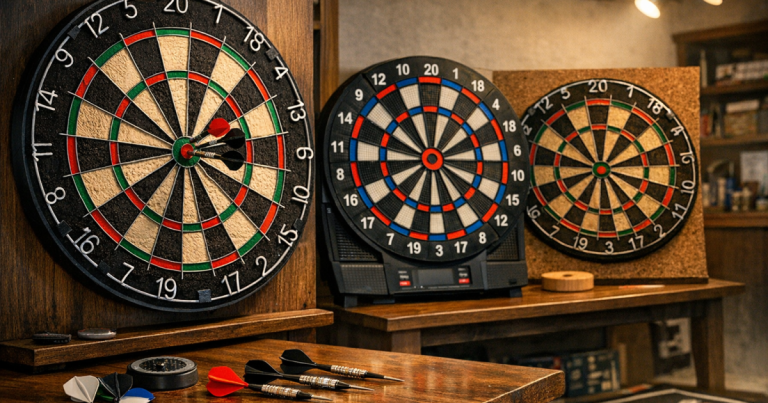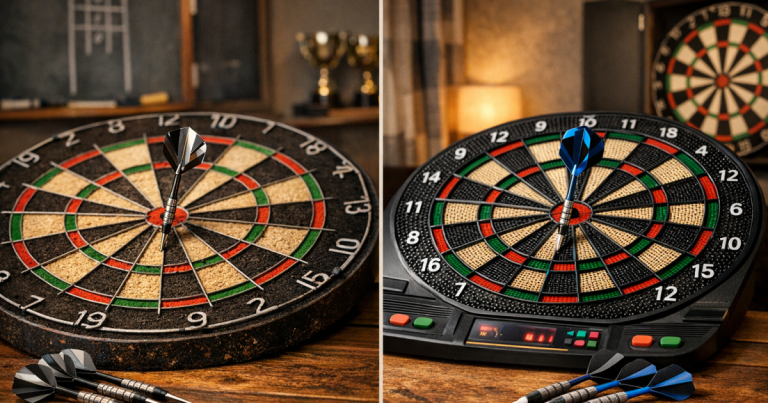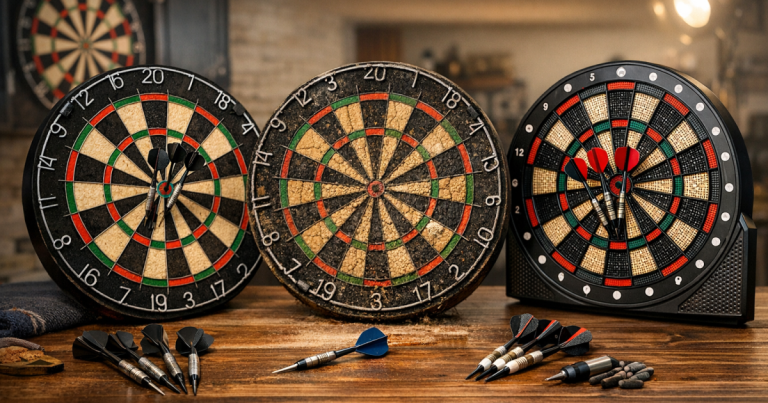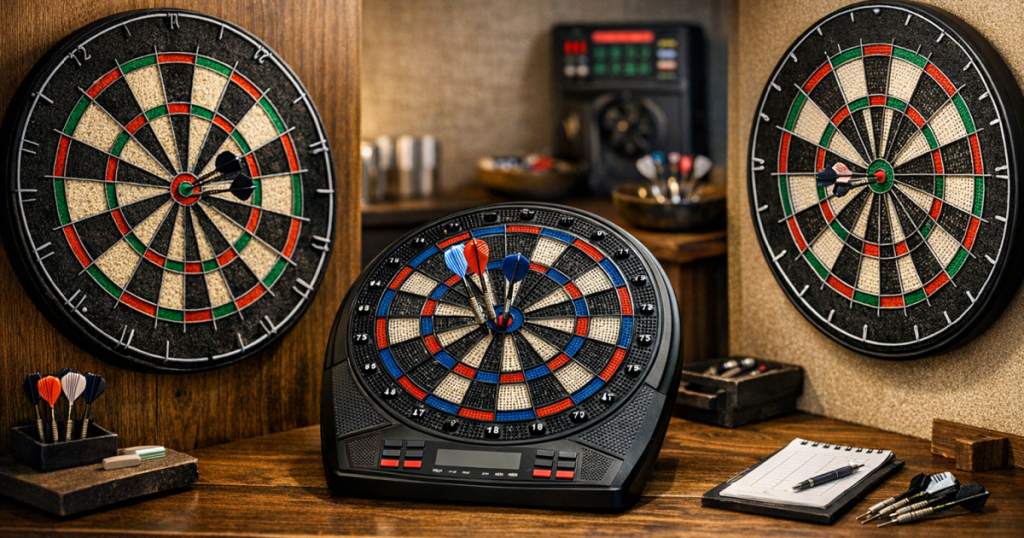
Choosing between bristle, electronic and training boards is really a question of how you play at home: steel-tip scoring practice, family-friendly soft-tip games, or sharper finishing work. The main dartboard types each solve a different problem, so the right answer depends on your darts, room, noise tolerance and whether you want match-realism or convenience.
For most UK home throwers, a quality bristle board is the closest everyday choice to pub and league darts. Electronic boards make scoring easier and can suit casual multiplayer sessions. Training boards are more specialised, usually bought after a player already has a normal board and wants to practise with smaller or more demanding targets.
At a glance
- Bristle boards: the standard choice for steel-tip darts, league-style practice and a traditional home setup.
- Electronic boards: usually used with soft-tip darts, built around automatic scoring and game modes.
- Training boards: designed to make practice harder, often with reduced scoring areas or altered target layouts.
- Small rooms: board depth, wall protection, lighting and oche space matter as much as the board face itself.
- Mixed households: the right board may depend on whether the priority is serious practice, low-friction family play or both.
Why board type changes the way you practise
A dartboard is not just a target on the wall. The board type affects the darts you use, the sound of impact, how bounce-outs feel, how scoring is handled and how closely your practice transfers to a pub or competition board. That is why two boards with the same basic wall space can create very different playing habits.
The useful way to think about dartboard types is by outcome. If you want to rehearse the same doubles, trebles and rhythm you use with steel-tip darts, bristle is the reference point. If you want relaxed games where the board does the arithmetic, electronic makes sense. If you already hit your regular targets and want to stretch accuracy, a training board can expose weaknesses quickly.
Bristle boards: the home standard for steel-tip darts
Bristle dartboards are the familiar sisal boards used for most steel-tip play. The fibres close around the point when the dart lands, which is why a good board can take repeated use when it is rotated regularly. They suit players who care about checkout practice, grouping, match rhythm and getting used to the feel of steel-tip darts.
The main differences between bristle boards are usually in the sisal quality, wiring, staple arrangement, bull design and how cleanly the scoring segments are separated. Thinner wiring can reduce deflections, while a well-made surface tends to feel more consistent across the board. If you want the deeper technical background, our guide to board materials and wiring explains the construction details in more depth.
Real examples in this category include boards such as the Unicorn Eclipse Ultra Dartboard, along with other modern staple-free or low-profile-wiring bristle boards. The exact model matters less than matching the board to your use: regular steel-tip practice benefits from a board that grips darts well, rotates easily and has clear segment definition under your room lighting.
Where bristle boards work well
- Practising standard steel-tip darts at a 2.37 m throw distance.
- Building checkout routines that transfer naturally to pub, club or league play.
- Using your preferred steel-tip darts rather than lighter soft-tip sets.
- Creating a traditional setup with a surround, cabinet, mat or raised oche.
The trade-off is that bristle boards do not score for you, and steel-tip darts need sensible wall and floor protection. They can also be noisier than people expect in flats or terraced houses, especially if the board is fixed directly to a shared wall. A surround, cabinet, stable mounting and mat can make the setup feel more complete and less harsh on the room.
Electronic boards: convenient scoring and softer play
Electronic dartboards are usually built for soft-tip darts. Instead of sisal, they have a segmented plastic face with holes that register where the dart lands. Their appeal is straightforward: the board handles scoring, offers built-in games and lets casual players get started without doing mental arithmetic every visit.
That makes electronic boards good for family rooms, mixed-ability groups and players who enjoy cricket-style games or quick social formats. Some connected boards also interact with phones, tablets or online play, but details vary widely by model. Before relying on that side of the experience, check device compatibility, UK plug or adaptor arrangements, app support and whether the board’s scoring format matches the games you actually want to play.
A known example in this area is the GranBoard 3s, which sits in the connected soft-tip board space. The important point is not that every home needs a connected board, but that electronic boards should be judged on their scoring reliability, segment feel, dart compatibility, sound level and ease of use for the people who will play most.
Where electronic boards make sense
- Casual households where automatic scoring keeps games moving.
- Soft-tip play where younger or newer players are involved, with suitable supervision and room layout.
- Social games where convenience matters more than exact steel-tip match feel.
- Spaces where a lighter dart impact is preferred, although wall noise still depends on mounting and room construction.
The limitation is realism. Soft-tip darts, plastic segments and electronic scoring do not feel identical to a bristle board with steel-tip darts. Segment sizes and board rules can also vary, so check the throw distance and board height recommended for the specific board rather than assuming every setup follows the same convention.
Training boards: harder targets for sharper practice
Training boards are built to make normal scoring areas feel less forgiving. Some have narrower doubles and trebles. Others use altered target zones or specialist layouts for grouping, finishing or accuracy work. They are not usually the first board a home player needs, but they can be valuable once ordinary practice starts to feel too comfortable.
A typical example is the Winmau Champions Choice Dartboard, a specialist board designed around reduced target areas. Boards like this can be useful for disciplined sessions because they punish loose darts quickly. After time on a tighter target, returning to a standard board can make normal trebles and doubles feel more inviting, although the benefit depends on regular, structured practice rather than the board alone.
Where training boards help
- Finishing drills where doubles need to be hit under pressure.
- Grouping practice for players who already have a repeatable throw.
- Short, focused sessions rather than casual games with visitors.
- Players preparing for competitive settings who want practice to feel demanding.
The downside is that training boards can be demoralising for beginners. If a player is still building stance, release and basic grouping, a reduced target may create frustration rather than improvement. In that case, a normal bristle board and a clear routine will usually be more productive.
Room setup matters as much as the board face
A board that looks perfect online can still feel wrong if the room is cramped, poorly lit or awkward to stand in. In many UK homes, the limiting factor is not the board diameter but the full throw line, the space behind the player and the wall area around the board. A standard steel-tip setup needs the bull at 1.73 m high and the oche at 2.37 m from the face of the board, so measure from the playing surface, not the wall behind it.
Lighting is another common difference between a board that is pleasant to use and one that becomes tiring. Shadows across the treble bed make practice less consistent, especially in box rooms, garages and shared living spaces. If glare or shadows are already a problem, compare dartboard lighting options before changing the board itself.
Floor marking is just as important. A mat, adhesive throw line or raised oche helps keep your stance repeatable, and it stops every practice session starting with a tape measure. For a home layout that feels consistent, use our guide to setting up a darts oche at home alongside your board choice.
Different views on what matters most
Some players argue that every serious home setup should begin with a bristle board because it mirrors the most common steel-tip environment. That is a strong argument if your aim is league practice, checkout confidence or improving with the same darts you use outside the home.
Another view is that electronic boards remove barriers. They help casual players enjoy darts without scoring disputes, mental maths or long pauses. For households where the board is used by friends, children and occasional players, that convenience can matter more than perfect match realism.
Training boards sit in a different lane. They are not more “advanced” in a universal sense; they are more demanding. Used well, they add pressure and focus. Used too early, they can make practice feel like missing rather than learning. The most sensible route is often standard bristle first, then a training board later if your practice goals justify it.
What to remember
Bristle boards are the closest fit for traditional steel-tip practice and suit most committed home throwers. Electronic boards are about convenience, scoring and soft-tip social play. Training boards are specialist tools for players who want smaller targets and more demanding drills.
The right choice is not only about the board face. Think about the darts you use, who else will play, how much space you have, whether you need automatic scoring and how closely your home practice should match competitive darts. Once those answers are clear, the board type usually becomes obvious.
Helpful questions
Can I use steel-tip darts on an electronic dartboard?
No. Electronic boards are normally designed for soft-tip darts. Steel tips can damage the segments and are not suitable for that style of board.
Is a training board worth it for a beginner?
Usually not as a first board. Beginners tend to improve faster on a standard bristle board with simple routines, clear scoring targets and consistent throw-line practice.
Do electronic boards use the same throwing distance as bristle boards?
Not always. Steel-tip bristle play is commonly set at 2.37 m, while soft-tip formats often use 2.44 m. Always check the guidance for the board and rule set you are using.
Which board type is quietest for a flat?
Soft-tip electronic boards can have a lighter dart impact, but mounting noise can still travel through walls. A stable mount, suitable backing and avoiding shared walls can matter more than the board type alone.
Can one setup handle both casual games and serious practice?
Yes, but compromise is involved. A bristle board with a clear scoreboard suits serious steel-tip practice, while an electronic board is easier for relaxed group games and automatic scoring.