A good dartboard surround protects the wall area most likely to be hit by stray darts without making your setup bulky or awkward. The right choice depends on who is throwing, how much wall you need covered, and whether your board sits on bare wall, in a cabinet, or in a dedicated darts corner.
The short version
- Choose wider coverage for beginners, family use, parties or tight rooms where misses are more likely.
- Check that the inner opening suits a standard steel-tip bristle board and sits snugly without forcing the board out of position.
- Look at depth as well as width: a thin ring may look neat, but thicker material usually gives more confidence against bounce-outs and angled misses.
- Match the material to the room. Lightweight foam is common for home setups, while cork panels or backing boards can help when you need a larger protected zone.
- Think beyond the wall immediately around the board if your darts corner is in a garage, spare room or shared living space.
Step 1: Work out what actually needs protecting
Start by looking at the wall damage you are trying to avoid. A confident adult player mainly needs protection around the scoring area, while newer throwers can miss higher, lower and wider than expected. Children, guests and casual family games usually need more forgiving coverage than solo practice by an experienced player.
Wall type matters too. Freshly painted plaster, wallpaper and soft plasterboard can show marks quickly. A bare brick garage wall may be tougher, but it can be unkind to dart points and can still produce awkward ricochets. If the board is near a door frame, shelving, radiator pipework or a cabinet edge, you may need protection that extends beyond a simple ring.
A dartboard surround is not a substitute for sensible placement. If the board is squeezed into a narrow alcove or mounted beside anything fragile, move the setup before relying on accessories. For a deeper look at protection depth, coverage and bounce-outs, see the surround thickness and bounce-out protection guide.
Step 2: Choose the coverage shape that fits your throwing situation
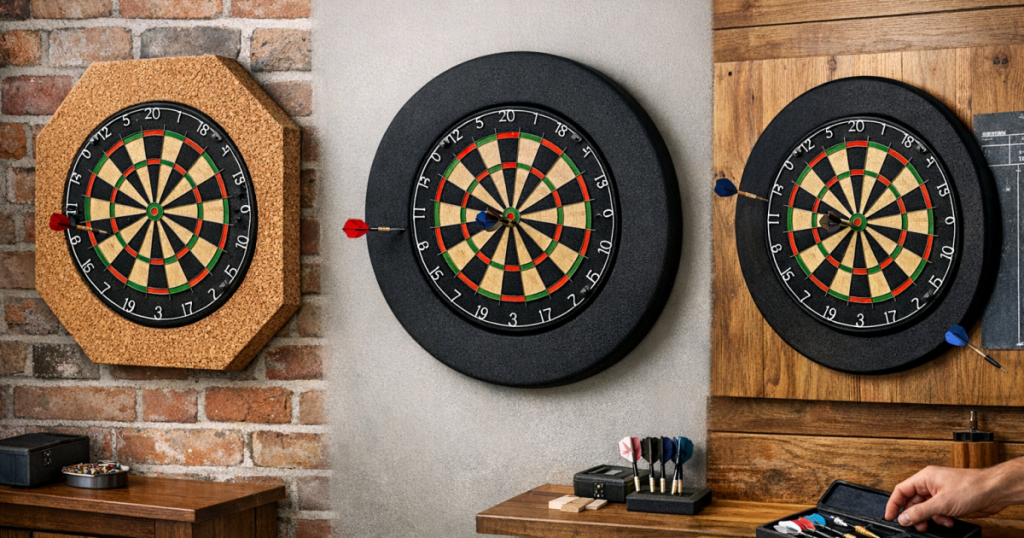
Most home players start with a circular or segmented foam ring. It slips around the board, covers the most common miss zone and keeps the setup looking tidy. This is usually the neatest answer for a spare room, home office or living-room board where you want protection without turning the wall into a full practice station.
Square and larger-format protection can make more sense when the throwers are mixed-ability. A rectangular backing board, cork-tile area or larger panel gives extra height and side coverage, which is useful when people are learning to group their darts. It also helps if the board is mounted on a wall where repainting would be irritating or costly.
Think in zones:
- Close misses: a standard ring around the board is usually enough for competent players.
- Wide misses: use a larger ring, backing board or tiled area to protect the left and right edges.
- High and low misses: add protection above and below the board, not just around the treble band.
- Shared family use: prioritise coverage over appearance, because occasional throwers rarely miss in predictable patterns.
Step 3: Check board fit before you worry about looks
A surround should sit firmly around the outer edge of the board without covering the scoring segments, leaning forward, or pushing the board away from the wall. Before buying, confirm that it is intended for a standard steel-tip bristle board rather than an electronic board or a soft-tip cabinet setup.
If your board is housed in a cabinet, measure the clearance between the board edge and the cabinet doors. Some surrounds will not fit inside a closed cabinet, and some cabinet layouts leave too little space around the board for a full ring. In that case, a smaller protective solution or removable setup may be more practical than forcing a bulky ring into place.
Named surrounds such as the Winmau PDC Dartboard Surround and Target Pro Tour Dartboard Surround are recognisable examples of the type of product many home players compare, but do not buy on brand name alone. Check the current product description, board compatibility, colour, segment design and whether it suits your room before ordering.
Step 4: Decide how much depth you really need
Depth is easy to overlook because shoppers often focus on diameter and colour. A deeper surround can give more reassurance when darts hit at an angle or glance off the wire. A very slim surround may look cleaner, but it may not feel as protective if the wall behind it marks easily.
For a casual player in a rented room, a thicker or larger protective area is worth considering because even small marks can become a problem later. For a dedicated practice area where accuracy is already good, a neat ring may be enough. If you are setting up in a garage, think about the wider space as well: lighting, storage, wall finish and the throwing lane all affect how often darts stray. The guide to planning a darts corner in a garage is useful if you are building the whole area from scratch.
Step 5: Match the material to your room
Foam surrounds are popular because they are light, simple to handle and usually easy to remove. They suit many home setups where the aim is to protect the wall immediately around the board without permanent changes. The main things to check are firmness, fit, thickness and whether the colour will show dart holes or scuffs more than you would like.
Cork, felt-covered boards and DIY-style backing panels can work well when you want a larger protected area. They can also help create a more permanent darts corner, especially on a garage or utility-room wall. The trade-off is that they take more planning, and some approaches can look less tidy if the edges, joins or adhesive are not handled carefully.
Wooden backboards can look smart but need careful thought. If a dart misses the board and hits hard timber, it may bounce or damage the point rather than absorbing the impact. A softer protective layer over a firm backing is usually a more forgiving arrangement than exposed hard board immediately around the target.
Step 6: Think about how it will sit with the rest of your setup
A wall protector should not interfere with board rotation, number ring alignment, lighting or daily practice habits. If the surround grips the board too tightly, it can make rotation more annoying than it needs to be. If it sits unevenly, it can cast shadows or make the board look off-centre even when the board itself is level.
Check these points before committing:
- Board access: can you still rotate the board easily and remove it from the bracket when needed?
- Number ring clearance: does the surround leave the number ring readable and undisturbed?
- Lighting: will a ring light, spotlight or cabinet light still illuminate the board evenly?
- Cabinet doors: can they open and close without rubbing against the protection?
- Oche alignment: does the added wall feature make the setup look visually centred from the throw line?
If you already use a mat, raised oche or cabinet, choose protection that works with the whole routine rather than treating the wall in isolation. A tidy setup is easier to keep in place, which means you are more likely to practise regularly.
Step 7: Consider larger wall protection for high-miss environments
Some rooms simply need more than a ring. If the board is used by guests, newer players or anyone still learning release control, wider protection can save a lot of touch-up painting. This is where cork tiles, wall panels or a framed backing board become more appealing.
Cork tiles are particularly useful when you want to build a custom protected area around the board, but they vary in thickness, adhesive strength and finish. If you are comparing that route with a ready-made ring, the Navaris self-adhesive cork board tiles review shows the sort of pros and cons to weigh up for wall protection.
For rented homes, be careful with anything adhesive. Some products can lift paint or leave residue when removed. A freestanding backing panel, cabinet-mounted solution or non-permanent surround may be a safer option if you need to return the wall to its original condition.
Buying checks before you order
- Confirm board type: make sure the product suits a steel-tip bristle board if that is what you use.
- Check inner fit: the opening should sit neatly around the board without covering scoring areas.
- Look at outer coverage: compare the protected area with the likely miss pattern in your room.
- Check depth: do not assume a wide-looking surround is also thick enough for your needs.
- Read recent buyer photos: they often show how the colour, seams and fit look in real home setups.
- Consider removability: important for rented rooms, shared spaces and cabinets that need occasional access.
- Match the finish: black hides marks well, while bright colours can look sharp but may show wear sooner.
FAQ
Is a standard ring enough for beginners?
Sometimes, but not always. A ring protects the most common miss zone close to the board, but beginners often miss high, low or wide. For mixed-ability play, wider backing protection is usually more forgiving.
Will a surround stop all wall damage?
No. It reduces the risk around the board, but it cannot protect areas outside its coverage. If your wall is delicate or the room is used by casual throwers, add a larger backing area.
Can I use a surround with a dart cabinet?
Only if there is enough clearance inside the cabinet. Measure the space around the board and check whether the doors can still close. Some cabinet setups work better without a bulky ring.
Do I need to fix a foam surround to the wall?
Many foam surrounds are designed to sit around the board rather than be fixed to the wall. Always check the product instructions, because fit and mounting style vary between designs.
What colour is best for home use?
Black is the safest choice for hiding dart marks and blending with most boards. Brighter colours can look good in a themed darts corner, but they may make holes and scuffs more obvious.
Main lessons
The best wall protection is the one that matches your room and the people throwing in it. A neat ring is ideal for many competent home players, but wider panels or cork-backed areas make more sense for beginners, guests and garage setups.
Before buying, check fit, depth, coverage and how the surround works with your board, cabinet, lighting and practice routine. Get those basics right and you will protect the wall without making your home darts setup feel overbuilt.