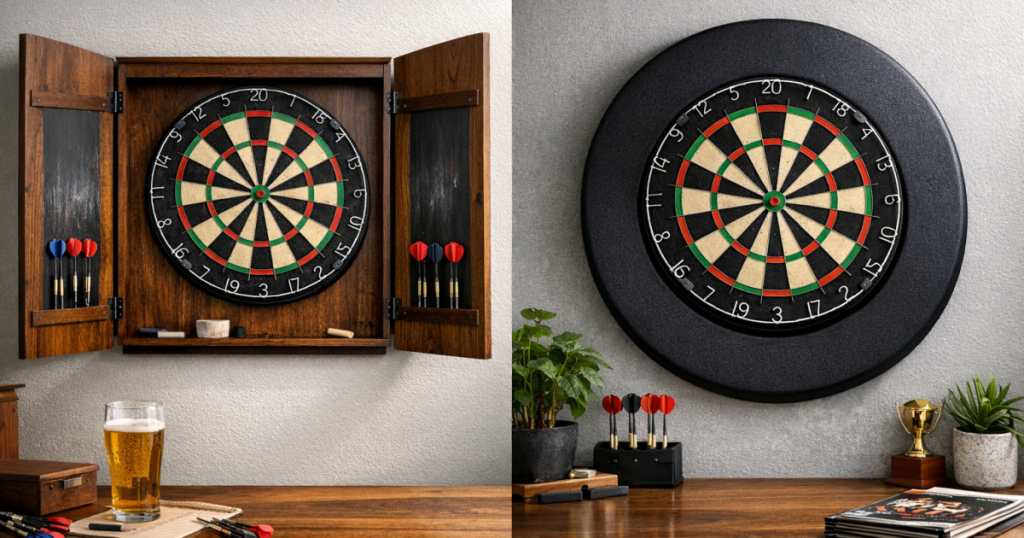
A neat darts wall has to absorb misses without making the room feel cluttered. If you are weighing up a dartboard cabinet vs surround, the better choice depends on where your darts tend to miss, how much wall you want covered, and whether storage matters as much as protection.
For pure protection during play, a surround usually covers the danger area more evenly. A cabinet gives a smarter framed look and useful storage, but its protection is more dependent on the door position and the size of your miss pattern.
The short answer
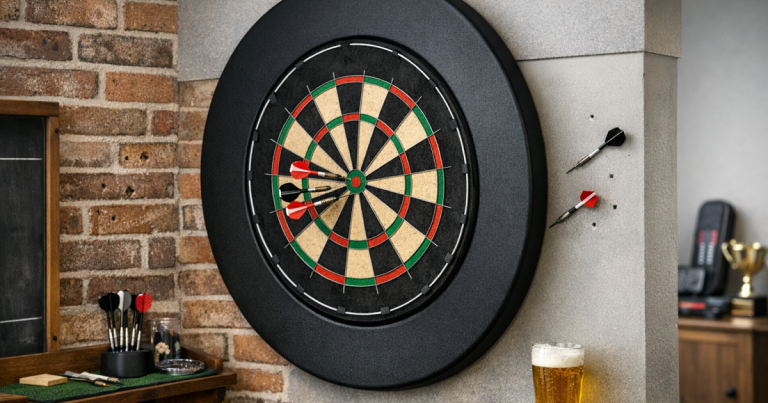
A dartboard surround is normally the stronger wall-protection choice for active play because it wraps closely around the board and covers the most common miss zone: just outside the doubles. That matters for casual games, new players, children under supervision, or anyone still developing a consistent throw.
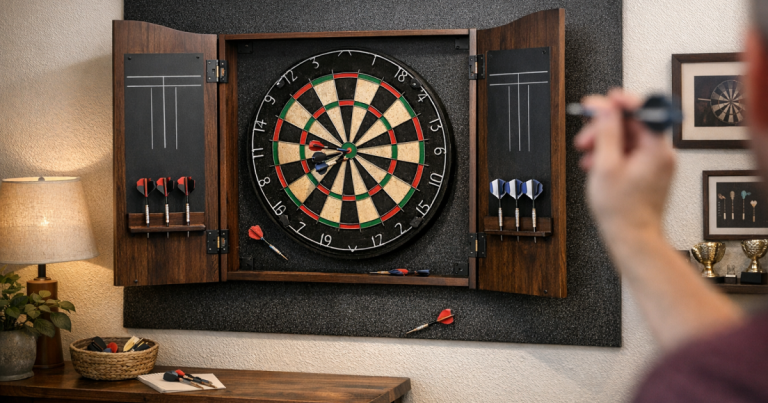
A cabinet protects differently. With the doors open, it shields the wall to the left and right of the board, and often gives you places for darts, chalk, markers or a small scoreboard. With the doors closed, it hides and protects the board when not in use. What it does not usually do as well is protect above, below and tightly around the whole board face.
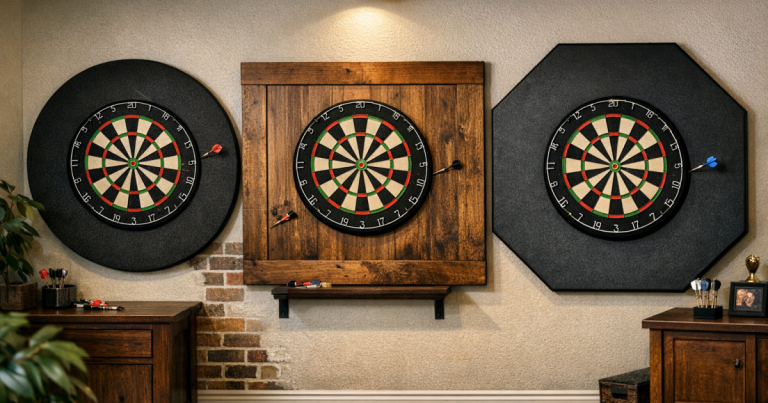
If you want the cleanest home setup, the answer is not always one or the other. Many players use a cabinet for storage and presentation, then add a compatible surround or larger backing panel where space allows. If you are planning a full wall rather than solving one mark on the plaster, this wider guide to building a tidy dartboard wall with cabinets and surrounds is a useful next step.
How each option actually protects the wall
What a surround does well
A surround is usually a foam or similar protective ring that sits around a bristle dartboard. It is designed for the area most darts miss: a narrow band around the outside of the scoring segments. Because it covers all the way round, it catches high, low, left and right misses more evenly than a cabinet door.
This makes surrounds particularly useful in spare rooms, garages, home offices and living spaces where the board is used often but you do not want a large permanent feature. Most are simple to remove, which also helps if the room has to double up for work, guests or storage.
The limitation is coverage. A standard surround protects the immediate area around the board, not the wider wall. If darts are landing far left, far right, below the board or into nearby skirting, a surround is not large enough on its own. That is a setup issue as much as a product issue: the oche position, player stance, lighting, board alignment and available space all affect where misses go.
What a cabinet does well
A cabinet frames the board and makes the setup feel more finished. It can hide the board when not in use, provide side protection when the doors are open, and keep small accessories in one place. For a shared room, that can be just as valuable as the protective benefit.
Cabinets work best when most stray darts miss slightly left or right of the board. The open doors effectively become side shields. Some players also prefer the visual reference of a framed board, because it makes the darting area feel more deliberate rather than simply fixed to a bare wall.
The weaker point is the vertical miss zone. A cabinet will not necessarily protect the wall above or below the board, and the central area around the outer numbers may still be exposed depending on the design. If a beginner regularly hits low beneath the board, a cabinet alone may leave you with marks exactly where you hoped to avoid them.
Choose by miss pattern, not just appearance
The most practical way to decide is to look at how your wall is likely to be hit. You do not need weeks of data; even a short practice session can show the risk areas.
- Misses just outside doubles: a surround is usually the better first layer because it hugs the board all the way round.
- Misses mostly left and right: a cabinet can work well, provided the doors open wide enough and sit close to the board.
- Misses below the board: consider a larger backing panel, mat placement checks, and throw-line discipline; neither a small cabinet nor a standard surround may be enough.
- Very wide misses: the issue may be room layout, distance, lighting or player position rather than the wall protector alone.
- Marks from bounce-outs: floor protection and the area below the board become more important than side panels.
For a typical steel-tip board used by mixed-ability players, the safest single choice is usually a surround. For a room where the setup has to look smart between games, a cabinet becomes more attractive. For rented homes or freshly decorated walls, broader protection behind the whole board can be worth considering.
Fit and alignment make a big difference
A protector only works properly if the board is mounted squarely, securely and at the correct height. A surround that is not seated flat can leave gaps. A cabinet that is slightly off-centre can expose one side while overlapping the other. Even a small visual lean can make players adjust subconsciously, which is the last thing you want during practice.
Before judging the protection, check the basics: the bull should be at the correct height, the board should sit flat against its fixing, and the number 20 should be at the top. If the whole setup looks uneven, use the checks in why your dartboard looks crooked and how to fix it before adding more accessories around it.
Cabinets need a little extra care. The board has to sit deep enough to look neat, but not so far back that the cabinet edges interfere with sight lines or make retrieval awkward. Door movement matters too. Make sure the doors do not hit shelves, curtains, sockets, picture frames or light fittings when fully open.
Surrounds have their own fit checks. The inner opening needs to sit neatly around the dartboard, and the outer edge should not cover anything you need to access. If you use a separate light ring, scoreboard or wall-mounted oche marker, check the spacing before assuming everything will work together.
Room examples that change the answer
Small spare room
In a compact spare room, a surround often wins because it gives effective protection without adding door swing. A cabinet can feel bulky if the board is close to a corner, wardrobe or desk. If you still want storage, a small drawer or nearby shelf may be simpler than a full cabinet.
Living room or dining room
A cabinet is more appealing in a shared living area because it hides the board and makes the wall look intentional. It is also handy for keeping darts and chalk out of sight. The compromise is that you may still want extra protection around the cabinet if guests or occasional players are likely to throw.
Garage or utility space
In a garage, looks may matter less than durability and coverage. A surround is useful, but a larger backing board behind the dartboard can be more forgiving if the wall is rough, uneven or already marked. A cabinet can still help with accessory storage, but it is not the only way to keep the area organised.
Family games area
Where newer players are involved, do not rely on a narrow protection zone. A surround is better than a cabinet for close misses, but wider protection may be sensible. Also think about walkways, retrieval space and keeping people away from the throw path. The guide on planning safe walkways around your dartboard covers the room-layout side of that decision.
Storage, scoring and day-to-day use
Wall protection is the main question, but everyday use often decides whether you stay happy with the setup. A cabinet gives you somewhere to keep darts, spare shafts, flights, chalk or markers. It can also give you a writing surface for casual scoring, depending on the design.
A surround is simpler. It does not usually store anything, but it is quick, tidy and easy to live with. For players who already keep accessories in a drawer, case or toolbox, that simplicity can be a benefit rather than a drawback.
Think about how you actually play. If you often have friends round and play legs casually, a cabinet with visible scoring space can be convenient. If you mostly practise doubles alone, a surround may be all you need. If you rotate the board regularly, make sure your chosen protector does not make access awkward.
When a surround is the better protector
Choose a surround first when the main problem is preventing peppered marks around the dartboard. It is the more direct fix for near misses, and it protects equally around the board rather than favouring the sides.
A surround also makes sense if you want a low-fuss setup. For example, a product such as the Target Pro Tour Dartboard Surround represents the familiar foam-ring style many home players use around a bristle board. The important checks are not brand claims; they are whether it fits your board cleanly, sits flat, and covers the area your darts actually threaten.
Surrounds are also useful for rented spaces, provided you are allowed to mount the board securely and the wall behind is suitable. They will not make a steel-tip setup mark-free in every situation, but they reduce the most common visible damage around the board.
When a cabinet makes more sense
Choose a cabinet when presentation and storage matter alongside protection. It can make a darts area feel like part of the room rather than a temporary fixture. It is also useful if you want to close the doors and reduce visual clutter between sessions.
A cabinet can protect the side areas well, but check the door width and board position carefully. Some setups leave a gap around the board where a close miss can still hit plaster. Others may protect the sides but leave the top and bottom exposed. That is why a cabinet should be judged in the context of the whole wall, not just as a neat frame.
If you are considering a named cabinet style, the Winmau Deluxe Dartboard Cabinet review is a useful example of how storage, wall coverage and room presentation come together in a home setup.
Simple checks before you commit
- Measure the wall area, not just the board: include space above, below and either side of the dartboard.
- Check door swing: a cabinet needs room to open fully without hitting furniture or fittings.
- Look at your miss pattern: play a short session and note where darts land outside the scoring area.
- Think about bounce-outs: wall protection does not replace sensible floor protection below the board.
- Allow for rotation: bristle boards need regular rotation, so avoid a setup that makes this a chore.
- Match the room style: a cabinet looks more furnished; a surround looks more like a dedicated practice setup.
- Keep retrieval comfortable: do not create a cramped area where players have to squeeze past furniture to collect darts.
Questions people ask
Can you use a cabinet and surround together?
Sometimes, yes, but compatibility depends on the cabinet depth, board position and surround thickness. Check that the surround sits flat and that the cabinet doors still open and close without rubbing.
Will a cabinet stop all wall damage?
No. A cabinet can protect the sides and hide the board, but it may leave the top, bottom and close outer area exposed. It is better for presentation and storage than full all-round protection.
Is a surround enough for beginners?
It helps a lot with near misses, but complete beginners may miss wider than a standard surround covers. For mixed-ability play, consider a larger backing area as well as a surround.
Does wall colour matter?
Yes. Darker or patterned walls can hide tiny scuffs better than pale painted plaster, but they do not prevent punctures. Physical protection is still the more reliable answer.
Which is better for a rented home?
A surround usually offers better protection around the board, but you still need permission for secure mounting and should avoid any setup that risks repeated marks beyond the protected area.
The big picture
For wall protection alone, the dartboard cabinet vs surround decision usually favours the surround. It covers the common miss zone more evenly and is the simpler fix for stray darts around the doubles. A cabinet is still valuable, but its strengths are presentation, storage and side shielding rather than full all-round protection.
The most reliable home setup starts with honest observation: where do darts actually miss, how much room do players have, and how tidy does the wall need to look when the darts are packed away? Answer those questions first, and the right choice becomes much easier.
Quick Buying Links
Dartboard Cabinet
If you are weighing up a dartboard cabinet vs surround, the better choice depends on where your darts tend to miss, how much wall you want covered, and whether storage matters as much as protection.For pure protection during play, a surround usually covers the danger area more evenly.
Surround: Which Protects Your Wall Better?
Worth considering if its strengths better match your needs.