A good darts oche setup does two jobs: it puts your toe line in the right place every time and keeps the floor around the board usable after hundreds of throws. The tricky part is choosing something that suits the room, not just the rulebook. A spare bedroom, garage wall and shared living room all need slightly different answers.
Roll-out mats, fixed raised oches and floor markers can all work well, but they solve different problems. The right choice depends on whether you need portability, a physical toe stop, floor protection, or the cleanest possible look when the darts are put away.
What to know first
For a standard steel-tip home set-up, the throw line is measured 2.37 m from the face of the dartboard, not from the wall. The bullseye should sit 1.73 m from the floor. If either measurement is slightly off, even a smart-looking mat or oche can train your throw from the wrong position, so measure the board first and mark the floor second.
If you are still confirming the board position, start with the basics in dartboard height and throwing distance before committing anything permanent to the floor. It is much easier to move tape than to reposition a fixed oche after drilling, sticking or aligning furniture around it.
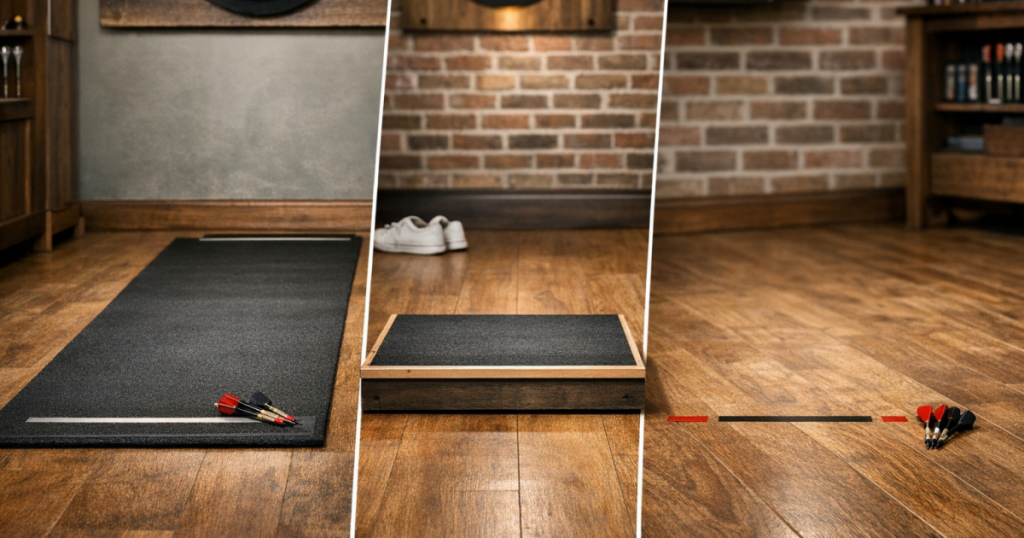
As a quick guide: roll-out mats are the most forgiving for multi-use rooms, fixed oches feel closest to a club or pub set-up, and floor markers are the simplest way to keep a clean floor while still throwing from the same spot.
How each option behaves in a real home
Roll-out darts mats
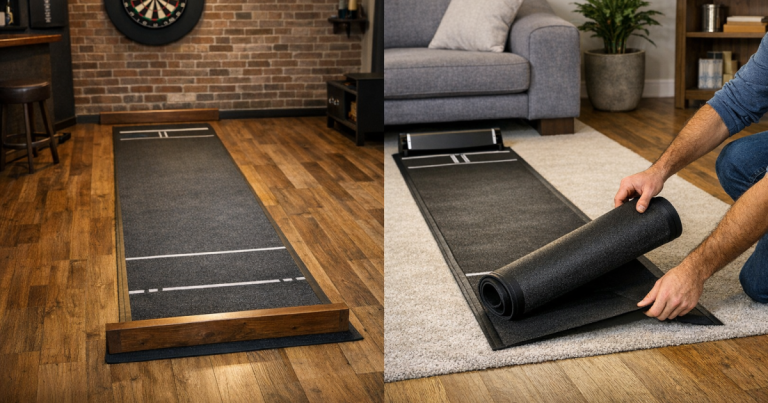
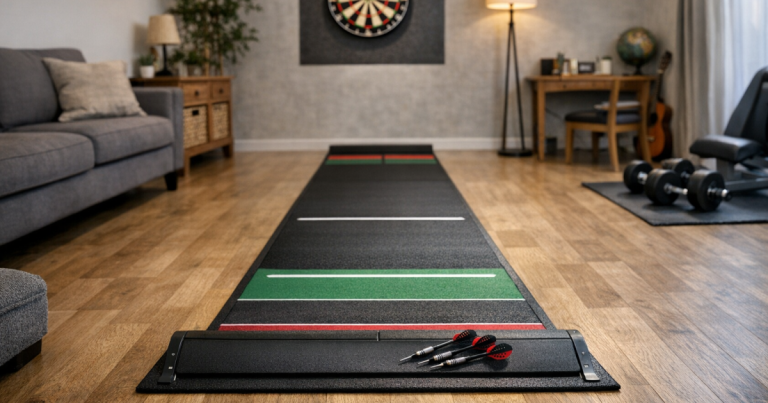
A roll-out mat gives you an instant throwing lane. It usually shows one or more oche lines, helps protect carpet or hard flooring, and can be stored when the room needs to go back to normal. That makes it a strong fit for rented homes, shared spaces, dining rooms, conservatories and spare rooms where darts is not the only purpose of the floor.
The main benefit is flexibility. You can roll the mat out, line it up with the board, play for an hour, then put it away. The main compromise is that a mat can shift, curl at the ends, or sit slightly proud of the floor depending on the material and surface below. On thick carpet, it may feel less stable underfoot. On smooth laminate or vinyl, it may need careful positioning so it does not creep forward during play.
Roll-out mats are also useful when you want a visual lane rather than only a line. For newer players, seeing the centre line to the board can help with alignment. For families, it makes the throwing area obvious, which reduces the chance of someone standing too close while a turn is in progress.
Fixed raised oches
A fixed raised oche gives you a physical stop for your front foot. Instead of glancing down to check whether your toe is on a printed line, you can step forward until your shoe touches the raised edge. For regular practice, that repeatable feel can be reassuring and can make a home board feel more like a serious playing area.
The trade-off is permanence. A raised oche needs to be positioned accurately and should not become a trip point in a room used for other things. Some players use a dedicated raised oche bar on top of a mat; others fix a raised strip to the floor in a garage, games room or darts corner. The more permanent the solution, the more confident you should be about the room layout.
A fixed raised line is rarely the neatest answer in a living room, but it can be excellent in a garage conversion, garden room, utility space or dedicated darts wall. It is also the option most likely to suit players who practise frequently and want the same foot position without thinking about it.
Floor markers
Floor markers are the minimalist option. They might be a discreet strip, a vinyl marker, low-profile tape or a small oche decal placed at the correct distance. They do not protect much floor area, and they do not stop your foot physically, but they give you a consistent reference point with the least visual impact.
This approach works well in tight UK rooms where a full mat would interfere with doors, furniture or walkways. It is also useful if you already have separate floor protection, such as a rug, rubber tile section, or a durable surface beneath the board. The key is visibility: if the marker is too subtle, guests and casual players may miss it and creep over the line.
The main trade-offs, side by side
There is no single correct answer for every home, so it helps to think in practical trade-offs rather than labels.
- For portability: choose a roll-out mat. It is easiest to store and move, though it needs aligning each time.
- For a consistent toe stop: choose a raised oche. It gives the clearest physical reference, but it suits a more permanent darts area.
- For the cleanest room: choose floor markers. They are discreet, though they offer little cushioning or protection.
- For floor protection: choose a mat or a separate protective zone. Markers alone will not do much against bounce-outs or foot traffic.
- For shared spaces: avoid anything that creates a trip hazard or blocks normal movement through the room.
- For regular solo practice: prioritise repeatability. A line that moves by a few centimetres every session is more annoying than it sounds.
Floor surface matters more than many players expect
The same mat or marker can behave differently depending on what it sits on. On carpet, a mat may feel comfortable but can ruck or drift if it is light. On laminate, vinyl or sealed concrete, it may lie flatter but slide more easily. On tiles, a thin marker may adhere neatly, but a heavy raised oche may feel awkward if it bridges grout lines.
Carpeted rooms often favour roll-out mats because they add a defined lane and protect the pile where players stand. Hard floors often need more thought around bounce-outs, especially with steel-tip darts. A dart landing point-first on timber, laminate or vinyl can leave marks, so the area below the board deserves attention as well as the toe line. For more on that side of the room plan, see the floor protection and oche positioning guide.
In garages and outbuildings, the floor may be slightly uneven or cold underfoot. A thicker mat can make the stance area more comfortable, while a fixed oche can still work if it is mounted level and does not become a nuisance when the space is used for storage, bikes or tools.
Room examples that point to the right choice
Small spare bedroom
A roll-out mat usually makes the most sense here. It gives a clear lane without permanently changing the room, and it can be lifted when the space is needed for guests, laundry or home working. Check door swings and chair positions before choosing the final line.
Dedicated garage board
A fixed raised oche becomes more tempting in a garage because the area can stay set up. If the floor is hard, consider combining the raised line with a protective mat or rubber section beneath the board. That keeps the toe stop precise while reducing visible wear from missed darts and bounce-outs.
Living room board in a cabinet
Floor markers are often the neatest answer in a living room, especially when the board is hidden in a cabinet between games. A low-profile marker keeps the playing distance honest without making the room look like a permanent practice lane.
Family games area
A roll-out mat with clear markings can help younger or occasional players stand in the right place. It also makes the throwing zone obvious, which is useful when several people are moving around the room. Store it flat or loosely rolled so the ends do not curl into the walking area.
Real product examples, without getting hung up on labels
Named products can be useful reference points, but the label matters less than whether the item fits your room. A roll-out option such as the Target World Champions Dart Mat is the kind of product people look at when they want an instant marked lane, while a raised oche product such as the Winmau Sabre Oche Master shows the appeal of a physical toe stop.
Before choosing anything similar, verify the printed distances, overall length, width, material, underside grip and how it behaves on your floor type. Product photos can make every mat look flat and every raised oche look unobtrusive, but your skirting boards, carpet thickness and furniture layout are what decide whether it will feel right day to day.
Checks before you mark, stick or fix anything
Measure from the face of the dartboard to the oche line, not from the wall or cabinet doors. If your board sits proud of the wall on a bracket or inside a cabinet, that difference matters. Use a tape measure straight along the floor and check the centre line visually from the board to the throw line.
Stand at the proposed oche and go through a few practice motions without darts. Check whether your back foot hits furniture, whether your throwing arm feels cramped, and whether anyone can walk across the lane from a doorway or kitchen entrance. A technically correct line in an awkward place will not be enjoyable.
If using a roll-out mat, mark a small alignment reference near the board end so you can place it quickly each time. If using floor tape or a vinyl marker, clean and dry the surface first and avoid placing it where shoes will twist constantly. If using a raised oche, test the position temporarily for several sessions before making it permanent.
Players who want a deeper look at mat styles, raised lines and marker formats can also read darts mats, raised oches and floor markers explained alongside this decision guide.
Maintenance and small annoyances
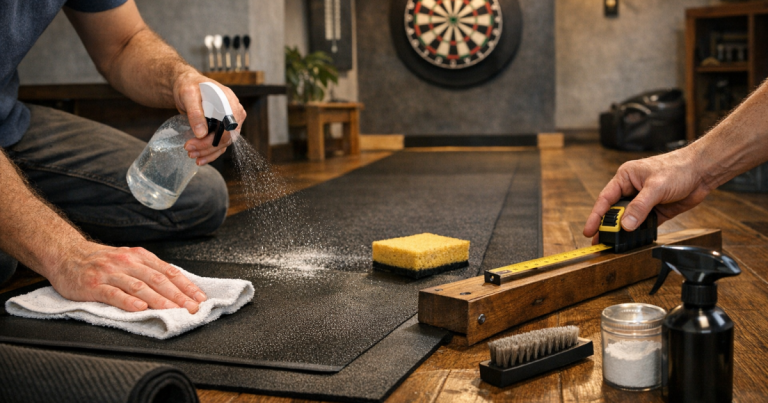
Roll-out mats need occasional flattening, cleaning and checking for edge curl. If a corner starts lifting, deal with it early rather than letting everyone step over it. Store the mat in a way that does not crush the edges, and avoid leaving it in damp spaces where the backing may suffer.
Fixed oches need less day-to-day attention, but they should stay secure and square to the board. If a raised strip moves, even slightly, it can undermine the whole point of having it. Floor markers need the least maintenance, though adhesive edges can lift in high-traffic areas or on textured surfaces.
None of these options should be treated as a substitute for checking the board area itself. Good lighting, wall protection and a sensible throwing lane all work together. A perfect oche line will not compensate for shadows over the treble bed or a wall that gets peppered by near misses.
Helpful questions
Can I just use tape on the floor?
Yes, for a simple home reference line, tape can work well. Use a low-profile tape suited to your floor surface, place it at the measured distance, and replace it when the edges start to lift or the line becomes hard to see.
Is a raised oche worth it for casual play?
Only if you like the feel of a physical toe stop or you leave the board set up most of the time. For occasional games in a shared room, a mat or discreet marker is usually easier to live with.
Do darts mats stop all floor damage?
No. A mat can reduce wear in the standing area and may help with some bounce-outs, but coverage, thickness and material vary. Check how much floor it actually covers around the board landing zone.
Should the oche line be measured from the wall?
No. For standard steel-tip play, measure from the face of the dartboard to the throwing line. Measuring from the wall can put the oche too far back or too close, depending on the board bracket and cabinet depth.
What is the neatest option for a rented home?
A roll-out mat or removable floor marker is usually the least intrusive. Avoid permanent fixings unless your agreement allows them, and test any adhesive in a discreet area before placing a visible marker.
Final thoughts
Choose the option that makes your throw line repeatable without making the room awkward. A roll-out mat is the safest all-round answer for flexible home use, a fixed raised oche is the most satisfying for a dedicated practice space, and floor markers are ideal when you want the room to stay visually tidy.
The best home set-ups are the ones people actually use. If your oche is accurate, comfortable underfoot and easy to live with, you are far more likely to practise regularly and enjoy the board rather than constantly adjusting the room around it.