A good darts area should feel deliberate, not like a board has been squeezed onto the nearest spare wall. Planning a darts wall with cabinets is about balancing protection, storage, sight lines and room style, so the setup works for a quick weeknight throw as well as a longer practice session. Start with the board position, then build the wall treatment around it.
Any mains electrical work for wall-mounted lighting, sockets or concealed cabling should be carried out by a qualified electrician to comply with UK electrical safety requirements and relevant Building Regulations.
The short version
- Fix the playing layout first: board height, throwing distance, clearance and floor protection matter more than the cabinet style.
- Choose a cabinet if you want a furniture-like finish, concealed board storage and somewhere to keep darts, chalk or small accessories.
- Choose a foam surround if missed-dart protection is the priority and you want a simpler, more open look.
- Use lighting, wall colour and cable control to make the setup look intentional rather than temporary.
- Leave enough side clearance for comfortable throwing and enough surrounding protection for real-world misses.
Begin with the playing zone, not the decoration
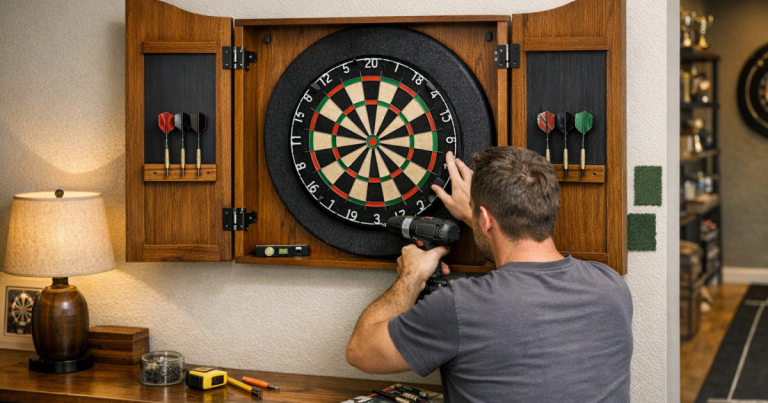
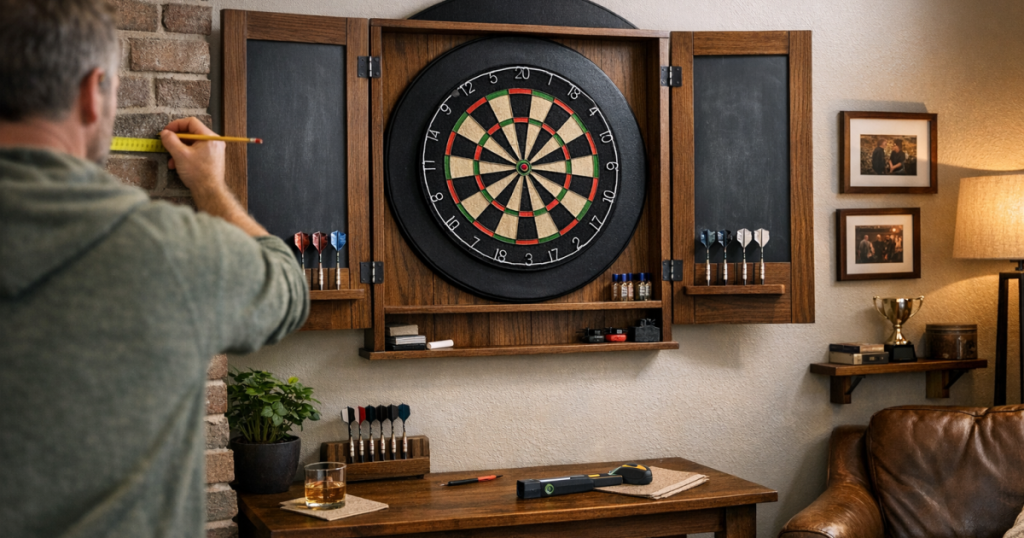
The most stylish darts wall still has to work as a proper oche. Before thinking about wood finishes, surround colours or framed prints, mark the exact board centre and the throwing line. A cabinet that looks perfect at eye level can become awkward if the board is mounted too low, too high or too close to furniture.
For a steel-tip setup, the standard board height is measured from the floor to the centre of the bull, and the throwing distance is measured from the face of the board to the oche line. If you are still setting out the room, use the measurements in our guide to dartboard height and throwing distance before committing to screw holes, paint lines or a permanent cabinet position.
In a typical UK spare room, garage, dining room corner or garden room, the limiting factor is often not the wall itself but the space behind the thrower. Check that doors can still open, people can walk past without crossing the throw, and the oche does not land on a rug edge or sloping floor transition.
Cabinet, surround or both?
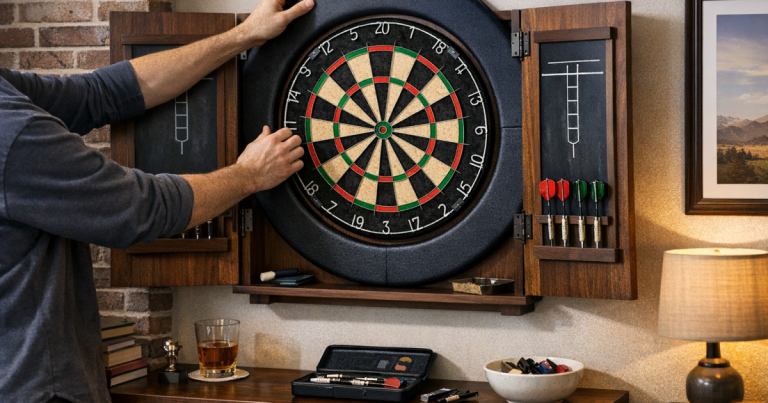
A cabinet gives the board a more finished, furniture-like presence. It can hide the dartboard when not in use, frame the playing area and provide storage for darts, spare stems, flights and small accessories. It also suits shared rooms where the setup needs to feel less like sports equipment left out all week.
A foam surround is more direct. It sits around the board and helps protect the wall from missed darts. It usually looks sportier and less formal than a cabinet, but it is simple, effective and easy to refresh if your room style changes. Some players use both: a cabinet for presentation and storage, plus additional side or lower wall protection where misses are most likely.
If you are unsure which direction suits your room, the practical differences between wooden cabinets and foam surrounds are worth weighing up before buying or drilling. The right answer often depends on whether the darts area is in a living space, a dedicated games room or a garage where function comes first.
Make the wall protection look deliberate
Wall protection is where many home setups either come together or look improvised. A small ring around the board may be enough for accurate players, but family games, casual guests and new throwers quickly reveal how wide the miss pattern can be.
Instead of adding protection only after damage appears, plan a protected zone from the start. A tidy approach is to use one main visual rectangle behind the board, cabinet or surround. This could be painted in a darker colour, clad with timber-effect panels, finished with cork tiles or built around a backboard. The aim is to make protection look like part of the design rather than a patch.
For most home players, the key areas to think about are:
- Above and below the board: low darts and bounce-outs can mark skirting-level walls or flooring.
- To the left and right: casual players often miss wider than expected, particularly during warm-ups.
- Behind cabinet doors: open doors can expose more wall than the cabinet covers when people retrieve darts.
- The floor below: steel tips can damage laminate, timber and vinyl if bounce-outs land point-first.
For more detail on material choices and coverage, the guide to wall protection around a dartboard explains how surrounds, backboards and cabinets behave in real homes.
Choose finishes that suit the room
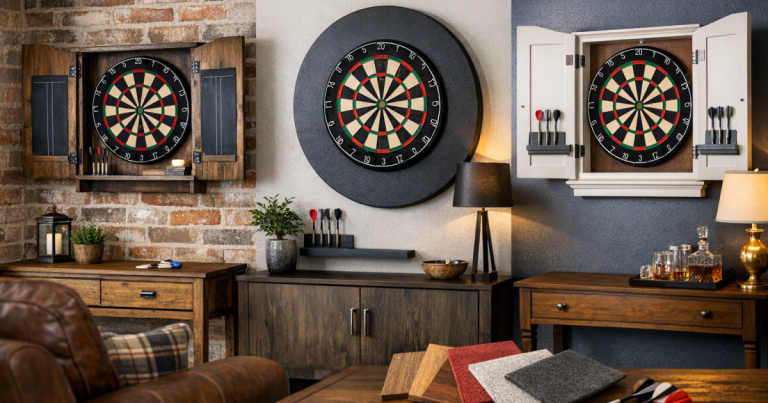
A stylish darts wall does not have to look like a pub corner unless that is the effect you want. In a modern room, matte black, charcoal, walnut, oak-effect finishes and plain white cabinets tend to blend more easily than high-gloss or heavily branded designs. In a garage or games room, stronger colours can work well because the whole space is more relaxed.
Try matching the cabinet or backing panel to something already in the room: door handles, shelving, flooring, desk furniture or picture frames. This makes the setup feel integrated. If the wall is already busy, keep the darts area simple. If the room is plain, the darts wall can become the feature.
Named products can be useful visual references, even if you choose something different in the end. A Winmau Deluxe Dartboard Cabinet represents the traditional enclosed look, while a Winmau Professional Dartboard Surround shows the cleaner ring-style protection many players use for a more open setup. Check the current dimensions, finish and compatibility before assuming either will suit your wall.
Think about storage before clutter appears
Darts areas become untidy when there is nowhere obvious for the small things. Flights, shafts, checkout cards, chalk, spare points, a sharpener and a second set of darts can all end up on shelves, windowsills or the floor. A cabinet helps, but only if the storage suits the way you actually play.
Before deciding on a layout, list what needs to live near the board. If you only use one set of darts and a score app elsewhere in the room, a simple cabinet may be enough. If you regularly swap stems and flights, play with family sets or keep steel-tip and soft-tip darts separate, allow for a small nearby shelf, drawer or organiser.
Keep the area around the board visually calm. Too many accessories mounted close to the scoring segments can distract the eye and make the wall feel crowded. A good rule is to keep the board and scoring area as the focal point, then place storage just outside the main sight line.
Lighting changes the whole look
Lighting is one of the easiest ways to make a darts setup feel more polished. Poor lighting makes even an expensive cabinet look flat, and shadows across the board can make practice frustrating. The best arrangement lights the face of the board evenly without dazzling the thrower.
In a small UK room, avoid relying only on a central ceiling pendant behind the oche. It can cast the player’s shadow over the board. Ring-style dartboard lights, slim wall lights and carefully positioned spotlights can all work, provided they do not interfere with cabinet doors or the board surround.
If you plan to keep the cabinet doors open during play, test the lighting with the doors open, not closed. Door edges can create shadows, and a light that looks neat above a closed cabinet may sit too far back once the playing area is in use.
Keep the oche and floor in the same design language
The wall is only half the visual story. A smart cabinet above a random strip of tape on the floor can make the whole setup feel unfinished. The oche marker, mat or raised line should match the level of permanence in the rest of the room.
For a shared living space, a roll-out mat can be practical because it protects the floor and disappears when the room is used for something else. In a dedicated darts room, a raised oche or fixed floor marker can look sharper and feel more consistent underfoot. If the wall has a timber finish, a darker mat or simple black oche line often looks neater than a brightly coloured design.
Also think about retrieval flow. Players should be able to walk to the board without stepping around furniture, cables, storage boxes or the edge of a mat. A stylish wall loses its appeal quickly if the room feels awkward every time someone collects their darts.
Common layout mistakes to avoid
- Mounting the cabinet first: the dartboard position should dictate the cabinet position, not the other way round.
- Forgetting door swing: cabinet doors need room to open fully without hitting shelves, curtains or side walls.
- Under-protecting the lower wall: missed darts and bounce-outs often end up below the board, not just beside it.
- Choosing a finish in isolation: check the cabinet, surround, wall colour and floor together before committing.
- Ignoring sound: a board mounted on a thin party wall can be more noticeable than expected in terraced or semi-detached homes.
Sound is not only about the board. A hollow cabinet, hard floor and bare wall can make impacts feel sharper. Soft furnishings, a mat, wall backing and careful mounting can all help the space feel less harsh without spoiling the look.
A simple planning sequence
When pulling the idea together, work in this order rather than starting with the most attractive accessory:
- Confirm the board position and throwing line.
- Check clearance for the thrower, doors, furniture and foot traffic.
- Decide whether the room needs a cabinet, surround, backboard or a combination.
- Choose the wall finish and protection zone as one visual feature.
- Plan lighting with the board, cabinet doors and shadows in mind.
- Add storage only where it helps keep the setup tidy.
- Finish the floor with a mat, marker or raised oche that suits the room.
This approach keeps the setup practical first and stylish second, which usually creates the best result. A good-looking darts wall with cabinets should not fight the room; it should make the darts area feel like it belongs there.
Helpful questions
Is a cabinet enough to protect the wall?
Not always. A cabinet protects the area it covers, but missed darts can still land outside the doors, below the board or beside the cabinet. Add a surround or wider backing panel if casual players will use the setup.
Can a foam surround look smart in a living room?
Yes, if the colour is restrained and the surrounding wall is tidy. Black or dark grey surrounds usually blend better than bright colours in shared spaces.
Should the cabinet match the dartboard brand?
It does not have to. Focus on fit, finish, door clearance and the overall look of the room. Always check that the cabinet suits the board size and mounting style you plan to use.
What is the neatest option for a small spare room?
A slim surround, a simple backing panel and a roll-out mat often feel less bulky than a full cabinet. If storage matters, choose a compact cabinet and keep the wall around it uncluttered.
How do I make the setup feel less temporary?
Use a defined wall colour or panel, hide loose accessories, add even lighting and choose a proper oche marker. Small finishing details make a big difference.
Key takeaways
A stylish darts wall starts with accurate layout and sensible protection, then uses cabinets, surrounds, lighting and storage to make the area feel finished. The best setups are not necessarily the most elaborate; they are the ones where the board is easy to use, the room is protected, and the whole wall looks intentional when the darts are packed away.