A bigger surround is about confidence as much as neat walls. For many home players, oversized dartboard surrounds are the simplest way to catch stray darts without turning a lounge, spare room or garage into a permanent games room. The right set-up depends less on brand names and more on how far your misses normally spread, what your wall is made from, and whether the board needs to look tidy when you are not playing.
Most missed darts land close to the scoring area, but beginners, children, tired throwers and cramped rooms can send darts wider than a standard foam ring covers. That is where a larger protective zone, a backing board, or a surround-and-panel combination makes more sense than relying on a neat circular ring alone.
The short answer
For maximum wall coverage, the best solution is usually not just the thickest foam ring. It is the set-up that creates enough protected area around the board while keeping the oche, lighting, cabinet doors and room layout usable.
- For neat everyday rooms: use a close-fitting foam surround plus a wider decorative backing panel.
- For shared rooms: choose a removable surround or foldaway backboard that can be stored quickly.
- For newer players: protect more width to the left and right of the board, not only below it.
- For garages and utility rooms: a larger rectangular panel can be more forgiving than a premium-looking ring.
- For rental homes: favour freestanding, removable or low-mark solutions rather than anything that needs heavy fixing.
What counts as oversized protection?
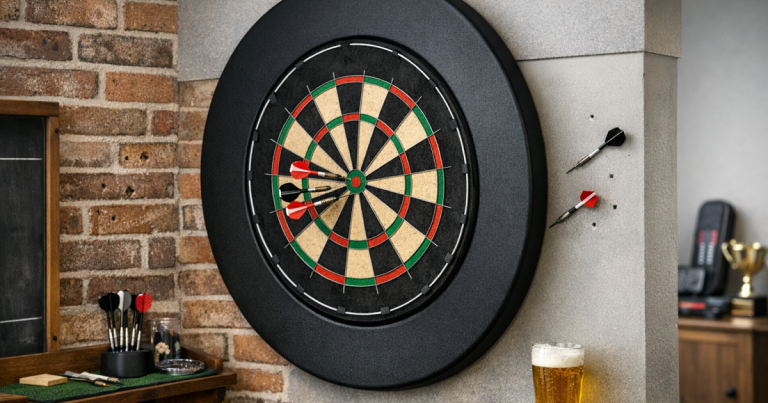
Standard circular foam surrounds are designed to sit around a regulation bristle board and catch near misses. They are tidy, quick to fit and usually look smarter than a plain sheet of board on the wall. The limitation is coverage: a standard ring may still leave exposed plaster, wallpaper or paintwork around the outer edges.
Oversized protection simply means increasing the safe area around the dartboard. That can be done with a purpose-made extended surround, a larger square or rectangular wall protector, a cabinet with extra backing, or a DIY backing panel finished in felt, cork, carpet tile or painted timber. The important point is that the outer protected area should match the way people actually miss in your room.
For many home set-ups, the most reliable arrangement is a normal surround fitted tightly around the board, mounted on a larger backing panel. The surround catches most darts cleanly, while the panel deals with the occasional wide throw. This approach also lets you choose a finish that suits the room, rather than accepting only the colours and shapes available in off-the-shelf surrounds.
Where oversized dartboard surrounds help most
Larger wall protection is especially useful in family rooms, garden rooms, converted garages and spare bedrooms where the dartboard shares space with furniture, sockets, shelving or decorated walls. It also helps when several people of different abilities use the same board. A confident league-style thrower might rarely miss the scoring area, while a guest or younger player can miss by a surprising distance.
Wide protection matters more than many people expect. Darts that slip on release often drift left or right, while darts thrown from an awkward stance can hit beside the board rather than below it. If your set-up is squeezed into an alcove, under a sloped ceiling, or near a door frame, give extra attention to the side most likely to take the stray darts.
Depth also matters. A very thin decorative panel can stop surface marks but may not hold or slow a dart well. A foam ring, cork layer or thicker fibreboard backing is generally better at absorbing impact. If you are using a panel behind the board, check that it does not push the dartboard so far forward that your measurements become inconsistent.
Set-up styles that give better coverage
1. Large foam surround around a bristle board
A large foam surround is the cleanest-looking option when you want a simple fit-and-play set-up. It usually sits around the dartboard without needing complicated work, and it can often be removed when you rotate the board or redecorate. Products such as the Mission Samurai Infinity Dartboard Surround show the kind of neat, purpose-made foam protection many home players look for, though you should check the actual outer size before assuming it will cover very wide misses.
This style is best when your missed darts are close to the board and the wall is already in decent condition. It is less convincing if you are protecting expensive wallpaper, fresh plaster or a narrow section of wall where darts can stray beyond the ring.
2. Extended wall protector for wider misses
An extended surround or larger wall protector is better for mixed-ability households. The Viper Defender III Extended Length Dartboard Surround is a recognisable example of a product designed around extra coverage rather than only a slim circular look. Availability and dimensions can vary by retailer, so treat the product name as a starting point and verify the measurements before you plan the wall around it.
This style makes sense if you have already seen marks outside a standard ring, or if the board is used at gatherings where not everyone throws regularly. It may look more prominent than a compact surround, so think about colour and shape if the board lives in a lounge or office.
3. Surround plus rectangular backing board
A rectangular backing board is often the most practical answer for home use. You can mount the dartboard and surround centrally on a larger sheet, then finish the panel to match the room. Some players use felt-covered board, cork panels, carpet tile, painted MDF or purpose-made wall protection panels. The benefit is control: you decide how much protection sits above, below and beside the dartboard.
Before cutting or ordering a panel, measure the space properly. Allow for the board, surround, fixing bracket, any cabinet doors, light ring and nearby furniture. The same measuring logic used when measuring for a dartboard cabinet or surround applies here: do not just measure the board; measure the protected area, the wall space and the clearance around it.
4. Cabinet with extra side protection
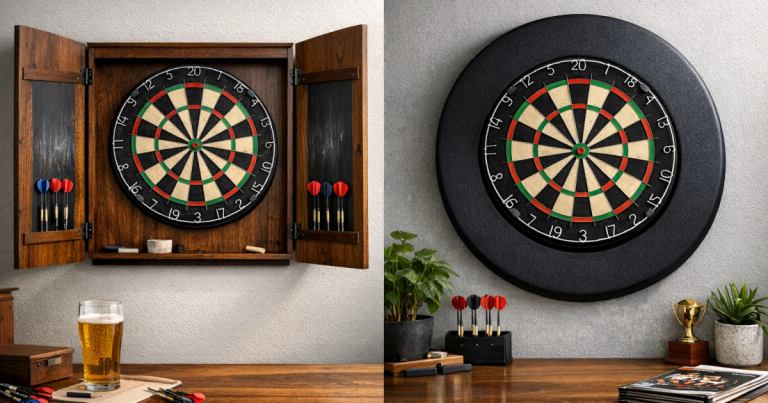
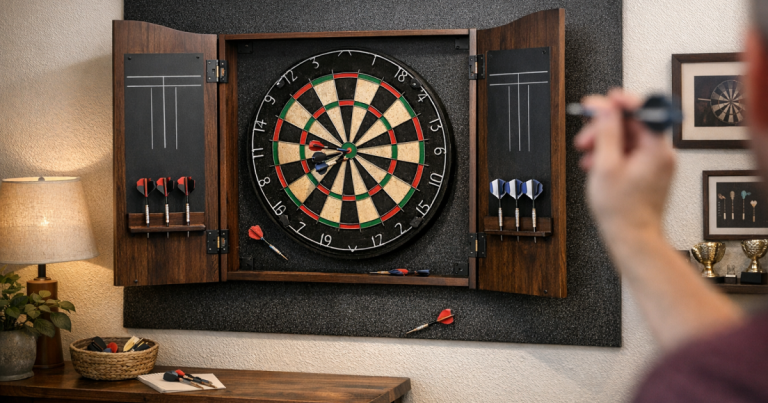
A dartboard cabinet gives a tidier look and can hide the board when it is not being used. However, many cabinets protect only the area immediately around the board, and open doors can still leave parts of the wall exposed. If wall coverage is the priority, check how far the cabinet extends beyond the dartboard and whether you still need a foam ring or backing panel inside it.
Cabinets work best in rooms where appearance matters and players are fairly consistent. For newer throwers, a cabinet on its own can be too narrow. A slim backing panel behind the cabinet can solve that without making the whole set-up look homemade.
How to judge coverage before you commit
The easiest test is to mark out the proposed protected area with low-tack tape before you buy or cut anything. Stand at the oche and look at the whole zone, not just the board. If the taped rectangle or ring looks small from throwing distance, it will probably feel small once people start playing.
- Check the common miss zones: left, right and low misses are more common than perfect vertical misses above the board.
- Allow for player height: younger players and guests may throw flatter or less consistently than the regular board owner.
- Think about wall finish: painted plaster can often be touched up, but wallpaper, panelling and exposed brick are less forgiving.
- Leave room for lighting: a light ring or overhead light may alter the visible edge of the protected area.
- Check board rotation: you still need to remove or rotate the board without dismantling the whole wall.
- Avoid tight edges: a surround that just fits beside a shelf, door frame or radiator can look neat but may leave awkward exposed corners.
If you are using a known surround, read real-world notes as well as the maker’s dimensions. Our Harrows dartboard surround review explains the sort of wall gaps and fit details that matter once a surround is actually on the board.
Room-by-room examples
Spare bedroom board
In a spare bedroom, a foam surround with a neat backing panel is usually the best balance. The panel protects the decorated wall, while the surround keeps the set-up looking like a darts area rather than a workshop. Choose darker or textured finishes if you want small dart marks to be less visible over time.
Garage or garden room
Garages and garden rooms can take a more practical approach. A wider rectangular board often beats a stylish compact ring because looks are less critical and the wall may be uneven. Moisture and temperature changes can affect some materials, so avoid anything that warps easily or relies on weak adhesive alone.
Lounge or shared family room
In a shared room, the surround needs to work visually as well as practically. A tidy circular surround, a cabinet, or a removable backboard may be preferable to a large permanent panel. If the room has to switch back to normal quickly, take inspiration from foldaway planning rather than treating the dartboard as a fixed feature. A removable or hinged panel can protect the wall during play and disappear afterwards, much like a foldaway darts area in a shared room.
Details that affect the finished result
Good wall coverage is not just about outer dimensions. The edge quality, grip, thickness and finish all change how the set-up feels after a few months of use.
- Fit around the board: gaps between the board and surround can let dart points hit the wall or backing behind.
- Material recovery: dense foam can close up around small punctures better than brittle or crumbly materials.
- Colour: black hides marks well, while lighter colours can make a room feel less dominated by the board.
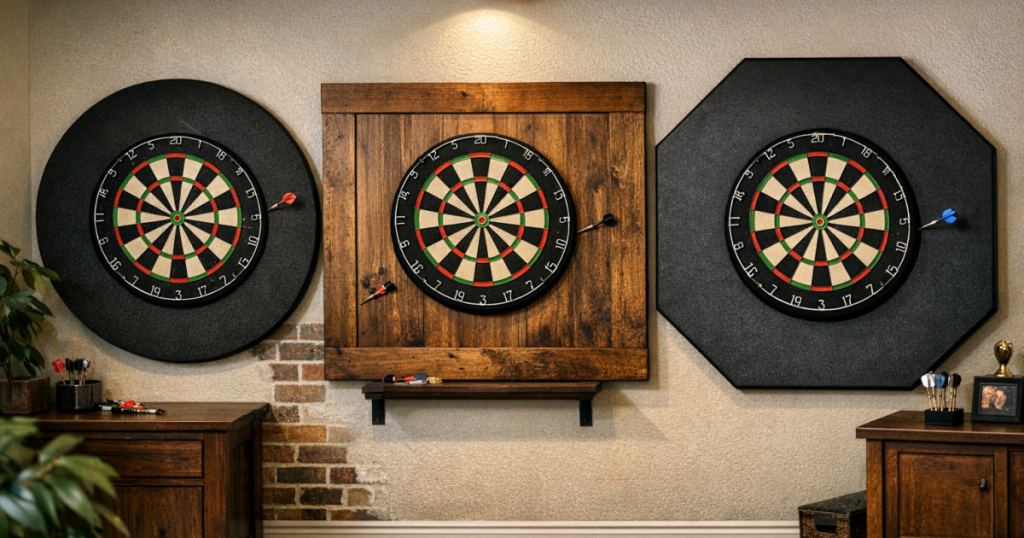
- Edge shape: square panels protect corners better; circular rings look cleaner but cover less total wall area.
- Mounting method: removable surrounds are easier to adjust; fixed panels need more careful alignment from the start.
- Oche consistency: if a backing panel changes the board position, re-check the throwing distance and board height.
Do not forget the floor. Wall protection stops paint chips and punctures, but bounce-outs can still damage laminate, tiles or softwood flooring. A sensible darts mat and oche setup completes the protective zone and helps players stand in the same place each throw.
Products worth using as reference points
Rather than treating any single model as automatically best, use recognised products to understand the main styles available. The Target Pro Tour Dartboard Surround is a familiar example of a tidy foam ring for a clean home set-up. The Winmau Professional Dartboard Surround is another common reference point for players comparing standard surround fit and finish. Neither should be assumed to give enough extra coverage for every room, so check the actual outer diameter and compare it with your marked wall area.
If your tape test shows that a standard ring leaves too much exposed wall, move up to an extended protector or add a separate backing panel. That is usually more effective than buying a premium-looking surround that is still too small for your players and room.
FAQ
Is an oversized surround better than a standard surround?
It is better when you need more protected wall area. If most misses land close to the dartboard, a standard surround may be enough. If beginners or guests play regularly, wider protection is usually more reassuring.
Can I use a backing board instead of a surround?
Yes, provided the backing material is suitable for dart impact and mounted securely. Many home set-ups use both: a foam surround for near misses and a larger board for wider stray darts.
Will a larger surround affect dartboard height or distance?
The surround itself usually should not, but a thick backing panel can move the board face forward. After fitting one, re-check the board height and throwing distance from the oche.
What wall area should I protect around a dartboard?
Protect at least the area where your household actually misses. Mark the wall with low-tack tape, throw a few careful practice sessions, and extend the protected zone if darts are landing near the edge.
Are oversized surrounds suitable for rented homes?
They can be, but removable options are safer for deposits. Avoid heavy permanent fixing unless your tenancy allows it, and consider a freestanding or foldaway backing panel if wall marks are a concern.
In brief
The best oversized set-up is the one that matches your room, players and wall finish. A compact foam ring looks smart, but a larger panel or extended protector gives more confidence when mixed-ability players are throwing. Measure the space, mark the likely miss zones, check the fit around the board, and make sure the final arrangement still works with your oche and lighting. Get those basics right and your wall protection will feel like part of the darts area, not an afterthought.