A good home darts area feels steady underfoot, protects the floor, and makes the throw line obvious every time you step up. The right darts mat and oche setup depends on three things: your floor surface, how permanent the space is, and how much protection you need around the board. Get those right and the whole area feels more like a proper practice lane, not just a board on a wall.
The short version
For most home players, a full-length mat with a clear throw line is the easiest starting point. It gives you a consistent stance, helps protect the floor from dropped darts, and makes the oche position repeatable. If you play often, a raised oche or fixed toe line can improve consistency. If your space is shared with a hallway, dining room or spare bedroom, a roll-up mat is usually more practical.
- For carpet: prioritise a mat that lies flat and does not creep forward during play.
- For laminate or wood: look for grip underneath and enough thickness to soften dropped darts.
- For tiles or concrete: focus on cushioning, slip resistance and noise reduction.
- For permanent setups: consider a raised oche so your foot position is consistent without checking markings.
- For temporary setups: a roll-out mat with printed distance markings is easier to store and reposition.
Why the floor matters more than people expect
The board gets most of the attention, but the floor sets the feel of the throw. A mat that slides, bunches, curls at the edges or feels spongy under one foot can make a good setup feel awkward. It also affects how relaxed you are when retrieving darts: nobody wants to worry about chipped laminate, dented timber or sharp points landing on a tiled floor.
A darts mat is doing several jobs at once. It marks the distance, gives your stance a repeatable reference, protects the floor, reduces noise, and helps define the playing lane. The best choice is not always the thickest or heaviest option; it is the one that behaves properly on your specific floor and suits how often the area is used.
If you are planning the whole space from scratch, it is worth thinking about the board, surround, mat and landing zone together rather than treating them as separate purchases. The floor area directly below and in front of the board is where most accidental drops happen, so you may also want to read more on planning floor protection for a darts area before settling on the final layout.
Match the mat to your floor surface
Carpeted rooms
Carpet is forgiving when darts fall, but it can make some mats move or ripple. Lightweight mats may creep forward as players step on and off them, especially on thicker pile carpet. A mat with enough weight to stay flat is useful, but avoid anything so stiff that it rocks over the carpet rather than settling into it.
On carpet, the biggest practical checks are edge curl and toe-line accuracy. If the mat shifts even a few centimetres during a session, your distance changes. For a regular practice area, mark the rear or side position discreetly so you can lay the mat in the same place each time.
Laminate, engineered wood and timber floors
Hard floors look smart, but they show damage quickly. Dropped steel-tip darts can mark softer finishes, and repeated foot movement can scuff areas around the throw line. A mat with a grippy underside is important because smooth floors can be slippery, particularly if the mat has a shiny backing.
Thickness matters here, but only up to a point. A very thick mat can feel comfortable, yet may make a raised edge more noticeable. A medium, stable mat that sits flat and resists sliding is usually more useful than a bulky one that becomes a trip point.
Tiles, stone and concrete
These surfaces are durable, but they can be noisy and unforgiving. Dropped darts may bounce, points can be damaged, and standing for long sessions can feel harder on your legs. A denser rubber-style mat or cushioned mat can make the space more comfortable and reduce the sharp sound of darts hitting the floor.
Check that the mat does not skate on smooth tiles. If the room gets cold, such as a utility room or garage, some materials can feel stiffer underfoot, so it is worth choosing something that still lies flat when the temperature changes.
Garages and multi-use rooms
Garage darts setups are common in the UK because they keep noise and wall protection away from living areas. The challenge is that the floor may be dusty, uneven or slightly damp. A mat should be easy to lift, clean and dry. Avoid leaving it down permanently if moisture can collect underneath, as that can affect both the mat and the floor finish.
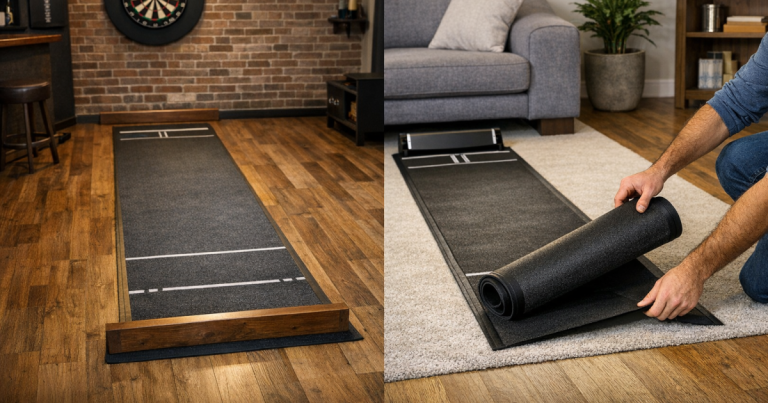
In shared rooms, storage matters. A mat that rolls neatly and returns flat is better than one that is theoretically more protective but awkward to use. If the setup takes too long to lay out, it tends to be used less.
Choosing the right style of oche
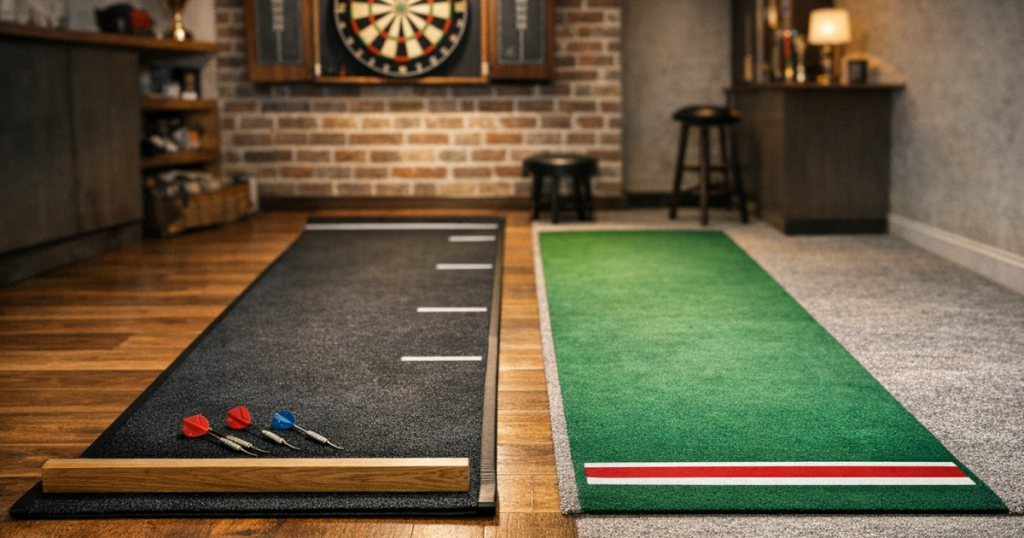
The oche is the line or raised marker you stand behind when throwing. A simple printed line is fine for casual play, but a physical toe stop can help if you practise regularly. It gives you something to set your foot against without looking down every visit.
- Printed throw line: simple, low profile and good for rooms where the mat is rolled away after play.
- Adhesive floor marker: useful for a fixed hard-floor setup, but check that it will not damage the floor finish when removed.
- Raised oche: gives the most consistent foot reference, but needs enough room so it does not become a trip hazard in a shared space.
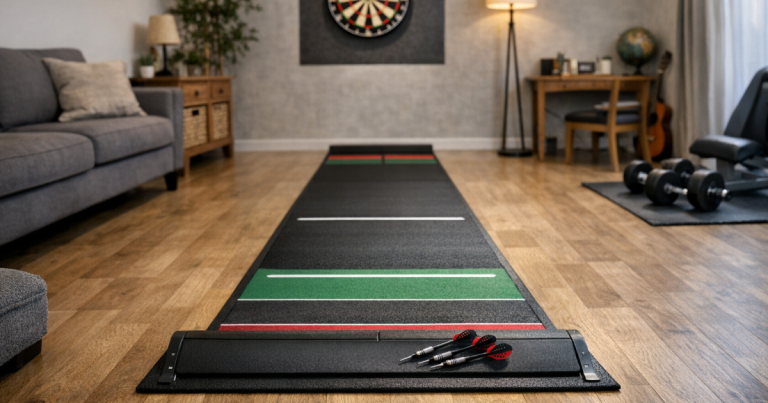
- Integrated mat and oche: convenient if you want one piece to define the lane, though it still needs to sit flat on your floor.
For steel-tip darts, the standard throwing distance is measured horizontally from the face of the board to the front edge of the oche. The commonly used distance is 2.37 m. Board height is normally 1.73 m from the floor to the centre of the bullseye. If you play in a specific league or use an electronic board, check the relevant rules or manufacturer guidance, as distances can vary.
Get the room measurements right before you commit
A mat can only work properly if the board area has enough clearance. Measure from the board face, not from the wall, because the board has depth. If the board is in a cabinet, the cabinet doors, surround and wall protection can all affect how comfortable the lane feels.
Start by confirming the board height, then measure the throw distance along the floor. Check that the mat will not clash with a door swing, radiator, skirting step, furniture leg or walkway. It is also worth checking side space, because a mat that fits the distance may still feel cramped if players have to stand partly against a wall or cupboard.
For a more complete room-planning check, especially if you are adding wall protection as well, use the same measuring discipline covered in measuring for a dartboard cabinet or surround. The aim is to make the whole setup feel deliberate rather than squeezed into the nearest spare patch of wall.
Material feel: grip, comfort and clean-up
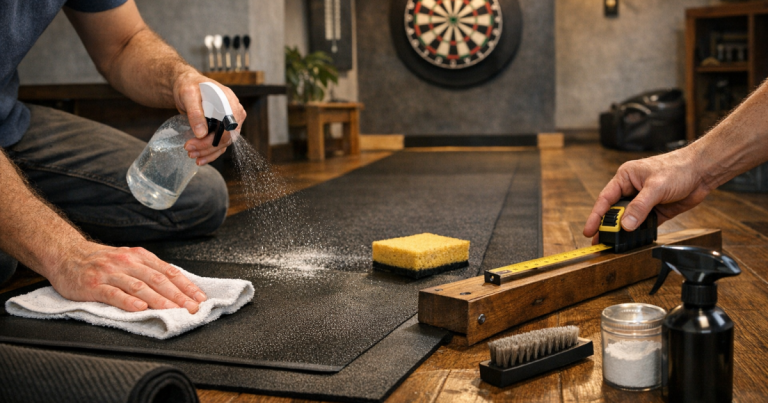
Different mat materials change the feel of the playing area. Rubber-style mats tend to grip well and offer useful protection, but can be heavier to move. Carpet-topped mats feel familiar underfoot and can look more at home in a living space, though they may collect dust, pet hair and point marks. Vinyl or PVC-style surfaces can be easy to wipe clean, but should still be checked for slip resistance on smooth floors.
Think about how the mat will age in your room. A light-coloured surface may show dirt around the stance area. A textured surface may hide marks better but take more effort to clean. If you wear outdoor shoes in a garage setup, cleanability matters more than it does in a spare bedroom where players wear trainers or socks.
For a deeper look at the trade-offs between rubber, carpet-style and other common surfaces, see our guide to darts mat materials for a better oche setup.
Think about the landing zone, not just the toe line
Many players choose a mat mainly for the printed measurements, then realise the most vulnerable area is closer to the board. Darts do not only drop at the throw line. Bounce-outs, pulled darts, missed catches and loose points can land anywhere between the board and the player.
If your board is on a hard or expensive floor, make sure the mat covers the area directly under the board as well as the standing position. Where a mat stops short, you may need extra protection near the wall. This is particularly relevant with bristle boards and steel-tip darts, where a bounce-out can fall point-first.
Also consider how people retrieve darts. Repeated turning, stepping and leaning often happens in the same small patch in front of the board. A mat that protects only a narrow lane may leave the surrounding floor taking most of the wear.
Permanent versus roll-away setups
A permanent setup can be heavier, flatter and more precise because it does not need to be packed away. You can align the oche once, check the distance, then leave everything in place. This suits garages, games rooms and dedicated spare-room boards.
A roll-away setup needs to be forgiving. It should unroll without fighting you, sit flat quickly, and have a throw line that is easy to line up accurately. If several people in the house use the room, low-profile edges matter. A mat that becomes a nuisance will be moved, folded badly or left leaning in a corner.
There is also a middle ground: a fixed floor marker for the oche position, with a removable mat used during play. That can work well when you want accurate distance but do not want a full mat visible all week.
Small checks that prevent annoying mistakes
- Check the board face distance: do not measure from the wall unless you have allowed for board depth.
- Look for edge curl: curled corners are irritating and can catch feet in tight rooms.
- Test stance comfort: stand where you normally throw and check whether the mat feels level under both feet.
- Allow retrieval space: make sure the mat does not end exactly where players naturally step forward.
- Check storage space: a roll-up mat needs somewhere clean and dry to live.
- Keep the toe line visible: dark rooms, patterned floors and low light can make subtle markings harder to see.
Things readers ask
Do I need a raised oche at home?
No, but it helps if you practise regularly. A raised oche gives a repeatable foot stop, while a printed line is usually enough for casual games or rooms that need to stay flexible.
Will a darts mat stop all floor damage?
Not always. A good mat reduces the risk of marks and dents, but sharp darts can still land outside the covered area. Protect the space under the board and the likely bounce-out zone.
Can I use a normal rug instead of a darts mat?
You can, but it will not usually give you an accurate throw line or the same level of point protection. Rugs can also move more easily unless they have a suitable non-slip backing.
How wide should the mat be?
It should be wide enough for your normal stance and retrieval path. Very narrow mats can protect the throw line but leave the surrounding floor exposed where players actually walk.
Should the mat stay down all the time?
Only if the room is dry, clean and not a trip risk. In garages or shared rooms, lifting and storing the mat after play can help keep it flatter, cleaner and in better condition.
Main points
Choose the floor setup around the room you actually have, not an idealised darts lane. Carpet needs stability, hard floors need grip and protection, and garage spaces need easy cleaning and moisture awareness. A clear toe line is the minimum; a raised oche is a worthwhile upgrade for regular practice.
The best result is simple: accurate distance, steady footing, sensible floor coverage and a setup you will use without fuss. Once those basics are right, the board area feels more consistent, the floor is better protected, and home practice becomes much more enjoyable.