Getting the wall layout right before you measure for a dartboard cabinet saves patching, cramped doors and awkward scoring later. The aim is simple: keep the board regulation-friendly, protect the wall, and leave enough clearance for darts, doors, lighting and your throwing line.
Cabinets and surrounds look tidy, but they add width, depth and practical constraints around the board. A few careful measurements make the difference between a neat home darts corner and a setup that always feels slightly in the way.
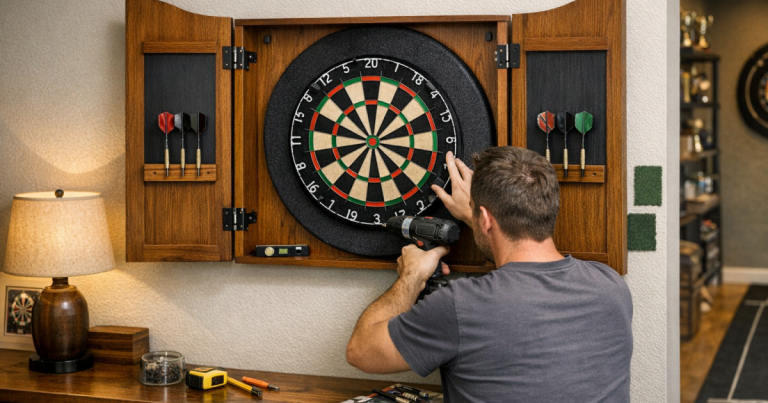
Wall drilling, fixing selection and mounting of a cabinet on masonry, plasterboard or stud walls should be carried out by a competent qualified professional to ensure concealed services are avoided and the fitting complies with UK safety requirements and suitable fixing standards.
At a glance
- Set the dartboard position first: the centre of the bull should be 1.73 m from the floor for a standard steel-tip setup.
- Measure the throwing distance from the face of the board, not from the wall behind it.
- Allow for the full outside width of the cabinet or surround, not just the dartboard itself.
- Check door swing, ceiling height, skirting boards, sockets, radiators, curtains and nearby furniture.
- Leave space for lighting, scoring and floor protection before deciding the final position.
Start with the board, not the cabinet
The cabinet or surround should be planned around the correct dartboard position. Mark a vertical centre line on the wall where the bullseye will sit, then mark the bull height at 1.73 m from the finished floor surface. If you use a darts mat, thick floor covering or protective tiles, measure from the surface you will actually stand on.
The throwing distance for standard steel-tip darts is 2.37 m from the face of the dartboard to the oche. This matters because a cabinet adds depth around the board, and some mounting systems bring the board slightly forward from the wall. If you measure from the skirting board or wall surface, your oche can end up short.
A useful cross-check is the diagonal measurement from the centre of the bull to the oche, which is commonly given as 2.93 m for a standard steel-tip layout. It is not a replacement for proper measuring, but it helps confirm that the board height and throwing distance make sense together.
Measure the wall area you actually have
Once the bull position is marked, measure the available wall space from left to right and from floor to ceiling. Do not assume a cabinet will fit just because the board fits. A cabinet needs room for its outside frame, open doors and any scoreboards or chalk panels inside. A surround needs enough blank wall around the board so the protective ring sits flat and does not foul shelves, picture rails or uneven trim.
For a cabinet, measure three widths: the closed cabinet width, the width with doors open, and the usable flat wall area around the board. The open-door measurement is easy to miss, especially in alcoves, box rooms and converted garage spaces where side walls or furniture sit close to the board.
For a surround, measure the full outer diameter of the surround you plan to use, then add a little comfort space around it. Foam surrounds are forgiving, but they still need a clean, flat area. If the wall has a light switch, socket, trunking or a radiator close to the board, the surround may not sit properly or may look off-centre even if the board is correctly placed.
Allow for depth and door movement
Depth is just as important as width. A cabinet projects from the wall, and the dartboard itself sits proud of the backing surface. That can affect the oche distance, lighting angle and how close the setup feels in a narrow room.
Check the cabinet depth with the doors closed and think about what happens when they open. In a hallway, spare room or garden office, an open cabinet door can catch people walking past or block access to shelves and cupboards. In a family room, it can also make the darts area feel more intrusive than expected.
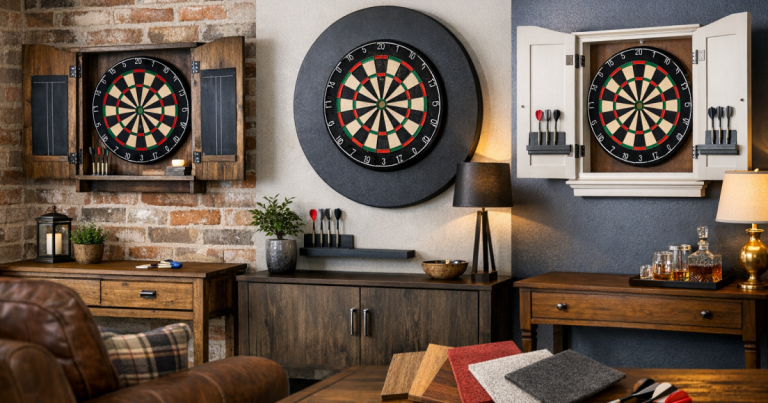
If you prefer a softer, simpler wall-protection setup, a surround usually has less visual bulk than a cabinet, but it does not provide built-in dart storage or enclosed score panels. For more detail on how wood, foam and finish choices affect the look and practicality of a setup, the guide to dartboard cabinet and surround materials is a useful next read.
A simple measuring routine
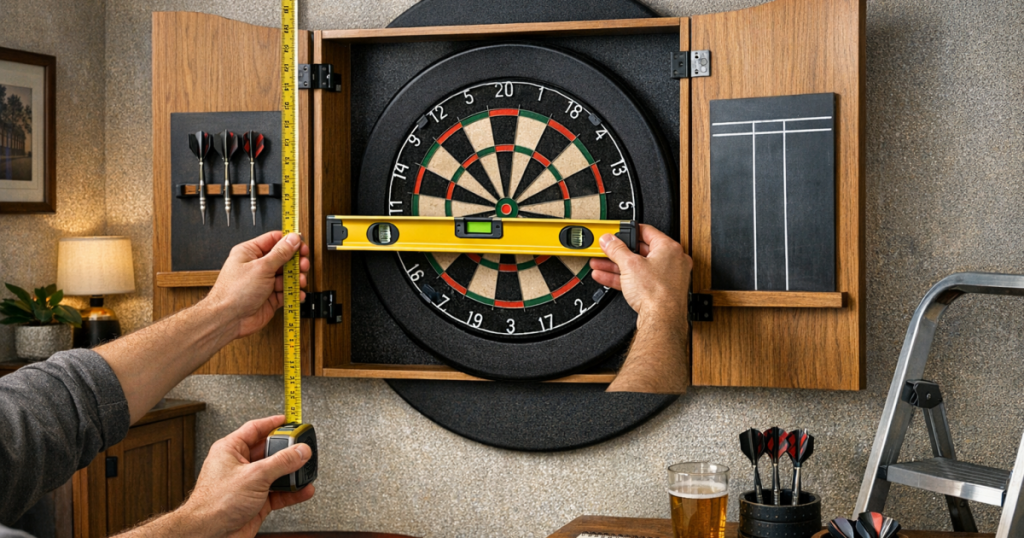
Use painter’s tape, a tape measure, a pencil and a spirit level. If possible, ask someone to hold the tape or the cabinet template while you step back and check the overall layout. Many measurement errors happen because the board is technically correct, but the surrounding area has not been considered.
1. Mark the centre line
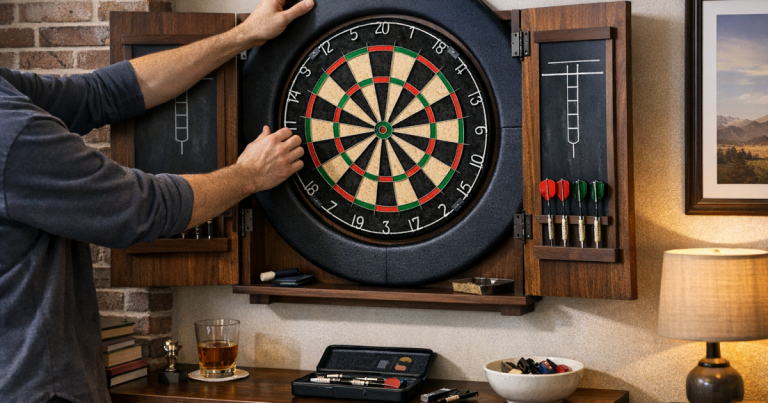
Choose the wall position and mark a vertical centre line. This line should run through the centre of the dartboard, cabinet and surround. Check it visually against nearby features such as door frames and shelving; a board can be level but still look awkward if it is squeezed too close to a prominent feature.
2. Mark the bull height
Measure 1.73 m from the finished floor to the centre of the bull. Mark this point clearly. If your floor slopes, which can happen in garages, sheds and older properties, measure from the standing area rather than a random point by the wall.
3. Map the outside shape
Tape out the full outside size of the cabinet or surround on the wall. For a cabinet, also tape where the doors will reach when open. For a surround, tape the outer edge so you can see whether it clashes with switches, shelves or wall lights.
4. Confirm the throwing line
Measure 2.37 m from the face of the dartboard to the oche position. If the board is not mounted yet, allow for the depth of the board and mounting hardware rather than measuring from the bare wall. Mark the oche and check whether players have enough room to stand comfortably without backing into furniture.
5. Step back and test the room
Open nearby doors, move chairs into their usual position and check sight lines from the throw area. A setup that works on a blank wall can become annoying once everyday room use is added back in.
Do not forget lighting and shadows
Cabinets can create shadows if the light source is too far to one side or mounted too close to the wall. Surrounds are usually less bulky, but they still need even light across the board face. Before fixing anything permanently, check where your ceiling light, lamps and any dedicated dartboard light will sit.
If the board will be in a room with one central pendant light, stand at the oche and look for your own shadow falling across the board. Dedicated ring-style lighting can help, but you still need enough clearance around the cabinet or surround. The separate guide on lighting a dartboard without shadows or glare explains how to plan the light angle before you commit to the wall position.
Plan the floor at the same time
Measuring the wall without planning the floor can lead to a tidy cabinet above a poorly placed oche. Mark the throw line early and check whether a mat, carpet runner or hard-floor protector will fit neatly between the board and the standing area.
On laminate, tile or wood floors, missed darts and foot traffic can leave marks over time. A cabinet protects the wall around the board, but it does nothing for the area below. If you are setting up in a lounge, spare bedroom or garage conversion, read the guide to planning floor protection for a darts area before finalising the oche position.
Cabinet and surround checks before you commit
- Check the external dimensions of the cabinet or surround against the available wall area.
- Confirm the board opening suits a standard bristle dartboard and does not cover scoring segments.
- Make sure cabinet doors can open fully without hitting side walls, shelves or curtains.
- Check whether score panels will be readable from the throw line and easy to reach between legs.
- Allow space above and around the board for lighting, not just the cabinet frame.
- Check the wall is flat enough for a surround to sit evenly without visible gaps.
- Think about dart storage: flights, shafts and spare points need somewhere sensible if the cabinet is your main organiser.
- Measure again after placing any mat, rug or floor protector, as floor thickness can slightly alter the effective standing surface.
Common measuring mistakes
The most common mistake is measuring the cabinet as if it were only a decorative frame. It is a working part of the darts area, so it affects how you score, stand, light the board and move around the room.
Another frequent issue is placing the board too close to a corner. A corner position can look efficient, but cabinet doors may not open properly and right-handed or left-handed players may feel boxed in. Leave enough side space for a natural stance and for retrieving darts without brushing against furniture.
People also forget that a surround is not a fixing system. It protects the wall around the board, but the board still needs to be mounted securely and centred correctly. If the board is even slightly off, the surround makes the error more obvious because the whole ring looks misaligned.
Finally, avoid measuring only once. Tape the layout, leave it for a while, then come back and view it from the doorway, the oche and the side of the room. Small adjustments at the planning stage are much easier than filling holes later.
Questions people ask
Can I measure for a dartboard cabinet before buying the cabinet?
Yes. Mark the regulation bull height and centre line first, then check the maximum wall width and door swing you can accommodate. Use the product’s actual dimensions before drilling.
Should a surround be centred on the board or the wall?
Centre it on the board. The dartboard position controls the game layout, so the surround should follow the bullseye centre rather than nearby shelves, sockets or wall panels.
How much wall space do I need around a dartboard?
You need enough for the board, the full outside size of the cabinet or surround, and comfortable clearance around doors, lights and nearby furniture. The exact amount depends on the product dimensions.
Does a cabinet change the oche distance?
It can if the board sits further forward than expected. Always measure the throwing distance from the face of the dartboard, not the wall or the back of the cabinet.
Is a cabinet better than a surround for a small room?
A surround often feels less bulky, but a cabinet gives enclosed storage and a tidier look when closed. In a tight room, door swing and depth usually decide which works better.
Key takeaways
Good measuring starts with the dartboard position, not the accessory. Mark the bull at 1.73 m, plan the 2.37 m throwing distance from the board face, then map the full outside size of the cabinet or surround around that centre point.
Allow for the room as it is actually used: doors open, lights on, furniture in place and the oche marked on the floor. When the wall protection, storage, lighting and floor area all work together, the finished darts setup feels deliberate rather than squeezed in.