A clear scoring routine makes home darts feel calmer, fairer and much closer to a proper match night. The easiest way to track sets and legs on a darts scoreboard is to separate the running score from the match score, so everyone can see both the current leg and the wider contest at a glance.
That matters whether you are playing a quick first-to-three legs of 501, a longer set-play format, or a friendly mini-tournament in the spare room. Once the layout is consistent, players spend less time asking what the score is and more time thinking about the next visit.
At a glance
- Use the largest part of the board for the current leg score, such as 501 down to a checkout.
- Keep legs won in a separate row or column beside each player’s name.
- Keep sets won in another separate row if the match uses set play.
- Reset the leg score after each leg, but only reset the leg count when a set is completed.
- Agree the format before the first dart is thrown: first to a number of legs, or best of a number of sets.
Know the difference before you start
A leg is one individual game. In a standard home 501 match, both players start on 501 and take turns subtracting their three-dart scores until one player finishes, usually on a double if you are playing standard rules.
A set is a group of legs. For example, a set might be the best of five legs, which means the first player to win three legs wins that set. A match can then be the best of three sets, first to two sets, or any format you agree before play begins.
The most common confusion comes from mixing the two. If you are playing a straight race to five legs, you do not need a set column at all. If you are playing set darts, the leg count sits inside the current set and resets when that set is won.
Step 1: Decide the match format
Before scoring starts, write down the format in plain language somewhere visible. This avoids arguments later, especially when players are tired or the match gets close.
Simple leg-only formats
- First to 3 legs: good for quick practice matches.
- First to 5 legs: better for a longer head-to-head without using sets.
- Best of 7 legs: the first player to 4 legs wins the match.
Set-play formats
- Best of 3 sets, best of 5 legs per set: first to 2 sets wins the match, and first to 3 legs wins each set.
- Best of 5 sets, best of 5 legs per set: first to 3 sets wins, with each set still decided by first to 3 legs.
- Short home format: first to 2 sets, with each set first to 2 legs, useful when you want set play without a long match.
Use first to language when you can. It is clearer than best of language for casual home games because it tells players the exact target: first to 3 legs, first to 2 sets, and so on.
Step 2: Lay out the scoreboard clearly
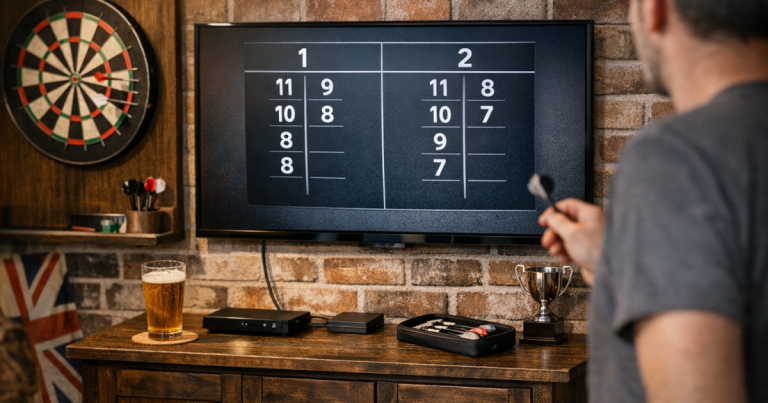
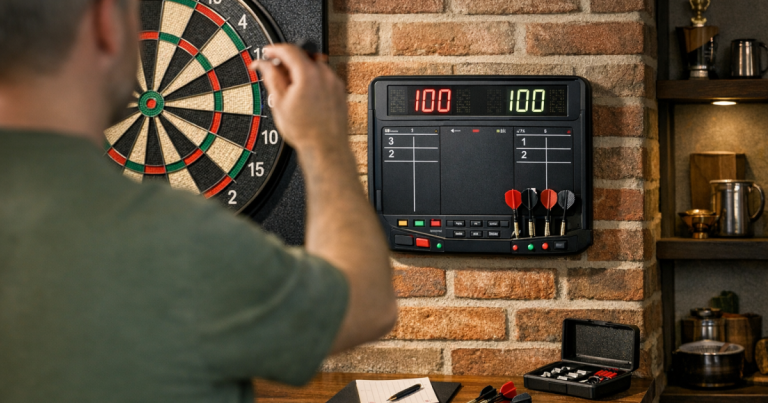
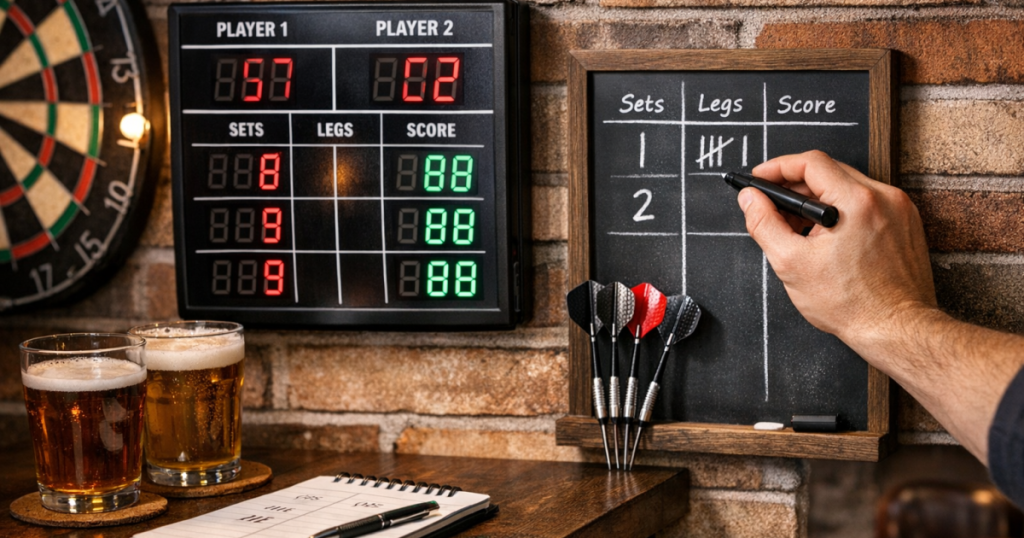
Whether you use a dry-wipe board, chalkboard, printed sheet or tablet, the basic layout should stay the same. Put player names at the top, current leg scores in the largest area, legs won in a smaller column, and sets won in a separate column if needed.
A simple two-player layout can look like this in practice: player name, current score, legs, sets. The current score changes every visit. The legs column changes only when someone wins a leg. The sets column changes only when someone wins enough legs to take a set.
If you use a tablet, keep the screen awake, positioned away from the throw line and large enough to read from the oche. For a more detailed home setup, see our guide on using a tablet as a darts scoreboard.
Step 3: Score the current leg first
Start each player on the agreed total, commonly 501 or 301. After each visit, subtract the score from that player’s remaining total. If a player scores 60 from 501, their remaining score becomes 441. Keep the running total neat and write the latest total below the previous one if you are using a board with enough space.
For double-out games, a player must finish exactly on zero with the final dart landing in a double or the bull, depending on your rules. A bust usually means the visit does not count and the player’s score returns to what it was before that visit. Common bust situations include going below zero, leaving one, or reaching zero without the required double finish.
Call the remaining score clearly after each visit. That helps both players check the maths and plan their next throw. If there is a scorer, the scorer should update the board after every three darts rather than waiting until the end of the leg.
Step 4: Add the leg when a player checks out
When a player finishes the leg correctly, add one mark to their legs column. Then reset both players’ running scores to the starting number for the next leg.
Do not change the set score yet unless that leg has also completed the set. This is the point where many home scoreboards become messy: someone wins a leg, the score is reset, and nobody is sure whether the set should move on. The rule is simple: update the leg count first, then check whether that leg total wins the set.
For a best-of-five-leg set, a player wins the set when they reach three legs. At 2-2, the next leg decides the set. At 3-1, the set is already over; there is no need to play the remaining possible leg.
Step 5: Convert legs into sets
If the format includes sets, the legs column belongs to the current set only. Once a player reaches the required number of legs, add one to their sets column and reset both leg counts to zero.
For example, imagine Player A leads 2-1 in legs in a best-of-five-leg set. Player A then wins the next leg. The leg score becomes 3-1, so Player A wins the set. You add one set to Player A, then reset the legs column to 0-0 for the next set.
If you need to track sets and legs for more than two players, such as pairs or a small round-robin, keep each match on its own line or sheet. Trying to run several matches on one crowded board usually creates more confusion than it saves.
Step 6: Keep the scoreboard easy to read during play
A scoreboard should be visible without pulling players into the throwing lane. If someone has to step across the oche to check the score, the layout needs adjusting. Position the board to the side of the dartboard, not behind the thrower or in a spot that encourages people to stand near the board while darts are being thrown.
Room layout matters as much as neat handwriting. If you are still arranging the space, the advice in planning a safe throwing area around your dartboard is a useful next step, particularly for shared rooms, garages and narrow home setups.
Lighting also affects scoring. A dim board leads to repeated questions, missed updates and mistakes in close legs. The scoreboard does not need to be lit like the dartboard, but it should be readable from the normal standing area. For more detail, read the darts room lighting guide.
Common scoring mistakes to avoid
- Mixing match legs with set legs: in set play, the legs column resets after each set.
- Updating sets too early: only add a set when the required number of legs has been won.
- Not agreeing the format: write the target before the match starts.
- Leaving old totals visible: cross out or erase clearly so players do not read the wrong number.
- Ignoring busts: if a visit busts, restore the previous score before the next player throws.
- Using tiny writing: the scorer, players and anyone watching should be able to read the board without crowding it.
Example: best of 3 sets, best of 5 legs
Here is a typical home match format. The match is best of 3 sets, so the first player to 2 sets wins. Each set is best of 5 legs, so the first player to 3 legs wins that set.
At the start, both players have 501 in the current score area, 0 legs and 0 sets. Player A wins the first leg, so Player A moves to 1 leg. Player B wins the second and third legs, so Player B leads 2-1 in legs. Player A wins the fourth leg, making it 2-2. The fifth leg is now the deciding leg for that set.
If Player B wins the fifth leg, Player B takes the set 3-2. Add one to Player B’s sets column, reset the legs to 0-0, and start the next set from 501 again. The match continues until one player reaches 2 sets.
Helpful questions
Do casual home games need sets?
No. If you just want a quick, easy match, play first to 3 or first to 5 legs. Sets add structure for longer matches but are not essential.
Where should I write the legs on a small scoreboard?
Put legs beside each player’s name, away from the running score. If space is tight, use simple tally marks and erase them only when the set ends.
What happens to the leg count after a set is won?
The set winner gets one added to their set total, then both leg counts go back to zero for the next set.
How do I fix a subtraction mistake?
Pause before the next visit if possible, agree the correct previous score, and update the board clearly. Calling scores aloud helps catch mistakes early.
Can one person score and play?
Yes, but it is slower. The player should update the score after each visit and stand clear of the board before anyone throws again.
What to remember
Good darts scoring is mostly about separation. Keep the live leg score, legs won and sets won in different places, then update them in the right order: current score first, leg count second, set count only when the set is complete.
Once the system is agreed, a simple scoreboard is enough for a tidy match. Clear marks, visible positioning and consistent resets will prevent most disputes and keep the rhythm of the game intact.