A hallway can look like unused throwing space, but hallway darts safety depends on more than whether the board physically fits. The real question is whether you can create a controlled lane where nobody walks through, doors do not swing into play, and missed darts will not damage something important.
Use the checks below before mounting a board or rolling out a mat. If the hallway fails one of the major safety tests, it is usually better to find another room than to try to force a darts setup into a poor space.
The short version
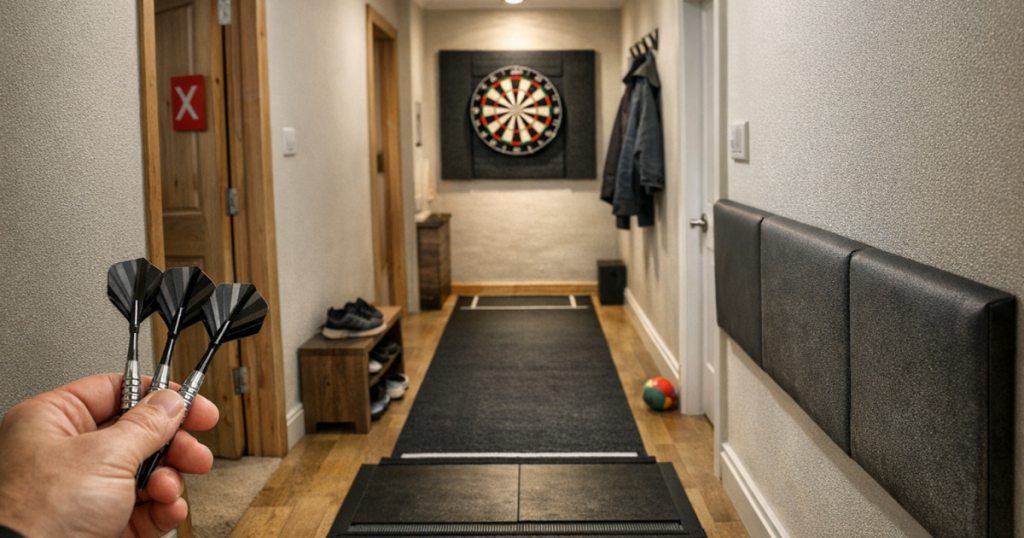
A hallway is only suitable for darts if it gives you a straight, uninterrupted throwing lane, enough distance from the board face to the oche, safe clearance around the board, reliable lighting and a way to stop people, pets and opening doors entering the lane during play.
- Best-case hallway: straight, quiet, well lit, no side doors near the throw, no glass or fragile fittings behind the board, and enough depth for a proper oche.
- Possible with care: a wider corridor with a single end wall, good wall protection, and a household rule that the hallway is closed during games.
- Avoid: shared through-routes, narrow landings, hallways beside stairs, areas with front doors opening into the throw, or spaces where people need to pass regularly.
Step 1: Measure the throwing distance properly
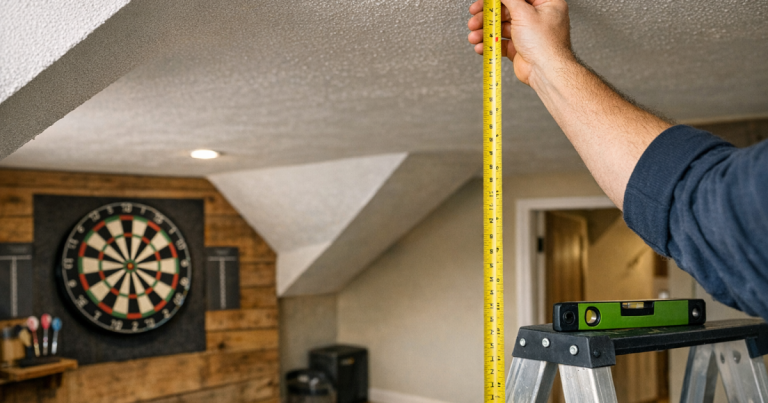
For a standard steel-tip home setup, the oche should be 2.37 m from the face of the dartboard, not simply from the wall. The bull should be 1.73 m from the floor. In a hallway, this matters because skirting boards, cabinets, surrounds and wall brackets can all shift the board face forward slightly.
Mark the board position first, then measure from the board face to the intended toe line. If your hallway only just reaches the distance when measured from the wall, it may be too short once the board is installed. Also allow a little room behind the thrower so their stance does not put them against a wall, staircase, radiator or coat rack.
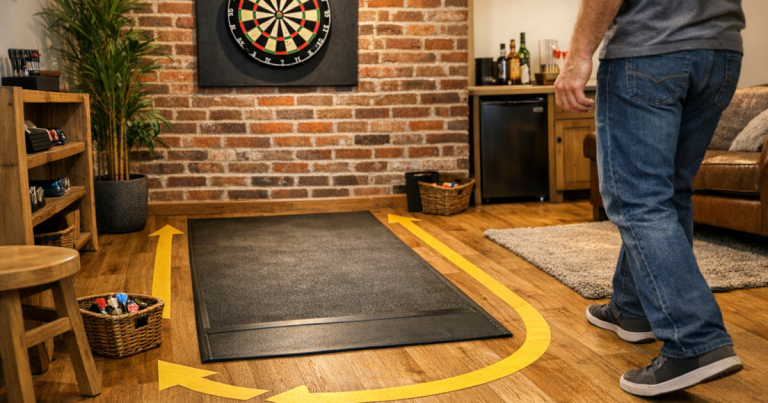
A darts mat can help define the lane and stop people drifting forward, but it needs to sit flat without becoming a trip point in a narrow corridor. If you are working out the exact length, width and oche line position, use the darts mat size guide before committing to the layout.
Step 2: Check whether the hallway is a through-route
This is the biggest pass-or-fail test. A hallway that people use to reach the kitchen, bathroom, stairs, front door or bedrooms is usually a poor darts area unless you can close it off during play. Darts are sharp, fast and easy to misjudge, especially when a casual throw goes low or wide.
Stand at the intended oche and ask what could enter the lane without warning. Look for side doors, cupboard doors, front doors, stair openings and corners where someone could appear suddenly. If any person or pet can step across the flight path while a dart is being thrown, the setup needs a clear stopping rule or a different location.
A good home rule is simple: when darts are out, the hallway is not a walkway. That means no one passes behind the thrower, no one crosses between the oche and the board, and the player collects darts only when every thrower has stopped.
Step 3: Look at doors, corners and blind spots
Hallways are awkward because they often contain several moving parts. A door opening into the throw can surprise the player, knock the thrower’s arm, or put someone in the line of a dart. A door beside the board can also create bounce-out problems if a dart hits timber, hinges or a handle.
Check each door in three positions: closed, half open and fully open. If any door crosses the throwing lane, lands beside the board, or hides a person approaching from a room, treat that as a serious warning sign. The safest hallway layouts usually place the dartboard on a dead-end wall with no doorway immediately beside it.
Be careful with L-shaped halls too. If the thrower cannot see someone approaching from around a corner, you need a clear barrier or household signal before play begins. A simple closed internal door can work better than a verbal warning, because it makes the boundary obvious.
Step 4: Allow for missed darts and bounce-outs
Even tidy players miss. Beginners, tired players and quick practice sessions can all send darts outside the board area. In a hallway, misses are more likely to hit plaster, door frames, mirrors, glass panels, picture frames, light switches or painted woodwork.
Look at the wall around the board and the floor below it. A surround, backboard or cabinet can reduce visible damage, but it cannot make an unsafe through-route safe. Think of protection as damage control, not as permission to play in a risky space.
Flooring matters as well. Hard tiles and laminate can mark easily when darts drop point-first, while carpet can hide dropped points until someone steps on them. If you use a protective mat, make sure it lies flat, does not curl at the edges and does not block a door from opening safely.
Step 5: Judge the width of the corridor
A narrow hallway can feel fine until a player draws their arm back, turns to speak, or bends to collect darts. There is no single official hallway width that guarantees safety, because the layout matters as much as the measurement. Still, the space should feel controlled rather than cramped.
As a practical check, stand at the oche with your normal throwing stance. Your elbow should move freely, your shoulder should not brush the wall, and another person should not need to squeeze past you. Then walk to the board and retrieve darts without stepping awkwardly around shoes, storage baskets, umbrella stands or furniture.
If the corridor is so tight that spectators naturally stand beside the thrower or near the board, it is not a good match for social play. It may still be usable for solo practice if the hallway can be closed off, but keep the setup disciplined and do not let it become a casual passing space.
Step 6: Test the lighting before you mount anything
Good lighting is part of safety, not just scoring comfort. Hallways often have ceiling lights behind the thrower, which can cast shadows across the board. Dim bulbs, glossy paint and uneven light can make doubles harder to see and encourage players to step forward or throw carelessly.
Stand at the oche and look at the board position at the time of day you expect to play. Check whether the number ring is readable, whether the lower half of the board falls into shadow, and whether anyone walking past a ceiling light would temporarily darken the target.
If you plan to add dedicated lighting, choose controls that are simple enough for everyday use. The dartboard lighting controls guide covers dimmers, switches and smart bulbs in more detail, which is useful if the hallway light also serves the rest of the home.
Step 7: Check what is behind, beside and below the board
A hallway dartboard should not be mounted where missed darts can hit glass, electrical fittings, pipe boxing, thermostats, alarm panels or anything fragile. It should also avoid walls that back directly onto areas where noise will be a problem, such as a child’s bedroom or a neighbour-facing party wall in a flat.
Look below the board too. Shoes, school bags, pet bowls, pushchairs and parcels often collect in hallways. These create trip points and make dart collection awkward. A safe setup needs the floor below the board kept clear before every session.
Beside the board, avoid coat hooks and hanging items. A coat sleeve can catch a dart, hide a damaged wall, or tempt someone to reach into the board area while play is still active.
Step 8: Decide whether storage will stay tidy
Hallway setups fail when darts gear starts spreading into the walking route. A few flights, shafts and tools on a console table might not look like much, but they can quickly become clutter in a narrow space. Darts should be stored point-safe when not in use, especially in homes with children, pets or visitors.
Use a small case, wall-mounted holder or closed cabinet if it keeps equipment out of the way. The key is not to create new hazards while solving the storage problem. Avoid anything that sticks out at shoulder height or narrows the route more than necessary.
If you use a cabinet, make sure the doors do not open into the throwing lane or clash with a side wall. For a hallway, slim and tidy normally beats bulky and decorative.
Step 9: Run a no-throw test
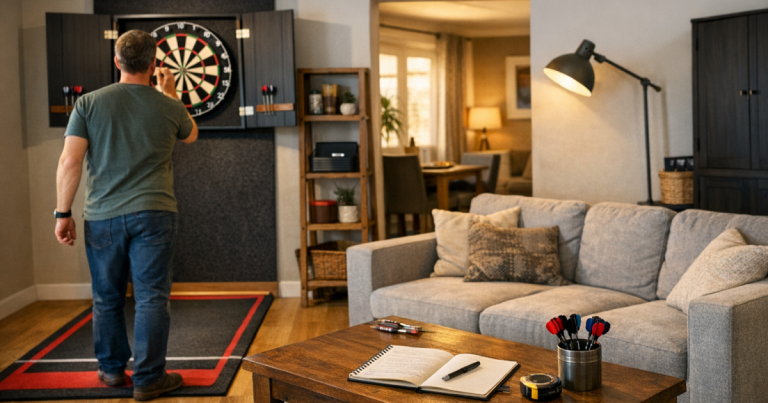
Before you throw a dart in the hallway, rehearse the setup without darts. Mark the board position, mark the oche, close any doors that need closing, switch on the lights and walk through a normal game routine.
- Can the thrower stand naturally at the oche without touching the wall?
- Can a person appear from a side room without being seen?
- Does any door open into the throwing lane?
- Can darts be collected without stepping around clutter?
- Does the board area stay well lit from the oche?
- Is there a clear place for spectators, or should this be solo practice only?
If the answer to any key question is uncomfortable, fix the layout before playing. A hallway setup should feel calm and predictable. If it relies on people remembering to dodge the lane, it is not controlled enough.
When a hallway is not the right place
Some hallways are simply not worth adapting. Avoid using a hallway for darts if it is the main route to the front door, if it sits beside stairs, if it has multiple side doors near the throw, or if children and pets regularly move through it. Also avoid spaces where the thrower stands with their back close to an external door that could open unexpectedly.
A hallway may be acceptable for short solo practice but unsuitable for family games. That distinction matters. One careful player in a closed-off corridor is very different from four people chatting, scoring, collecting darts and moving around between throws.
If you are choosing between a cramped hallway and a slightly less tidy spare room, the spare room will usually be easier to control. Darts rewards repeatable conditions, and a safer room often produces better practice as well as fewer dents in the woodwork.
Small changes that make a borderline hallway safer
If the hallway passes the main tests but still feels tight, small room-planning changes can help. Remove loose storage from the lane, set a visible toe line, keep footwear away from the board area, and use a wall protector that covers the most likely miss zone. Good lighting and a flat mat can also make the space feel more deliberate.
Board alignment is worth checking after any hallway installation. Narrow spaces make a slightly tilted board more noticeable because the throw line, wall edges and door frames give your eye lots of straight references. If the board looks off after fitting, follow the steps in fixing a dartboard that sits slightly crooked before assuming the wall or bracket is the problem.
Set a simple pack-away routine too. Darts away, mat flat or stored, lights off, floor checked for dropped points. In a hallway, tidy-up is part of the safety system.
Things readers ask
Can children play darts in a hallway?
Only if the hallway can be fully controlled and supervised. For most homes, a hallway is better for adult solo practice than for children’s games because doors, movement and distractions are harder to manage.
Is a soft-tip board safer for a hallway?
Soft-tip darts reduce some damage and puncture risk, but they do not remove the need for a clear lane. People and pets still should not cross between the thrower and the board.
Can I put a dartboard on the back of a hallway door?
It is usually a poor choice unless the door can be locked or secured during play. A moving door changes the board position and can open unexpectedly into the throwing area.
How do I stop people walking through during a game?
Use a clear household rule and a physical cue, such as a closed door, visible mat or temporary sign. Verbal warnings alone are easy to forget in a busy home.
What is the biggest warning sign that a hallway is unsafe?
The biggest warning sign is an uncontrolled crossing point. If someone can step into the dart’s path without the thrower seeing them early, choose another location.
The big picture
A hallway can work for darts, but only when it behaves like a dedicated throwing lane rather than a normal corridor. Measure from the board face, control doorways, protect the wall and floor, improve lighting, and keep the route free from clutter.
The safest decision is often the simplest one: if you cannot stop people passing through, do not use the hallway for darts. A home setup should make practice more enjoyable, not turn every throw into a negotiation with the room.