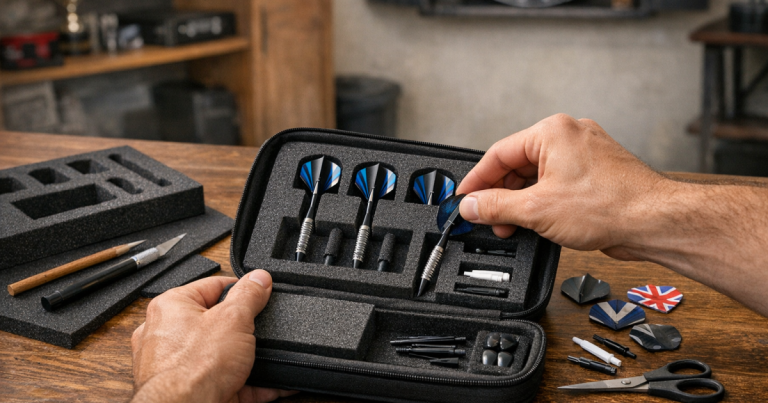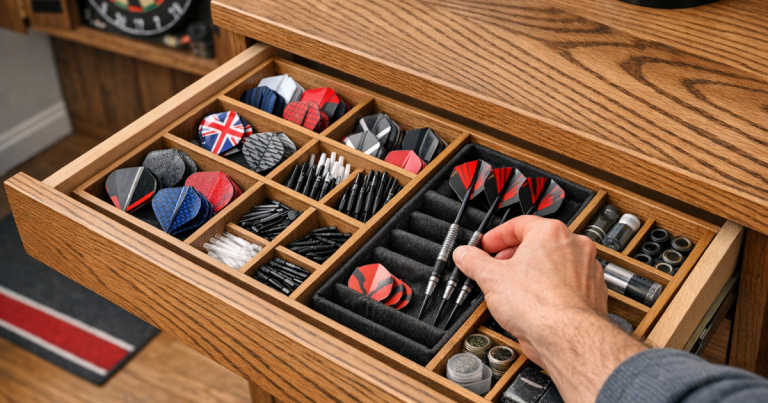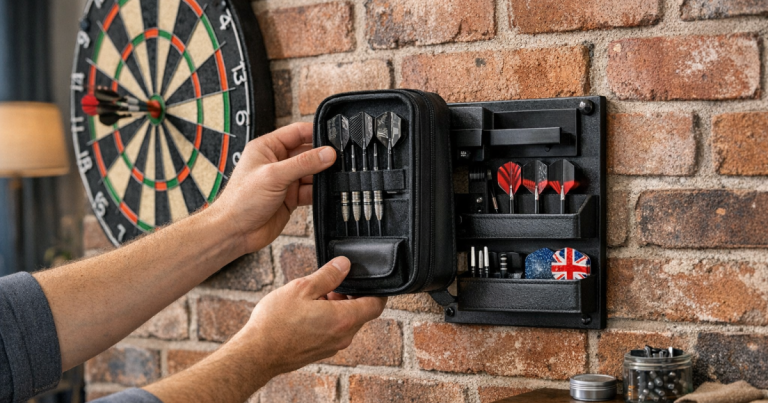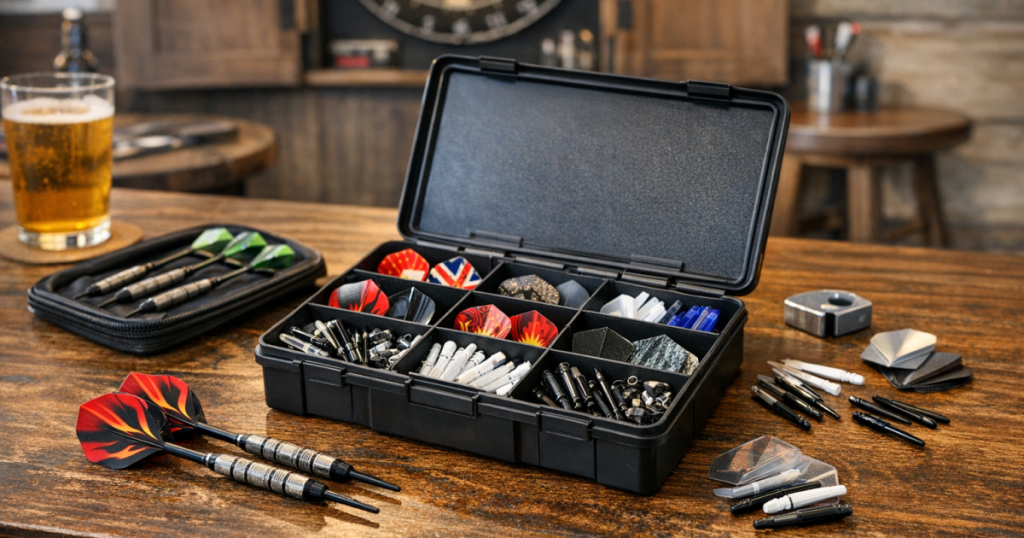
A chipped flight or cracked shaft rarely ruins a session because the part is expensive; it ruins it because nobody can find the replacement. A small, well-labelled darts spares box solves that by keeping flights, shafts, rings and tiny tools within reach of the board, rather than scattered through cases, drawers and pockets.
The aim is not to hoard every accessory you own. It is to build a compact, reliable station that lets you repair a set quickly, keep matching parts together, and avoid stopping a home match while someone rummages through a cupboard.
The short version
A useful spares box should hold the parts that fail or go missing most often: flights, shafts, flight protectors, stem rings, spare points if relevant to your setup, and a small dart tool. Keep it near the board, divide it by part type, and label it simply enough that guests can use it without asking.
For most home players, the best arrangement is one box for playing spares and one separate place for surplus stock. The playing box stays lean and easy to use. The surplus store can hold extra packets, alternate colours and parts you only use occasionally.
Step 1: Decide what the box is actually for
Before adding anything, decide whether the box is for quick match repairs, full kit storage, or both. A match-side box should be small enough to sit in a cabinet, drawer, shelf or nearby caddy. It should contain the parts you might need between legs, not your entire darts collection.
A good match-side kit usually covers three situations:
- A flight tears, bends badly or drops out too easily.
- A shaft cracks, loosens, cross-threads or gets damaged after a bounce-out.
- A player wants a like-for-like replacement without changing the feel of the dart mid-session.
If you also keep spare barrels, multiple full sets and point tools in the same area, give them their own storage. Mixing heavier kit with delicate flights is how flights get crushed before they ever reach the board.
Step 2: Pick a box that suits your darts area
You do not need anything elaborate. A small compartment organiser, craft box, tackle-style box or drawer insert can work well. The useful features are separate compartments, a lid that closes securely, and enough depth for shafts to sit without being forced at an angle.
Clear plastic is handy because you can see what is running low. A darker box can look neater if it lives on show in a living room or office setup. If the box is going inside a cabinet, measure the shelf space before you commit to a layout; a box that is slightly too deep becomes annoying very quickly.
Avoid loose bags for the main playing stock. They are fine for unopened packets, but once flights and shafts are in use, bags make it harder to spot matching pieces and damaged parts. Compartments save time because you can lift the lid, take the part and get back to the throw.
Step 3: Separate flights by set, shape and condition
Flights are the easiest part to overstock and the easiest part to damage in storage. Keep complete sets together, ideally in groups of three or six. If you mix shapes, keep standard, slim, kite and pear-style flights in different sections so a guest does not accidentally fit two matching flights and one odd one.
Sort flights into three simple groups:
- Ready to play: clean, flat and matching sets that can go straight onto a dart.
- Practice only: slightly scuffed or marked flights that are still usable but not ideal for matches.
- Recycle or bin: split, warped or badly creased flights that will not sit properly.
Do not keep damaged flights out of habit. They take up space and encourage inconsistent setups. If a flight has a split at the top, keeps popping off, or no longer holds its shape, it belongs in the discard pile rather than the spares box.
Step 4: Organise shafts by length, material and thread condition
Shafts need a little more structure than flights because small differences can change the balance of a dart. If players in your home use different lengths, give each length its own compartment or label. You do not need technical labels if you do not use them; “short”, “medium” and “long” is enough for a practical home setup.
Keep plastic or nylon shafts apart from aluminium or other metal shafts if you use both. They often feel different in the hand and can behave differently when tightened, so mixing them in one section makes quick repairs slower. Also keep spare rings, springs or locking parts close to the shafts they belong with.
Check the threads before adding a shaft to the ready section. If the thread looks chewed, does not screw in cleanly, or sits wonky in a barrel, do not keep it as a match spare. It will only waste time later. If you are still experimenting with setup feel, it is worth reading about how barrel, grip and balance choices work together in buying darts by weight, grip and barrel shape.
Step 5: Add the small bits that make repairs quicker
A spares box is most useful when it includes the little items that stop a simple repair becoming a hunt around the room. These do not need much space, but they should be easy to find.
Useful small accessories include:
- Stem rings or springs for shafts that use them.
- Flight protectors if you use them and want a consistent setup.
- A compact dart tool for tightening, opening shaft slots or basic adjustments.
- A few spare soft-tip points if your home setup uses a soft-tip board.
- A small cloth for wiping barrels before putting darts away.
- A couple of grip-seal bags for separating used parts from clean stock.
Keep tools away from loose flights if possible. Metal edges can mark or crease flights when the box is moved. A narrow end compartment or small lidded insert works well for tools and rings.
Step 6: Label it so other people can use it
The best system is the one that still works when someone else opens the lid. Labels do not need to be pretty; they need to be obvious. Use simple wording such as “standard flights”, “slim flights”, “medium shafts”, “rings” and “damaged or used”.
If you play regular home leagues, family matches or casual Friday-night games, colour coding can help. For example, one player might use black standard flights and medium shafts, while another uses red slim flights and short shafts. A small labelled section for each regular player avoids accidental mixing.
Do not rely only on original packaging. Once a packet has been opened, parts move around. Labels on the storage compartments make the box easier to maintain over time.
Step 7: Place it where it supports the throw, not where it clutters it
Keep the box close enough that a player can fix a dart between turns, but not so close that it becomes a trip point or a distraction near the oche. A shelf beside the board, the lower part of a cabinet, a small drawer unit or a nearby side table usually works better than putting the box on the floor.
If your board is in a shared living space, the box should be easy to put away when the darts are not in use. A tidy, contained spares setup makes a home darts area feel intentional rather than temporary. For broader room planning, especially if you are combining storage with foot placement and throw flow, see how to create a match-ready darts mat and oche area.
Step 8: Build a simple restocking routine
The easiest way to keep the box useful is to review it briefly after a few sessions, not once a year. You do not need a spreadsheet. Just check whether the common parts are still present in matching sets.
A quick restock check might look like this:
- Are there at least two complete matching sets of flights for the darts used most often?
- Are there enough shafts to replace a full set without mixing lengths?
- Have any cracked shafts been left in the usable section?
- Are rings, protectors or small fittings still in their own compartment?
- Is there any dust, moisture or musty smell inside the storage area?
Moisture is worth taking seriously in garages, sheds and spare rooms that are not heated consistently. Flights can curl, packaging can soften, and cases can start to smell stale. If your wider darts storage has picked up a damp odour, the same prevention habits used to stop a dart case smelling musty also apply to accessory storage.
Common mistakes that make spares harder to use
Most spares boxes fail because they become dumping grounds. A little clutter is normal, but the box should not contain every old part just because it once fitted a dart.
Keeping singles with match spares
One spare flight is useful only if you already have two matching ones. Keep odd singles in a separate “odds” section if you use them for practice, but do not let them sit beside your best matching sets.
Mixing trial parts with trusted parts
If you are testing different shaft lengths or flight shapes, keep those trial parts away from your normal match spares. Otherwise you may change the feel of a dart without meaning to.
Storing everything too tightly
Flights should not be crushed flat under tools, packets or heavy accessories. If you have to force the lid shut, the box is too full. Move surplus packets elsewhere and keep only usable, accessible spares near the board.
Never removing worn parts
A spares box is not a museum. Cracked shafts, bent flight protectors and torn flights should leave the box quickly. If a part is not good enough to fit during a close leg, it does not belong in the ready section.
Helpful questions
How many spare flights should I keep near the board?
For a normal home setup, two or three complete matching sets for each regular player is usually enough. If you play often or host guests, keep a few neutral spare sets as well so visitors are not borrowing your preferred match flights.
Should I keep flights in the original packet?
Unopened packets are fine in a surplus drawer, but open packets can become awkward during a game. For match-side storage, it is usually quicker to keep complete sets loose in labelled compartments, provided they are not being crushed.
Can different shafts go in the same compartment?
They can, but it slows things down and increases the chance of mixing lengths. If you only use one length, one compartment is fine. If you use several, split them clearly.
Where should used but still playable parts go?
Give them a practice section. That keeps match-ready parts clean and complete while still letting you use slightly worn flights or shafts for warm-ups, casual throws or guests who are just having a go.
What to remember
A good spares box is small, clear and disciplined. It keeps the parts you actually use within reach, separates flights and shafts in a way that makes sense, and removes worn items before they cause problems during a game.
Start with the darts you and your regular players already throw. Match the storage to those setups first, then add a few guest-friendly extras. Once the box has clear compartments, simple labels and a quick restocking routine, broken flights and cracked shafts become minor interruptions rather than session-stoppers.